Hyperhidrosis in Singapore: Excessive Sweating and Treatment Options
Medically reviewed by Dr Rachel Ho, MBBS, MRCS, MMed (ENT), 1 October 2026.
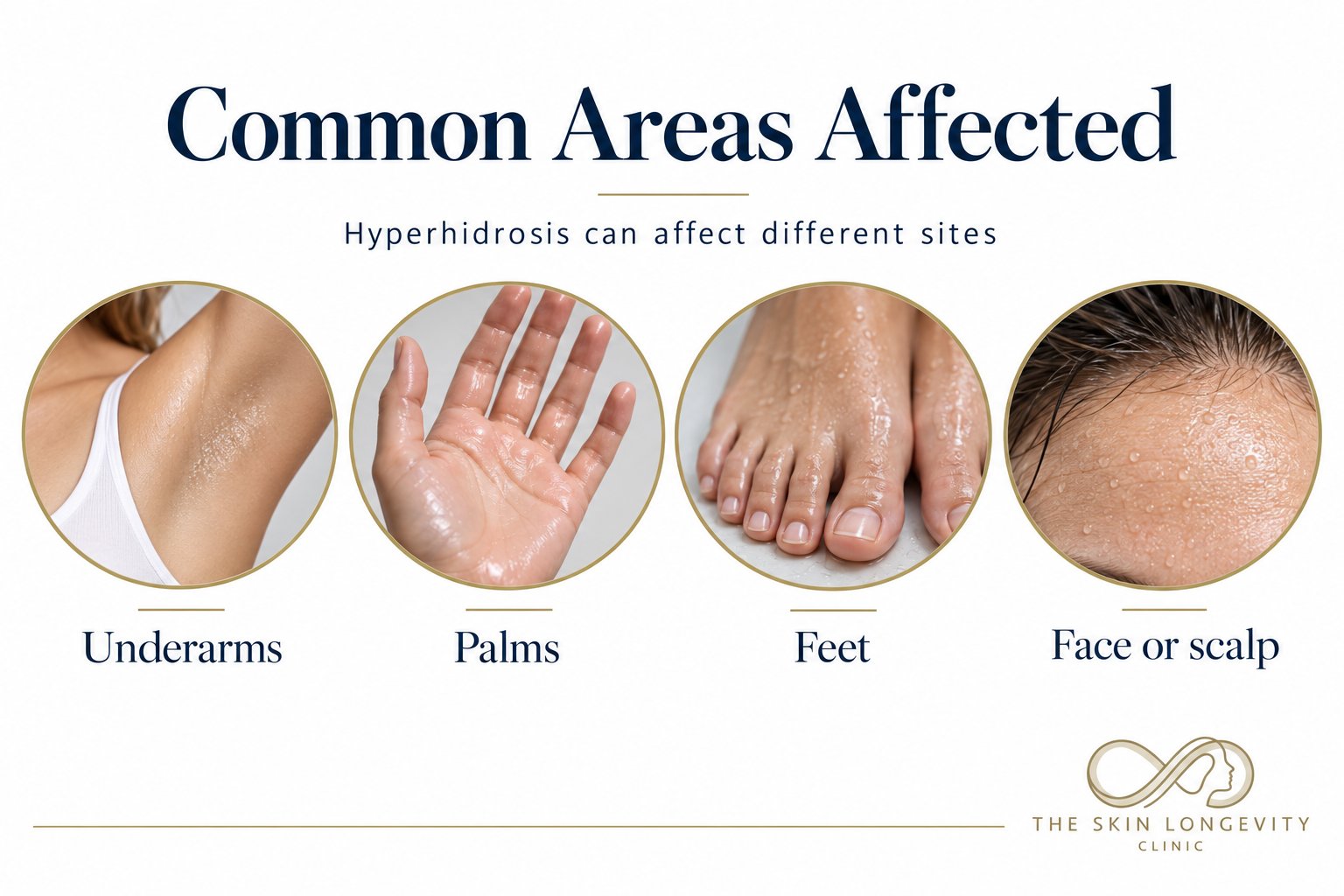
Hyperhidrosis means sweating beyond what the body needs to regulate temperature1. People describe it as sweating profusely or sweating a lot, often as underarm sweating, sweaty palms, sweaty hands, sweaty feet, or sweating on the face or scalp. It can occur even when a person is calm or in a cool environment2.
Sweating that interferes with work, clothing or everyday activities deserves attention3. At The Skin Longevity Clinic, the assessment starts with where the sweating occurs, what may be driving it, and which changes would make daily life easier.
Hyperhidrosis can affect the underarms, palms, feet, face or scalp.
What causes excessive sweating?
Sweat glands receive signals from nerves that help regulate body temperature4,10. In primary hyperhidrosis, increased activity in the nerve pathways that control sweating is thought to play an important role. Secondary hyperhidrosis has another underlying contributor1.
Telling the two apart decides whether treatment focuses on the affected skin, a medication review, or investigation of another condition1,3. The amount of sweat alone does not explain it.
Secondary sweating may relate to medicines, thyroid problems, diabetes or hormonal changes such as menopause4. The medical history therefore matters even when the main concern is wet clothing.
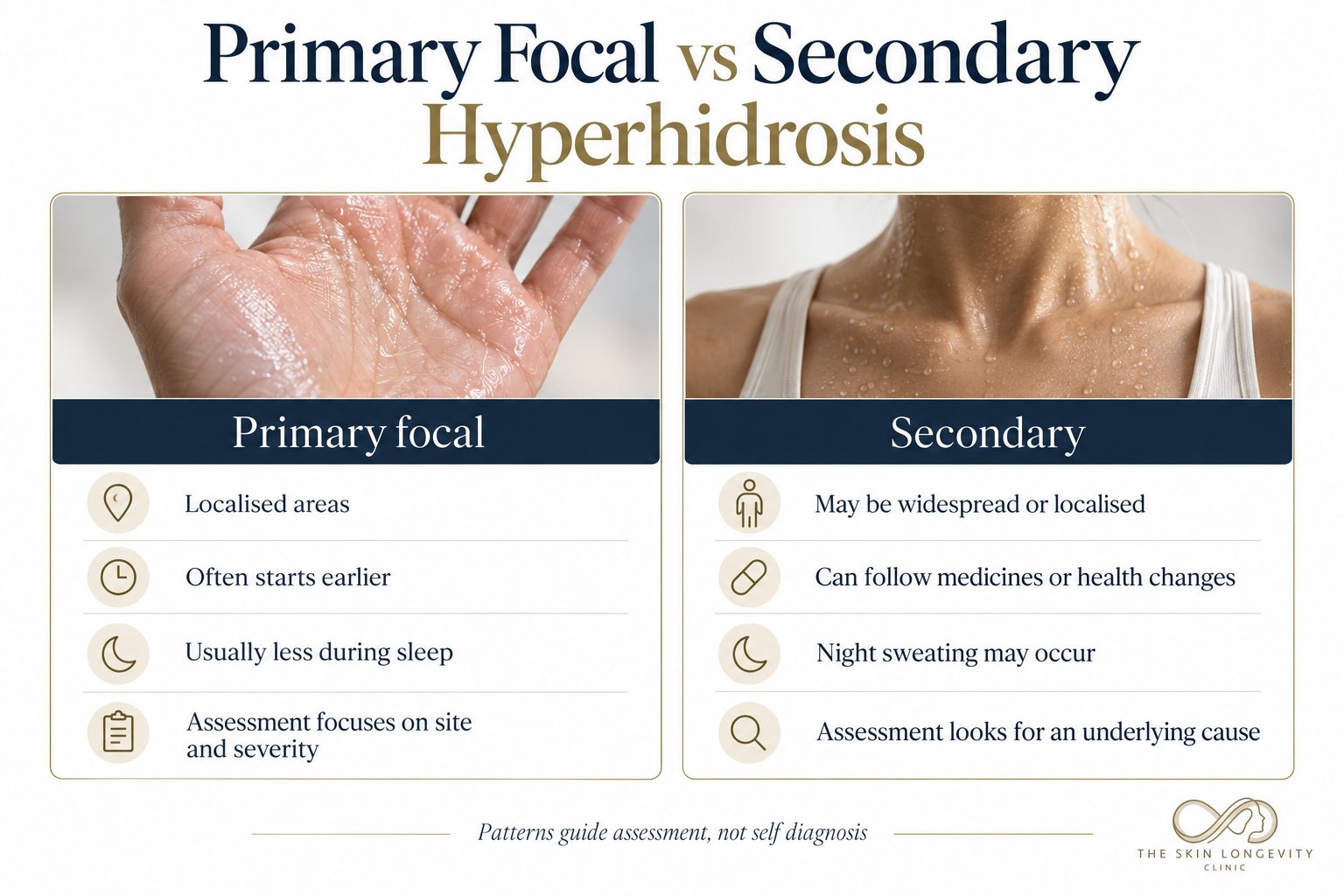
Commonly affects particular areas, such as both underarms, the palms or the soles
May be widespread or localised, depending on the cause1,10
History
Often begins earlier in life and may run in families
May follow a new medical condition or medicine2,4
During sleep
Typically reduces or stops during sleep
Night sweating can occur and is interpreted alongside other symptoms10
Assessment priority
Site, severity, daily impact and previous care
Identifying and addressing the underlying contributor where possible1,3
Sweating patterns guide assessment. They are not a self-diagnosis checklist.
These patterns are clinical guides, not a checklist for self-diagnosis3. New, generalised or unexplained night sweating needs medical assessment, particularly with fever, weight loss or other changes in health1.
Is sweating in Singapore’s heat the same as hyperhidrosis?
Sweating during heat or exercise is part of normal temperature regulation4. Hyperhidrosis can cause persistent dampness even in cooler conditions, so its pattern and daily impact matter2,5.
Heat, emotional stress and certain foods or drinks can make sweating more noticeable, and triggers differ between people5. A brief record of when heavy sweating happens can show whether there is a consistent trigger.
How is hyperhidrosis assessed?
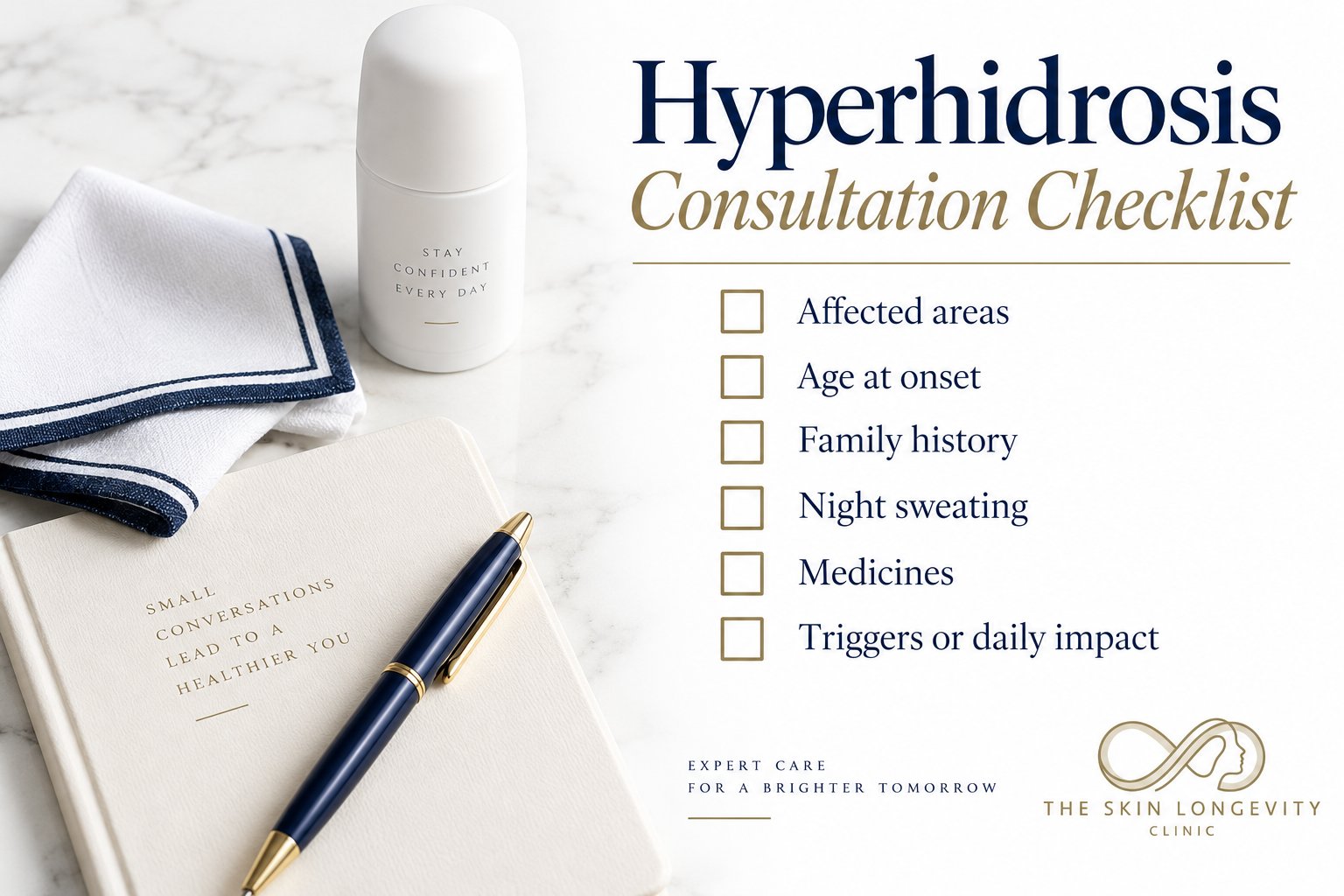
The consultation covers the affected areas, age at onset, family history, whether sweating occurs during sleep, and current medicines3,6. Blood tests or other investigations are chosen according to the history and examination; they are not required for everyone10.
Doctors may use the four-point Hyperhidrosis Disease Severity Scale (HDSS), which rates how tolerable the sweating is and how often it disrupts daily activities3. It gives a way to track progress against your own priorities, such as handling paper comfortably or needing fewer clothing changes.
What to bring to a hyperhidrosis consultation.
Persistent wetness can also contribute to skin irritation and infection, so rashes, soreness or broken skin should be examined1. Our skin allergy guide covers product-related rashes.
Hyperhidrosis treatment in Singapore: the options
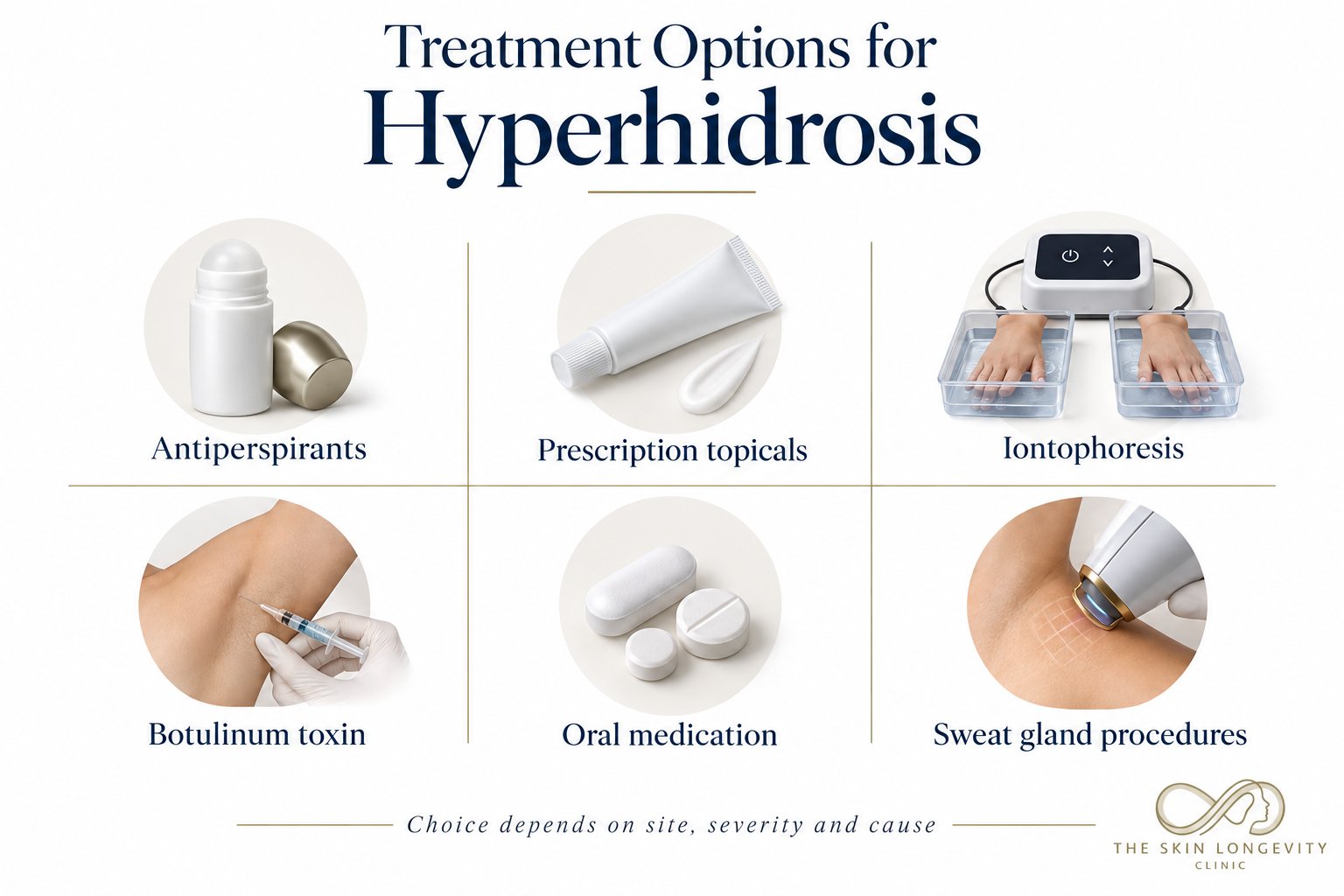
Treatment depends on the site, severity, cause and how well previous measures were tolerated3,6. Some options require referral, and suitability and local availability are confirmed at assessment.
Approach
Where it may fit
Main consideration
Antiperspirants
First-line care for underarm sweating, sweaty hands and sweaty feet
Reduce sweat output; irritation can limit use4,5
Prescription topical treatment
Selected localised sweating, particularly the underarms
Formulation, application area and side effects need review1,6
Iontophoresis
A common option for sweaty palms and soles
Usually needs an initial course and maintenance7,8
Botulinum toxin
Selected persistent focal sweating after assessment
Temporary effect, injection discomfort and site-specific risks2,9
Oral medication
Selected cases, including several affected areas
Whole-body effects and reduced heat tolerance2,6
Sweat gland procedures or surgery
Selected persistent symptoms after less invasive options
Recovery, irreversible effects, and compensatory sweating with sympathectomy1,6
The choice depends on site, severity and cause.
Antiperspirant vs deodorant for excessive sweating
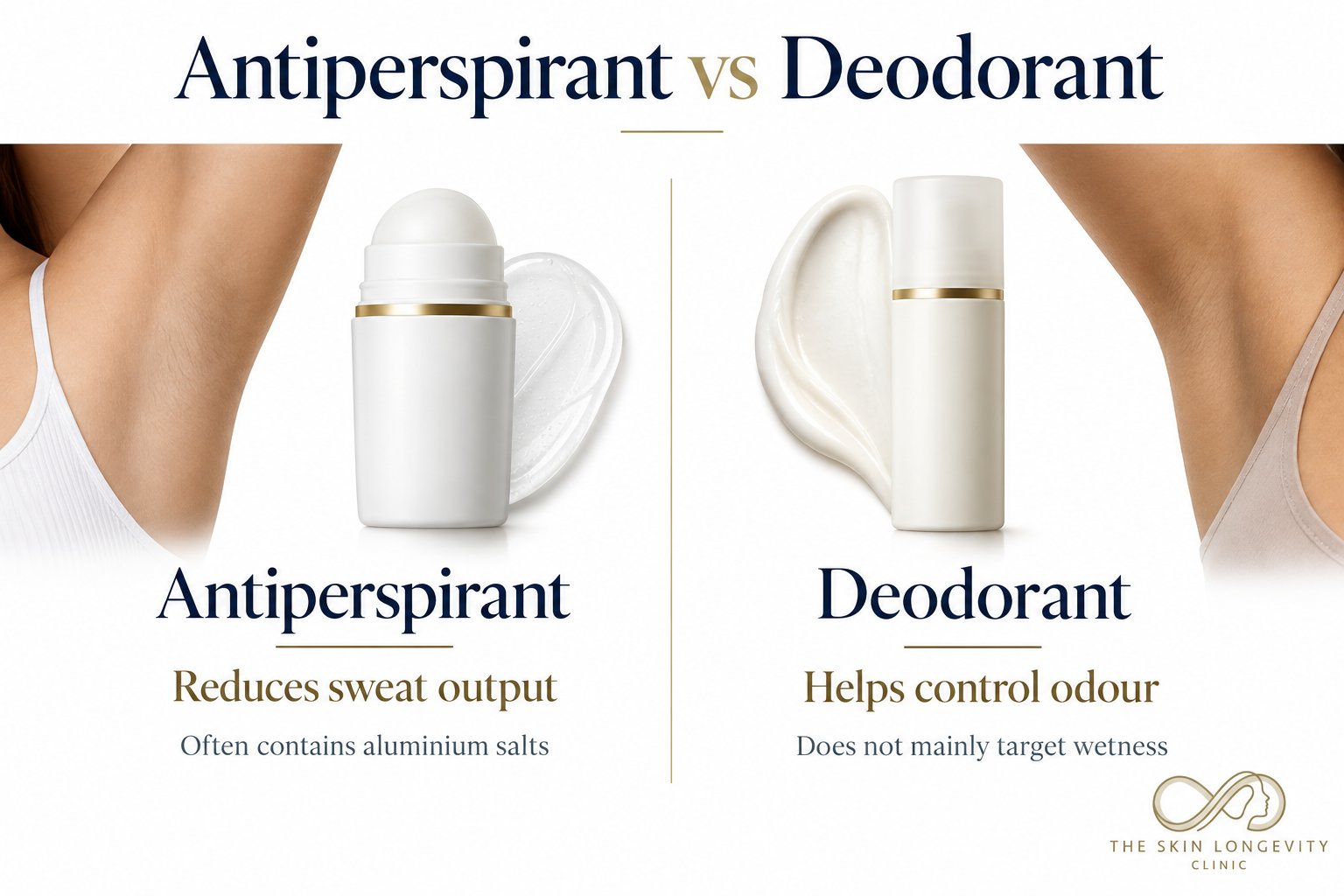
Antiperspirants reduce sweat output; deodorants mainly address odour5. A product may do both, so check the label rather than assuming any deodorant will control wetness5.
Aluminium salt antiperspirants are commonly used, and applying them to dry skin helps reduce irritation2,5. Many are applied before bed; frequency and application area follow the product instructions or the plan agreed with your clinician4,5.
Continued burning or a rash means the formulation and how it is used should be reviewed4. Applying it more often is not necessarily the next step.
Antiperspirants reduce sweat; deodorants mainly control odour.
Prescription creams, gels or wipes
Some prescription topical medicines reduce the signals that stimulate sweat glands1. They differ from ordinary antiperspirants and may be considered for selected areas when first-line care is not enough1,6.
They can still cause irritation and other side effects, and accidental transfer to the eyes can cause visual symptoms6. Suitability, local availability and the instructions for the specific preparation are checked before use.
Sweaty palms, sweaty hands and sweaty feet: iontophoresis
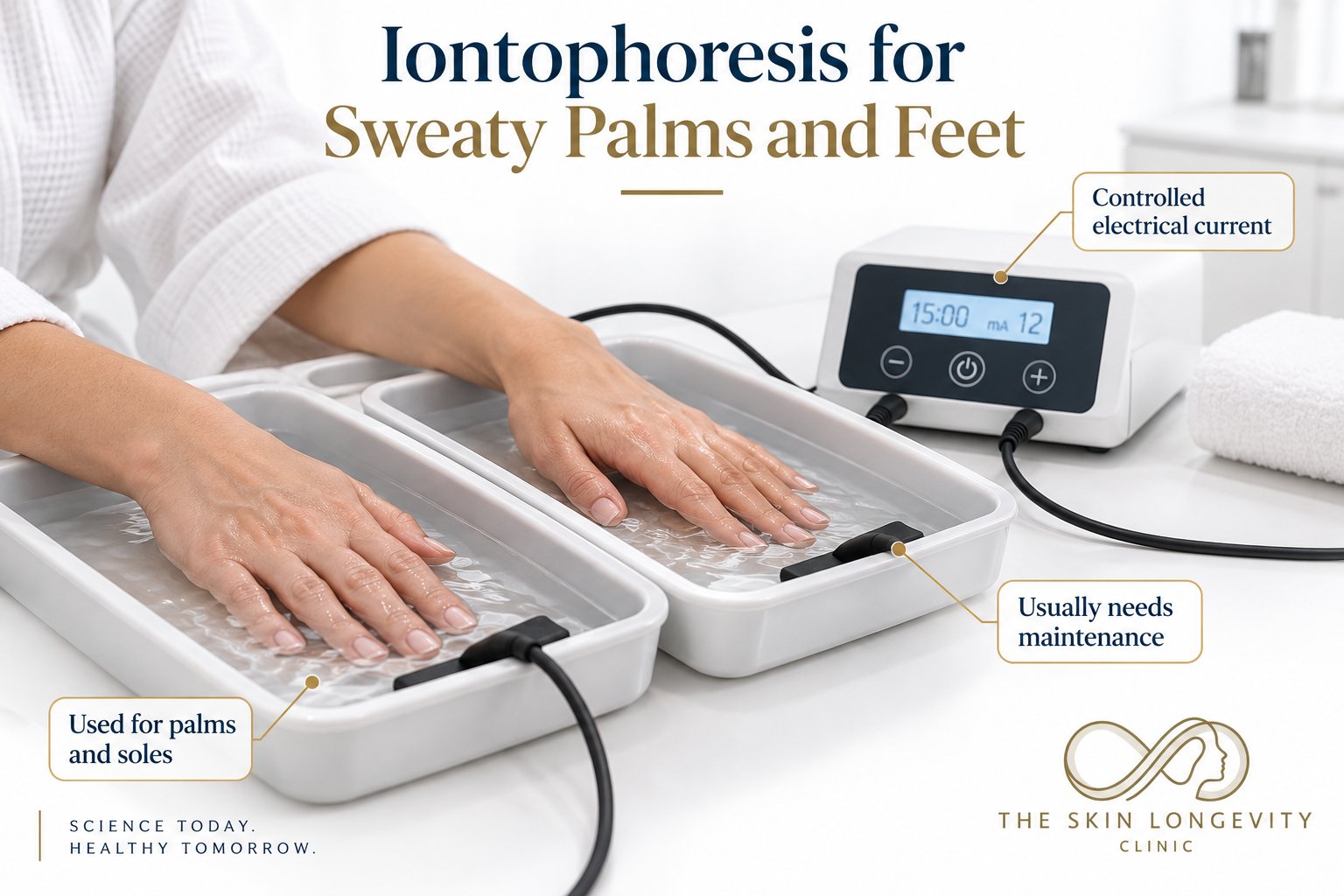
Iontophoresis passes a controlled electrical current through water in contact with the skin7,8. A randomised, sham-controlled trial found improvement in palmar sweating compared with sham treatment7.
The effect usually needs maintenance rather than a single permanent course8. Tingling or irritation can occur. Pregnancy, implanted electronic devices or relevant metal implants are discussed before treatment8.
Iontophoresis is used for the palms and soles and usually needs maintenance.
Botulinum toxin for underarm sweating
Botulinum toxin temporarily reduces nerve signalling to the sweat glands in the treated area10. A 2025 meta-analysis found reduced sweat production compared with placebo in primary underarm hyperhidrosis, with no statistically significant advantage over the other treatments pooled in that analysis9.
This supports its use in selected patients rather than ranking it above other treatments9. Evidence for the underarms is separate from the considerations for the palms, soles or face2,9.
Injections can be uncomfortable, and treating the palms can cause temporary weakness in the hand muscles2. The effect lasts months rather than removing the tendency to sweat, so the response is reviewed before further treatment4. Our botulinum toxin guide covers how the treatment works.
Oral medicines for hyperhidrosis
Oral anticholinergic medicines reduce sweat-gland stimulation throughout the body. They may be considered when several areas are affected or local measures are not enough6. Dry mouth, constipation, blurred vision and difficulty passing urine can limit their use2.
Reduced sweating can impair the body’s ability to cool itself in hot conditions6. Outdoor work, exercise and relevant medical conditions are discussed before treatment; doses are not adjusted independently.
Sweat gland procedures and surgery
Some procedures reduce or remove underarm sweat glands, while sympathectomy interrupts part of the nerve supply involved in sweating10. They work differently and are discussed separately, including the possibility of persistent discomfort, nerve injury or scarring with particular procedures1,10.
Sympathectomy is generally reserved for carefully selected patients with substantial symptoms despite other care2. Compensatory sweating, meaning increased sweating elsewhere, is an important potential consequence and is part of the decision before surgery10.
Why the treatment area and your routine matter
Underarm sweating, sweaty hands and sweaty feet affect different activities, and a treatment that suits one site may be less practical for another3. For the hands, keeping grip and fine movement comfortable is a key consideration2.
Tell us whether the main difficulty is writing, using equipment, footwear or clothing. The plan accounts for that priority along with skin sensitivity, recovery and the time needed for maintenance.
Everyday care for excessive sweating
Breathable clothing, changing damp socks and letting footwear dry help with comfort5. A record of foods, drinks or situations linked to heavier sweating can identify personal triggers5.
These steps support daily care; they do not replace assessment of persistent or unexplained symptoms5.
Emotional stress can stimulate sweating, but primary hyperhidrosis also occurs when someone feels calm2,4. Understanding the sweating pattern avoids treating every episode as an anxiety problem1.
Can hyperhidrosis be permanently cured?
Most non-surgical treatments control sweating while they are used or for a limited time afterwards4,8. Longer-lasting procedures carry their own risks, and the right aim depends on the cause, the site and the balance between improvement and side effects1,6.
Will treating my underarms make me sweat elsewhere?
Compensatory sweating is mainly a concern with sympathectomy, which alters nerve signalling6. The same risk does not apply equally to every local skin treatment, so ask about the specific procedure proposed1,6.
Do I need blood tests for sweaty palms or sweaty hands?
A long-standing, localised pattern can usually be assessed clinically, while new or widespread sweating may need further investigation3,10. Your symptoms, examination and medical history decide which tests are useful10.
Doctor Rachel’s takeaway
Hyperhidrosis is common, and treatable. The most important steps are:
Identify the type
Measure impact (HDSS helps guide the intensity of treatment)
Use targeted therapy based on body area and severity
Support the skin barrier so the skin stays resilient in Singapore’s humidity
If sweating is interfering with your daily life, a personalised medical plan can meaningfully improve comfort, confidence and long-term skin health.
Hyperhidrosis consultation in Singapore
You can arrange a consultation at The Skin Longevity Clinic, Scotts Medical Center at Pacific Plaza, 9 Scotts Road, to discuss the sweating that affects you and the products or treatments already tried. The assessment covers the next step, including whether another medical or procedural service is needed.
Bring your medication list and details of any night sweating or recent health changes.
References
Maazi M, Leung AKC, Lam JM. Primary hyperhidrosis: an updated review. Drugs Context. 2025;14:2025-3-2. doi:10.7573/dic.2025-3-2. PubMed. Corrigendum: Drugs Context. 2026;15. doi:10.7573/dic.2026-1-6. PubMed.
National University Health System. Hyperhidrosis. Updated 27 January 2025. NUHS.
Solish N, Bertucci V, Dansereau A, et al. A comprehensive approach to the recognition, diagnosis, and severity-based treatment of focal hyperhidrosis: recommendations of the Canadian Hyperhidrosis Advisory Committee. Dermatol Surg. 2007;33(8):908-923. doi:10.1111/j.1524-4725.2007.33192.x. PubMed.
SingHealth. Hyperhidrosis / Sweaty Palms and Feet. SingHealth.
American Academy of Dermatology. How to control excessive sweating. AAD.
American Academy of Dermatology. Hyperhidrosis: diagnosis and treatment. Updated 16 July 2024. AAD.
Kim DH, Kim TH, Lee SH, Lee AY. Treatment of palmar hyperhidrosis with tap water iontophoresis: a randomized, sham-controlled, single-blind, and parallel-designed clinical trial. Ann Dermatol. 2017;29(6):728-734. doi:10.5021/ad.2017.29.6.728. PubMed.
British Association of Dermatologists. Iontophoresis for hyperhidrosis. Patient information leaflet. BAD.
Sun J, Chen S, Yang T, et al. Efficacy and safety of botulinum toxin type A in primary axillary hyperhidrosis: a meta-analysis and systematic review. Aesthetic Plast Surg. 2025;49:4932-4940. doi:10.1007/s00266-025-04909-6. PubMed.
Haider A, Solish N. Focal hyperhidrosis: diagnosis and management. CMAJ. 2005;172(1):69-75. doi:10.1503/cmaj.1040708. PubMed.