Eye Bag Treatment in Singapore: Options and Suitability
Selected eye bags can look less prominent without surgery, although treatment may be improving the hollow or skin around a bag rather than removing fat1,2. More pronounced fat protrusion, substantial excess skin or poor eyelid support may be better addressed through surgical assessment3.
At The Skin Longevity Clinic, assessment considers fat prominence, swelling, skin quality and the transition between the lower eyelid and cheek. The treatment discussion should explain which feature can be improved, what is likely to remain and whether the expected change matches your goals.
Who may benefit from non surgical eye bag treatment?
A person with a defined hollow beneath a mild bag may benefit from a different approach than someone whose main concern is crepey skin2,6. The consultation should identify the dominant feature and establish whether the expected improvement is sufficient for the change you are seeking2,5.
Persistent swelling, active inflammation, previous filler problems or substantial tissue excess may require further assessment before proceeding3,4,5. Choosing a non surgical procedure solely to avoid surgery can still leave the main concern inadequately addressed3.
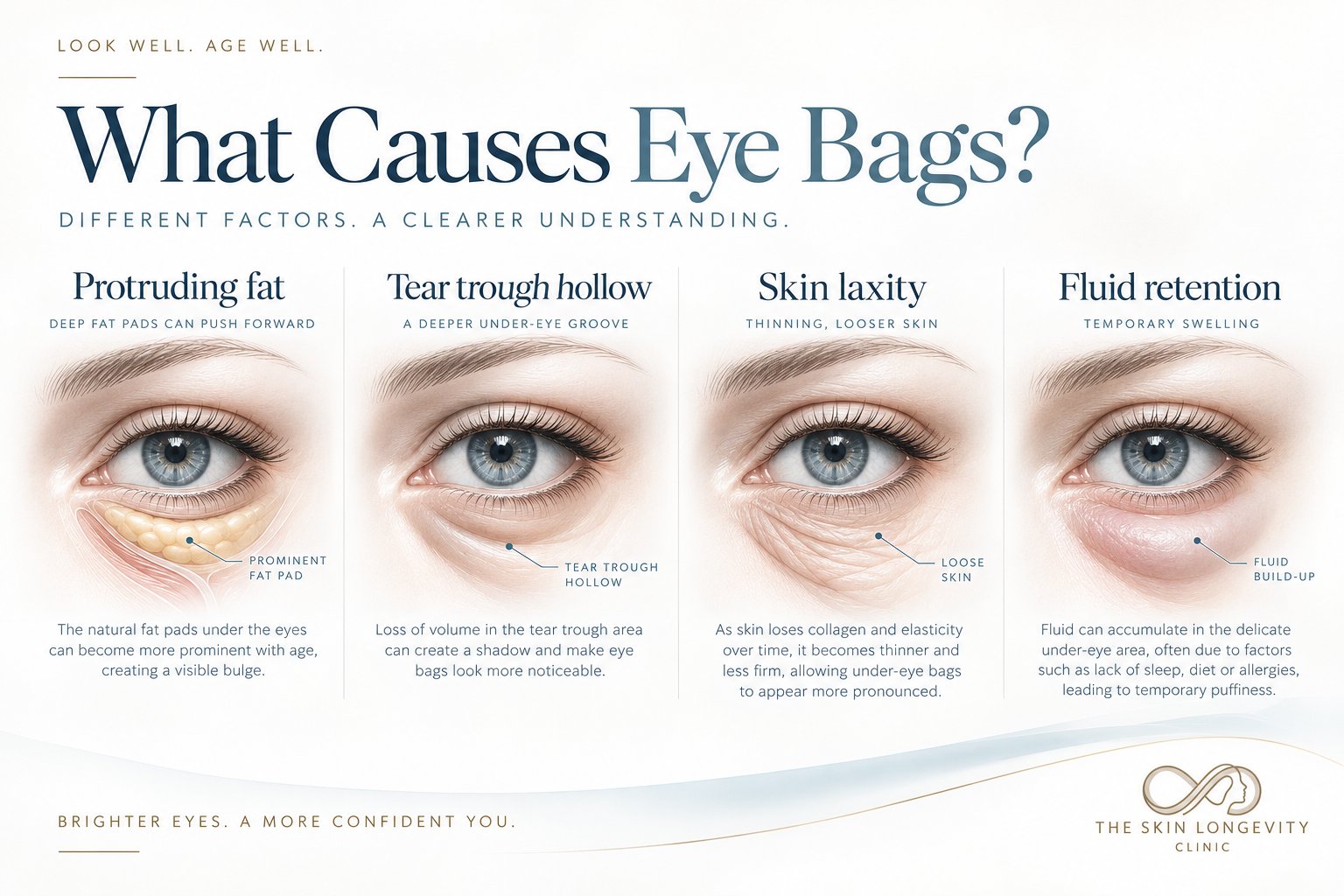
What causes eye bags: protruding fat, tear trough hollow, skin laxity and fluid retention.
Protruding fat and changes in eyelid support
Orbital fat cushions the eye and normally sits behind supporting structures, including the orbital septum3. Changes in these tissues can allow the fat to become more prominent beneath the lower eyelid3.
Loose skin and changes in cheek position can add to the appearance1. Several features often coexist, which explains why treating only the visible bulge may overlook part of the concern1.
Tear trough hollowing
A tear trough is a depression between the lower eyelid and cheek2. When a hollow sits beneath an eye bag, the contrast between the raised area and the groove can make the bag more noticeable2.
Cheek support also influences this transition2,5. In suitable patients, correcting an adjacent hollow can therefore improve the appearance without removing the orbital fat2.
Swelling and inflammation
Fluid accumulation can produce puffiness that changes over time, while eyelid inflammation and certain medical conditions can contribute to persistent swelling4. Fluctuating puffiness should therefore be assessed before selecting an injectable or device treatment4.
Management may involve addressing an inflammatory or medical contributor rather than beginning an aesthetic procedure4. Dr Rachel Ho’s guide to eye bag causes and treatments explains these differences in greater detail.
Are eye bags the same as dark circles?
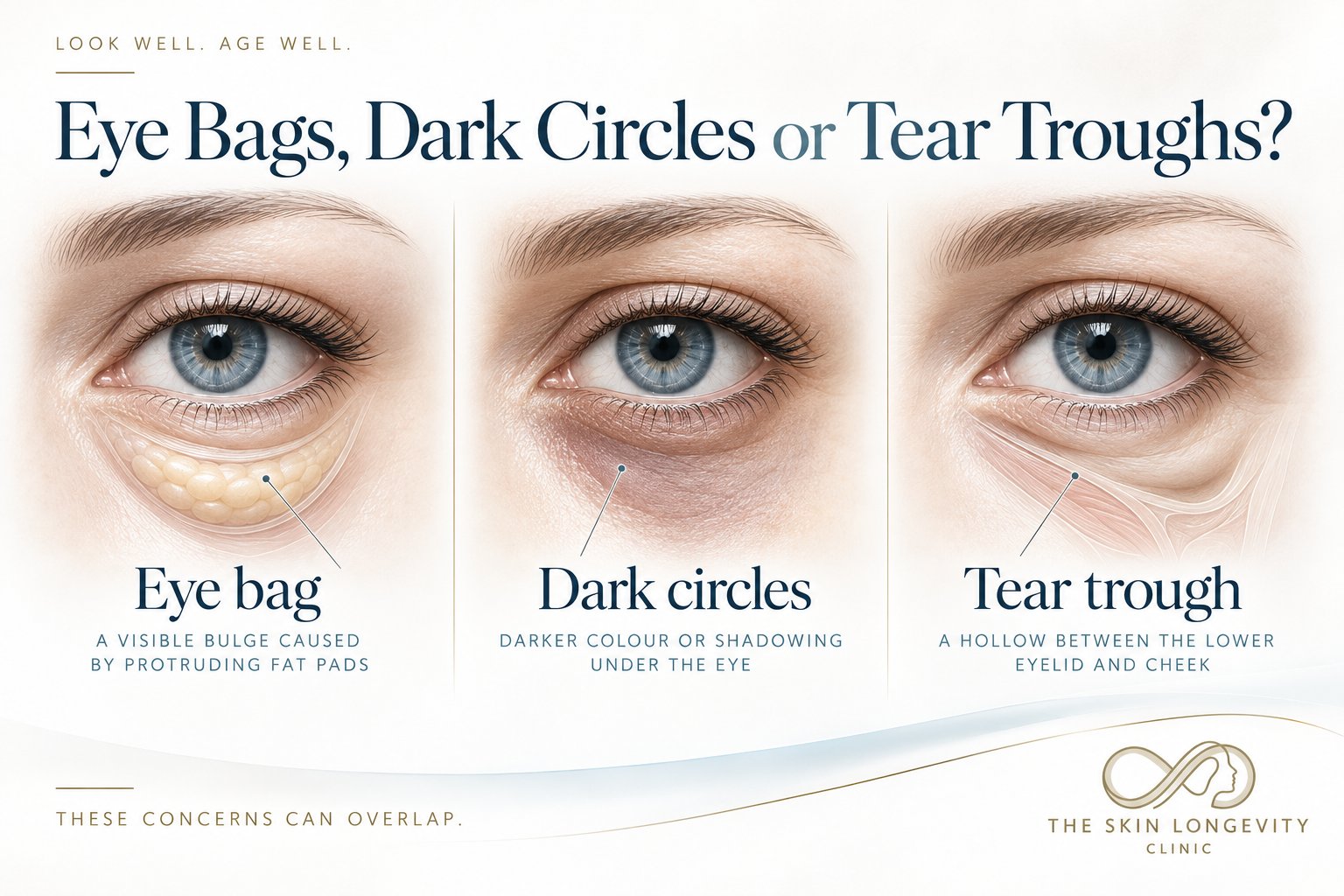
Eye bags, dark circles or tear troughs? These concerns can overlap.
Eye bags describe fullness, while dark circles describe a darker appearance that may include colour or shadow5. A tear trough is a hollow, and these features can occur together5.
A treatment that softens a hollow may leave pigmentation unchanged2,5. Our dark eye circle assessment guide explains why identifying the source of darkness is a separate part of treatment planning.
Which eye bag treatment may be suitable?
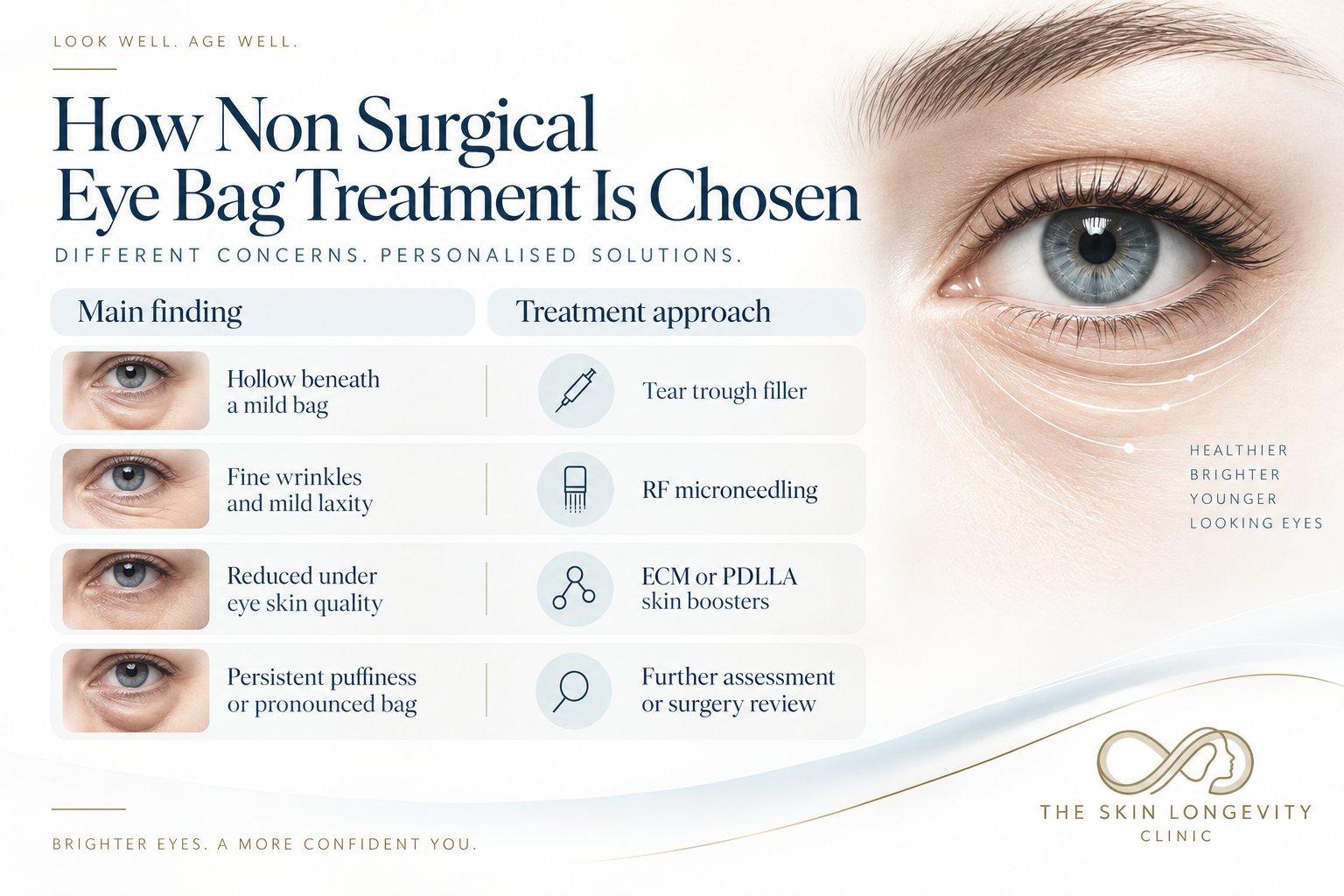
How non surgical eye bag treatment is chosen.
Non surgical eye bag removal can mean different things depending on the procedure. Improving skin texture, camouflaging a hollow and reducing a selected fat bulge are distinct treatment goals2,6,10.
Main finding
Approach that may be considered
Intended improvement
Important limitation
Fluctuating puffiness
Assessment and management of contributing inflammation or medical factors
Reduce the swelling component where its cause can be addressed4
An aesthetic procedure may be inappropriate before assessment4
A hollow beneath a mild bag
Tear trough filler, with cheek support where indicated
Smooth the transition between the lower eyelid and cheek2
Adds volume rather than removing orbital fat2
Fine wrinkles and mild skin laxity
Selected dermal RF microneedling
Improve skin texture and associated wrinkles6
Skin improvement differs from correcting a substantial fat bag6
Reduced under eye skin quality
Selected ECM or PDLLA skin booster treatment
Address accompanying skin quality concerns7,8
Evidence is emerging and does not establish removal of protruding fat7,8
Marked fat protrusion or excess skin
Surgical assessment
Consider fat removal or repositioning and management of excess skin3
Surgery has different recovery requirements and risks3
Tear trough filler and cheek support
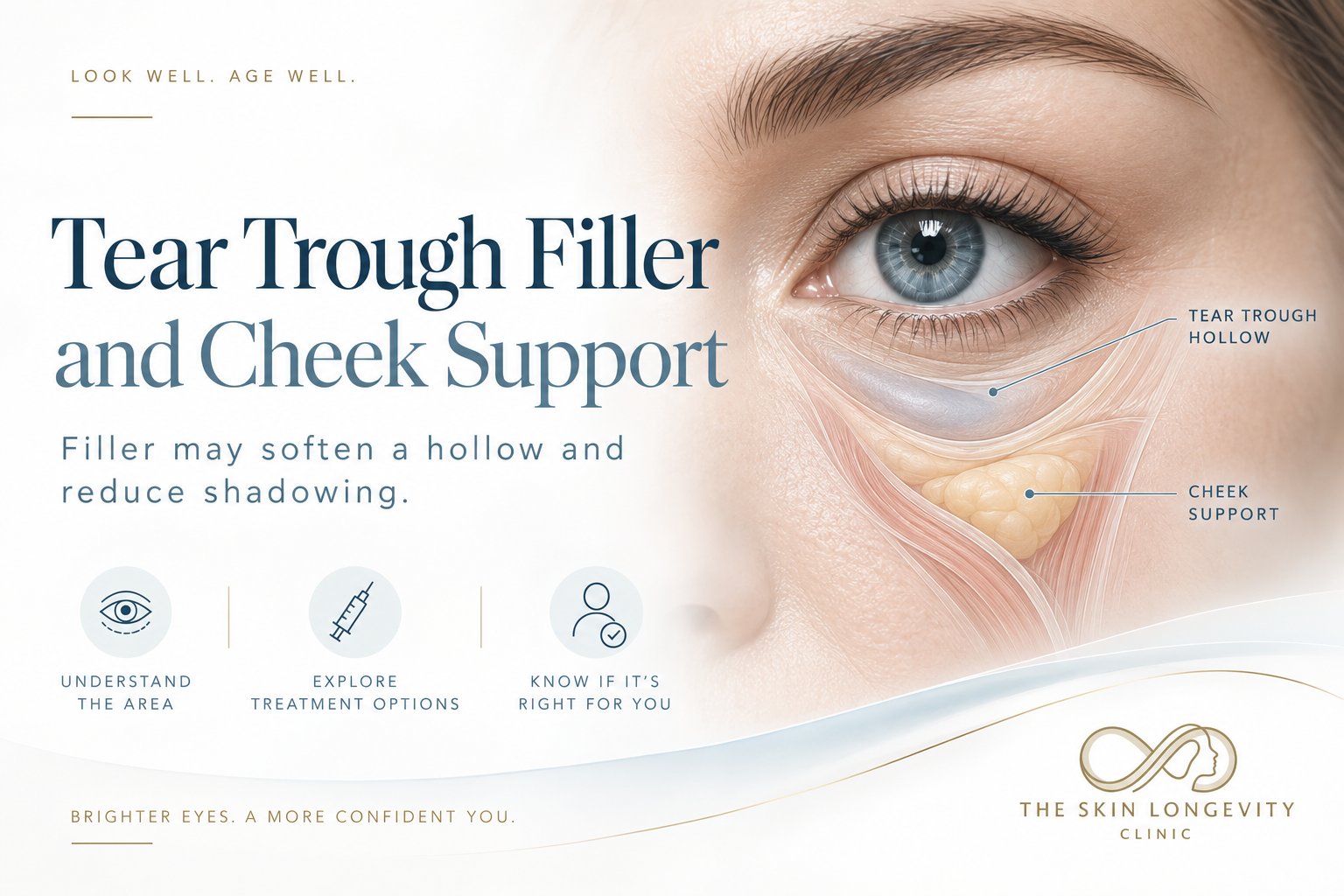
Tear trough filler and cheek support.
Hyaluronic acid filler can soften a depression beneath an eye bag, reducing the contrast around the bulge2. It is most relevant when hollowing contributes to the appearance and the existing anatomy is suitable2,5.
Cheek filler may also be considered when reduced midface support contributes to the lower eyelid contour2. Published work in Japanese patients describes treatment planning that accounts for facial structure and changes seen during smiling, rather than filling every tear trough in isolation2.
What does treatment involve?
After assessment and preparation, the doctor places selected amounts of filler using a needle or cannula5. The aim is to improve the contour without adding unnecessary volume to an already full area5.
Existing swelling, prominent bags, very thin skin or previous filler can complicate treatment selection5. Our tear trough filler guide explains suitability, the procedure and recovery.
RF microneedling for skin texture and tightening
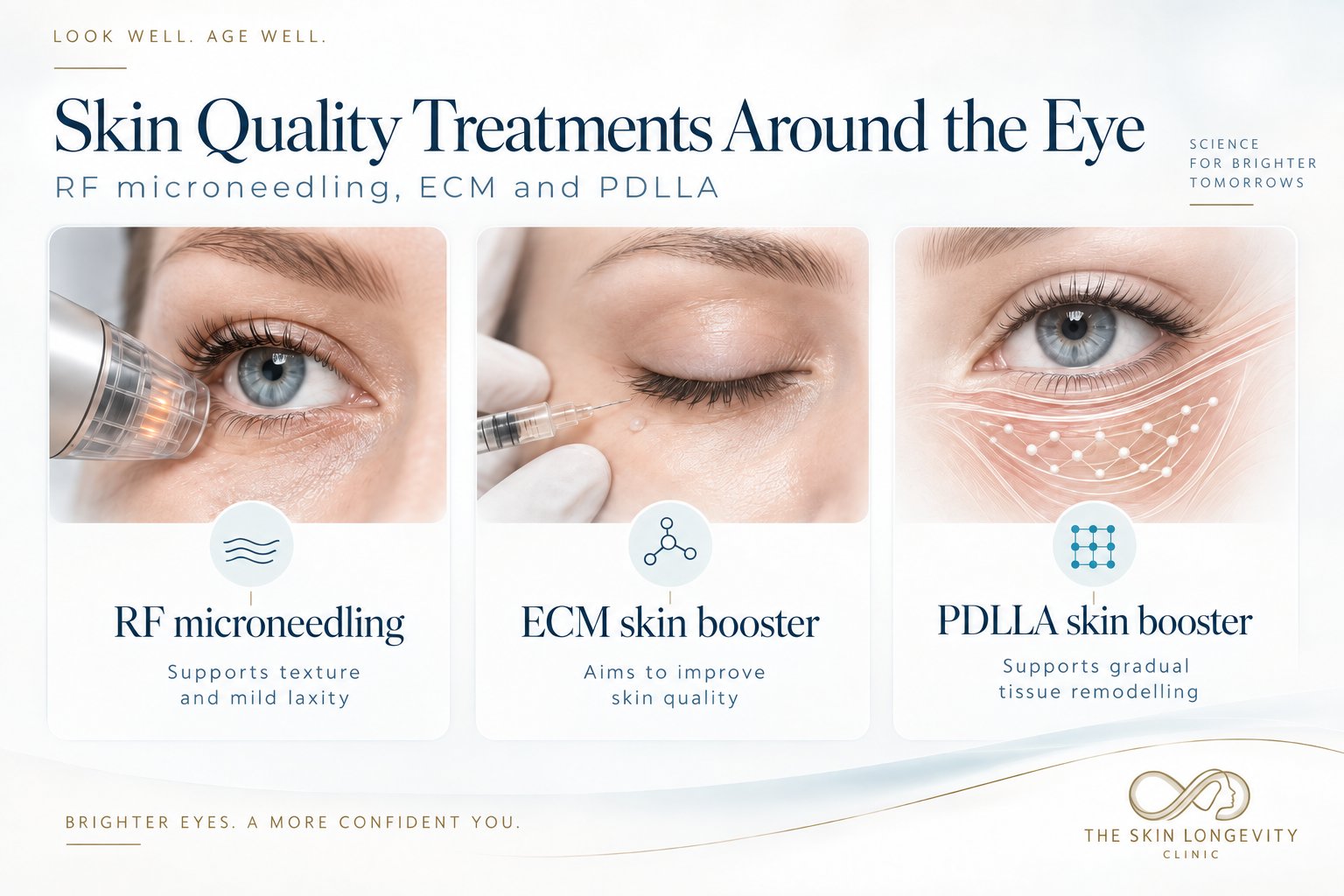
Skin quality treatments around the eye: RF microneedling, ECM and PDLLA.
Dermal RF microneedling uses fine needles to deliver radiofrequency energy within the skin, initiating tissue remodelling6. Research around the eyes has reported improvements in wrinkles and dermal collagen, supporting a role for selected skin quality concerns6.
Treatment generally involves cleansing, numbing and applying a microneedle device to the chosen area6. The device and treatment parameters must be appropriate for the eyelid region rather than copied from a protocol used elsewhere on the face6,12.
A smoother skin surface may improve the overall appearance of a lower eyelid, while the underlying fat bulge remains6. Our RF microneedling guide explains this dermal treatment approach.
How does this differ from RF treatment directed at fat?
A separate technique uses specialised insulated needles to treat selected lower eyelid fat bulges10. This differs from dermal RF microneedling intended to improve wrinkles and texture6,10.
In a study of 22 participants, two treatments four weeks apart reduced measured bulging, with improvement maintained through the 24 week assessment10. Swelling and bruising lasted approximately one week, and the study lacked a separate untreated control group10.
These findings apply to the particular technique studied10. They should not be interpreted as evidence that every RF device removes eye bags or produces results equivalent to surgery10.
ECM skin boosters for accompanying skin quality concerns
Some ECM skin boosters contain processed human acellular dermal matrix, derived from donor skin with its cellular components removed7. The material is being investigated for tissue remodelling and improvements in skin quality7.
A randomised study involving 20 adults with cheek roughness compared one preparation with hyaluronic acid over 20 weeks7. Researchers reported improvements in several skin measurements, including density, elasticity, wrinkles and hydration7.
The study concerned facial skin restoration rather than removal of lower eyelid fat7. For an eye bag accompanied by fine wrinkles or crepiness, the proposed treatment goal is improvement in the overlying skin, with the limits of the evidence explained during consultation7.
Treatment involves injections into selected areas after assessment7. Our ECM skin booster under eye article discusses the procedure and the distinction between skin quality and structural correction.
PDLLA skin boosters
PDLLA and hyaluronic acid preparations have also been studied for under eye rejuvenation8. A prospective study of 15 women in Singapore and Malaysia reported improvements in tear trough appearance and skin quality ratings after three treatments8.
The study was small and uncontrolled, and its outcomes do not establish removal of protruding orbital fat8. Its findings are better considered preliminary evidence for selected contour and skin quality concerns8.
Treatment involves injections, and nodules following PDLLA tear trough treatment have been reported9. Our guide to PDLLA and hyaluronic acid skin boosters explains the components and why product specific assessment is important.
Recovery, treatment sessions and review
Recovery depends on the procedure, material and individual response5,6. Injectable treatments can cause bruising and swelling, while RF microneedling can produce redness, discomfort and swelling6,11.
Early fullness after an injection can also affect the apparent result11. Review should distinguish temporary reactions from a persistent contour concern before additional treatment is considered14.
Published expert consensus recommends review at approximately two to four weeks when filler is used in a new treatment area14. Concerning or worsening symptoms require earlier assessment rather than waiting for that appointment11,14.
What are the risks?
Under eye filler can cause bruising, swelling, visible irregularities and bluish discolouration, with swelling sometimes persisting beyond the initial recovery period11. Rare vascular complications can injure the skin or affect vision11.
Skin boosters also carry injection related risks7,8. Vascular injury following facial ECM injections and nodules following PDLLA tear trough treatment have been reported, although these reports do not establish a complication rate for every product or treatment area9,13.
RF microneedling has its own risk profile12. The US FDA has warned about reports of burns, scarring, unwanted fat loss and nerve damage with certain uses, reinforcing the need for an appropriately trained medical practitioner and suitable device selection12.
Sudden changes in vision after a facial injection require emergency care11. In Singapore, call 995 for emergency assistance, and explain that you recently received a facial injection11,16.
Severe or increasing pain, unusually pale skin or a developing dusky pattern requires immediate contact with the treating doctor11. These symptoms should not be managed by waiting for a routine review11.
When is eye bag surgery more appropriate?
Lower eyelid blepharoplasty may be more appropriate when prominent fat protrusion, substantial excess skin or poor eyelid support is the main concern3. A surgeon can assess whether fat removal, repositioning or management of excess skin would provide a more suitable correction3.
Some approaches use an incision inside the lower eyelid, avoiding an external skin incision in suitable patients3. This remains surgery, even when described as scarless eye bag removal, and risks such as dry eye, bleeding and changes in eyelid position require discussion3.
How many sessions are needed, and how long do results last?
Treatment schedules differ between procedures and between published studies6,7,8,10. A course evaluated for one product or technique should not be treated as a standard schedule for every patient.
The specialised fat directed RF study followed results through 24 weeks, while the ECM trial assessed skin changes over 20 weeks7,10. Neither establishes permanent eye bag removal, and decisions about further treatment should follow reassessment rather than an assumed maintenance timetable7,10.
How much does eye bag treatment cost in Singapore?
An eye bag treatment quotation should reflect the proposed procedure, treatment area, amount of material and number of sessions. Ask whether it covers one or both sides and whether consultation, numbing, GST, aftercare and review appointments are included.
A single treatment price should also be distinguished from the anticipated cost of a course. Our guide to your first aesthetic clinic consultation includes questions to ask before agreeing to a treatment plan.
Can HIFU remove eye bags?
Research on microfocused ultrasound includes temporary eyebrow lifting, which is a different outcome from reducing lower eyelid fat bulges15. Evidence for one treatment area should not be assumed to establish effectiveness for another15.
When ultrasound treatment is considered, ask which tissue and concern the proposed treatment addresses. The distinction between improving surrounding laxity and removing a bag should remain clear.
Booking an eye bag assessment
The purpose of assessment is to identify what is creating the fullness and discuss an appropriate level of correction. Bring details of previous under eye injections or procedures, along with information about swelling, skin irritation and what you would like to improve.
The Skin Longevity Clinic is located at Scotts Medical Center, 9 Scotts Road, Singapore 228210. Arrange a consultation to discuss whether medical management, a non surgical option or a surgical assessment is appropriate.
Scientific and clinical references
Goldberg RA, McCann JD, Fiaschetti D, Ben Simon GJ. What causes eyelid bags? Analysis of 114 consecutive patients. Plastic and Reconstructive Surgery. 2005;115(5):1395 to 1402. PMID 15809605.
Kato K, Kajiwara T, Furuyama N, Liew S. Filler based correction of tear trough depressions and eye bags in Japanese patients: A classification system and treatment algorithm. Journal of Cosmetic Dermatology. 2023;22(2):439 to 448. PMID 36208029.
Bhattacharjee K, Ghosh S, Ugradar S, Azhdam AM. Lower eyelid blepharoplasty: An overview. Indian Journal of Ophthalmology. 2020;68(10):2075 to 2083. PMID 37531619.
Sami MS, Soparkar CNS, Patrinely JR, Tower RN. Eyelid edema. Seminars in Plastic Surgery. 2007;21(1):24 to 31.
Woodward J, Cox SE, Kato K, Urdiales Gálvez F, Boyd C, Ashourian N. Infraorbital hollow rejuvenation: Considerations, complications, and the contributions of midface volumization. Aesthetic Surgery Journal Open Forum. 2023;5:ojad016. PMID 36998744.
Kim KE, Park JH, Seul TW, Kim IH, Ryu HJ. Periorbital skin rejuvenation of Asian skin using microneedle fractional radiofrequency. Annals of Dermatology. 2023;35(5):360 to 366. PMID 37830418.
Lee YI, Chau NH, Nguyen NH, et al. Injectable particulated human acellular dermal matrix booster for skin restoration: An integrated randomized, split face, double blinded clinical trial and preclinical study. International Journal of Molecular Sciences. 2026;27(5):2193. PMID 41828422.
Young SM, Lau EKH. Hybrid biostimulator and hyaluronic acid injectable for tear trough rejuvenation. Aesthetic Plastic Surgery. 2026;50:5337 to 5343. PMID 42493592.
Seo SB, Wan J, Yi KH. Energy based device management of nodular reaction following poly D,L lactic acid injection for tear trough rejuvenation. Journal of Cosmetic Dermatology. 2025;24(1):e16575. PMID 39283001.
Shin JW, Park JT, Chae JB, et al. The efficacy of micro insulated needle radiofrequency system for the treatment of lower eyelid fat bulging. Journal der Deutschen Dermatologischen Gesellschaft. 2019;17(2):149 to 156. PMID 30698910.
Zein M, Tie Shue R, Pirakitikulr N, Lee WW. Complications after cosmetic periocular filler: Prevention and management. Plastic and Aesthetic Research. 2020;7:44. PMID 33102629.
US Food and Drug Administration. Potential risks with certain uses of radiofrequency microneedling. Safety communication. October 15, 2025.
Sung SW, Lee SY, Seok J, Kim BJ. Vascular complication following injection of particulated human acellular dermal matrix: A case report. Journal of Cosmetic Dermatology. 2026;25(7):e71049.
Goodman GJ, Liew S, Callan P, Hart S. Facial aesthetic injections in clinical practice: Pretreatment and posttreatment consensus recommendations to minimise adverse outcomes. Australasian Journal of Dermatology. 2020;61(3):217 to 225. PMID 32201935.
Choi EJ, et al. Efficacy and safety of microfocused ultrasound for temporary eyebrow lift and glabellar wrinkle reduction. Lasers in Medical Science. 2025;40:79. PMID 39920474.
Singapore Civil Defence Force. Emergency Medical Services. Official guidance on emergency ambulance assistance through 995.