RF Microneedling in Singapore for Acne Scars and Skin Texture
When acne has settled but the skin still looks uneven, choosing a treatment can be difficult. You may be comparing needling with laser, wondering about recovery or trying to understand why another procedure has been suggested alongside it.
RF microneedling combines fine needles with radiofrequency energy to create controlled treatment zones within the skin, with the aim of supporting dermal remodelling1. This page focuses on fractional RF for scars and texture; our acne scar treatment guide compares the wider options, while the scar assessment page helps readers who are unsure about the type of scar.
Medically reviewed by Dr Rachel Ho, MBBS, MRCS, MMed (ENT), 21 September 2026.
What is fractional RF microneedling?
The needles place energy at selected depths, producing a thermal effect in addition to the mechanical effect of needling1. Devices and treatment settings vary, so the term RF microneedling describes a category of procedures rather than one standard treatment1.
Ask which areas are being treated and why the proposed approach fits the scar depth and surrounding tissue. The device name or a claim about maximum power is less useful than understanding the plan for your skin.
Research supports considering fractional RF for selected atrophic acne scars, with separate studies also examining texture and skin rejuvenation1,2. Suitability depends on the features identified at assessment and the outcome being sought, rather than expecting every pit or pore to respond in the same way3.
Acne scars and mixed texture
Some scars have attachments beneath them, while others are deeper individual defects or areas of broader unevenness3. The consultation should explain what RF is intended to improve and which findings might need a different approach.
Our subcision guide discusses tethered scars, and the TCA CROSS article explains focal treatment of selected pits. These links are useful when a plan includes more than resurfacing alone.
Pores, fine lines and firmness
Clinical studies have examined RF microneedling for rejuvenation as well as scars, but those outcomes should be assessed separately1. Ask which change will be used to judge progress rather than treating a general claim about skin quality as a measurable result.
The proposed treatment area and depth also matter when your concern is texture rather than contour reduction. Discuss facial fullness and any previous treatments before proceeding.
Secret RF for melasma
The dermis under a melasma patch shows solar elastosis, a disrupted basement membrane, extra blood vessels and senescent fibroblasts that keep signalling to melanocytes. Secret RF heats this layer while sparing most of the surface skin. A 2026 systematic review of 12 studies found RF microneedling lowered melasma severity scores for up to 6 months, with a low rate of PIH in darker skin types7. Combining it with low-fluence Q-switched Nd:YAG laser gave more improvement than laser toning alone8,9. In a 50-patient retrospective study, median mMASI fell by 32%10; a Japanese series found 28% of patients reached a 30% reduction11. RF microneedling is used for melasma as an adjunct to sunscreen, topical treatment and laser, and is performed by a doctor5. See our pigmentation treatment guide.
What does the clinical evidence show?
A 2025 systematic review included 16 studies involving 481 patients treated for acne scars and concluded that fractional RF microneedling was likely effective as a stand alone treatment2. The authors also called for further randomised trials to establish appropriate treatment parameters2.
Those findings support a treatment discussion, rather than a guaranteed percentage improvement or a fixed course for everyone. Ask how the evidence applies to the scars and protocol being proposed.
How does it compare with fractional CO2 laser?
In a randomised study of 15 patients, both treatments produced similar median improvement in scar texture three months after a single session4. The CO2 treated areas had more pronounced early skin reactions, while RF microneedling was rated more painful under the protocols studied4.
This small trial illustrates a tradeoff rather than proving either treatment universally better. Our fractional CO2 laser page explains that procedure, which can be discussed alongside recovery preferences and skin assessment.
Microneedling vs RF microneedling: what is the difference?
Conventional microneedling creates a mechanical injury, whereas RF microneedling also delivers thermal energy through its needles1. Adding RF changes the treatment and risk discussion; it should not be interpreted as automatic superiority for every concern.
Ask why energy delivery is appropriate for the finding being treated. A comparison should address expected benefit, discomfort, recovery and risk, not just the number of technologies combined in a device.
This service page concerns fractional RF treatment for scars and texture. Readers seeking a procedure for recurring active acne should instead read about selective sebaceous gland ablation.
When breakouts and scars coexist, the plan should consider both active inflammation and existing damage3. Begin with acne assessment rather than assuming that a scar treatment will replace ongoing acne care.
What happens during an appointment?
At The Skin Longevity Clinic, the appointment includes assessment, treatment planning, appropriate skin preparation and discussion of aftercare. Mention previous fillers, threads, energy treatments, medicines and any history of difficult healing or pigmentation after procedures.
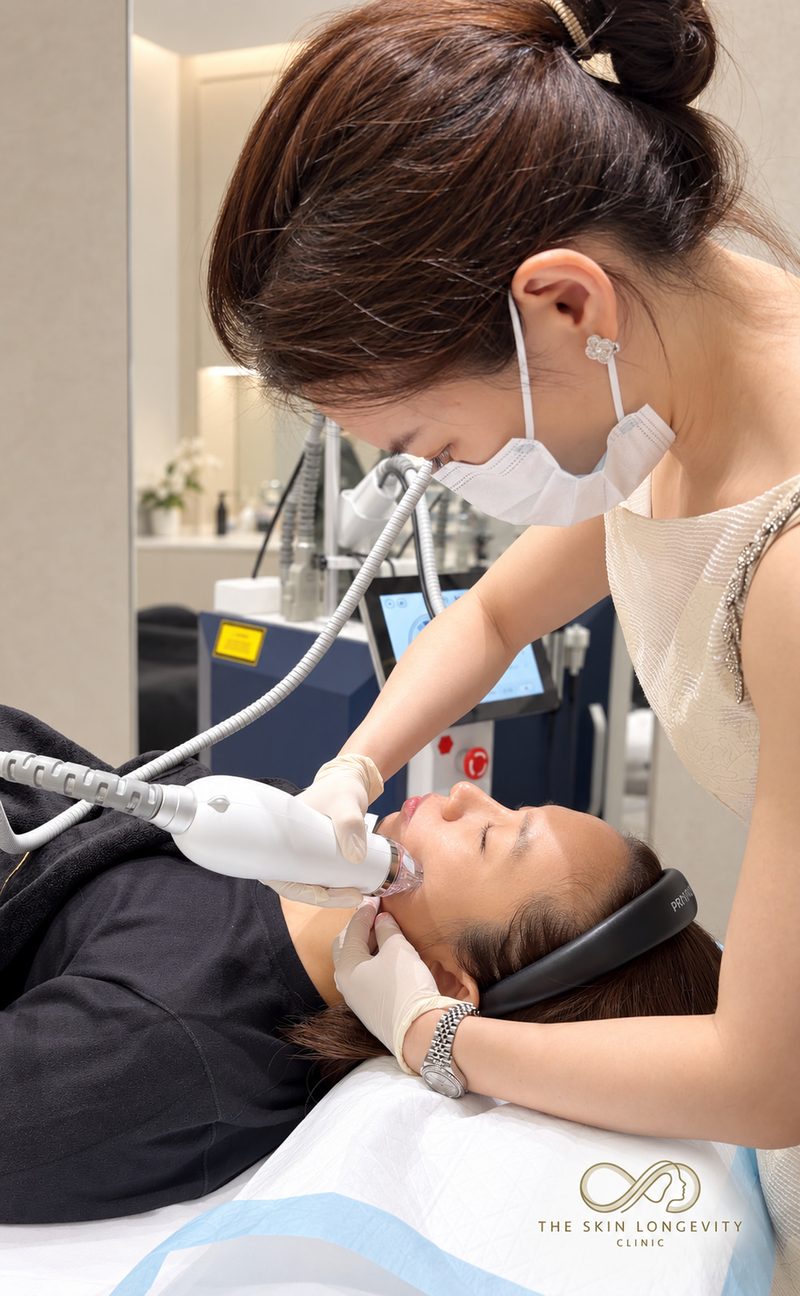
RF microneedling of the lower face and jawline.
At The Skin Longevity Clinic, RF microneedling is performed by Dr Rachel Ho using the Secret RF fractional radiofrequency microneedling system. Topical anaesthetic is applied for 15 to 30 minutes before treatment, and the appointment takes about 45 to 60 minutes in total.
Stage
What to clarify
Assessment
The target scars or texture concern, and whether any area needs another approach.
Preparation
The comfort measures, estimated appointment time and any skincare changes required.
Treatment
Which device is being used, who performs the procedure and how the plan differs across areas.
Aftercare
When to resume cleansing, makeup, active skincare, exercise and sun protection.
Review
When photographs and the skin response will be assessed before further treatment.
Ask for written instructions that reflect the procedure actually performed. Changes to prescribed medicines should be discussed with the prescribing clinician rather than made independently.
What is recovery like after RF microneedling?
Reported short term effects include redness, swelling, discomfort and temporary surface roughness or crusting2. In comparative research, the degree of early skin reaction has depended on the procedure and settings used4.
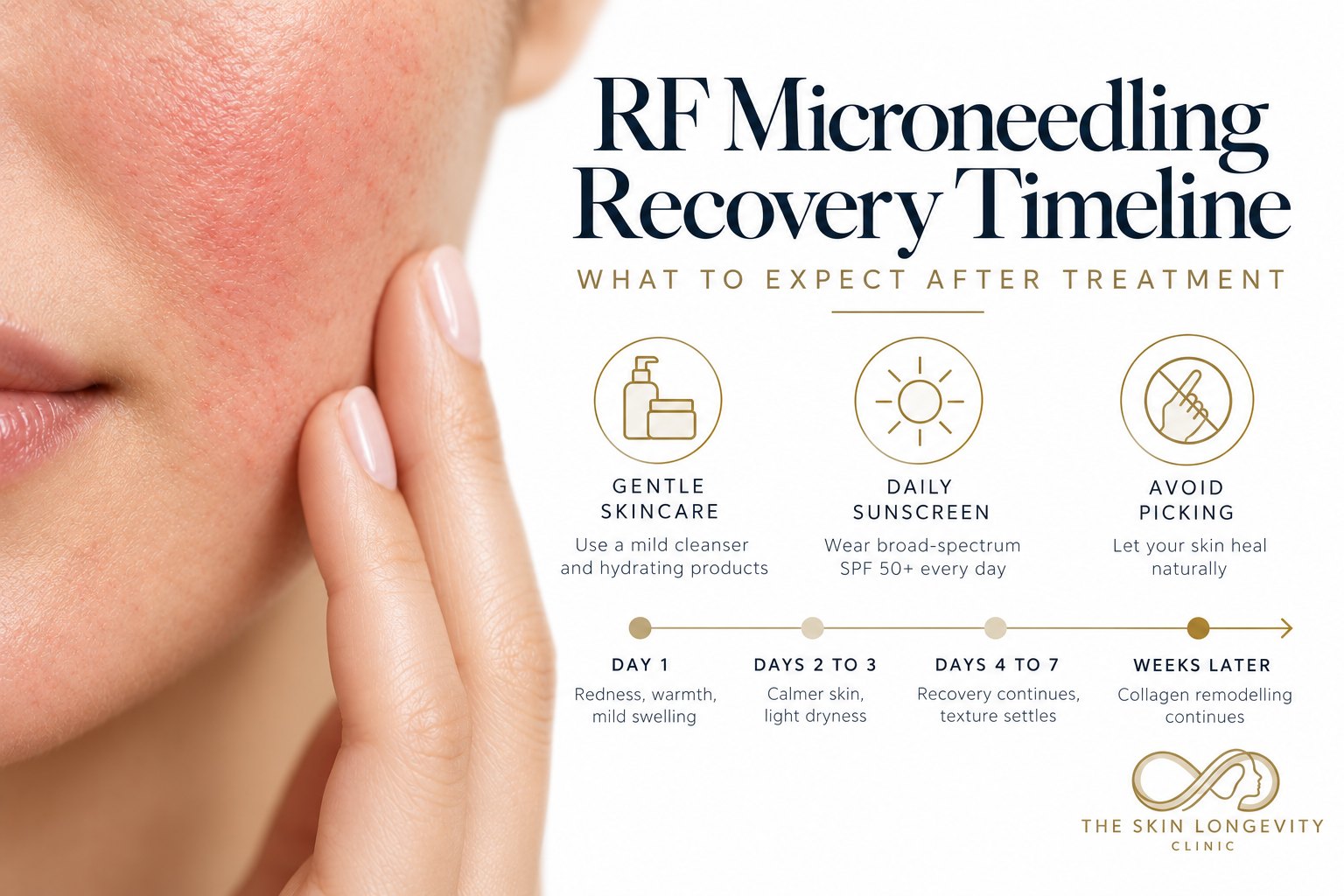
At the clinic, redness and mild swelling usually settle over 3 to 4 days.
Plan around the recovery expected for your treatment area rather than a universal promise of no downtime. Mention work presentations, photographs, flights or sport before agreeing on a date.
RF microneedling recovery timeline after treatment.
Caring for the treated skin
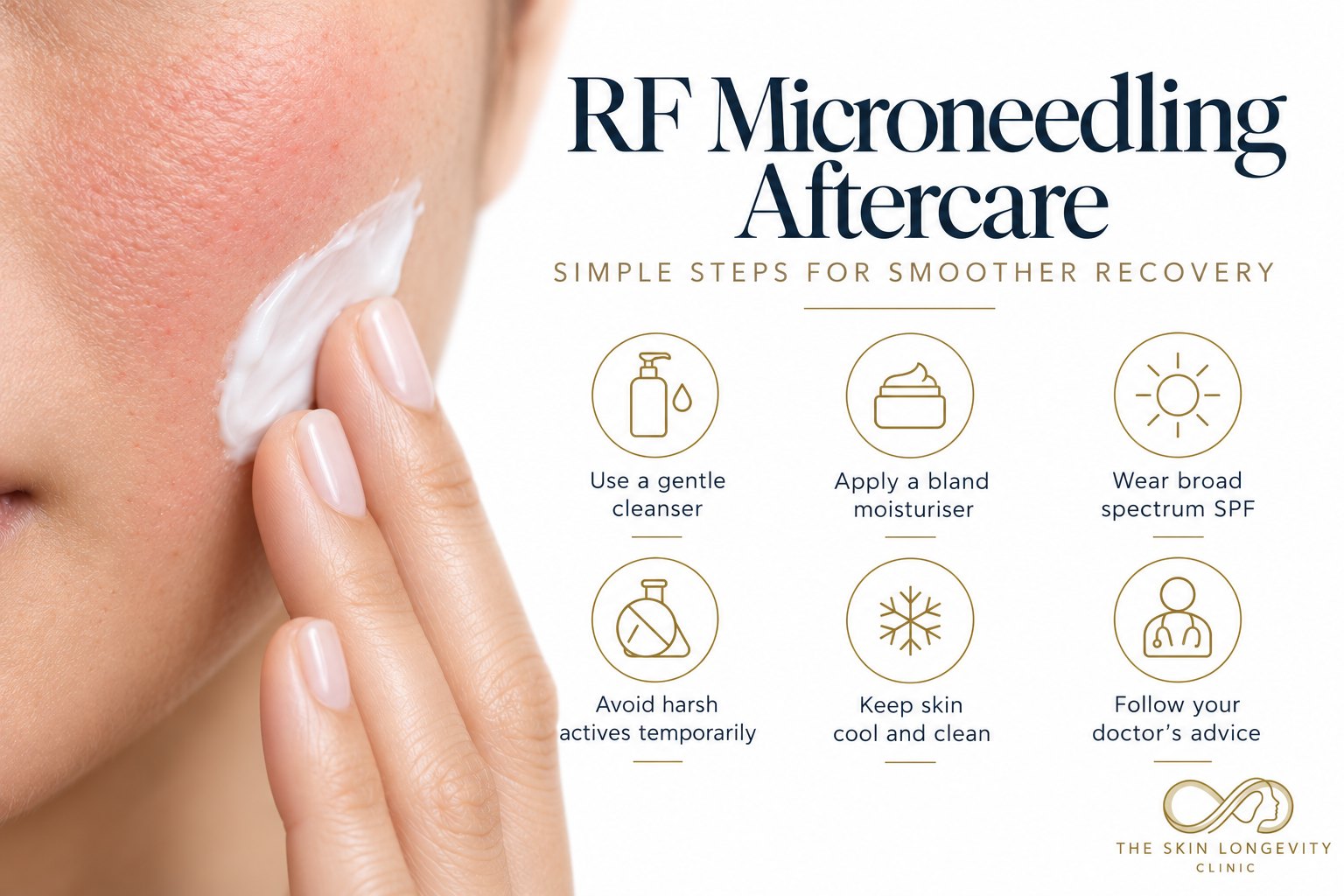
Follow the clinic’s instructions about gentle cleansing, moisturiser and the timing of sunscreen, makeup and active skincare. Ask specifically when to restart retinoids or exfoliating acids rather than returning immediately to the full routine.
Use shade and plan sun protection during outdoor journeys while the skin is recovering. Contact the clinic promptly about unexpected or worsening symptoms rather than applying another acid, a home needling device or an unprescribed treatment to the area.
RF microneedling aftercare steps.
What risks should be discussed?
RF microneedling is a medical procedure, and the consent discussion should include more than temporary redness. The US FDA’s October 2025 safety communication describes reports of burns, scarring, fat loss, disfigurement and nerve damage with certain uses of RF microneedling, sometimes requiring medical or surgical treatment5.
The notice does not establish the frequency of these complications or an individual patient’s risk5. Ask about the proposed device, treatment area, practitioner’s experience and how a complication would be assessed; seek prompt medical advice for blistering, increasing pain, new numbness or an unexpected contour change5.
The US FDA safety statement on radiofrequency microneedling: a medical device for doctors, not facials or home use.
What about darker skin tones?
RF microneedling has been studied in Asian patients and in darker skin phototypes1,6. Pigment change remains a relevant part of the discussion, so share any history of melasma, persistent marks after inflammation or a previous reaction to treatment2,3.
A published result in one skin group does not establish that every setting suits every patient. Ask how the proposed protocol accounts for your skin and the area being treated.
At The Skin Longevity Clinic, patients with darker skin tones are treated under a protocol with settings specific to their skin type; test spots are not required.
How soon can results be assessed, and how many sessions are needed?
Dermal remodelling is gradual, and published work has assessed changes over months rather than only immediately after treatment1. Early swelling and the later texture outcome should therefore be considered separately when reviewing photographs.
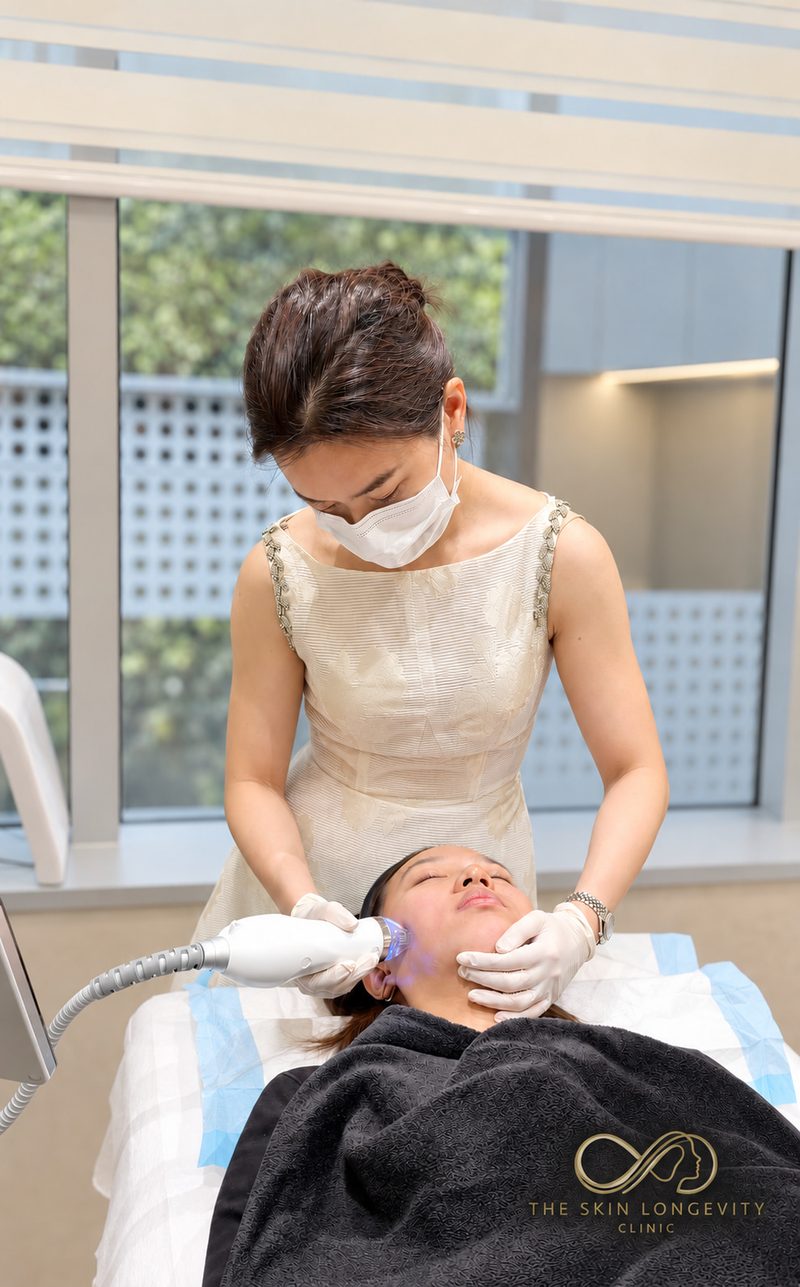
Fractional RF microneedling on the cheek.
Treatment courses vary between studies, with no single session count established for every scar pattern2. Request an initial plan with a review point, including what would justify repeating RF, changing approach or finishing treatment.
At The Skin Longevity Clinic, a course is usually 3 to 4 sessions spaced 4 to 6 weeks apart, with photographs reviewed before each session.
RF microneedling cost in Singapore
Ask for a quotation that specifies the treatment area, preparation, proposed sessions and review arrangements. Clarify whether aftercare items and any applicable tax are included.
When subcision, a focal scar procedure or an injectable is proposed alongside RF, ask for its purpose and separate cost. Comparing these components is more informative than comparing two packages that may cover different areas and procedures.
Can I have RF microneedling and subcision in the same plan?
Combination treatment may be considered when scarring has features that need different approaches3. Ask why each component is being proposed and whether it is preferable to assess the first treatment before deciding on the next.
Does a more intense treatment mean a better result?
Clinical reviews describe variation in RF settings and incomplete evidence for an optimal universal protocol2. Discuss the intended treatment depth and benefit together with recovery and risk, rather than choosing the highest intensity available.
Can I use a home device to maintain the result?
The FDA advises that RF microneedling should not be performed at home5. Discuss maintenance skincare and review arrangements with your treating doctor instead of trying to reproduce the procedure yourself.
Is RF microneedling worth it?
For rolling and boxcar acne scars, enlarged pores and early texture change, randomised trials and two meta-analyses show consistent improvement with a low pigmentation risk in Asian skin. It is not the right tool for ice-pick scars on their own, deep laxity or active melasma as a first step, so the value of treatment depends on the diagnosis made at the consultation.
Is RF microneedling better than microneedling?
For scars and pores, RF microneedling is the stronger treatment. Radiofrequency heat at the needle tip remodels the dermis more than needle injury alone, and a randomised split-face trial showed greater scar and acne improvement than surface radiofrequency. Mechanical microneedling is sufficient for superficial radiance.
What is the downside of RF microneedling?
The downsides are two to four days of redness and crusting, discomfort despite numbing cream, the need for three to four sessions, and uncommon post-inflammatory hyperpigmentation. Rarely, fat loss or nerve injury has been reported when devices are used outside cleared parameters, which the clinic's protocol avoids.
Why do some plastic surgeons not like RF microneedling?
The concerns centre on over-treatment, because deep, high-energy settings over thin tissue can cause fat loss or contour change, and results for true sagging are modest compared with surgery. When RF microneedling is used at dermal depth for scars and texture, with settings matched to the area, the heat stays in the dermis above the fat layer and the risk of fat loss is low.
How often should RF microneedling be done?
RF microneedling is repeated every four to six weeks for a course of three to four sessions, followed by a review at three months. Maintenance is decided individually rather than booked in advance.
Tan MG, Jo CE, Chapas A, Khetarpal S, Dover JS. Radiofrequency microneedling: a comprehensive and critical review. Dermatologic Surgery. 2021;47(6):755–761. doi:10.1097/DSS.0000000000002972.
Niaz G, Ajeebi Y, Alshamrani HM, Khalmurad M, Lee K. Fractional radiofrequency microneedling as a monotherapy in acne scar management: a systematic review of current evidence. Clinical, Cosmetic and Investigational Dermatology. 2025;18:19–29. doi:10.2147/CCID.S502295.
Salameh F, Shumaker PR, Goodman GJ, et al. Energy-based devices for the treatment of acne scars: 2022 international consensus recommendations. Lasers in Surgery and Medicine. 2022;54(1):10–26. doi:10.1002/lsm.23484.
Hendel K, Karmisholt K, Hedelund L, Haedersdal M. Fractional CO2-laser versus microneedle radiofrequency for acne scars: a randomized, single treatment, split-face trial. Lasers in Surgery and Medicine. 2023;55(4):335–343. doi:10.1002/lsm.23655.
US Food and Drug Administration. Potential risks with certain uses of radiofrequency (RF) microneedling: FDA safety communication. Issued 15 October 2025; accessed 21 September 2026. Regulatory safety notice, not a clinical trial.Read the FDA communication.
Vejjabhinanta V, Wanitphakdeedecha R, Limtanyakul P, Manuskiatti W. The efficacy in treatment of facial atrophic acne scars in Asians with a fractional radiofrequency microneedle system. Journal of the European Academy of Dermatology and Venereology. 2014;28(9):1219–1225. doi:10.1111/jdv.12267.
Kumar N, et al. The Efficacy and Safety of Radiofrequency Microneedling for Melasma: A Systematic Review and Qualitative Evidence Synthesis. Aesthet Surg J Open Forum. 2026;8:ojag075. doi:10.1093/asjof/ojag075.
Kwon HH, et al. Combined treatment of melasma involving low-fluence Q-switched Nd:YAG laser and fractional microneedling radiofrequency. J Dermatolog Treat. 2019;30(4):352–356. doi:10.1080/09546634.2018.1516858.
Jung JW, et al. A Face-Split Study to Evaluate the Effects of Microneedle Radiofrequency with Q-Switched Nd:YAG Laser for the Treatment of Melasma. Ann Dermatol. 2019;31(2):133–138. doi:10.5021/ad.2019.31.2.133.
Kim HB, et al. Clinical Effects and Safety of Radiofrequency Microneedling for the Management of Melasma: A Retrospective Study. Aesthet Surg J Open Forum. 2026;8:ojag143. doi:10.1093/asjof/ojag143.
Imaizumi A, et al. A Retrospective Analysis of Radiofrequency Microneedling for Melasma Management in the Japanese Population. Clin Cosmet Investig Dermatol. 2026;19:601440. doi:10.2147/CCID.S601440.
Is Secret RF microneedling right for you?
Bring previous treatment details and identify the areas you want assessed under ordinary lighting. Explain both your priorities and the amount of recovery you can reasonably accommodate.
Contact The Skin Longevity Clinic to ask about RF microneedling assessment with Dr Rachel Ho. A useful consultation should explain the proposed benefit, alternatives, risks and estimate before you decide on treatment.