Large pores treatment aims to make pores less noticeable and improve skin texture1. Options include skincare, chemical peels, fractional lasers and radiofrequency microneedling, selected according to the skin findings and treatment goals1,5,6,7,8.
Visible pores alone are generally a cosmetic concern1. A consultation should focus on the changes that matter to you, with a clear explanation of the likely improvement, recovery and cost.
Large pores at a glance
What makes pores look bigger: oil, loss of firmness in the skin around the pore opening, and blocked follicles. Usually more than one of these at once.
What treatment can do: make pores less visible and the skin smoother. Pores are permanent structures, so “closing” them is not the goal.
Main options: 1540 nm erbium glass laser (Secret DUO), RF microneedling, fractional pico laser, fractional CO2 laser, chemical peels and collagen-stimulating skin boosters, each suited to a different cause.
First step: an assessment that works out which cause is driving your pores, before any device is chosen.
What makes facial pores look larger?
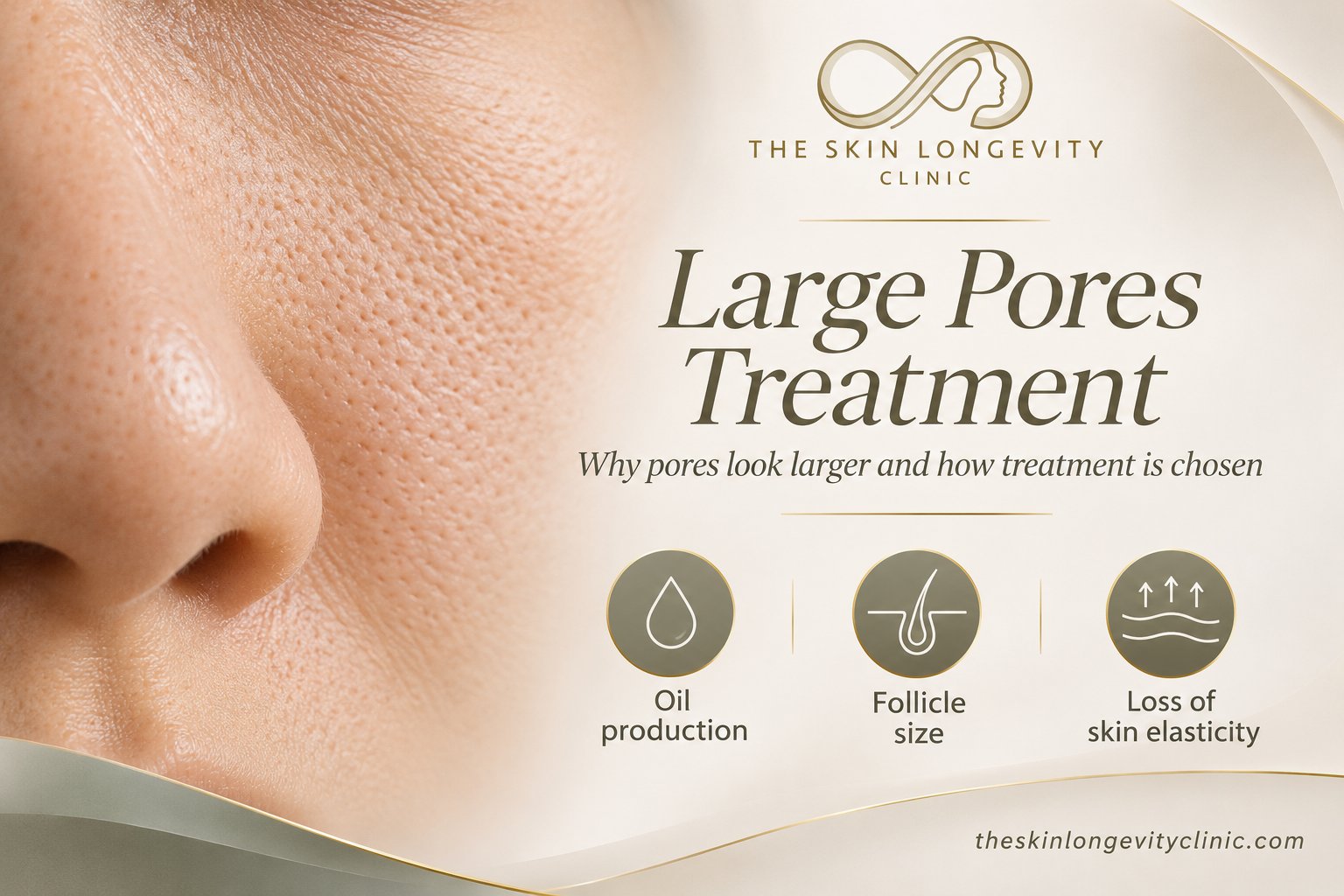
Visible facial pores are the openings of hair follicles associated with oil glands1. Higher oil production, larger follicles and reduced elasticity around these openings can contribute to their prominence1,2.
Clogging and acne can also make pores more noticeable1,4. Treatment therefore considers both the contents of the follicle and the condition of the surrounding skin1.
How large pores treatment is selected in Singapore
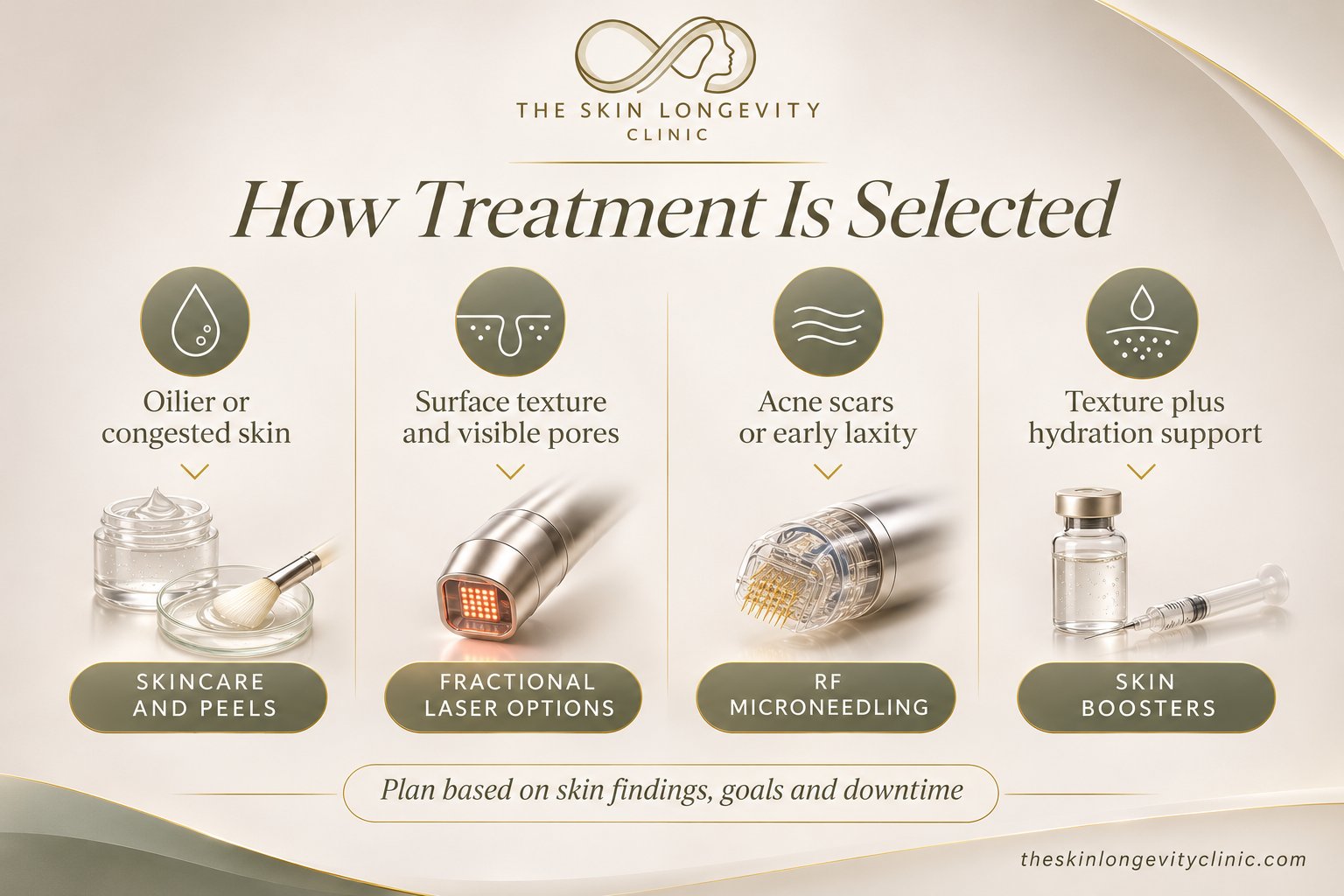
How large pores treatment is selected: matched to skin findings, goals and downtime.
The first step is to establish which areas concern you and what has changed. The assessment should distinguish visible pores from blocked follicles and acne scars, while considering skin sensitivity, previous procedures and the products you already use.
For background on persistent pits and uneven contours, read our guide to the types of acne scars. Bring your skincare products or a list of their names to the consultation, particularly when breakouts or irritation accompany the texture concern.
Treatments for large pores in Singapore
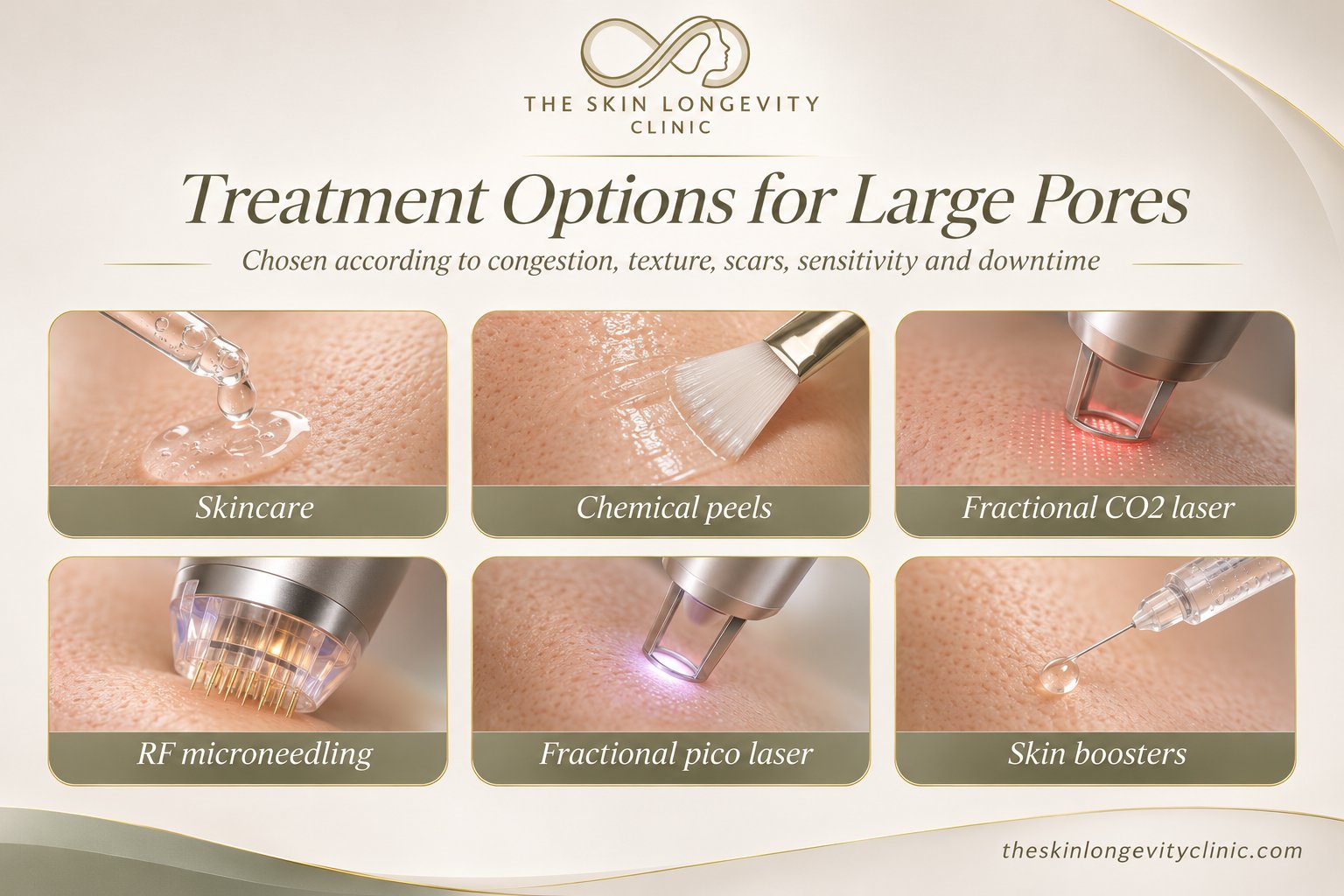
Treatment options for large pores, chosen according to congestion, texture, scars, sensitivity and downtime.
1540 nm erbium glass laser (Secret DUO)
A non-ablative laser that works under the surface, so the skin is not wounded and recovery is short. The 1540 nm erbium glass laser sends thousands of tiny columns of heat into the dermis while leaving the top layer of skin intact. The skin responds by building new collagen around each column over the following weeks, which firms the tissue surrounding the pore opening and smooths the texture between pores. In a study of 15 patients treated monthly for five months, 3D imaging showed a measurable improvement in skin roughness and texture twelve weeks after the last session, with no significant side effects18.
It is one of the two technologies in the Secret DUO platform. Secret DUO combines the 1540 nm erbium glass laser with Secret RF microneedling in one system, so the doctor can treat surface texture and pores with the laser and deeper laxity or scars with the needles, in the same session or on different visits. Our Secret DUO and 1540 nm erbium glass laser page explains how the two differ and when each is used.
Expect redness for a day or two, not peeling. Non-ablative fractional lasers in the 1540 to 1565 nm range have been compared directly with other pore treatments in randomised studies. Against a long-pulsed 1064 nm laser, both reduced pore counts with no significant difference between them19. Against a fractional pico laser, pore reduction was again similar, with the pico laser better tolerated9. These results are the reason the choice between them rests on your skin type, your pain tolerance and what else needs treating, not on one device being stronger.
Skincare for oily or congested skin
Topical retinoids and salicylic acid are recognised options for acne, including the congestion that can accompany visible pores3,4. Gentle cleansing and products labelled noncomedogenic can also help limit pore blockage4.
The choice and frequency of active skincare should account for irritation, and retinoids are avoided during pregnancy4. For a broader discussion of skincare and procedures, read Dr Rachel Ho’s large pores treatment review.
Chemical peels
Chemical peels use exfoliating acids to improve the skin surface1,5. In a study of 22 women, a series of five glycolic acid peels reduced the number of visibly prominent pores on image analysis5.
The consultation should explain which peel is proposed and how it fits alongside your existing skincare. Our chemical peel treatment page provides further information about the procedure and aftercare.
Fractional CO2 laser
Fractional CO2 laser creates microscopic treatment zones that stimulate skin repair and collagen remodelling6. A study of 32 Korean patients reported fewer enlarged pores and increased collagen fibres after three treatment sessions6.
This option deserves a discussion of the intended texture improvement and the recovery involved. Read about fractional CO2 laser treatment before comparing it with treatments that affect the skin surface differently.
RF microneedling
Radiofrequency microneedling combines fine needles with controlled energy delivery beneath the skin surface7. A retrospective study of 75 patients reported improvement in enlarged pores, with responses differing between facial areas and across treatment sessions7.
The proposed needle depth, energy settings and treatment area should form part of the explanation. Our RF microneedling guide covers the procedure, recovery and questions to discuss before treatment.
Fractional pico laser
Certain fractional picosecond laser treatments have clinical evidence for improving enlarged pores8,9. In a study of 25 Asian participants, pore volume improved after three sessions using a 1064 nm picosecond laser with a fractionated microlens array, with improvement observed at six months8.
The fractional handpiece and treatment settings matter. These findings concern specific fractional protocols, so results should be interpreted in relation to the device and settings studied8,9. Our pico laser treatment guide explains the different treatment approaches.
Polynucleotide skin boosters
A 2026 study involving 30 participants found improvements in pore volume and texture after three polynucleotide treatments10. Both sides of the face received polynucleotides, using different injection techniques, so the study compared delivery approaches rather than treatment against a placebo10.
Oil measurements did not change significantly in that study10. When considering polynucleotide skin boosters, discuss the exact formulation and whether the intended benefit is pore appearance, hydration or another skin concern. The skin boosters in Singapore page compares the booster categories used for pores.
ECM skin boosters
ECM stands for extracellular matrix, the structural network surrounding skin cells14. ECM skin boosters made from human acellular dermal matrix use donated tissue processed to remove cells while retaining components of this supporting network14. Our overview of ECM skin boosters in Singapore explains who may suit them.
A 2026 randomised study compared an injectable ECM preparation with hyaluronic acid on opposite sides of the face in 20 adults14. The ECM treated side showed a greater reduction in measured pore area from week 12 onwards during the 20 week study, alongside improvements in hydration and elasticity14.
These findings provide early clinical evidence for improving pore appearance with the specific preparation studied14. Read our ECM skin booster treatment guide for consultation and recovery information, and Dr Rachel Ho’s explanation of ECM skin boosters for a closer look at the science.
PDLLA skin boosters
PDLLA, or poly D,L lactic acid, is a biodegradable material used in collagen stimulating skin boosters, including formulations combined with hyaluronic acid15. Its role is to support gradual improvement in skin texture and fine lines through collagen remodelling15.
A preliminary study of 16 participants found improvements in texture and fine wrinkles after PDLLA with hyaluronic acid injections, with skin biopsies showing increased collagen and elastic fibres15. A separate study involving 27 women found smoother skin after PDLLA delivered with a microjet injector, although pore size did not change significantly16.
For patients with visible pores and uneven texture, the treatment discussion should distinguish the expected texture benefits from the degree of pore improvement. Our PDLLA skin booster guide explains the procedure, treatment planning and recovery.
Which large pores treatment suits which kind of pore
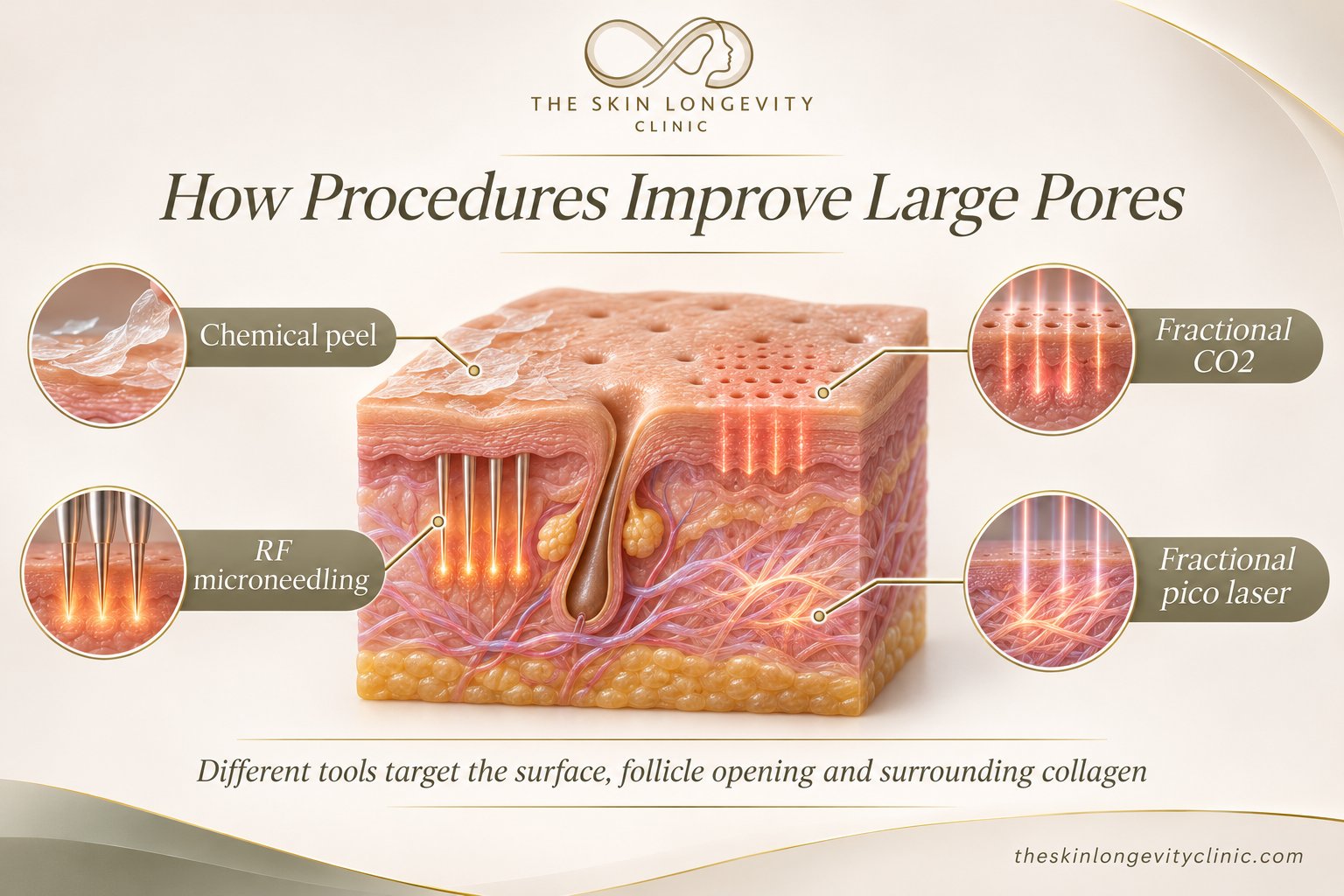
How procedures improve large pores: different tools target the surface, follicle opening and surrounding collagen.
Treatment
Mainly targets
Typical downtime
Typical course
Usually not the first choice when
1540 nm erbium glass laser (Secret DUO)
Texture, fine lines, pores stretched by early loss of firmness, dull skin
Redness 1 to 2 days
3 to 5 sessions, 3 to 4 weeks apart
Active acne is the main problem; very deep ice-pick scars
RF microneedling (Secret RF)
Scar-type pores, deeper laxity, oily and acne-prone skin
Redness and small marks 2 to 5 days
3 to 4 sessions, 4 to 6 weeks apart
Very thin or lean faces without good numbing; a history of keloids
Fractional pico laser
Pores with pigmentation or acne marks; darker skin where lower heat is preferred
Redness up to 1 day
3 sessions, 2 to 4 weeks apart
The main issue is laxity rather than surface texture
Fractional CO2 laser
Deeper atrophic scars and marked texture change
Peeling and redness 5 to 7 days
1 to 3 sessions
Darker skin with a history of dark marks after irritation; no time for recovery
Chemical peels
Congested, oily skin with blocked pores
Mild flaking 2 to 3 days
Series of 4 to 6
The pores are stretched by laxity rather than blocked
Skin quality, hydration and fine texture over months
Injection marks 1 to 2 days
2 to 3 sessions
Rapid texture change is wanted; pregnancy
How many pores treatment sessions are needed
Published fractional laser studies have used treatment courses and assessed changes over the following months6,8,9. For example, the CO2 and picosecond studies described above each used three sessions, although their protocols and assessment methods differed6,8.
Your plan should specify an initial course and a review point, with further treatment based on your response. Compare photographs taken under similar lighting and positioning, and discuss the visible change alongside your own assessment of the result.
Recovery after pores treatment and who is suitable
Temporary redness, swelling and discomfort have been reported after RF microneedling and fractional picosecond treatment7,8. Fractional CO2 resurfacing also requires a discussion of skin healing and potential complications such as pigment changes, infection and scarring11.
For RF microneedling, the consent discussion should include reported burns, scarring, fat loss and nerve injury with certain uses of the technology12. These reports do not establish how frequently the complications occur12.
Share any history of persistent dark marks after irritation, unusual scarring or previous treatment reactions. Plan the procedure around the expected recovery, and obtain clear instructions on cleansing, sunscreen, makeup and when to restart active skincare.
The ECM and PDLLA studies reported temporary reactions such as redness, swelling or procedural discomfort14,15,16. Delayed inflammatory lumps have also been reported after PDLLA injections17. Before treatment, discuss the proposed product, expected recovery, relevant risks and how the clinic would manage complications.
Skincare between pore treatments
Gentle cleansing and avoiding repeated squeezing or abrasive scrubbing can reduce irritation that makes pores more noticeable4. Daily sunscreen use also helps slow skin ageing, as demonstrated in a randomised trial, although that study did not measure pore reduction13.
Compare the cost of the proposed treatment plan, including the area treated and the number of sessions. A quotation for the nose or cheeks may cover a different scope from treatment of the whole face, so confirm exactly what is included.
What to compare
What the quotation should clarify
Treatment area
Whether the plan covers the nose, cheeks, another targeted area or the whole face.
Procedure
The peel, laser, RF treatment or injectable being proposed.
Sessions and review
The initial course, review arrangements and any separately proposed maintenance.
Inclusions
Consultation, numbing where relevant, aftercare, review fees and applicable GST.
Request an explanation of why each procedure is included, particularly when several treatments are suggested. Compare their purpose and total cost before deciding on a package or maintenance schedule.
Pores are normal skin structures, and treatment aims to improve their appearance rather than remove them1. The studies discussed here demonstrate changes over their observation periods, rather than establishing permanent pore elimination6,8,10.
Which laser is best for enlarged pores?
A randomised trial of 25 participants found that fractional 1064 nm picosecond and 1565 nm nonablative laser treatments both improved pore measurements, with no significant difference in efficacy between them9. The decision should therefore consider the specific treatment protocol, skin findings, recovery and suitability, rather than treating one laser category as universally preferable.
Is laser or RF microneedling better for large pores?
Neither is better for everyone; they treat different causes. A non-ablative laser such as the 1540 nm erbium glass laser suits pores that look larger because the skin around them has lost firmness or become rough, and it has a shorter recovery. RF microneedling suits scar-type pores, oily and acne-prone skin, and deeper laxity, because the needles deliver heat deeper than a non-ablative laser reaches. In a split-face trial in Asian patients, microneedle RF and a non-ablative fractional laser both improved pores and wrinkles with no significant difference between them, and the laser side recovered about two days faster20. Many patients with mixed concerns have both, which is what the Secret DUO platform is designed for.
How many sessions of pores treatment are needed?
Plan for a course, not a single visit. The published pore studies used three to five sessions spaced two to four weeks apart, and assessed results two to three months after the last one, because collagen remodelling takes that long to show6,8,9,19. Your plan should name the number of sessions, the spacing and the review date before you start, and further sessions should depend on the photographs taken at that review.
Can large pores be treated on oily, acne-prone skin?
Yes, but active acne is treated first or alongside. Oil and blocked follicles are often the main reason pores look large in acne-prone skin, so retinoid or salicylic acid skincare and, where needed, acne treatment come before energy devices3,4. RF microneedling has the advantage here because the heat also reduces oil-gland activity; the 1540 nm erbium glass laser is usually added later for texture once breakouts are controlled. Read our guide to acne and a damaged skin barrier if your skin is both oily and irritated.
What does large pores treatment cost in Singapore?
The cost depends on the device, the area and the number of sessions, so compare like with like. A quotation for the nose and cheeks covers a different scope from the whole face, laser and RF microneedling sessions are priced differently from peels, and a course is usually quoted differently from a single session. Ask for the total for the proposed course, what is included in aftercare, and what happens if fewer sessions are needed. We discuss the plan and its cost at the consultation and do not publish prices online.
Discussing large pores treatment at The Skin Longevity Clinic
To discuss enlarged pores with Dr Rachel Ho, arrange a consultation at The Skin Longevity Clinic at Scotts Medical Center, Pacific Plaza, in the Orchard area of Singapore. Bring details of previous treatments and the skincare you use, so the discussion can focus on an appropriate next step.
Medically reviewed by Dr Rachel Ho, MBBS, MRCS, MMed (ENT), 2 November 2026.
Large pores treatment in Singapore: why pores look larger and how treatment is chosen.
References
Show all 20 references
Lee SJ, Seok J, Jeong SY, et al. Facial Pores: Definition, Causes, and Treatment Options. Dermatologic Surgery. 2016;42(3):277 to 285. doi:10.1097/DSS.0000000000000657
Kim BY, Choi JW, Park KC, Youn SW. Sebum, acne, skin elasticity, and gender difference: which is the major influencing factor for facial pores? Skin Research and Technology. 2013;19(1):e45 to e53. doi:10.1111/j.1600-0846.2011.00605.x
Reynolds RV, Yeung H, Cheng CE, et al. Guidelines of care for the management of acne vulgaris. Journal of the American Academy of Dermatology. 2024;90(5):1006.e1 to 1006.e30. doi:10.1016/j.jaad.2023.12.017
Kakudo N, Kushida S, Tanaka N, et al. A novel method to measure conspicuous facial pores… the effect of glycolic acid chemical peeling. Skin Research and Technology. 2011;17(4):427 to 433. doi:10.1111/j.1600-0846.2011.00514.x
Kwon HH, Choi SC, Lee WY, et al. Clinical and Histological Evaluations of Enlarged Facial Skin Pores… Dermatologic Surgery. 2018;44(3):405 to 412. Study of fractional CO2 treatment in Korean patients. doi:10.1097/DSS.0000000000001313
Ren K, Liu H, Li B, Zhou B. Fractional microneedle radiofrequency treatment for enlarged facial pores: a real world retrospective observational study on 75 patients. Journal of Cosmetic Dermatology. 2022;21(12):6742 to 6753. doi:10.1111/jocd.15339
Palawisuth S, Manuskiatti W, Apinuntham C, et al. Quantitative assessment of the long term efficacy and safety of a 1064 nm picosecond laser… Lasers in Surgery and Medicine. 2022;54(3):348 to 354. Study of a fractionated microlens array for enlarged pores in Asian participants. doi:10.1002/lsm.23449
Liu X, Zeng R, Liu Y, et al. Comparison of the 1064 nm picosecond laser with fractionated microlens array and 1565 nm nonablative fractional laser… Lasers in Medical Science. 2024;39:80. Randomised trial for enlarged pores. doi:10.1007/s10103-024-04028-9
Chinpipat P, Chirasuthat S, Boonpethkaew S, et al. Polynucleotide Injection for Enlarged Pores: Comparison of Intradermal Needle and Subdermal Cannula Techniques in a Randomized Split Face Trial. Journal of Cosmetic Dermatology. 2026;25(6):e70946. doi:10.1111/jocd.70946
Ramsdell WM. Fractional CO2 Laser Resurfacing Complications. Seminars in Plastic Surgery. 2012;26(3):137 to 140. doi:10.1055/s-0032-1329415
Hughes MCB, Williams GM, Baker P, Green AC. Sunscreen and prevention of skin aging: a randomized trial. Annals of Internal Medicine. 2013;158(11):781 to 790. doi:10.7326/0003-4819-158-11-201306040-00002
14. Lee YI, Chau NH, Nguyen NH, et al. Injectable Particulated Human Acellular Dermal Matrix Booster for Skin Restoration: An Integrated Randomized, Split Face, Double Blinded Clinical Trial and Preclinical Study. International Journal of Molecular Sciences. 2026;27(5):2193. doi:10.3390/ijms27052193
15. Seo SB, Park H, Jo JY, Ryu HJ. Skin rejuvenation effect of the combined PDLLA and non cross linked hyaluronic acid: A preliminary study. Journal of Cosmetic Dermatology. 2024;23(3):794 to 802. doi:10.1111/jocd.16085
16. Oh DY, Seo SB, Jang YJ, Park EJ, Kim KH. Facial Skin Rejuvenation Using Poly dl Lactic Acid Injected With a Laser Generated Needle Free Microjet Injector. Dermatologic Surgery. 2024;50(8):739 to 745. doi:10.1097/DSS.0000000000004195
17. Perez Willis KM, Ramirez Galvez R. Granuloma after the Injection of Poly D,L Lactic Acid (PDLLA) Treated with Triamcinolone. Case Reports in Dermatological Medicine. 2024;2024:6544506. doi:10.1155/2024/6544506
Naranjo García P, Llamas Martín R, Ifrach E, et al. Visible and quantifiable improvement in skin roughness and texture using a high power non-ablative 1540-nm fractional erbium:glass laser. Journal of Clinical and Aesthetic Dermatology. 2022. PubMed 36312824
Wang Y, Zheng Y, Cai S, et al. Efficacy and safety of 1565-nm non-ablative fractional laser versus long-pulsed 1064-nm Nd:YAG laser in treating enlarged facial pores. Lasers in Medical Science. 2022. PubMed 35971017
Dou Y, Yang Y, Yin Y, et al. Fractional microneedle radiofrequency device and fractional erbium-doped glass 1,565-nm device treatment of human facial photoaging: a prospective, split-face, random clinical trial. Journal of Cosmetic and Laser Therapy. 2021. PubMed 35083965