PDLLA Skin Boosters Singapore: Collagen Skin Booster Treatment for Skin Quality

PDLLA Skin Boosters Singapore

PDLLA skin boosters are collagen stimulating injectable treatments used to improve skin quality, texture, firmness and early signs of ageing1,2. In Singapore, they are often considered by patients who want smoother skin, refined pores, better elasticity and gradual collagen support without changing the shape of the face.

At The Skin Longevity Clinic, PDLLA skin boosters are assessed as part of a wider skin quality and collagen support plan. Dr Rachel Ho considers the patient’s skin texture, pore pattern, acne scar type, collagen loss, skin thickness, treatment history and recovery capacity before recommending treatment.

The aim is gradual improvement in skin quality, rather than instant facial contouring.

What are PDLLA skin boosters?


PDLLA stands for poly D,L lactic acid. It is a biodegradable and biocompatible polymer from the lactic acid family1. In aesthetic medicine, PDLLA is used as a collagen biostimulator1,4. This means it works by encouraging the skin to produce its own collagen over time.


A PDLLA skin booster usually consists of microscopic PDLLA particles placed into selected layers of the skin. Some PDLLA skin booster formulations also contain hyaluronic acid, which provides hydration while the PDLLA component supports gradual collagen stimulation2,3.


This makes PDLLA different from ordinary hydrating skin boosters. Hyaluronic acid skin boosters mainly support hydration and surface smoothness. PDLLA skin boosters focus more on collagen, firmness, texture and dermal quality.

How do PDLLA skin boosters work?


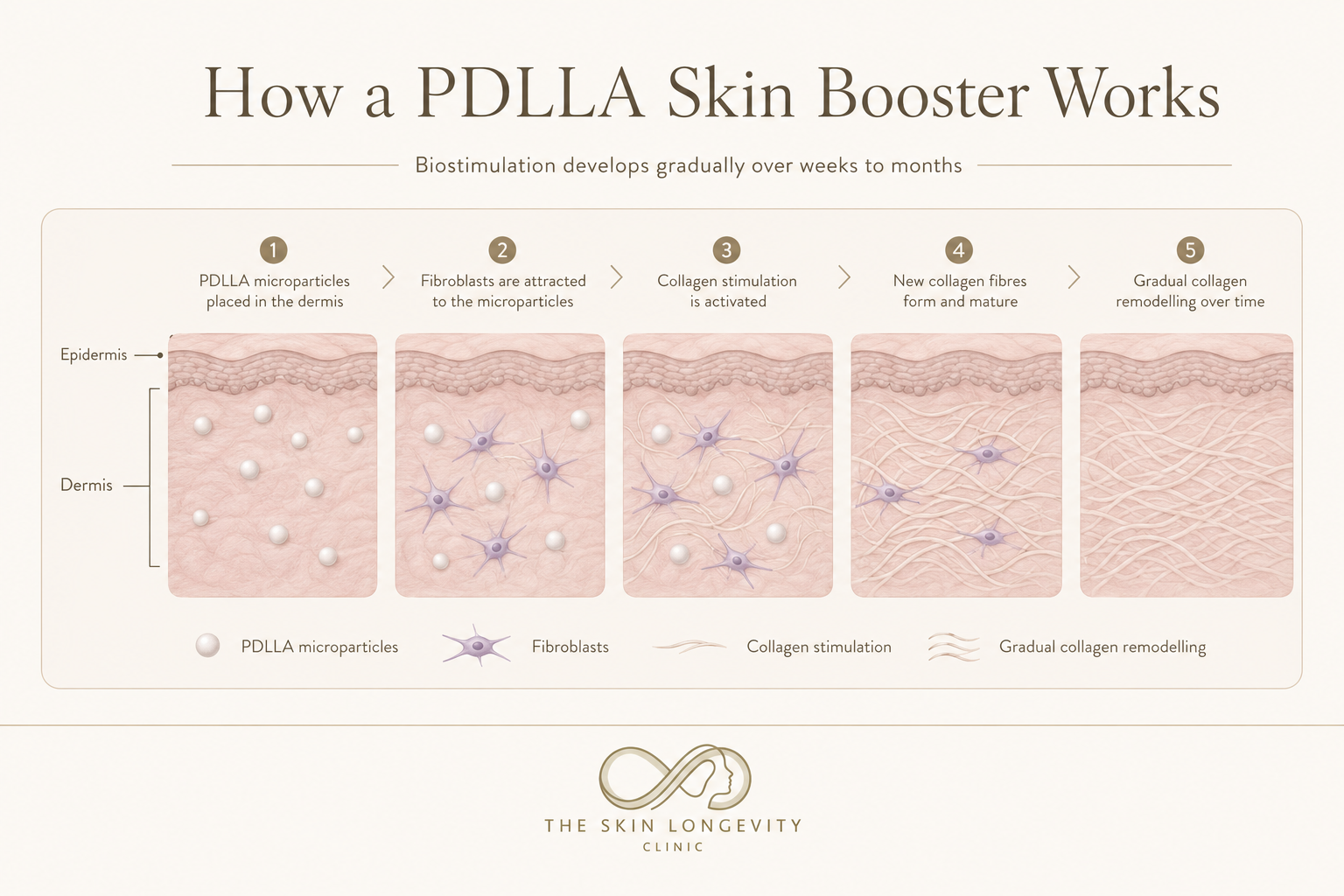
PDLLA skin boosters work through collagen biostimulation1,4. After PDLLA microparticles are placed in the skin, they create a controlled repair response. Fibroblasts, which are the cells involved in connective tissue formation, become more active and produce new collagen around the particles1,5.


As PDLLA gradually breaks down, the newly formed collagen remains and contributes to firmer, smoother skin1,5. This is why results develop progressively over weeks to months, rather than appearing immediately after treatment.


PDLLA is best understood as a skin quality treatment. It does not relax muscles like botulinum toxin. It does not replace lost facial volume in the same way as dermal fillers. It does not surgically lift sagging tissue. Its main role is to support collagen and dermal quality.

What can PDLLA skin boosters help with?


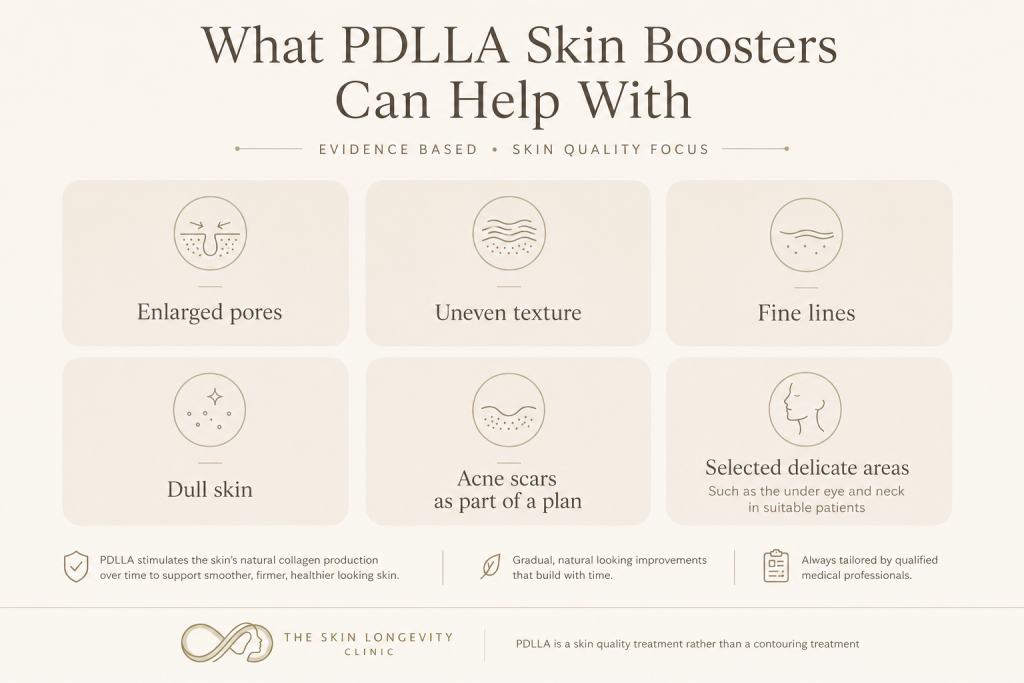
PDLLA skin boosters may be considered for selected patients with enlarged pores, uneven texture, fine lines, mild crepiness, acne scars and dull or tired looking skin1-3.


By supporting collagen in the dermis, PDLLA may help the skin feel firmer and look smoother over time1,4. Patients who have early collagen loss, mild textural change or reduced skin resilience may benefit from this type of collagen-based skin booster.


PDLLA may also be used as part of an acne scar treatment plan1,2. Acne scars often involve abnormal collagen repair after inflammation. In suitable patients, PDLLA can support dermal remodelling, although deeper scars may still need other treatments such as subcision, fractional laser, radiofrequency microneedling or collagen biostimulators.


For the under eye and neck, PDLLA requires extra caution because the skin is thin and delicate. These areas should only be treated after careful assessment.

FAQs

Who may be suitable for PDLLA skin boosters?

PDLLA skin boosters may suit patients who are concerned about skin quality rather than facial shape1-3. Common concerns include rough texture, enlarged looking pores, fine lines, mild crepiness, dullness and early loss of firmness2,3.

Patients in their thirties, forties and fifties often ask about PDLLA skin boosters, but age alone is not the main deciding factor. Skin condition, collagen loss, treatment goal and medical history are more useful in determining suitability.

PDLLA may be less suitable as a first treatment when the main concern is significant facial volume loss, pronounced sagging, active inflammation, unstable pigmentation, active acne or strong movement related wrinkles. These concerns may require different treatment directions.

PDLLA treatment is usually deferred during pregnancy and breastfeeding. Patients with a history of keloid scarring, autoimmune disease or previous reactions to injectables should discuss these issues clearly during consultation.

What is the PDLLA skin booster procedure like?

The treatment begins with a doctor led consultation. Dr Rachel Ho will assess skin quality, texture, pore appearance, acne scars, facial anatomy, skin thickness, medical history and previous treatments.

The skin is cleansed before treatment. Numbing cream may be applied for comfort. The PDLLA skin booster is then placed into selected areas using a fine needle, cannula or appropriate delivery technique, depending on the treatment area and the desired depth.

A session usually takes about 30 to 45 minutes, excluding consultation and numbing time. Patients may feel mild discomfort, pressure or small pinpricks during treatment.

After treatment, temporary redness, swelling, tenderness, bruising or small bumps may occur. These effects usually settle over several days, although recovery varies between patients1,2,4.

How many sessions are needed?

A course of PDLLA skin boosters usually involves more than one session1-3. Many treatment plans involve 2 to 4 sessions spaced several weeks apart, depending on the patient’s skin condition, concern and response.


Collagen stimulation is gradual1,4,5. A single session may give some improvement, but a planned course is often more appropriate when the goal is collagen support, texture refinement and skin quality improvement.


Maintenance may be recommended after the initial course. The timing depends on age, collagen response, skin condition, lifestyle, sun exposure and other treatments in the plan.

When will I see results?

Some patients notice early freshness or hydration, especially if the formulation includes hyaluronic acid. More collagen related changes usually appear over several weeks to months1,3,4.


Texture, pore appearance, fine lines and firmness may gradually improve as collagen forms and remodels. Most patients should think of PDLLA as a progressive treatment rather than a same day result.


A review is useful after treatment because the doctor can assess the response, decide whether more sessions are needed and adjust the plan if the skin concern is better addressed by another treatment.

How long do PDLLA skin booster results last?

Results vary between patients. Duration depends on the product used, number of sessions, injection depth, skin condition, collagen response, sun exposure, lifestyle and maintenance plan.


Because PDLLA works through collagen biostimulation, results are usually gradual and may last longer than purely hydrating treatments. However, ageing continues. Maintenance and good skincare are still needed.


Sunscreen, pigment control, barrier repair and appropriate skin treatments can help support the result over time.

Is PDLLA skin booster safe?

PDLLA is generally well tolerated when the correct product, dilution, depth and technique are used1,2,4. Common side effects include redness, swelling, bruising, tenderness and temporary small bumps1,2,4.

Less common risks include prolonged lumps, nodules, inflammation, infection, asymmetry and rarely granuloma formation1,4. The risk is influenced by product preparation, injection technique, treatment area and patient factors.

This is why PDLLA should be administered by an experienced doctor who understands facial anatomy, product behaviour and how to manage complications.

At The Skin Longevity Clinic, PDLLA skin boosters are planned with conservative dosing, appropriate technique and clear aftercare instructions. Patients are also advised on what to expect and when to return for review.

Can PDLLA be combined with other treatments?

Yes, PDLLA skin boosters may be combined or sequenced with other treatments when appropriate.


For pigmentation, lasers, pigment skincare and sunscreen may be more relevant. For acne scars, fractional laser, radiofrequency microneedling or subcision may be needed. For dynamic wrinkles, botulinum toxin may be more suitable. For significant volume loss, dermal fillers or other collagen biostimulators may be considered. For laxity, HIFU or radiofrequency tightening may be more appropriate.


Combination treatment can be useful when different layers are involved. Timing should be planned carefully to reduce swelling, irritation and pigment risk.

PDLLA skin boosters versus fillers

PDLLA skin boosters and dermal fillers are often confused.


Dermal fillers are usually used to restore volume, contour or structural support5. They create more immediate changes because the product physically occupies space.


PDLLA skin boosters work mainly by stimulating collagen1,4,5. Their changes are gradual and focus on skin quality rather than facial reshaping.


Patients who want a sharper contour, cheek support or correction of volume loss may need fillers. Patients who want gradual improvement in texture, pores, fine lines and firmness may be more suited to PDLLA.


Doctor Rachel’s Takeaway

PDLLA skin boosters are best understood as collagen stimulating skin booster treatments. They are not simply hydrating skin boosters, and they are not conventional fillers.


Their strength is gradual collagen support. In suitable patients, PDLLA can help improve pores, texture, fine lines, mild crepiness, acne scars and overall skin quality. Their limitation is that they do not replace treatments for muscle movement, significant volume loss, pigmentation, advanced sagging or deep scar tethering.


At The Skin Longevity Clinic, I assess PDLLA skin boosters according to the patient’s skin biology, facial anatomy and treatment goal. The right plan depends on what the skin needs, how it recovers and whether collagen stimulation is the correct treatment direction.


For patients considering PDLLA skin boosters in Singapore, a consultation can clarify whether PDLLA, another skin booster, a collagen biostimulator, laser, radiofrequency microneedling or filler would be more suitable.

References

  1. Poly D,L Lactic Acid Application in Dermatology. Lee KWA, et al. Polymers. 2024. Volume 16, Issue 18. 
  2. Injectable Skin Boosters in Aging Skin Rejuvenation. Rho NK, et al. Dermatology and Therapy. 2024. 
  3. A Split Face Study Comparing the Effect of a PDLLA Based Product With Hyaluronic Acid for Skin Rejuvenation. Skin Research and Technology. 2026. 
  4. Efficacy and Safety of Poly L Lactic Acid in Facial Aesthetics. Signori R, et al. Polymers. 2024. Volume 16, Issue 18. 
  5. Effect of Hyaluronic Acid and Poly L Lactic Acid Dermal Fillers on Collagen Synthesis: An in vitro and in vivo Study. Cabral LRB, et al. Clinical, Cosmetic and Investigational Dermatology. 2020.