

24 Apr A comprehensive doctor’s review of skinboosters
By Dr Rachel Ho | Aesthetic Doctor, Founder, The Skin Longevity Clinic, Singapore
In my 16 years as an aesthetic doctor in Singapore, I have seen one major shift in how patients think about anti-aging and aesthetic treatments. People are no longer asking only for lifting, volume, or wrinkle correction alone. More patients are understanding the importance of healthier skin that delays the onset of signs of aging. This is why skinboosters have become such an important category in aesthetic medicine in Singapore.
The term “skinbooster” is used very broadly today. In clinics across Singapore, it may refer to hyaluronic acid injectables, polynucleotides, collagen stimulators,or even regenerative injectable treatments that improve hydration, elasticity, texture, and glow. But not all boosters are the same, and not all are suitable for every patient.
This is a doctor-led review of skinboosters, based on both published evidence and Dr Rachel Ho’s clinical perspective on how to choose a skin booster treatment in Singapore that works best for your skin.

What are skinboosters?
Skinboosters are injectable treatments designed to improve skin quality rather than create volume. Unlike traditional dermal fillers, which are primarily used to shape the face or replace lost structural support, a skinbooster is meant to enhance the skin itself. That includes hydration, elasticity, smoothness, radiance, and sometimes collagen renewal.
Why skinboosters matter in the context of skin longevity
As skin ages, we see progressive dehydration, dullness, thinning, loss of elasticity, roughness, and fine lines. Collagen declines, the extracellular matrix becomes weaker, and skin no longer reflects light the same way. This is why ageing skin often looks tired even before wrinkles become deep.
A good skinbooster treatment can help target this early and intermediate phase of ageing. In my view, this is where skinboosters are most valuable. They sit between basic skincare and more structural injectable treatments. They are especially useful for patients who want to maintain skin quality proactively, or who want a more natural approach to rejuvenation.
The main types of skinboosters
One of the biggest misconceptions is the idea that all skinboosters work in the same way. They do not.
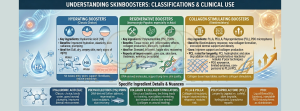
Skinboosters can be classified according to their active ingredients, including hyaluronic acid, polynucleotides, collagen-based injectables, synthetic collagen stimulators such as PLLA, PDLLA, PCL and PDO, as well as amino acid and polycomponent boosters.
From a practical standpoint, I think of them in three broad groups based on their expected benefits.
First, hydrating boosters. These are often hyaluronic acid-based and are useful when the skin is dull, dry, crepey, or lacking glow.
Second, regenerative boosters. These include polynucleotides and related products, which may support tissue repair, reduce inflammation, and improve skin quality over time.
Third, collagen-stimulating boosters. These include PLLA, PDLLA, PCL, and PDO-based injectables, which are more biostimulatory and are usually chosen when the goal is to improve dermal support and collagen production.
This is why having a thorough consultation with your doctor before proceeding is necessary to understand which skin booster that matches the biology of your skin.
Hyaluronic acid skinboosters: the choice for skin hydration and glow
If we are talking about the most established skinbooster, it is still hyaluronic acid.
Hyaluronic acid is naturally present in the skin and has an extraordinary ability to bind water. HA-based skinboosters are strongly associated with improved hydration, elasticity, and skin radiance.
But hydration is only part of the story. HA may also support fibroblast migration and collagen production, while reducing collagen breakdown. In other words, a well-chosen HA booster can do more than simply “plump” the skin. It can improve the quality of the dermal environment.
Clinically, I think of HA skinboosters as a very good entry point for patients who want fresher, smoother, better hydrated skin with minimal downtime. They are especially useful for early signs of ageing, fine lines, and dehydrated skin.
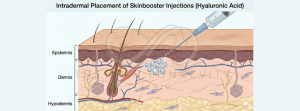
Technique of injections also matters for the results of skinboosters. Superficial intradermal placement improves skin texture and dermal thickness, but overly superficial placement can lead to visible papules or beads, especially in the cheek area.
This is why the skill of your doctor matters just as much as the product.
Polynucleotide skinboosters: choice for repair
Polynucleotide-based skinboosters have become increasingly popular, especially in Asia. These are DNA-derived molecules, often sourced from salmon or trout, and they are thought to act as regenerative biostimulators. PDRN can improve collagen production, elasticity, hydration, and tissue repair, while also offering anti-inflammatory effects.
In practice, polynucleotide boosters are often chosen for skin that is stressed, inflamed, fragile, or recovering. I find this category particularly interesting because skin ageing is not only about volume loss or dehydration. It is also about inflammation, impaired repair, and declining skin resilience.
Studies reported improvement in pore size, skin tone, skin thickness, wrinkles, sagging, and periorbital lines. Combining PN with HA may activate fibroblasts more effectively than either ingredient alone.
For patients in Singapore looking for a booster that supports skin recovery and long-term skin quality, this category of PDRN skinboosters is worth considering.
Collagen and collagen stimulators: where the conversation gets more nuanced
No discussion of skinboosters is complete without talking about collagen.
Collagen is the structural backbone of youthful skin. It gives skin firmness, resilience, and density. Once collagen declines, the skin becomes thinner, looser, and less reflective. So it is not surprising that many injectable boosters today are marketed around collagen stimulation.
Injectable collagen products are scientifically interesting because they may support regeneration, flexibility, and tissue remodeling. However, more research is still needed to understand exactly how much benefit comes from collagen itself versus the wound-healing response after injection. That is an important distinction as “collagen boosting” is often used as a very loose marketing phrase. As doctors, we need to be more precise with the mechanisms of treatments administered.
PLLA and PDLLA biostimulators
PLLA and PDLLA are well-known collagen stimulators. Rather than hydrating the skin directly, they work by triggering a biostimulatory response that promotes new collagen formation over time. The review notes that these materials can increase collagen and elastic fibers, and may also support angiogenesis and immune modulation.
This category can be very effective, but it is also more technique-sensitive. One of the most important issues is the risk of nodules, especially when products are placed too superficially or used with poor dilution or poor injection technique.
Polycaprolactone PCL biostimulator
Polycaprolactone is another collagen-stimulating material notable for its longevity. The durability is appealing, but it also raises practical concerns. PCL is slow to degrade and more hydrophobic than HA. The review notes that although its safety profile is generally favorable, there have been reports of late granulomatous reactions and nodules, particularly when technique is poor or placement is inappropriate.
For me, long duration is not automatically an advantage as product longevity must always be balanced against reversibility, predictability, and safety.
PDO biostimulator
PDO is best known in the context of threadlifts and liquid threadlifts, but injectable PDO microspheres are now also being studied as a skinbooster and collagen stimulator. The evidence base is still more limited than for HA or some other agents, but early studies in the review suggest improvements in skin gloss, wrinkles, and density, with collagen stimulation that may be comparable to PLLA or PCL.
This is an evolving area, and I think it is one to watch, but not one to oversell.
Hybrid and cocktail boosters: promising, but harder to compare
The review also covers newer booster formulations that combine ingredients.
These include HA with glycerol, HA with amino acids, and more complex polycomponent “cocktail” products containing vitamins, antioxidants, amino acids, minerals, coenzymes, and nucleic acids.
These formulations are attractive because they try to support multiple pathways at once. Some improve hydration, some aim to support fibroblast activity, and some may improve radiance, elasticity, dermal density, and collagen remodeling. For example, HA-glycerol combinations showed improvements in hydration, elasticity, roughness, and tone, with hydration benefits lasting months in some patients.
I think these cocktail skinboosters are interesting but not all of them are equally evidence-based? The challenge with multi-ingredient boosters. The more components you add, the harder it becomes to study which ingredient is doing what, and how reproducible the results really are.
Can botulinum toxin be a skinbooster?
Interestingly, yes, in selected situations. Intradermal botulinum toxin as a skin quality treatment. In small intradermal doses, botulinum toxin may improve skin texture, reduce erythema, lower sebum output, and enhance skin smoothness. It may also work well when combined with HA-based boosters, particularly for the forehead and neck.
This reflects something I often tell patients: a skinbooster is not just a product. It is a treatment concept with better skin quality as the aim. That can be achieved through hydration, collagen stimulation, inflammation control, sebum regulation, or a thoughtful combination of these.
Delivery technique matters as much as the product
Skinboosters are generally placed by superficial intradermal microinjections, ideally into the papillary dermis.
This may sound technical, but it has real consequences for results. Wrong depth, wrong product, wrong dilution, or wrong placement can mean poor outcome, more downtime, visible lumps, or avoidable complications.
In my opinion, the future of skinboosters in Singapore will not just be about newer booster or collagen building injectables. It will also be about better protocols, more precise delivery, and more individualised treatment planning.
Are skinboosters safe?
In properly selected patients, with approved products and correct technique, skinboosters are generally safe. Common side effects include redness, swelling, bruising, discomfort, and transient injection-site bumps.
But safe does not mean trivial. Reported complications of skinbooster injections include papules, nodules, delayed inflammatory reactions, foreign body granulomas, and, in rare cases, vascular compromise. Synthetic collagen stimulators in particular may be associated with more persistent lumps if technique is poor.
Doctor’s view of skinboosters in Singapore
After 16years in aesthetic medicine, my view is simple: skinboosters are effective when they are used with precision.
For example, a patient with dehydrated, dull skin may do beautifully with a hyaluronic acid skinbooster. However, a patient with reactive, inflamed, fragile, or post-procedure skin may benefit more from a regenerative booster such as polynucleotides. A patient with thinning skin and visible collagen decline may need a more biostimulatory collagen-focused treatment plan.
And many patients do best with a staged approach rather than a single treatment. That is especially true in Singapore, where sun exposure, humidity, pigment issues, barrier disruption, and lifestyle stress all influence skin ageing differently.
Final thoughts on skinboosters, booster treatments, and collagen renewal
The rise of skinboosters reflects a welcome shift in aesthetic medicine. We are moving away from simply filling lines and toward supporting healthier, stronger, more resilient skin.
It’s also important that we recognise that every skinbooster performs the same way. The best outcomes come from understanding the science, respecting anatomy, prioritising safety, and choosing the right product for the right indication. While the field is promising, more controlled studies are still needed to define the best protocols, combinations, and long-term outcomes.
My final takeaway is this: skinboosters have an important place in modern skin longevity medicine, but only when used thoughtfully. When done well, they can improve hydration, texture, elasticity, radiance, and collagen support in a way that looks refreshed, natural, and healthy.