

28 Apr PRX Plus: The Needle-free Skinbooster Treatment for Brighter Skin
By Dr Rachel Ho | Aesthetic Doctor, Founder, The Skin Longevity Clinic, Singapore
A very common skin concern I hear from patients in their mid-30s, 40s and beyond is one of dullness and discolouration, although they may not articulate this directly.
“My skin does not look bad. It just looks tired.”
“My skin is dull and rough.”
“Makeup does not sit as well as it used to”
This is where treatments such as PRX Plus can be helpful.
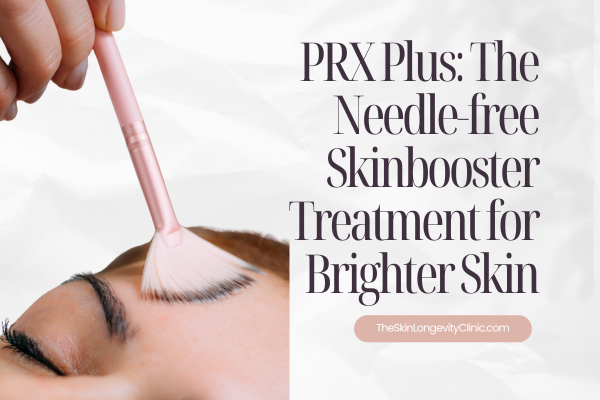
PRX Plus is often described as a no downtime chemical peel or a biostimulating peel. Strictly speaking, it is not a traditional peeling treatment. It is a professional, in-clinic topical biostimulator designed to improve the appearance of skin brightness, texture, enlarged pores, hyperpigmentation and visible signs of ageing, with little to no visible peeling. WiQo, the company behind PRX Plus, describes it as an in-office skin booster for mature or textured skin, delivered using a patented formulation and clinician-performed technique.
At The Skin Longevity Clinic, PRX Plus is used as part of a doctor-led skin health plan. This means the goal is not simply to “peel the skin”. The goal is to improve skin quality while respecting the biology of pigmentation, inflammation and barrier function.
What is PRX Plus?
PRX Plus is a topical in-clinic skin treatment designed for patients who want brighter, smoother and healthier-looking skin without the downtime commonly associated with stronger chemical peels or resurfacing procedures.
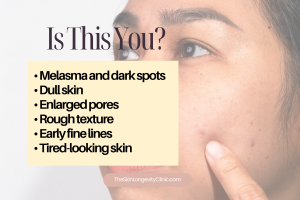
It may be considered for concerns such as:
• Melasma-prone skin
• Uneven pigmentation
• Dull skin
• Enlarged pores
• Rough texture
• Early fine lines
• Mild loss of firmness
• Tired-looking skin
• Photodamage
PRX Plus is especially relevant for patients who want a skin brightening treatment but are cautious about aggressive peels, lasers or procedures that may trigger irritation.
This is important in Asian skin and melasma-prone skin, where excessive inflammation may worsen post-inflammatory hyperpigmentation. Melasma itself is now understood as a chronic, relapsing pigmentary condition influenced by ultraviolet light, visible light, hormones, genetics, vascular changes and dermal signalling — not simply “extra pigment on the surface”.

What does PRX Plus contain?
PRX Plus contains:
• Homocysteic Acid
• Ammonium Trichloroacetate, also known as ATCA
• Citric Acid
• Phytic Acid
These ingredients are selected to support skin renewal, brightness and texture improvement while reducing the visible peeling typically expected from traditional chemical peels.
1. Ammonium Trichloroacetate
Trichloroacetic acid, or TCA, is a well-established chemical peel agent in dermatology. Traditional TCA peels work by inducing controlled protein denaturation and keratocoagulation in the skin, which then stimulates skin renewal and dermal remodelling.
In PRX Plus, TCA is present as ammonium trichloroacetate, a modified form designed for a different treatment experience from a conventional TCA peel.
2. Homocysteic Acid
Homocysteic acid is the key brightening ingredient that differentiates PRX Plus from earlier PRX technologies. It is positioned to support tone refinement and radiance.
3. Citric Acid
Citric acid is an alpha-hydroxy acid that contributes to surface refinement and brightness.
4. Phytic Acid
Phytic acid is commonly used in pigmentation-focused and brightening protocols. It is also known for antioxidant and chelating properties, which may be relevant in skin exposed to oxidative stress.
The science behind PRX Plus
To understand PRX Plus, it helps to first understand how chemical peels work.
A traditional chemical peel applies a controlled chemical injury to the skin. Depending on the agent, concentration, number of layers and exposure time, a peel can act superficially within the epidermis or extend more deeply into the dermis. Dermatology reviews describe chemical peels as treatments that induce keratolysis, coagulation and protein denaturation in the epidermis and dermis, with effects on pigmentation, skin texture and collagen remodelling depending on depth.
PRX Plus is different because it is designed to deliver skin stimulation without the same visible peeling endpoint.
In traditional TCA peels, frosting and peeling are visible signs of protein denaturation and peel depth. With PRX Plus, the aim is not aggressive exfoliation. The aim is controlled biostimulation and brightening while keeping the skin surface relatively intact.
This matters for three reasons.
First, many patients in Singapore have medium to deeper skin tones, where post-inflammatory hyperpigmentation is an important consideration. Second, melasma-prone skin is often reactive to inflammation, heat and irritation. Third, patients in their 35s, 40s and 50s often want treatments that fit into work, family, travel and social commitments.
For this reason, PRX Plus may be attractive for patients seeking a no downtime chemical peel alternative.
However, it is also important to be precise: the strongest body of peer-reviewed evidence is still for chemical peels, TCA peels, melasma management and related PRX-T33/TCA-based technologies. Published evidence specifically on PRX Plus as a distinct product is currently more limited, so treatment claims should be framed as improvement in skin quality, brightness and texture rather than a cure for melasma or ageing.
What are the benefits of PRX Plus?
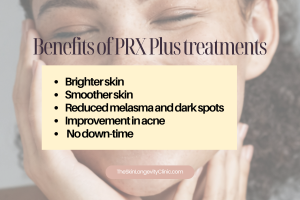
PRX Plus may help improve the appearance of:
1. Skin brightening
PRX Plus can be useful for patients whose skin looks dull, uneven or tired. Skin brightening is not the same as skin whitening. In medical aesthetics, true skin brightening means improving clarity, pigment evenness, texture, hydration and light reflection.
2. Melasma and pigmentation support
PRX Plus may be used as part of a broader plan for melasma and pigmentation. This may include sunscreen, tinted visible-light protection, pigment-regulating skincare, topical prescriptions where appropriate, and carefully selected procedures.
Melasma is chronic and relapsing. StatPearls describes melasma as a condition where long-term control and prevention of recurrence are as important as initial pigment clearance.
3. Smoother skin texture
Because PRX Plus supports renewal without obvious peeling, it may help patients with roughness, uneven texture and enlarged pores.
4. Early ageing changes
Patients in their late 30s and beyond often notice changes in firmness, fine lines and skin reflectivity before they notice deep wrinkles. Chemical peels and TCA-based procedures have been studied for photoageing, dyspigmentation, rhytides and texture improvement.
5. Minimal disruption to daily life
The appeal of PRX Plus is that it is designed for little to no downtime. Most patients do not want to explain visible peeling, redness or prolonged recovery after a weekday appointment. PRX Plus fits the needs of patients who want visible freshness without taking time away from work, meetings or social plans.
PRX Plus for melasma: why “gentle” can be effective.
Melasma is not a typical hyperpigmentation. Unlike other types of dark spots, melasma is exquisitely light-sensitive, inflammation-sensitive and relapse-prone skin condition.
This is why stronger is not always better.
In melasma, the aim is to reduce pigment while minimising unnecessary irritation. A treatment that is too aggressive may worsen pigmentation in susceptible patients. Reviews on chemical peels for melasma caution that deeper peels are not recommended in darker skin types because of the risk of scarring and severe dyschromia.
Superficial and carefully selected TCA peels may have a role in melasma treatment when used appropriately. A split-face randomized trial in Latin American women with melasma found superficial TCA peels could augment treatment response when combined with hydroquinone and tretinoin, with no post-inflammatory hyperpigmentation observed in that study. The authors still emphasised sun protection and heat avoidance as key to preventing flares.
This is the clinical context for PRX Plus: it is not a standalone melasma cure, but it may be part of a measured pigmentation plan when selected appropriately.
For melasma patients, the foundation remains:
• Daily broad-spectrum sunscreen
• Visible-light protection, often with tinted sunscreen containing iron oxides
• Heat and UV avoidance where possible
• Pigment-regulating skincare
• Maintenance treatment
• Avoidance of unnecessary inflammation
Visible light is especially relevant in melasma. The American Academy of Dermatology has recommended tinted sunscreens containing iron oxides for melasma because visible light can worsen melasma, particularly in darker skin tones.
PRX Plus vs traditional chemical peels
PRX Plus is often searched together with “chemical peel” because both involve topical acid-based treatments. But the treatment goals and recovery are different.
| Feature | PRX-Plus | Traditional Chemical Peel |
|---|---|---|
| Main goal | Brightening, texture, pores, early ageing | Exfoliation, acne, pigmentation, texture |
| Visible peeling | Usually minimal to none | Depends on peel depth |
| Downtime | Little to none | Varies from none to several days |
| Suitability for busy patients | High | Depends on peel selected |
| Melasma approach | Gentle brightening support | Must be selected carefully |
| Skin barrier impact | Lower visible disruption | Depends on peel strength |
Traditional chemical peels remain valuable. They are evidence-based, versatile and widely used for acne, congestion, pigmentation, texture and photoageing. A major review in the Journal of Clinical and Aesthetic Dermatology describes chemical peels as an important tool when the correct agent, depth and patient selection are used.
The difference is that PRX Plus may be better suited for patients who want a chemical peel-like brightening effect with less visible recovery.
Who is PRX Plus suitable for?
PRX Plus may be suitable for men and women aged 35 and above who want to improve skin quality without looking “done”.
It may be considered for patients who:
• Want brighter and smoother-looking skin
• Have dullness, uneven tone or pigmentation
• Have melasma-prone skin and want a gentler in-clinic option
• Prefer no needles
• Prefer little to no downtime
• Want to improve skin texture before an event
• Want a maintenance treatment for skin quality
• Are not ready for lasers, injectables or more intensive procedures
It may not be suitable for patients with active skin infection, open wounds, uncontrolled eczema, dermatitis, recent aggressive resurfacing or known sensitivity to treatment ingredients.
What is the PRX Plus treatment experience like?
A PRX Plus session at The Skin Longevity Clinic would typically begin with a skin assessment. This is important because dullness, pigmentation and melasma are not treated the same way.
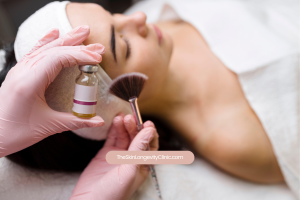
The skin is cleansed and prepared. PRX Plus is then applied using a controlled technique. Patients may feel mild warmth, tingling or tightness. After treatment, the skin is supported with barrier care and sunscreen.
For pigmentation and melasma-prone skin, the aftercare is as important as the treatment itself. Irritating skincare, excessive exfoliation, heat and unprotected sun exposure can reduce results or trigger pigmentation relapse.
Is there really no downtime for PRX Plus?
PRX Plus is designed to be a no downtime treatment, but “no downtime” should be understood medically.
Most patients can return to normal activities after treatment. However, mild temporary redness, dryness, tightness or light flaking can still occur, especially in sensitive or dehydrated skin.
The correct phrase is: little to no downtime for most suitable patients.
That is more accurate than promising that nothing will happen to the skin at all.
How many sessions of PRX Plus are needed?
This depends on the condition of the skin.
For a brighter, fresher appearance, some patients may notice improvement after one session. For melasma, pigmentation, pores, texture and early ageing, a series of treatments is usually more appropriate.
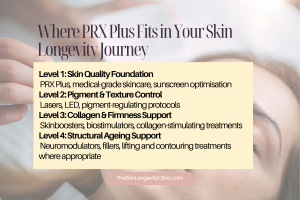
A doctor-led plan may include PRX Plus together with:
• Skincare
• Sunscreen optimisation
• Pigment-regulating topicals
• LED light therapy
• Pico laser or Q-switched laser in selected patients
• Skinboosters or collagen-stimulating treatments where appropriate
More treatment is not always better. In pigmentation-prone skin, the correct sequence and intensity matter.
The emotional truth: patients do not want “younger” skin, they want skin they recognise and look less tired. They want their skin to look clearer in morning light. They want their pigmentation to be less distracting. They want to feel comfortable without heavy foundation.
This is why PRX Plus is interesting. It sits in a space between skincare and more intensive procedures. It is not as aggressive as resurfacing. It is not injectable. It is not a dramatic transformation treatment.
It is a skin quality treatment.And for many patients, that is exactly the point.
Doctor’s takeaway on PRX Plus treatements in Singapore
PRX Plus is a useful option for patients who want skin brightening, smoother texture and improved skin quality with little to no downtime.
PRX Plus may be considered as part of a broader skin longevity plan — especially for patients who want clearer, brighter and healthier-looking skin without visible peeling or prolonged recovery.
At The Skin Longevity Clinic, treatments are selected based on skin diagnosis, evidence and suitability, not trends.
References:
1. WiQo PRX Plus product information: ingredients and positioning as a professional in-office skin booster with no needles/downtime.
2. Journal of Clinical and Aesthetic Dermatology review on chemical peels: mechanism, indications, depth selection and collagen remodelling.
3. NCBI StatPearls on chemical peels: keratolysis, coagulation, protein denaturation and depth-based peel effects.
4. NCBI StatPearls on melasma: chronic relapsing nature, multifactorial pathogenesis, UV and visible light triggers.
5. JCAD split-face randomized trial on superficial TCA peels in melasma: TCA peels as an adjunct in selected patients with melasma.
6. American Academy of Dermatology guidance on melasma and visible light protection with tinted sunscreens containing iron oxides.