

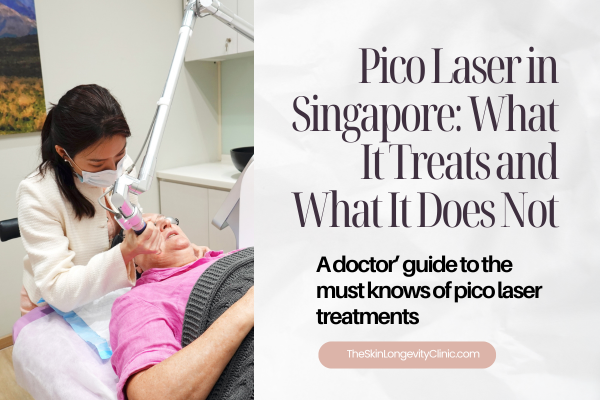
02 May Pico Laser in Singapore: What It Treats and What It Does Not
By Dr Rachel Ho | Aesthetic Doctor, Founder, The Skin Longevity Clinic, Singapore
Pico laser is often marketed as an instant solution for pigmentation, dullness, acne marks and tattoo removal. In Singapore, where ultraviolet index is high and Asian skin can be reactive, the more important question is not whether Pico laser is powerful, but whether it is the right treatment for the pigment pattern in front of us.
At The Skin Longevity Clinic, Dr Rachel Ho approaches Pico laser through a skin longevity lens: diagnose the pigment, treat the visible excess pigment, and reduce the biological triggers that cause it to return. This matters because laser energy can help selected pigmentation, but it cannot correct every cause of uneven skin tone on its own.
Quick answer: What does Pico laser treat?
Pico laser in Singapore may be used for selected pigmentation, sun spots, freckles, post acne dark marks, some cases of melasma, tattoo removal, dullness, uneven tone and certain acne scars when a fractional handpiece is used. It does not reliably treat redness, broken capillaries, active acne, deep wrinkles, skin laxity, raised scars, all types of melasma or pigmentation that keeps recurring because of hormones, sun exposure, inflammation or poor skin barrier function.
What is Pico laser?
Pico laser refers to a laser that delivers energy in extremely short pulses measured in picoseconds. These pulses are shorter than one nanosecond and produce mainly photoacoustic energy, meaning they break up pigment or tattoo ink with less surrounding heat than some older laser technologies.
That shorter pulse duration is why Pico laser is often used for pigmentation and tattoo removal. It can also be used with fractional handpieces to create controlled microscopic effects in the skin, which may support dermal remodelling for texture, acne scars and photoageing.
Still, Pico laser is a medical laser, not a facial. The result depends on diagnosis, wavelength, settings, skin tone, treatment interval, aftercare and whether the underlying triggers for pigmentation are also being managed.
Pico Laser Singapore: what it treats and what it does not
| Best suited for | Not ideal for |
|---|---|
| Freckles | Facial redness |
| Sun spots | Broken capillaries |
| Post acne dark marks | Active acne |
| Selected pigmentation | Skin laxity |
| Tattoo pigment | Deep wrinkles |
| Mild uneven tone | Raised scars |
| Selected acne scar texture with fractional Pico | Keloids |
| Unstable or untreated melasma |
Pico laser pigmentation: when it helps
Pico laser pigmentation treatment is most useful when the target is suitable for laser fragmentation. This generally means discrete pigment, selected pigmentary disorders and cases where the skin is stable enough to tolerate treatment.
For freckles and sun spots, Pico laser can be a useful option when the spots are clearly diagnosed and the surrounding skin is not overly inflamed or recently tanned. These brown spots often sit closer to the surface, which can make them more responsive than diffuse or hormonally driven pigmentation.
For post acne dark marks, Pico laser may help fade excess pigment once acne inflammation is controlled. Treating the pigment while acne is still active can be counterproductive, because new breakouts may continue to trigger fresh pigmentation.
For melasma, the answer is more careful. Pico laser may be considered in selected cases, but melasma is a chronic, relapse prone pigment disorder influenced by light, heat, hormones, inflammation and skin barrier function. It should not be presented as a permanent cure.
For tattoo removal, Pico laser has one of its strongest evidence based roles. Tattoo clearance still depends on ink colour, depth, density, body site, immune clearance and previous treatments, so complete removal cannot be guaranteed in every case.
What Pico laser does not treat well
Pico laser is not the best tool for facial redness, flushing or broken capillaries. Those concerns are usually vascular rather than pigmentary, so other light or laser platforms may be more appropriate after assessment.
It is also not a primary treatment for active acne. Acne needs control of oil activity, clogged pores, bacteria, inflammation and triggers; laser can support selected post acne marks or scars, but it does not replace acne treatment.
Pico laser does not lift sagging skin or restore facial volume. If the concern is lower face heaviness, hollowing, deep folds or laxity, the treatment plan may need to consider collagen stimulation, injectables, energy based tightening or surgical options depending on severity.
Deep wrinkles and etched lines are also not usually solved by Pico laser alone. Fractional Pico treatments may improve texture and mild photoageing, but deeper lines often require a broader plan that addresses collagen loss, movement, skin quality and structure.
Pores may look better when oil control, collagen support and skin texture improve, but Pico laser cannot erase pores. Pores are normal anatomical structures, and their appearance is shaped by sebum, elasticity, genetics, congestion and ageing.
Raised scars and keloids are not typical Pico laser targets. These scars behave differently from atrophic acne scars and need a scar specific approach, sometimes involving injections, vascular lasers, silicone therapy or other medical treatments.
Diagnosis first: Not all types of hyperpigmentation are the same
| Pigment concern | Freckles | Sun spots | Post acne dark marks/ post inflammatory hyperpigmentation | Melasma | Hori’s naevus or dermal pigment |
|---|---|---|---|---|---|
| What it may look like | Small brown spots, often sun related | Discrete brown patches or spots | Brown marks after breakouts | Diffuse brown grey patches | Deeper blue grey or brown grey pigment |
| Can Pico laser help | Often yes | Often yes | Sometimes | Sometimes, selected cases only | Sometimes, selected cases only |
| What else may be needed | Sun protection and maintenance skincare | Assessment to confirm diagnosis | Acne control and barrier repair | Topicals, light protection, pigment stabilisation | May need sequential treatments |
| Key limitation | Can recur with UV exposure | Not all brown spots are benign pigment | New acne can create new marks | Relapse is common | Often slower response |
Why diagnosis matters in Asian skin before starting pico laser treatments
Many patients searching for Pico laser Singapore treatments have Asian skin types that can develop post inflammatory hyperpigmentation after irritation, heat or overly aggressive procedures. This does not mean Pico laser is unsuitable for Asian skin, but it does mean treatment should be conservative, diagnosis led and properly paced.
The most common mistake is treating all brown patches as the same problem. Freckles, sun spots, melasma, Hori’s naevus, post acne marks and pigment from irritation can look similar to the untrained eye, but they behave differently and respond differently to lasers.
This is where skin longevity becomes important. Durable improvement is not just about breaking pigment; it is also about calming inflammation, strengthening the barrier, reducing ultraviolet and visible light triggers, and using maintenance care that lowers the chance of recurrence.
What to expect after Pico laser
| Treatment style | Gentle toning style treatment | Spot pigment treatment | Fractional Pico for texture | Tattoo pigment treatment |
|---|---|---|---|---|
| Possible visible effect | Mild redness or warmth | Temporary darkening or light crusting | Redness, mild swelling, roughness | Redness, swelling, frosting or crusting |
| Typical recovery pattern | Often settles quickly | Pigment may lift or fade gradually | May take several days depending on settings | Multiple sessions usually needed |
| What to avoid | Heat, harsh exfoliation, strong actives | Picking, scrubbing, sun exposure | Exercise heat, exfoliation, aggressive skincare | Picking and sun exposure |
| When to contact the clinic | If irritation worsens or persists | If blistering, pain or swelling occurs | If prolonged swelling or unexpected reaction occurs | If signs of infection or marked reaction occur |
What happens during a Pico laser treatment?
A consultation should come first, because the skin has to be examined before the laser treatment can be determined to be effective, and safe. Dr Rachel Ho will assess the pigment pattern, skin tone, recent sun exposure, skincare routine, medical history and whether there are signs of irritation or instability.
During treatment, patients may feel a light snapping or prickling sensation. Depending on the indication and settings, there may be temporary redness, mild swelling, darkening of pigment, pinpoint crusting or sensitivity after treatment.
Downtime varies. Gentle toning style treatments may have little visible downtime, while spot treatments for discrete pigmentation can lead to temporary darkening and crusting before pigment lifts or fades.
Possible side effects and risks of pico laser treatments
Pico laser is generally well tolerated when used appropriately, but side effects can occur. Reported risks include discomfort, redness, swelling, pinpoint bleeding, crusting, blistering, post inflammatory hyperpigmentation, lightening of pigment and, rarely, scarring.
Risk is higher when the wrong pigment is treated, settings are too aggressive, the skin is recently tanned, the barrier is compromised or aftercare is poor. In Asian skin, a cautious approach is often preferable to chasing fast clearance at the expense of pigment rebound.
How many sessions of pico laser treatments are needed?
The number of Pico laser sessions depends on the diagnosis and severity. A few discrete sun spots may respond in fewer sessions, while melasma, post inflammatory hyperpigmentation, uneven tone and acne scars usually need a series of treatments and maintenance.
Tattoo removal often requires multiple sessions and can be unpredictable. Colour, ink density, depth and previous treatments affect the outcome, so responsible clinics should not promise complete clearance before assessing the tattoo.
Pico laser versus Q switched laser versus other options
| Treatment type | Pico laser | Q switched laser | Topical pigment treatment | ||
|---|---|---|---|---|---|
| Common role | Selected pigment, tattoo pigment, texture with fractional handpiece | Pigment toning and selected pigment disorders | Melasma, post inflammatory pigmentation, maintenance | ||
| Strength | Short pulse duration and reduced surrounding heat compared with older laser types | Established technology with long clinical use | Helps control pigment pathways and recurrence | ||
| Limitation | Still carries pigment rebound risk if used wrongly | May not be ideal for every pigment type or every patient | Takes time and consistency | ||
| Best used when | Diagnosis fits and skin is stable | Doctor chooses it based on diagnosis | Pigmentation is chronic or relapse prone |
Is Pico laser better than Q switched laser?
Pico laser uses shorter pulses than Q switched laser and may be more efficient for selected pigments and tattoos. However, better technology does not automatically mean better results for every patient.
At The Skin Longevity Clinic, treatment choice depends on the diagnosis, skin tone, downtime tolerance, budget, risk profile and expected response. In some cases, Q switched laser, chemical peels, topical therapy, vascular treatment, fractional laser or combination care may be more appropriate.
Who may not be suitable for Pico lasers?
Pico laser may not be suitable, or may need to be postponed, if the skin is sunburnt, recently tanned, actively inflamed, infected or very irritated. It may also be approached cautiously in patients with unstable melasma, a history of abnormal scarring or a recent aggressive procedure.
A good consultation should also review skincare actives, photosensitising medications and the patient’s ability to follow sun protection and aftercare. Laser results are not only created during the session; they are protected in the weeks after treatment.
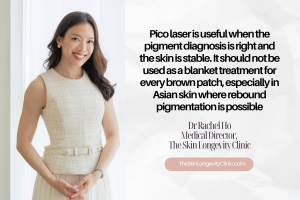
Dr Rachel Ho from The Skin Longevity Clinic’s review on Pico laser treatments in Singapore
The Skin Longevity Clinic approach to Pico laser treatments
For patients considering Pico lasers in Singapore, the goal should be clearer, healthier and more stable skin, not simply a stronger laser setting. Pigmentation is often a visible sign of deeper skin behaviour: inflammation, light sensitivity, barrier weakness, acne, hormones or accumulated sun exposure.
Dr Rachel Ho’s approach is to treat pigmentation with precision and restraint, while addressing the factors that influence recurrence. This may include medical skincare, pigment stabilisation, barrier repair, sun protection, Pico laser, other lasers or combination treatments where appropriate.
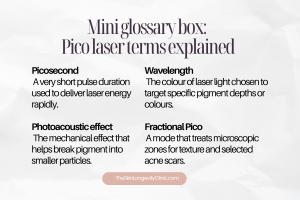
Glossary of terms used in pico laser reviews
FAQ on Pico laser treatments
Is Pico laser safe for Asian skin?
Pico laser can be used in Asian skin, but settings and patient selection matter. Asian skin can be more prone to post inflammatory hyperpigmentation, so treatment should be diagnosis led and performed with appropriate caution.
Can Pico laser remove melasma permanently?
No, Pico laser should not be viewed as a permanent cure for melasma. Melasma is chronic and recurrence is common if light exposure, heat, hormones, inflammation and barrier issues are not managed.
Is Pico laser good for acne scars?
Fractional Pico laser may help selected cases atrophic acne scars and skin texture by supporting dermal remodelling. Deeper scars, tethered scars and mixed scar types often need combination treatment for better results.
Does Pico laser remove pigmentation in one session?
Some discrete pigment spots may improve after one session, but many pigmentation concerns need a series of treatments. Melasma, post acne marks and uneven skin tone usually need a longer plan with maintenance.
Is Pico laser painful?
Most patients describe Pico laser as tolerable, with a snapping or prickling sensation. Comfort depends on the treatment setting, body area, skin sensitivity and whether numbing is used.
What should I avoid after Pico laser?
Avoid unnecessary sun exposure, heat, harsh exfoliation and irritating skincare immediately after treatment. Use gentle skincare and proper sun protection, because aftercare has a major influence on pigment stability.
Final thoughts on Pico laser treatments in Singapore
Pico laser is a useful treatment for selected pigmentation, tattoo removal, uneven tone and certain acne scars. Its value lies in precision, not in treating every skin concern with the same device.
For discerning patients, the better question is not simply whether Pico laser works. The better question is whether your pigmentation has been correctly diagnosed, whether your skin is ready for laser, and whether the treatment plan protects your skin health beyond short term brightening.