Freckles, sun spots and age spots
Freckles, sun spots and age spots lie within the epidermis, which makes them the most predictable pico laser targets, as superficial pigment is reached at lower energy and cleared in fewer sessions. Across clinical trials, picosecond lasers cleared solar lentigines in 67.9 to 93 per cent of cases, compared with 36 to 77 per cent for Q-switched lasers4. In a split-face randomised trial in Asian patients, 85.7 per cent of picosecond-treated sites showed more than 50 per cent improvement at six months, against 57.2 per cent for the Q-switched side, with less treatment discomfort and no difference in side effects3. Read which freckles, sun spots and age spots respond best to laser.
Post-acne dark marks (post-inflammatory hyperpigmentation)
Post-inflammatory hyperpigmentation (PIH) responds once the acne driving it is controlled. Inflammation stimulates melanocytes to deposit additional pigment, so treating marks while breakouts continue is counterproductive, as each new lesion generates a fresh deposit faster than the laser clears the old one. Many post-acne marks also fade without any laser over three to twelve months once the inflammation settles, so acne control is addressed first and laser is reserved for pigment that persists beyond that window. Our guide to acne marks versus acne scars explains how the two are told apart and treated.
Melasma
Melasma is chronic and relapse-prone, driven by ultraviolet and visible light, heat, hormonal influence, inflammation and impaired barrier function. A 2023 meta-analysis found that low-fluence 1064 nm picosecond laser significantly reduced melasma severity scores without significant side effects, whereas 755 nm picosecond laser was not superior to topical agents and caused post-inflammatory hyperpigmentation5. Pico laser is therefore used for melasma at this clinic as one part of a long-term plan with sun protection, trigger control and topical maintenance, not as a cure. Singapore’s year-round ultraviolet exposure and ambient heat make that maintenance layer the harder half of the plan, as pigment suppressed by laser alone recurs once the triggers resume. See why melasma comes back and where pico laser fits.
Hori’s naevus and other dermal pigment
Hori’s naevus, acquired bilateral naevus of Ota-like macules, is frequently mistaken for melasma or freckles and is a common reason pigmentation persists despite repeated laser treatment. The pigment sits in the dermis rather than the epidermis, beyond the reach of topical agents and of any wavelength that stops at the surface, which is why treatment aimed at epidermal pigment produces no visible change. A 2026 systematic review pooling 40 studies found 47.8 per cent of patients reached at least 75 per cent clearance with Q-switched or picosecond lasers, with response depending on the number of sessions6. Our article on stubborn pigmentation in Asian skin covers why the diagnosis matters.
Acne scars and skin texture
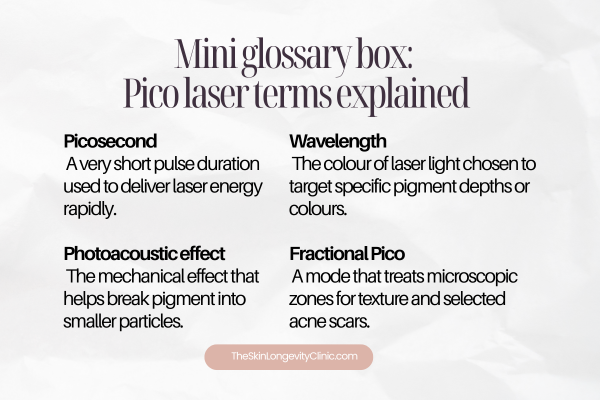
With a fractional handpiece (diffractive lens array or micro-lens array), pico laser creates microscopic columns of laser-induced optical breakdown that trigger collagen remodelling without removing the skin surface. Because the epidermis is left intact, the healing response proceeds without the surface injury that drives post-inflammatory hyperpigmentation in darker skin. In a randomised split-face trial for atrophic acne scars, fractional picosecond 1064 nm laser matched fractional CO2 laser for texture and scar volume, with no post-inflammatory hyperpigmentation on the picosecond side against 24 per cent on the CO2 side7. Deep, tethered or mixed scars still need combination treatment, as a tethered scar is held down by fibrous bands that collagen stimulation alone does not release. Our acne scar treatment page describes the combinations used.
Tattoo removal
Tattoo removal carries the strongest evidence grade for picosecond lasers1. In a systematic review of human trials, 69 to 100 per cent of tattoos showed more than 70 per cent clearance after one to ten treatments8. A 2022 systematic review of 36 studies found picosecond and Q-switched lasers both safe and effective for black ink, with picosecond superior for blue, green and yellow pigments9. Those colours absorb poorly at the wavelengths older lasers deliver and are the pigments most often left behind by earlier treatment. Clearance still depends on ink colour, depth, density, body site and the efficiency of the individual immune response, so complete removal cannot be promised before assessment. See our tattoo removal page.
Dullness and uneven tone
Low-fluence toning passes across the whole face can improve tone and clarity with little downtime. Each pass fragments a small proportion of the dispersed epidermal pigment and provokes a mild dermal remodelling response, so the change accumulates across a series rather than appearing after one session. The evidence for rejuvenation is graded level II1. Results also depend on skincare, sun protection and sleep, as continued ultraviolet exposure and poor recovery generate fresh pigment while the laser is clearing the old. Our dull skin page covers the wider options.