Keloids are not merely scars. Instead, keloids are a wound-healing disorder where the skin produces excess scar tissue beyond the original injury to a raised growth that can be itchy, tender, and emotionally distressing. Keloids can also continue to enlarge over months to years and may recur after treatment if not managed strategically.
At The Skin Longevity Clinic, Dr Rachel Ho takes an evidence-based, stepwise approach to flatten keloids, control symptoms, reduce recurrence.
What are keloid scars?
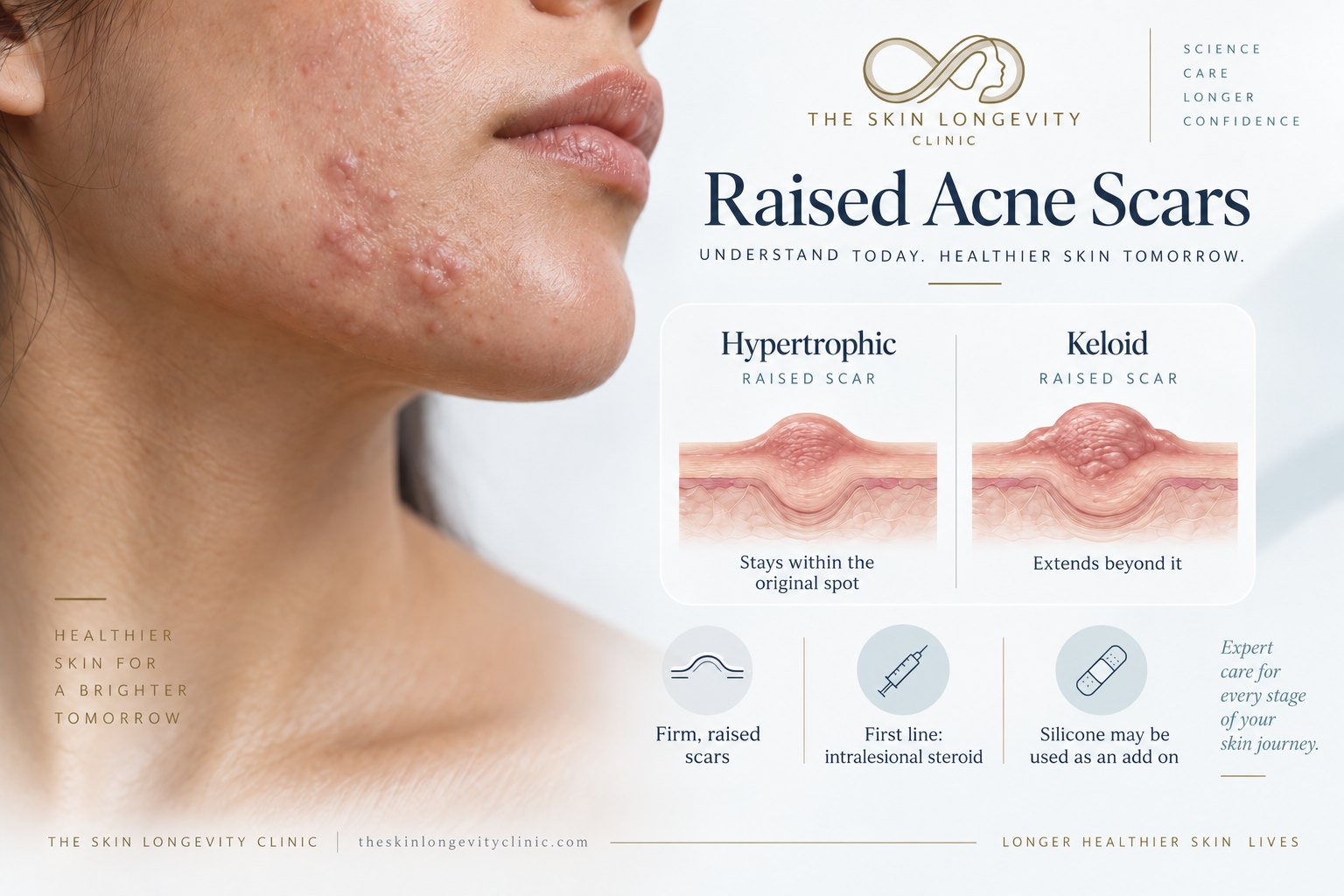
A keloid is a type of abnormal scar that:
Grows beyond the boundaries of the original wound
Is often raised, smooth, firm, and can be pink, red or brown depending on skin tone
Commonly appears on the chest, shoulders, upper back, jawline, and earlobes
Keloids are not the same as hypertrophic scars which stay within the original wound edges and may improve over time.
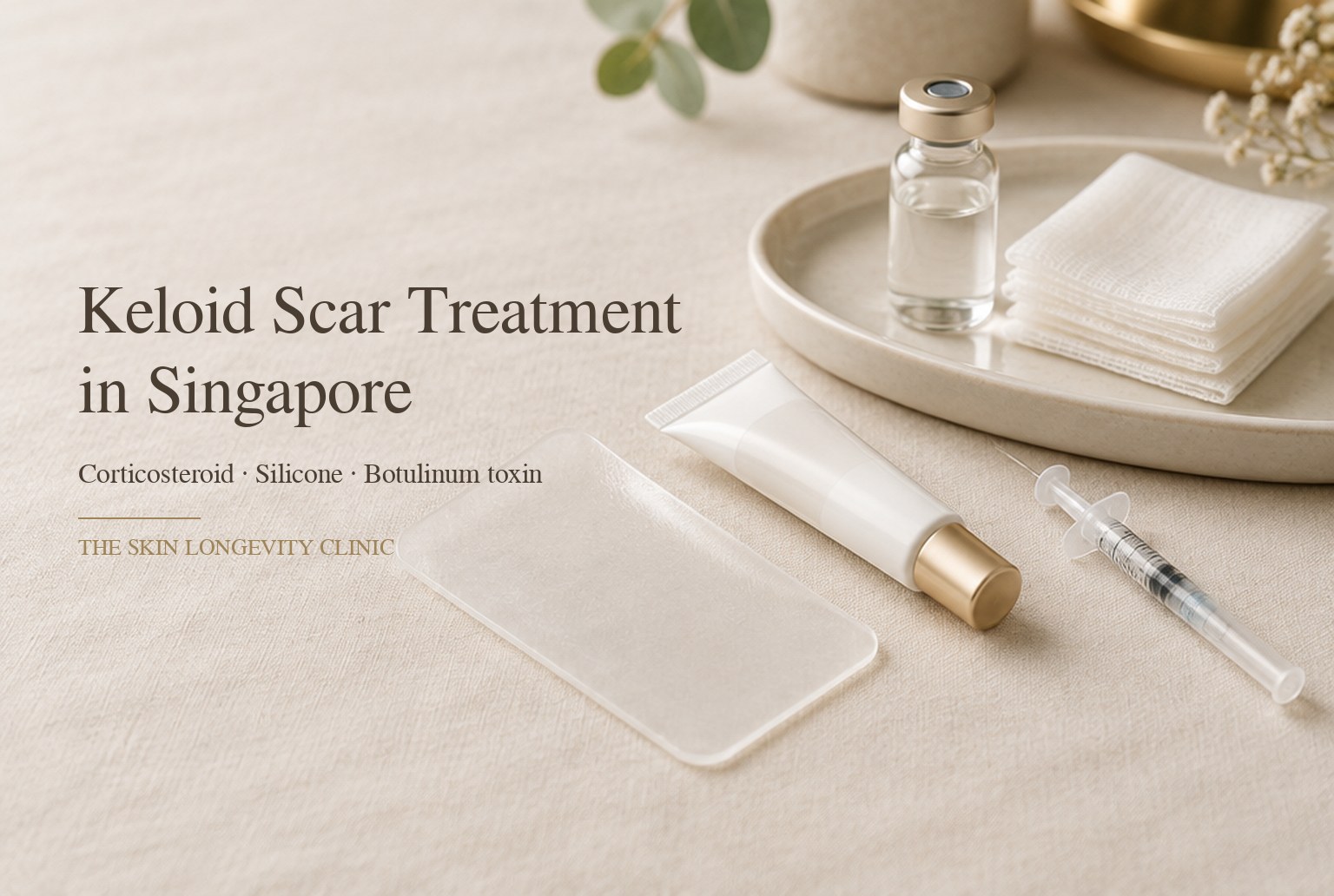
Keloids are treated at The Skin Longevity Clinic with the three approaches that international scar guidelines recommend as first-line care for raised scars, namely intralesional corticosteroid injections, silicone gel or sheeting, and intralesional botulinum toxin.1,2 Each plan is set by the keloid’s size, thickness and site, by symptoms such as itch and pain, and by how long the scar has been present. Guidelines favour combining agents over any single treatment, since each acts on a different driver of keloid growth.1 Surgical excision, laser and radiotherapy are not performed at the clinic, and keloids that need them are referred to a plastic surgeon or dermatologist. Keloids that follow acne are assessed alongside the other types of acne scars, depressed scars are covered in acne scar treatment in Singapore, and other scars in the clinic’s scar treatment guide.
Keloid scar treatment in Singapore: corticosteroid injections, silicone and botulinum toxin.
Intralesional corticosteroid injections for keloids
A corticosteroid is injected directly into the keloid at intervals of four to six weeks. Within the scar, the drug suppresses the chronic inflammation that drives keloid growth and slows collagen production by the scar-forming cells (fibroblasts), so the keloid flattens and softens and the itch usually settles.1,3 A course typically runs to three to six sessions, with the response reviewed and the dose adjusted at each visit. A 2026 network meta-analysis of 24 randomised trials of intralesional therapies found corticosteroid effective for scar height and symptoms, with the most consistent recurrence control when corticosteroid was combined with a second agent.3 Side effects include pain on injection, temporary lightening or thinning of the surrounding skin, and small surface blood vessels (telangiectasia). Confining the injection to the scar itself limits these skin changes.
Silicone gel and silicone sheeting for keloid scars
Silicone gel or sheets are applied to the keloid for 12 to 24 hours a day for at least two to three months. Silicone forms an occlusive layer that reduces water loss from the scar surface, and the better-hydrated outer skin sends fewer growth signals to the fibroblasts beneath, so collagen production in the scar falls. A Cochrane review of 20 trials in 873 people found that silicone sheeting reduced scar thickness and improved scar colour compared with no treatment, although the trials were of poor quality.4 Major scar guidelines still recommend silicone as the base of treatment and as prevention after injury or surgery in keloid-prone skin.2 In Singapore’s heat and humidity, gel is often better tolerated than sheets, which lift and trap sweat. At the clinic, silicone is used alongside the injections and continued after the course ends to lower the risk of recurrence.
Botulinum toxin injections for keloids
Botulinum toxin injected into the keloid relaxes the surrounding muscle, which reduces the tension that stretches the scar, and also acts directly on fibroblasts to slow their activity. A 2019 meta-analysis of controlled trials found botulinum toxin more effective than corticosteroid injection for symptom scores and overall response.5 Unlike corticosteroid, it does not thin the surrounding skin. The 2026 network meta-analysis ranked botulinum toxin highest for treatment response but found that it did not lower recurrence on its own.3 A 2024 meta-analysis of 11 trials in 561 patients found that adding botulinum toxin to corticosteroid improved response and symptom scores, although scar thickness was not reduced further.6 At the clinic, botulinum toxin is used for keloids on high-tension sites such as the chest, shoulder and jawline, for patients whose skin thinned after corticosteroid, and with corticosteroid where a keloid has not responded to one agent.
Who is suitable for keloid scar treatment
Patients with small to medium keloids that itch, hurt or are still growing, most often on the chest, shoulders, ear lobes, jawline or back.
Patients whose keloids followed back and body acne, ear piercing, surgery, vaccination or minor injury.
Patients with a family history of keloids who are planning a procedure, so that silicone and early injection can be started as prevention.
Very large or bulky keloids that need excision, keloids that have failed two intralesional agents, and any scar with features that need a biopsy are referred. Current algorithms treat small, single keloids with either multimodal conservative therapy or surgery followed by radiotherapy, and large or multiple keloids with volume-reducing surgery.2 The clinic provides the conservative arm and refers for the surgical one.
Keloid treatment sessions, results and recurrence
Flattening is usually visible after two to three injection sessions. The full course is three to six sessions over two to seven months, after which silicone is continued for a further three months.1 Recurrence is common after any single-agent treatment, and the network meta-analysis found the lowest recurrence with combined intralesional agents, so combination and maintenance are planned from the first visit.3 Colour improves more slowly than height, and residual redness or darkening can persist after the scar has flattened. Follow-up continues after the course ends, because keloids can recur long after treatment.2
Keloid treatment risks in Asian skin
Keloids are more common in darker skin types, and in keloid-prone skin even a minor injury that reaches the deeper dermis, such as acne, piercing or vaccination, can start a new keloid.7 Corticosteroid injection can lighten the skin at the injection site. The change is more visible on darker skin, usually fades over several months, and is limited by keeping the injection within the scar. Silicone can soften and wrinkle the skin (maceration) or cause a rash when worn on damp skin, a common problem in Singapore’s humidity, so the gel or sheet is removed and the skin washed and dried twice a day. Botulinum toxin can temporarily weaken a nearby muscle when the keloid lies over one, for example at the jawline. Each of these effects is checked at every visit.
What affects keloid scar treatment cost in Singapore
The cost of keloid treatment depends on the number and size of the keloids, the agents used and the number of sessions required. A quote is given after assessment, once the treatment plan has been set.
Keloid scar FAQs
Can a keloid be removed completely?
Keloids can be flattened and their symptoms cleared, but the scar tissue does not disappear and recurrence remains possible. Treatment aims for a flat, soft and comfortable scar.3
Are steroid injections for keloids painful?
The injection causes a brief, sharp sting because keloid tissue is firm. A topical anaesthetic is applied beforehand, and the discomfort lasts a few seconds.
How many injections does a keloid need?
A typical course is three to six sessions, four to six weeks apart. Small ear lobe keloids may need fewer sessions, whereas chest keloids, which sit under constant skin tension, often need more.1
Does botulinum toxin work for keloids?
Controlled trials show that botulinum toxin flattens keloids and relieves symptoms at least as well as corticosteroid injection, without causing skin thinning.5 It does not prevent recurrence on its own, so it is combined with corticosteroid or silicone at the clinic.3
Will the keloid come back?
Recurrence is common after any single treatment.3 Combining agents and continuing silicone after the injection course lowers the risk. New keloids at other sites depend on the underlying tendency to form them, not on the treatment of the first keloid.
Keloid scar assessment at The Skin Longevity Clinic
Keloid scar treatment starts with the scar’s size, site, symptoms and age. Dr Rachel Ho combines corticosteroid injections, silicone and botulinum toxin, and refers keloids that need surgery, laser or radiotherapy.
The approach at the clinic is structured:
flatten the scar and settle itch and pain first
combine agents rather than rely on one
continue silicone and follow-up after the course to limit recurrence
Assessments take place at Scotts Medical Center, 9 Scotts Road. Book through the contact page or call +65 6514 2688.
Selected References
Gold MH, McGuire M, Mustoe TA, et al. Updated international clinical recommendations on scar management: part 2 — algorithms for scar prevention and treatment. Dermatol Surg. 2014;40(8):825–831. doi:10.1111/dsu.0000000000000050.
Ogawa R. The Most Current Algorithms for the Treatment and Prevention of Hypertrophic Scars and Keloids: A 2020 Update of the Algorithms Published 10 Years Ago. Plast Reconstr Surg. 2022;149(1):79e–94e. doi:10.1097/PRS.0000000000008667.
Lai IC, Huang GL, Lee KC, et al. Comparative Efficacy and Recurrence Risk of Intralesional Therapies for Hypertrophic Scars and Keloids: A Network Meta-Analysis. Aesthet Surg J. 2026;46(2):202–212. doi:10.1093/asj/sjaf182.
O’Brien L, Jones DJ. Silicone gel sheeting for preventing and treating hypertrophic and keloid scars. Cochrane Database Syst Rev. 2013;(9):CD003826. doi:10.1002/14651858.CD003826.pub3.
Bi M, Sun P, Li D, et al. Intralesional Injection of Botulinum Toxin Type A Compared with Intralesional Injection of Corticosteroid for the Treatment of Hypertrophic Scar and Keloid: A Systematic Review and Meta-Analysis. Med Sci Monit. 2019;25:2950–2958. doi:10.12659/MSM.916305.
Shi J, Zhang S, Zhang Z, et al. Efficacy of triamcinolone acetonide combined with botulinum toxin A in the treatment of hypertrophic scars and keloids: A meta-analysis. Burns. 2024;50(9):107250. doi:10.1016/j.burns.2024.08.016.
Ogawa R. Keloid and Hypertrophic Scars Are the Result of Chronic Inflammation in the Reticular Dermis. Int J Mol Sci. 2017;18(3):606. doi:10.3390/ijms18030606.