


19 Mar Why the Matrix Matters: ECM Boosters Explained
By Dr Rachel Ho | Aesthetic Doctor, Founder, The Skin Longevity Clinic, Singapore
For much of aesthetic medicine’s history, we have been chasing symptoms: filling a hollow here, tightening a sag there, resurfacing rough texture. Much of these symptoms are due to to a gradual, progressive collapse of the extracellular matrix (ECM), the living scaffold that holds everything together.
The extracellular matrix is essentially, the structural and biochemical environment that allows skin to stay firm, elastic, hydrated and resilient. When the ECM is healthy, skin looks smoother, bouncier and more luminous. When it deteriorates, the skin begins to look thinner, rougher, duller and older.
This is why a new category of injectable treatments has captured the attention of doctors across Seoul and Singapore alike: the ECM booster. ECM boosters it replenishes the skin scaffold for more resilient and younger looking skin.. In this post, I want to walk you through the science, the procedure, and who I believe stands to gain the most from it.
What is the extracellular matrix (ECM) in the skin?
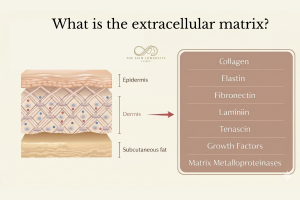
The extracellular matrix (ECM) is the structural framework that surrounds skin cells within the dermis. You can think of it as the skin’s internal scaffolding and signalling environment.
It is made up of several key components, including:
• Collagen (primarily Type I and III): The structural backbone of the dermis, responsible for tensile strength, firmness, and wound healing. Collagen constitutes approximately 70–80% of the dry weight of skin.
• Elastin: The protein responsible for the skin’s recoil and bounce — the quality that allows skin to snap back after stretching. Elastin fibres are extraordinarily long-lived but essentially irreplaceable once degraded.
• Glycosaminoglycans (GAGs) including hyaluronic acid: Hydrophilic molecules that bind water at up to 1,000 times their own weight, maintaining dermal hydration, turgor, and the aqueous environment fibroblasts need to function.
• Fibronectin and laminin: Adhesion glycoproteins that anchor cells to the matrix, regulate cell migration, and signal wound repair cascades.
• Proteoglycans: Modulate growth factor signalling and help organise collagen fibres into the orderly bundles responsible for smooth, resilient skin.
The ECM is not just “filler” substance between cells. The matrix is a biologically active framework that influences how fibroblasts behave, how wounds heal, how well the skin resists mechanical stress, and how efficiently tissue repair occurs. In other words, the ECM affects not only how skin looks, but also how skin functions.
The ECM is composed of several essential macromolecules, each with a distinct structural and biological role:
How the ECM changes as we age
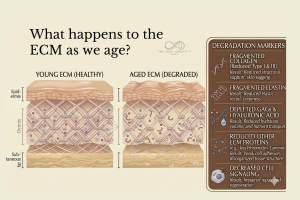
Ageing skin is not simply about collagen loss alone. It is really about progressive changes in the entire extracellular matrix.
Over time, several things happen:
• Collagen production declines and existing collagen becomes fragmented
• Elastin fibres become disorganised
• Hyaluronic acid and other GAGs diminish or become less functional
• Fibroblasts become less efficient and less responsive
• Chronic low-grade inflammation and UV exposure increase matrix breakdown
Clinical implications
The downstream consequences of ECM deterioration include fine lines and wrinkles, enlarged pores (as dermal support is lost around follicular openings), skin laxity, reduced healing capacity, increased redness (the degraded ECM permits inflammatory mediators to spread more freely), and textural roughness.
From a dermatological perspective, ECM deterioration also has implications beyond cosmetic ageing. A compromised matrix contributes to impaired barrier recovery, delayed repair after injury, increased fragility in mature skin, and can influence the tissue environment in conditions such as photoageing, scarring and poor healing.
This is why treatments that address only a single component like hydration, or collagen stimulation alone can feel inadqueate. True regenerative medicine asks: can we restore the matrix itself?
This is why the health and quality of the ECM matter so much.
What is an ECM booster?
An ECM booster is a regenerative injectable skinbooster designed to support the skin’s extracellular matrix. ECM boosters represent something genuinely distinct in the landscape of aesthetic injectables. It is not a hyaluronic acid filler. It is not a polynucleotide. It is not a collagen stimulator. It is, more precisely, a human-derived ECM replenishment therapy.
Its active ingredient is hADM, human acellular dermal matrix, a micronised, powder-form preparation derived from donor human skin tissue. Through a proprietary purification process called AlloClean™ Technology, all cellular components (including DNA, lipids, and immunogenic proteins) are removed, leaving behind only the native ECM scaffold: the collagen, elastin, and structural proteins that are structurally and biologically identical to those found in youthful human dermis.
The tissue source is accredited by the AATB (American Association of Tissue Banks) and the product holds KFDA approval (Korea’s equivalent of the FDA). It is reconstituted with saline at the time of treatment and administered via fine-needle micro-injection into the superficial dermis.
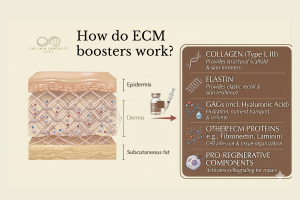
The composition of ECM skinboosters is designed to reflect the architecture of healthy dermal matrix and includes:
- Collagen as the main component
- Elastin
- Other ECM proteins
- Glycosaminoglycans (GAGs), including naturally matrix-associated hydrating molecules
In simple terms, ECM booster is intended to replenish structural matrix components rather than simply adding water or temporary volume.
How do ECM boosters work?
Once injected into the superficial dermis, the micronised hADM particles integrate into the existing ECM scaffold. Because the material shares the same molecular architecture as the body’s own connective tissue, it is recognised by local fibroblasts not as a foreign implant, but as a biological template i.e. a scaffold for cellular ingrowth and tissue remodelling.
The mechanism operates on two levels simultaneously:
- Direct ECM supplementation: The collagen, elastin, GAGs, and structural proteins in ECM booster immediately augment the depleted dermal matrix to improve dermal density, hydration, and structural organisation from the moment of integration.
- Autologous collagen induction: As fibroblasts migrate into and around the hADM scaffold, they are stimulated to produce new, endogenous collagen and elastin fibres. ECM boosters thus act as both a direct supplement and a long-term regenerative signal, with ongoing improvements beyond the initial treatment period.
Skin indicators assessed in human trials show visible improvements from around two weeks post-treatment, with progressive enhancement over the following months as collagen remodelling matures.
ECM boosters also complements skin hydration treatments as matrix support can also improve how the skin retains water and maintains a healthier dermal environment.
What are the benefits of ECM booster treatments?
Because ECM boosters target the foundation from which all other skin qualities emerge, its benefits are broad and interconnected rather than isolated. Patients and clinical studies report improvements across the following parameters:
• Improved skin firmness and elasticity: Restoration of collagen and elastin density directly addresses the structural causes of laxity and poor skin recoil.
• Reduction of fine lines and wrinkles: As the dermis becomes denser and more hydrated, superficial lines soften progressively.
• Pore refinement: A healthier ECM scaffold around follicular openings reduces the appearance of enlarged pores.
• Improved skin texture and smoothness: Dermal remodelling promotes a more even, refined skin surface.
• Reduced skin redness: A more robust ECM contains inflammatory signals more effectively, supporting a calmer complexion.
• Natural, healthy luminosity: Improved dermal hydration and nutrient flow translate into a healthy inner glow
• Amplification of other treatments: A healthier ECM serves as a more receptive canvas for treatments such as lasers, energy devices, and other injectables all perform more effectively when the structural foundation is strong.
Are ECM Skin Booster Treatments Safe?
The primary safety advantage of hADM-derived treatments is their exceptional biocompatibility. Because Re20 is derived from human tissue and processed to remove all cellular and immunogenic material, the immune response is fundamentally different from treatments derived from animal collagen or synthetic polymers. The ECM architecture left behind after AlloClean™ processing is structurally more compatible with the human body and it integrates rather than provokes.
Safety Profile at a Glance
• Tissue source: AATB-accredited, FDA-listed human donor tissue. These are the same standards applied to surgical tissue grafts.
• Immune response: Significantly lower risk of allergic or hypersensitivity reactions compared to animal-derived collagen products.
• Regulatory status: KFDA approved. Widely used in clinical settings across South Korea since 2025.
• Common side effects: Mild redness, swelling, and small injection-site papules, typically resolving within 24–48 hours.
• Bruising: Possible, particularly in patients with thinner skin or those on blood thinners. Generally minimal.
• Downtime: Minimal. Most patients return to daily activities the same day, with makeup suitable from the following morning.
ECM Skinboosters are not appropriate for patients who are pregnant or breastfeeding, those with active skin infections at the treatment site, or individuals with known hypersensitivity to human tissue products. A thorough medical consultation is essential before proceeding.
Who Is Suitable for ECM Booster?
One of the most important aspects of regenerative medicine is matching the right treatment to the right patient. ECM Skin Boosters not a one-size-fits-all solution, but its indication set is broad.
Ideal Candidates Include:
• Adults from their mid-twenties onwards who are experiencing early signs of ECM depletion (mild laxity, pore enlargement, dullness, or fine lines) and wish to intervene preventively rather than reactively.
• Men and women in their thirties to fifties noticing increased skin thinness, crepiness, or a loss of the “density” that characterised their younger skin.
• Patients who want natural-looking results and have expressed fatigue with treatments that alter their features rather than restore their intrinsic skin quality.
• Individuals with sensitive or reactive skin who have not responded well to synthetic polymer-based biostimulators.
• Post-treatment patients seeking to consolidate and extend the results of laser resurfacing, radiofrequency, or HIFU treatments.
• Patients with acne scarring or textural concerns arising from dermal ECM disruption.
ECM Skinboosters are equally suited to men and women. In my clinic, I see a growing proportion of male patients in their thirties and forties who are seeking skin quality improvement without the aesthetic hallmarks of traditional overdone looks. ECM restoration is, by its very nature, restorative rather than transformative.
Can ECM Skinboosters Be Combined with Other Treatments?
Yes, it can. A healthier, denser ECM does not just look better in isolation; it amplifies the efficacy of virtually every other aesthetic treatment. Korean dermatologists have described ECM boosters as a foundational treatment that makes everything else work more effectively.
At The Skin Longevity Clinic, I commonly pair ECM boosters with:
+ HIFU
+ Radiofrequency microneedling
+ Fractional laser resurfacing
+ Collagen biostimulators
+ Hybrid cooperative complex treatments
+ Hyaluronic acid fillers
+ Botulinum toxin
+ Chemical Peels
+ Laser treatments
+ LED light therapy
Sequencing of the treatments matters. In many cases, I recommend ECM booster as a foundational treatment first so that the skin is in an optimal structural state to respond. A laser delivers energy; an ECM-replete dermis uses that energy more efficiently, heals faster, and maintains results longer.
Similarly, ECM boosters can extend and deepen the results of fillers and biostimulators by improving the quality of the tissue matrix into which those agents are introduced. Rather than treating isolated compartments of the face, we are building a comprehensive skin quality strategy — one that works at multiple levels simultaneously.
The precise combination and sequence will always be individualised.
Your Journey to Skin Longevity with Extracellular Matrix restoration
True skin health isn’t about freezing time; it’s about ensuring your skin has the resources to strengthen its biological functions. Know what works for your skin longevity, not against it with a consultation and individualised treatment plan. Book a consultation with Dr Rachel Ho at The Skin Longevity Clinic today.