



03 May Collagen Biostimulators in Singapore: PLLA, PDLLA, CaHA, PCL and PDRN Explained
By Dr Rachel Ho | Aesthetic Doctor, Founder, The Skin Longevity Clinic, Singapore
Collagen is one of the most important structural proteins in the skin. It gives the dermis strength, support and resilience, while fibroblasts act as the skin cells that help maintain this collagen rich extracellular matrix. With age, sun exposure and inflammation, collagen becomes more fragmented, fibroblast activity declines and the skin gradually loses firmness, elasticity and thickness1-3.
This is why collagen biostimulators have become an important category in skin longevity and aesthetic medicine. Unlike a conventional filler that mainly replaces lost volume, a collagen biostimulator is designed to trigger a controlled biological response so that the skin produces more of its own collagen over time. In Singapore, patients often ask about PLLA, PDLLA, CaHA, PCL and PDRN, but these are not interchangeable treatments.
This guide explains how the main types of collagen stimulators work, what they may be useful for, and where their limitations lie. The aim is not to present one collagen biostimulator as the best, but to help you understand which option may be more suitable for your skin, anatomy and ageing pattern.
Collagen biostimulators work by encouraging a controlled repair response in the skin, where fibroblasts gradually produce new collagen.
What is a collagen biostimulator?
A collagen biostimulator is an injectable treatment that encourages the skin to remodel its collagen matrix over time. Most collagen biostimulators work by placing biocompatible particles or regenerative molecules into selected layers of the skin or soft tissue, where they interact with immune cells, fibroblasts and the surrounding extracellular matrix. The visible result is usually gradual, because new collagen formation takes time.
This is different from simply adding collagen into skincare or taking collagen supplements. Injected collagen stimulators are placed where they can interact with skin cells and tissue architecture, whereas topical collagen generally sits on the skin surface and oral collagen must first be digested. The science, delivery depth and expected outcomes are therefore very different.
In Singapore, aesthetic procedures by licensed healthcare providers are medical procedures, and advertising for these services must be accurate, truthful and should not induce unnecessary treatment. This matters because collagen biostimulators are medical treatments, not beauty trends, and they should be recommended only after proper assessment.
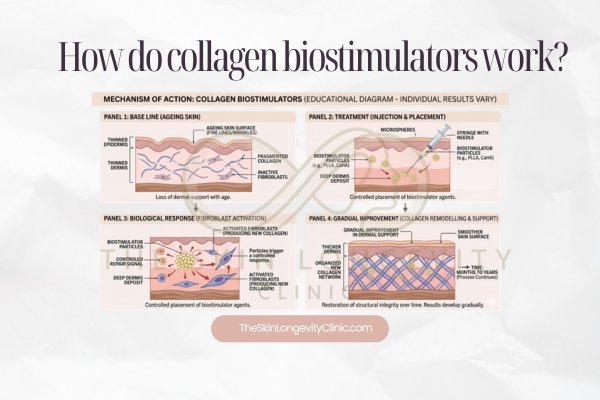
Collagen stimulation is gradual. Some injectables have an early carrier effect, but collagen remodelling usually develops over weeks to months
How collagen biostimulators improve skin longevity?
Skin longevity is not just about looking younger. It is about maintaining healthier, more resilient skin as the skin ages. From a biological perspective, this means supporting barrier function, pigment stability, inflammation control and collagen integrity.
Collagen loss does not appear as only one concern. It can show up as fine lines, crepey texture, enlarged pores, laxity, dullness, soft tissue deflation or reduced skin bounce. A good treatment plan therefore has to separate skin quality concerns from volume loss and structural ageing.
Collagen biostimulators may be considered when the goal is gradual improvement in firmness, texture, elasticity and support. They are usually not the right answer for every concern, and they cannot replace skincare, sun protection, lasers, surgery or good facial anatomy assessment.
Comparison table of collagen biostimulators in Singapore including PLLA, PDLLA, CaHA, PCL and PDRN
| Type | Main role | Commonly considered for | Strengths | Limitations |
|---|---|---|---|---|
| PLLA | Gradual collagen stimulation and volume support | Broad collagen loss, facial deflation, skin laxity | Long clinical history, gradual change | Not immediate, not easily reversible, requires careful placement |
| PDLLA | Skin quality and collagen support | Texture, firmness, early laxity, scars in selected patients | Regenerative rationale, versatile use | Evidence is newer and formulation dependent |
| CaHA | Structural support and collagen stimulation | Contour support, firmer tissue support | Immediate support plus collagen effect | Not a superficial hydration treatment, not dissolved like HA filler |
| PCL | Contour support and collagen stimulation | Folds, selected contour concerns | Durable support in selected patients | Not readily reversible, requires precise depth |
| PDRN | Regenerative skin quality support | Dullness, repair, texture, early ageing | Lighter skin quality focus | Not a lifting or volumising treatment |
Main types of collagen biostimulators in Singapore
Poly- L- lactic acid collagen biostimulator
PLLA stands for poly L lactic acid. It is one of the best studied collagen stimulators in aesthetic medicine and is used to gradually improve facial volume loss and collagen support. Medical sources describe PLLA as an absorbable injectable biostimulator that stimulates collagen formation over time4.
PLLA (Sculptra) biostimulator works by creating a controlled tissue response. After injection, the carrier fluid is absorbed and PLLA microparticles interact with macrophages and fibroblasts. Over time, the particles are broken down into lactic acid components, while new collagen, especially type 1 collagen, is produced around the treated areas4.
PLLA biostimulator are usually suited for patients who prefer gradual, global collagen support rather than an instant filler effect. It can be useful for facial volume loss, skin laxity and areas where a subtle rebuilding effect is desired. Results are not immediate and typically require a series of sessions, which makes patient selection and expectation setting very important4.
The advantages of PLLA biostimulators include its long clinical history, gradual natural looking change and ability to support collagen remodelling. The limitations are that it is not easily reversible, it requires correct preparation and placement, and it may not be ideal for very thin skin or delicate areas if not carefully planned. Reported adverse effects include swelling, bruising, nodules, delayed inflammatory reactions and rare serious vascular events associated with soft tissue fillers.
Poly D L lactic acid biostimulators
PDLLA stands for poly D L lactic acid. It belongs to the same broad lactic acid polymer family as PLLA, but its particle structure, formulation and clinical behaviour can differ. In aesthetic practice, PDLLA Poly D L lactic acid biostimulators are often discussed as a separate collagen stimulator for skin quality, firmness, wrinkles and tissue remodelling5.
A 2024 literature review reported that PDLLA biostimulators have potential benefits in improving skin elasticity, firmness, wrinkles, tissue regeneration and scar remodelling6. A preliminary clinical study on combined PDLLA biostimulators and non cross linked hyaluronic acid also reported skin rejuvenation effects without serious adverse events in that study population6.
PDLLA (Juvelook) biostimulators may be useful when the concern is not just volume loss, but also skin quality, texture and early laxity. It is often considered for patients who want collagen stimulation with a lighter skin booster style approach, depending on the product formulation and injection plan. However, PDLLA biostimulators should not be assumed to be risk free simply because it is used for skin quality.
The advantages of PDLLA include its regenerative rationale, potential skin quality benefits and versatility7. The limitations are that the evidence base is still developing compared with older collagen stimulators, and outcomes can vary across formulations. Nodules and delayed reactions have also been reported, which reinforces the need for appropriate product selection, injection depth and follow up7,8.
Calcium hydroxylapatite biostimulators
CaHA stands for calcium hydroxylapatite. It is made of calcium based microspheres suspended in a gel carrier. Compared with some other collagen biostimulators, CaHA biostimulators may provide a more immediate supporting effect from its carrier gel, followed by longer term collagen stimulation from the microspheres.
A systematic review of controlled clinical trials found that CaHA injections biostimulators were associated with improvements in facial aesthetic outcomes and patient satisfaction, although the studies were heterogeneous and further controlled trials would help clarify its advantages9. Mechanistic studies also suggest that CaHA biostimulators can support collagen production, cell proliferation, angiogenesis and elastin related changes, although not all mechanisms are equally proven10.
CaHA biostimulators are often considered when firmer structural support is needed, such as in areas with thicker skin or where contour support is clinically appropriate. It can be useful when the treatment goal includes both immediate support and collagen stimulation. The injection plan should be conservative, especially in patients who prefer very soft or subtle changes.
The advantages of CaHA biostimulators include structural support, collagen stimulation and usefulness in selected contouring situations. The limitations are that it is not a simple hydrating skin booster, is not dissolved like hyaluronic acid filler, and must be placed carefully to avoid visible irregularities. It may not be suitable for very superficial placement, very thin skin or areas where excessive firmness would be undesirable.
Polycaprolactone biostimulators
PCL stands for polycaprolactone. It is another collagen stimulating material used in aesthetic medicine, usually in the form of microspheres within a gel carrier. Like other particulate collagen biostimulators, it aims to give some immediate correction while encouraging collagen formation over time.
Clinical studies have reported that PCL based biostimulators can improve moderate to severe nasolabial folds, including in Chinese patients, with reported efficacy and safety in the studied setting11. However, the amount and quality of evidence differ across products, indications and patient groups, so results should not be overgeneralised.
PCL biostimulators may be considered for patients who need contour improvement and collagen support. It is generally not chosen for someone who wants only hydration or a very superficial glow treatment. As with CaHA and PLLA biostimulators, the doctor’s assessment of facial anatomy, skin thickness and treatment depth is critical.
The advantages of PCL biostimulators include its collagen stimulating potential and suitability for selected contour concerns. The limitations are that it is not readily reversible, requires precise placement and may not be the best choice for very thin or highly mobile areas. It should be approached as a medical injectable with durability, not as a casual quick fix.
Polycaprolactone collagen stimulators are marketed as Ellansé. A 2017 consensus set out recommendations for volume augmentation of the face and hands with the product, and a 2024 review in Aesthetic Plastic Surgery summarised its technology and patient selection18,19.
Polydeoxyribonucleotide biostimulators
PDRN stands for polydeoxyribonucleotide. It is often grouped with regenerative injectables, although it is not the same type of particulate collagen biostimulator as PLLA, PDLLA, CaHA or PCL. PDRN and related polynucleotides are nucleic acid based molecules studied for tissue repair, wound healing, fibroblast activity, collagen production and anti inflammatory effects12=14.
In aesthetic medicine, PDRN (Rejuran) biostimulators are usually positioned more as a skin quality and repair treatment rather than a lifting or volumising collagen stimulator. It may be used for dullness, rough texture, post procedure recovery, hydration related skin quality and early ageing changes. It is not designed to build facial structure in the way a firmer biostimulator or filler might.
The advantages of PDRN biostimulators include its regenerative rationale, suitability for skin quality concerns and generally lighter treatment profile. The limitations are important. PDRN biostimulatorswill not replace volume, lift sagging tissue significantly or correct deep folds by itself. The aesthetic evidence base is also still evolving, and topical PDRN should not be assumed to behave like injectable PDRN because delivery depth is different12,15.
PLLA vs PDLLA vs CaHA vs PCL vs PDRN biostimulators
PLLA biostimulators are usually considered when the goal is gradual collagen support and volume rebuilding over a broader area. PDLLA biostimulators are often discussed for skin quality, firmness and collagen stimulation, although the evidence base is newer and formulation dependent.
CaHA biostimulators are useful when more immediate structure and collagen stimulation are both desired. PCL biostimulators may be suitable for selected contour and fold concerns where collagen stimulation and durability are priorities.
PDRN biostimulators are best understood as a regenerative skin quality treatment rather than a classic structural biostimulator. It may support repair and skin quality, but it should not be presented as a substitute for treatments that provide stronger contour support.
Pros and limitations of collagen biostimulators for skin longevity and facial ageing
| Potential benefit | Important limitation |
|---|---|
| Gradual, subtle improvement | Results are not immediate |
| Supports collagen remodelling | Often requires a series of sessions |
| May improve firmness and texture | Does not treat every cause of ageing |
| Can be part of skin longevity planning | Not all types are easily reversible |
| Can reduce reliance on simple volume filling | Requires careful medical assessment and placement |
Pros of collagen biostimulators
Collagen biostimulators can be attractive because they work gradually and often produce subtle improvement rather than a sudden change. For patients who want to look fresher without looking obviously treated, that gradual response can be an advantage.
They can also address aspects of skin ageing that conventional fillers do not fully treat. When used appropriately, collagen stimulation may improve firmness, texture, elasticity and dermal support, especially as part of a broader skin longevity plan.
Another advantage is that collagen biostimulators can be planned preventively or correctively. Some patients in their late twenties or thirties may use them for early collagen support, while older patients may use them as part of a more comprehensive treatment plan for laxity and volume loss.
Safety checklist for collagen stimulator treatment suitability in Singapore
| Before treatment, assess | Why it matters |
|---|---|
| Active skin infection or inflammation | May increase risk of complications |
| Pregnancy or breastfeeding | Treatment is usually deferred |
| Prior filler or biostimulator history | Helps avoid overlap and delayed reactions |
| Keloid tendency or abnormal scarring | May affect suitability |
| Bleeding risk or medication history | Helps manage bruising and safety |
| Expectations and timeline | Prevents mismatch between goals and likely outcomes |
Side effects, risks and limitations of collagen biostimulators
The biggest limitation is that results are not instant. Most collagen stimulators require time, and some require a series of sessions before the full effect is visible. This makes them less suitable for patients seeking immediate correction before an event.
Another limitation is reversibility. Some hyaluronic acid fillers can be dissolved, but PLLA, PDLLA, CaHA and PCL are not managed in the same way. This is why conservative planning, proper product choice and correct placement matter.
Collagen biostimulators also do not treat every sign of ageing. Pigmentation, redness, active acne, significant skin laxity, deep structural descent and skin barrier problems may require other treatments. In some cases, lasers, energy based devices, skincare, surgery or a combination plan may be more appropriate.
Possible side effects and risks of collagen biostimulators
Common short term effects include redness, swelling, tenderness, bruising and small bumps at injection points. These are usually temporary, but the expected downtime depends on the product, area treated and individual healing response.
Less common complications include infection, persistent nodules, delayed inflammatory reactions, asymmetry and unsatisfactory cosmetic outcomes4,16. Patients who are pregnant, breastfeeding, have active skin infection, uncontrolled inflammation, certain allergies, bleeding risks or a tendency to form keloids may not be suitable for some collagen stimulators. Suitability should always be assessed by a doctor rather than decided from a trend, a friend’s result or a social media post.
Collagen biostimulators in Singapore compared
| Type of collagen biostimulator | Evidence themes to cite | Doctor Rachel's note |
|---|---|---|
| PLLA | Collagen stimulation, volume restoration, gradual tissue response | Longer history of aesthetic use |
| PDLLA | Skin quality, elasticity, wrinkles, scar remodelling | Newer and formulation dependent |
| CaHA | Structural support, collagen stimulation, facial aesthetic outcomes | Useful when immediate support is relevant |
| PCL | Fold correction, contour support, collagen stimulation | Evidence varies by indication and population |
| PDRN | Tissue repair, fibroblast activity, skin quality | Better framed as regenerative skin quality support |
How to choose a collagen biostimulator in Singapore?
The right collagen biostimulator depends on the diagnosis. Is the main concern collagen loss, volume loss, skin thinning, acne scarring, laxity, dullness, pores or texture? These concerns can look similar in the mirror, but they are not treated in the same way.
A doctor-led assessment should consider skin thickness, facial anatomy, ethnicity, pigmentation tendency, previous injectable history, medical history, downtime tolerance and the level of correction desired. The best choice is often not the newest product, but the one that matches the biology of the problem.
At The Skin Longevity Clinic, collagen support is viewed as one part of skin longevity rather than a standalone trend. A thoughtful plan may include skincare, sunscreen, pigment control, barrier repair, lasers, skinboosters, collagen biostimulators or other treatments depending on what the skin actually needs.
Frequently asked questions about collagen biostimulators in Singapore
| Question | Short answer |
|---|---|
| Is PDRN a collagen biostimulator | PDRN is better described as a regenerative skin quality injectable rather than a classic structural collagen biostimulator. |
| Which collagen stimulator is best | There is no single best collagen stimulator. The right choice depends on the concern, anatomy, skin thickness, downtime and safety profile. |
| Are collagen biostimulators better than fillers | They are different. Fillers mainly restore volume or structure, while collagen stimulators support collagen remodelling over time. |
| How long do collagen stimulators take to work | Collagen remodelling usually develops over weeks to months, depending on product type and patient factors. |
| Are collagen biostimulators reversible | Some are not dissolved like hyaluronic acid fillers, so careful planning is important. |
Frequently asked questions about collagen biostimulators
Nodules after polycaprolactone (Ellansé M) cannot be dissolved with hyaluronidase; a 2025 case series described treating them with collagenase20.
Are collagen biostimulators better than fillers?
They are not better or worse. They are different, so it’s not a clear cut comparison. Dermal fiillers are often used to replace lost volume or support facial structure, while collagen biostimulators aim to improve collagen support over time. Some patients need one, some need the other, and some need both in a carefully staged plan.
How long do collagen biostimulators take to work?
Most collagen biostimulators work gradually because collagen remodelling takes time. Some products have an immediate carrier effect, but the collagen stimulating effect usually develops over weeks to months. Your doctor should explain what part of the result is immediate and what part is delayed.
Which collagen biostimulator is best for skin quality?
For skin quality, PDLLA and PDRN are often discussed because they are commonly used for texture, hydration related quality, firmness and early ageing concerns. However, the best option depends on whether the skin needs collagen stimulation, repair, hydration, resurfacing or pigment control.
Which collagen biostimulator is best for lifting?
For structural support, CaHA, PCL and PLLA may be considered in selected patients. That said, no injectable should be oversold as a replacement for surgical lifting when there is significant tissue descent. A balanced consultation should explain what can realistically be improved with injectables and what cannot.
Can collagen biostimulators be combined with lasers or skinboosters?
Yes, combination plans are common in aesthetic medicine, but timing matters. Some treatments should be staged to reduce inflammation and avoid confusing side effects. The safest approach is to plan treatments around skin stability, healing time and the biological target of each procedure.
Combination protocols have been reported: a 2014 series in the Journal of Cosmetic Dermatology combined intense pulsed light, Sculptra (PLLA) and Ultherapy for the ageing face17.
Is PDRN a collagen biostimulator?
PDRN is better described as a regenerative skin quality injectable rather than a classic particulate collagen biostimulator. It may support tissue repair, fibroblast activity and collagen related pathways, but it does not provide the same structural support as PLLA, CaHA or PCL. This distinction is important for realistic expectations.
Dr Rachel Ho’s clinical takeaway on collagen biostimulators and skin longevity.
Doctor’s takeaway on collagen biostimulator treatments in Singapore
Collagen biostimulators are useful when they are chosen for the right reason. PLLA, PDLLA, CaHA, PCL and PDRN all sit within the broader conversation of collagen, skin repair and skin longevity, but they are not the same treatment. Their mechanisms, strengths, limitations and risks differ.
For well informed patients, the key question should not be which collagen stimulator is the most popular. A better question is what is my skin actually missing, and which treatment best addresses that biology with the least unnecessary risk?
A considered consultation should give you clarity on your skin ageing pattern, the treatment options available, the expected timeline, possible side effects and the limitations of each choice. That is how collagen biostimulators can be used responsibly, safely and in a way that supports healthier skin over time.
References:
1. Skin aging from the perspective of dermal fibroblasts: the interplay between the adaptation to the extracellular matrix microenvironment and cell autonomous processes. Fisher et al. J Cell Commun Signal. 2023 Apr 17;17(3):523–529.
2. Decreased Collagen Production in Chronologically Aged Skin Roles of Age-Dependent Alteration in Fibroblast Function and Defective Mechanical Stimulation. Varani et al. Am J Pathol. 2006 Jun;168(6):1861–1868.
3. Matrix-degrading metalloproteinases in photoaging. Quan et al. J Investig Dermatol Symp Proc. 2009 Aug;14(1):20-4.
4. Poly-L-Lactic Acid. StatPearls [Internet].
5. Poly-d,l-lactic Acid (PDLLA) Application in Dermatology: A Literature Review. Lee et al. Polymers (Basel). 2024 Sep 13;16(18):2583.
6. Skin rejuvenation effect of the combined PDLLA and non cross-linked hyaluronic acid: A preliminary study. Seo et al. J Cosmet Dermatol. 2024 Mar;23(3):794-802.
7. A Randomized, Evaluator-Blinded, Multicenter Study to Compare Injectable Poly-D,L-Lactic Acid vs Hyaluronic Acid for Nasolabial Fold Augmentation. Ting et al. Aesthet Surg J. 2024 Nov 15;44(12):NP898-NP905.
8. Clinical Management of Poly‐D,L‐Lactic Acid Nodules: A Guideline With Diagnostic and Treatment Flowchart. Magacho‐Vieira and Ducati. J Cosmet Dermatol. 2025 Mar 31;24(4):e70158.
9. Calcium Hydroxylapatite (CaHA) and Aesthetic Outcomes: A Systematic Review of Controlled Clinical Trials. Amiri et al. J Clin Med. 2024 Mar 14;13(6):1686.
10. Skin regeneration-related mechanisms of Calcium Hydroxylapatite (CaHA): a systematic review. Amiri et al. Front Med (Lausanne). 2023 Jun 2:10:1195934.
11. Efficacy and Safety of Polycaprolactone in Treating Nasolabial Folds: A Prospective, Multicenter, and Randomized Controlled Trial. Zhao et al. Facial Plast Surg. 2022 Dec 27;39(3):300–306.
12. Polydeoxyribonucleotide: A Promising Biological Platform to Accelerate Impaired Skin Wound Healing. Galeano et al.Pharmaceuticals (Basel). 2021 Oct 29;14(11):1103.
13. Polynucleotides in Aesthetic Medicine: A Review of Current Practices and Perceived Effectiveness. Lee et al. Int J Mol Sci. 2024 Jul 27;25(15):8224.
14. Pharmacological Activity and Clinical Use of PDRN. Squadrito et al. Front Pharmacol. 2017 Apr 26;8:224.
15. Polydeoxyribonucleotide-delivering therapeutic hydrogel for diabetic wound healing. Shin et al. Sci Rep. 2020 Oct 8;10(1):16811
16. Complications of collagen biostimulators in Brazil: Description of products, treatments, and evolution of 55 cases. Ianhez et al. J Cosmet Dermatol. 2024 Sep;23(9):2829-2835.
17. Friedmann DP, Kurian A, Fitzpatrick RE. Combination of intense pulsed light, Sculptra, and Ultherapy for treatment of the aging face. Journal of Cosmetic Dermatology. 2014;13(2):109–118. doi:10.1111/jocd.12093.
18. de Melo F, Nicolau P, Piovano L, et al. Recommendations for volume augmentation and rejuvenation of the face and hands with the new generation polycaprolactone-based collagen stimulator (Ellansé). Clinical, Cosmetic and Investigational Dermatology. 2017;10:431–440. doi:10.2147/CCID.S145195.
19. Chen Q, Wang Y. Ellansé: Advanced Technology and Advantageous Selection of New Collagen Stimulating Agents for Face Rejuvenation. Aesthetic Plastic Surgery. 2024;48(10):1977–1984. PMID 38305923.
20. Wu L. iCare Technique of Dissolving Ellanse M Nodules Using Collagenase: A Case Series and Experimental Study. Journal of Cosmetic Dermatology. 2025;24(5):e70201. doi:10.1111/jocd.70201.