

06 May Aesthetic Treatments for Your 20’s, 30’s, 40’s, 50’s, 60’s and Beyond
By Dr Rachel Ho | Aesthetic Doctor, Founder, The Skin Longevity Clinic, Singapore
Aesthetic Treatments for Your 20’s, 30’s, 40’s, 50’s, 60’s and Beyond
A clear decade by decade guide to ageing signs and evidence based treatment options
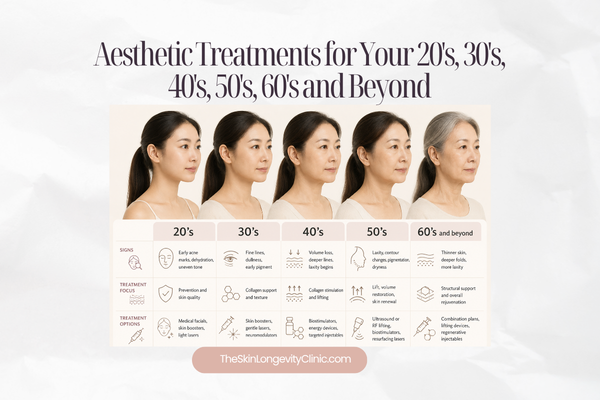
Aesthetic treatments for your 20’s, 30’s, 40’s, 50’s, 60’s and beyond SHOULD be different. That’s because each decade of aging brings about different changes in facial anatomy, biology and of course, personal goals. Facial support, hyperpigmentation, texture, lines and laxity are constantly evolving and can result in different signs of aging at each decade.
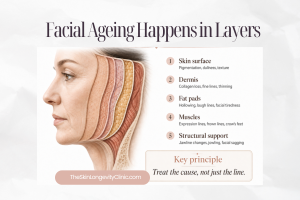
Natural looking results come from matching the treatment to the correct ageing layer.
This guide explains the common signs of ageing in each decade alongside aesthetic treatments that may be considered at each stage for patients who prefer natural results.
Aesthetic Treatments by Decade: Quick Overview
| Decade | Common ageing signs | Main treatment focus | Treatments to discuss |
|---|---|---|---|
| 20's | Acne, oiliness, post acne marks, pores, early pigmentation, dullness | Prevention and skin clarity | Sunscreen, medical skincare, chemical peels, pico laser, Q switched laser, skinboosters, Baby BTX |
| 30's | Fine lines, dullness, stubborn pigmentation, early collagen loss, mild hollowing | Early correction and collagen support | Botulinum toxin, PDRN skinboosters, hyaluronic acid skinboosters, light fillers, collagen biostimulators |
| 40's | Established lines, rough texture, deeper pigmentation, hollow cheeks, tear troughs, jowling | Combination treatment for skin quality and support | HIFU, RF lifting, RF microneedling, pico laser, fillers, collagen biostimulators |
| 50's | Thinner skin, dryness, deeper lines, sun damage, volume loss, neck laxity | Restoration with restraint | Botulinum toxin, structural fillers, skinboosters, collagen biostimulators, resurfacing treatments |
| 60's and beyond | Thin delicate skin, deep folds, hollowing, lower face sagging, dullness, dryness | Safety, comfort, refinement and consistency | Gentle facials, conservative toxin, RF microneedling, HIFU, RF lifting, advanced fillers |
In Your 20’s
Common signs of ageing and skin changes in your 20’s
The 20’s are usually not about advanced ageing. They are more often about acne, oiliness, post acne marks, enlarged pores, uneven tone and early pigmentation. Many people also begin to notice dullness from stress, travel, irregular sleep and sun exposure.
Fine lines may appear around the eyes or forehead. These are usually dynamic lines. They show when you smile, frown or raise your brows. At this age, they often fade when the face rests.
Facial structure is usually still well supported. However, some patients may feel that their chin, jawline, nose or under eye area affects facial balance. These concerns are not always related to ageing. They may reflect natural anatomy.
Suitable aesthetic treatments in your 20’s
The priority in your 20’s is prevention and correction of early skin concerns. A strong foundation matters more than doing many procedures.
Daily sunscreen is essential. Broad spectrum sunscreen helps reduce the visible effects of ultraviolet damage, including wrinkles, age spots and sagging.
For acne and clogged pores, chemical peels and selected laser treatments may help. Chemical peels can improve acne, uneven texture, hyperpigmentation and early photodamage when chosen correctly.
For post acne marks and hyperpigmentation, pigmentation lasers like pico lasers and Q-switched lasers may be considered together with chemical peels. Individuals with darker skin, including Asians, post inflammatory hyperpigmentation or post acne marks are more common and can be more persistent.
For dry, dull or tired looking skin, hyaluronic acid skinboosters are an effective treatment option. Skinboosters replenish hyaluronic acid into the dermis to improve hydration, radiance and skin quality.
Botulinum toxin may be considered for expression lines or dynamic wrinkles. Besides treating these wrinkles, botulinum toxin has a preventive role in preventing static (fixed wrinkles). In your 20’s, dosing should be conservative, with an approach that Dr Rachel Ho calls “Baby BTX”. Botulinum toxin is injected very strategically and carefully to soften repeated muscle movement while retaining natural expressions.
For patients who desire itreating early signs of aging, a good option would be collagen biostimulators that repair lost collagen and structural support in the face to reduce nasolabial folds, sagging in the jawlines and early dark eye circles.
In Your 30’s
Common signs of ageing and skin changes in your 30’s
The 30’s are often when early ageing becomes more noticeable. Skin may look less bright. Recovery from late nights may take longer. Fine lines may remain visible even when the face is relaxed.
Pigmentation can become more stubborn and melasma may appear or worsen, especially with sun exposure, hormonal changes and heat. Pores may enlargge because collagen support is begining to diminish.
Facial changes are usually subtle in your 30’s. The cheeks may lose a little support. and the under eye area may begin to look more hollow. The lower face may also appear slightly heavier in photographs.
Suitable aesthetic treatments in your 30’s
The 30’s are an ideal decade for early, precise intervention. The aim is to support collagen, prevent deeper lines and maintain skin clarity.
Botulinum toxin is commonly used for dynamic lines. These include frown lines, forehead lines and crow’s feet. It works by relaxing selected facial muscles that create expression lines.
Skinboosters containing PDRN and hyaluronic acid are useful for patients with dehydration, dullness and fine crepiness. They do not replace facial volume. They improve skin quality. This makes them suitable for people who want a refreshed look without obvious contour changes.
Dermal fillers may be considered when there is early hollowing or imbalance. Small amounts can support the midface, chin, temples or under eye area. The goal is light restoration, not volume excess.
Collagen stimulating treatments may also become relevant, with particular attention paid to the matrix and skeletal support with specific types of collagen biostimulators, that has been covered in Collagen Biostimulators in Singapore: PLLA, PDLLA, CaHA, PCL and PDRN Explained. These treatments aim to improve firmness and dermal support over time and are most useful when collagen loss is early and skin still has good healing capacity.
In your 40’s
Common signs of ageing and skin changes in your 40’s
The 40’s often bring more visible changes. Fine lines become more established. Pigmentation may deepen. Skin texture may become rougher, pores can appear larger and makeup may sit less smoothly.
Collagen and elastin loss become more obvious to cause more obvious sagging along with resorption of the facial fat pads. This results in hollow cheeks and more obvious laugh lines, hollow tear troughs that worsen the look of dark eye circles and a loss of jawline definition and jowling.
Suitable aesthetic treatments in your 40’s
The 40’s usually benefit from combination treatment. One procedure alone may not address all layers of facial ageing.
Non-surgical lifting can be explored with high intensity focused ultrasound (HIFU) or radiofrequency lifting and tightening devices. These energy based devices target deep tissue layers to stimulate collagen fibres to lift and tighten.
Radiofrequency microneedling treatment is another dual modality treatment that combines the benefits of microneedling with targeted radiofrequency. This treatment is ideal for skin tightening, reducing pore size, smoother texture and melasma.
Collagen biostimulators containing PDLLA and ECM are particularly useful in this age group. This category of collagen biostimulators encourage skin repair and restore skin support to lift and improve skin quality.
Hyperpigmentation such as melasma is more common in this decade. Pico laser is one evidence based treatment that effectively reduces dark spots with little down time.
Dermal fillers may be useful for structural support by restoring lost volume and improving contours, particularly in the cheeks and lower face.
In your 50’s
Common signs of ageing and skin changes in your 50’s
The 50’s often bring clearer changes in skin quality and facial structure. Skin may feel thinner, drier and less resilient. This is especially common around menopause, when hormonal changes can affect collagen, hydration and skin thickness.
Lines may deepen around the eyes, mouth, forehead and neck. Pigmentation and sun damage can become more visible. Broken capillaries, redness and uneven tone may also appear.
Facial volume loss may become more pronounced. The temples may hollow. The cheeks may lose projection. The jawline may soften. The corners of the mouth may turn downward. Neck laxity may become more obvious.
Suitable aesthetic treatments in your 50’s
Aesthetic treatments in the 50’s should focus on restoration, not drastic alteration of volumisation.
Botulinum toxin can still be helpful for expression lines. It may also be used for selected neck bands or lower face muscle activity. Dosing should be tailored because xcessive relaxation can make mature faces appear heavy or unnatural.
Fillers can be effective when used structurally. In this decade, filler should usually support the face rather than simply fill individual lines. Cheek, temple, chin and jawline support may improve the overall appearance of fatigue.
Skinboosters may improve dryness and fine crepiness. They are especially relevant for patients who feel that their skin looks tired even when facial volume is adequate.
Collagen biostimulators are also very helpful in replenishing matrix and dermal support, and can improve skin quality and lift saggy regions.
In your 60’s and beyond
Common signs of ageing and skin changes in your 60’s and beyond
In your 60’s, ageing changes are often more established. Skin may become thinner, drier and more delicate. It may also lose some elasticity, which can make lines and folds look more visible.
Common concerns include deeper static wrinkles, expression lines, hollowing at the temples, cheeks or under eyes, and sagging around the lower face, jawline and neck. Uneven tone, dullness and dryness are also common, especially when the skin barrier is weaker.
At this stage, treatment goals often shift from correction to refinement, comfort and consistency. Many patients want to preserve what still looks good, while softening areas that draw attention, such as deep folds, hollowing or jawline laxity.
Suitable aesthetic treatments in your 60’s and beyond
Nourishing your skin barrier with rejuvenating and calming facials can be very helpful for dry, dull or sensitive skin that needs radiance without aggressive exfoliation. Using
Botulinum toxin, small, carefully placed doses can soften expression lines while preserving natural facial movement. The aim is not to freeze the face, but to reduce lines that make the face look tense or tired.
Radiofrequency microneedling treatments can improve pigmentation, dullness and surface irregularities. Treatment settings should be conservative, especially for thinner or more sensitive skin.
High intensity focused ultrasound or radiofrequency based lifting treatments as facial sagging becomes more pronounced. These non-surgical treatments can help firm the jawline and neck by stimulating collagen in deeper layers. They are most suitable for mild to moderate laxity and usually have little to no downtime.
Advanced dermal fillers for structural rejuvenation can be restore support in key areas such as the cheeks, temples, nasolabial folds, chin and jawline. In the 60’s, filler should be placed conservatively to avoid heaviness. The goal is structure, balance and a fresher appearance.
What Each Aesthetic Treatment Does
| Treatment | Main role | Commonly discussed for | Key point |
|---|---|---|---|
| Botulinum toxin | Relaxes selected facial muscles | Frown lines, forehead lines, crow's feet, neck bands | Best for expression related lines while preserving natural movement |
| Baby BTX | Conservative low dose toxin approach | Early expression lines in selected younger patients | Softens movement without a frozen look |
| Hyaluronic acid skinboosters | Improve hydration and radiance | Dryness, dullness, fine crepiness | Improves skin quality rather than facial shape |
| PDRN skinboosters | Support skin repair and quality | Dullness, fine crepiness, early ageing | Often used for patients who want rejuvenation without obvious contour change |
| Pico laser | Targets selected pigmentation concerns | Post acne marks, sun spots, melasma where suitable | Requires pigment diagnosis and trigger control |
| Q switched laser | Targets selected pigment concerns | Hyperpigmentation and post inflammatory marks | Must be selected carefully in Asian skin |
| RF microneedling | Stimulates collagen and improves texture | Pores, texture, mild laxity, acne scars, selected melasma cases | Combines microneedling with radiofrequency energy |
| HIFU | Supports non surgical lifting | Mild to moderate sagging, jawline and neck laxity | Best for selected patients with realistic expectations |
| RF lifting | Firms and tightens selected areas | Mild laxity and skin firmness loss | Often used for gradual tightening with minimal downtime |
| Dermal fillers | Restore volume and structural support | Cheeks, temples, chin, jawline, tear troughs | Should support proportion rather than overfill |
| Collagen biostimulators | Encourage collagen support over time | Firmness loss, skin thinning, early structural ageing | Works gradually and is often used as part of a long term plan |
How to choose treatments wisely for your concerns
The most useful question to ask is, what’s causing the concern? One symptom can have several causes, like dark eye circles. However, one condition, like sagging, can result in several signs, like tear trough deformity, nasolabial folds, marionette lines and jowling. A good aesthetic plan should first identify the contributing causes correctly before embarking on treatment planning.
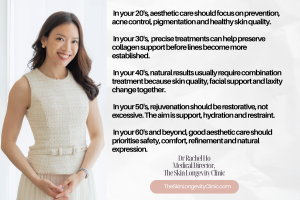
Dr Rachel Ho explains how aesthetic treatment priorities change across the 20’s, 30’s, 40’s, 50’s, 60’s and beyond.
Conclusion Aesthetic Treatments for Your 20’s, 30’s, 40’s, 50’s, 60’s and Beyond
Aesthetic treatments for your 20’s, 30’s, 40’s, 50’s, 60’s and beyond should follow the biology of ageing. Each decade brings about different anatomical and physiological changes and priorities.
In the 20’s, focus on prevention, acne control, pigmentation and skin quality. In the 30’s, support early collagen loss and soften expression lines. In the 40’s, combine skin texture, pigmentation treatment and facial support. In the 50’s, restore structure and hydration with restraint. In the 60’s and beyond, prioritise safety, skin health and refined rejuvenation.
The best treatment plan is not the most dramatic one. It is the one that helps you look well, confident and unmistakably yourself with preservation of your identity, expressions and individuality. They should not distort or leave you looking overdone or overfilled. In this undetectable era of aesthetics and discerning patients, we should be leaning towards elegant, refined outcomes that complement your features.