



08 May A doctor’s guide to Botulinum Toxin (BTX) Treatments in Singapore
By Dr Rachel Ho | Aesthetic Doctor, Founder, The Skin Longevity Clinic, Singapore
A doctor’s guide to Botulinum Toxin (BTX) Treatments in Singapore
Many patients in Singapore begin considering botulinum toxin injections when expression lines start to stay on the face even at rest. The forehead looks more lined. Frown lines make the face look tense. Crow’s feet appear earlier in photos. The jawline may look broader because of strong masseter muscles. Some patients also ask about BTX for jaw clenching, teeth grinding, excessive sweating or facial slimming.
Botulinum toxin is one of the most established injectable treatments in aesthetic medicine. It is commonly used to relax selected muscles that create dynamic wrinkles or muscle bulk. When used appropriately, it can soften facial lines, reduce excessive muscle activity and refine facial balance without changing the patient’s identity.
At The Skin Longevity Clinic, Dr Rachel Ho approaches botulinum toxin treatment with a focus on diagnosis, facial anatomy and conservative planning. The goal is to understand which muscles are contributing to the concern, how strong those muscles are, and how much movement should be preserved for a natural result.
This guide explains how botulinum toxin and BTX treatments are used in Singapore, what patients can expect, who may be suitable and how to choose an aesthetic doctor for safe, natural looking outcomes.

BTX is commonly used for selected movement lines and muscle related concerns.
What is botulinum toxin?
Botulinum toxin is a purified injectable treatment that temporarily relaxes selected muscles. In aesthetic medicine, it is commonly used to reduce dynamic wrinkles. These are wrinkles caused by repeated facial movement, such as frowning, squinting or raising the eyebrows.
Small amounts are injected into specific muscles. This reduces excessive muscle contraction and softens the overlying lines over time. The effect is temporary. Most patients notice early changes within a few days, with fuller results usually seen around two weeks. Results commonly last about three to four months, although this varies by dose, muscle strength, treatment area and individual metabolism.
The treatment should be tailored to be precise for each patient’s anatomy and preferences. A patient with strong forehead movement requires a different plan from someone with mild crow’s feet or heavy jaw muscles. Good results depend less on the product name and more on assessment, dose and injection techniques.
Common BTX Treatment Areas
| Treatment area | Common concern | What BTX may help with | Important limitation |
|---|---|---|---|
| Frown lines | Angry or tense looking expression | Relaxes muscles that pull brows inward | Deep etched lines may need skin quality support |
| Forehead lines | Horizontal lines when raising brows | Softens excessive forehead movement | Over treatment may cause brow heaviness |
| Crow’s feet | Lines beside the eyes when smiling | Softens repeated squinting lines | Smile should still look natural |
| Masseter muscles | Broad jawline or clenching | Reduces muscle activity and bulk over time | Does not change bone or remove fat |
| Neck bands | Visible vertical bands | Softens selected muscle activity | Significant laxity may need other options |
| Underarms | Excessive sweating | Reduces sweat gland activation | Results are temporary |
What can botulinum toxin injections treat?
Botulinum toxin is best known for facial wrinkles, but its use in aesthetic medicine is broader.
Common treatment areas include frown lines, forehead lines and crow’s feet. These areas are strongly influenced by facial expression. BTX can soften these lines by relaxing the muscles that repeatedly crease the skin.
For bruxism or clenching, BTX may be injected into enlarged masseter muscles. This can help relax hyperactive jaw muscles to and reduce jaw muscle size over time. The facial slimming effect is gradual because muscle size reduces slowly after repeated relaxation. Similarly, botulinum toxin injections are also used to treat overactive and hypertrophic trapezius muscles.
Botulinum toxin may also be used for excessive sweating or hyperhidrosis in areas such as the underarms. In suitable patients, it helps reduce sweat gland activation by blocking the nerve signals that stimulate sweating.
Some patients ask about BTX for enlarged pores or oily skin. In selected patients, superficial microinjections may improve oiliness and the appearance of pores, although this is different from standard wrinkle treatment and should be discussed carefully.
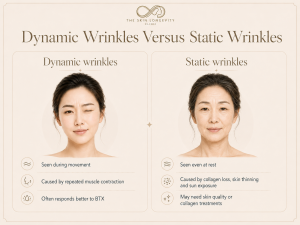
Botulinum toxin is most useful when lines are driven by repeated muscle movement.
Dynamic wrinkles versus static wrinkles
A key part of consultation is determining whether a line is dynamic or static.
Dynamic wrinkles appear during movement. Examples include frown lines when concentrating, forehead lines when raising the brows and crow’s feet when smiling. These lines usually respond better to botulinum toxin because the treatment targets the muscle activity that creates the crease.
Static wrinkles remain visible even when the face is relaxed. They are often caused by a combination of repeated movement, collagen loss, skin thinning, sun exposure and dehydration. Botulinum toxin can soften the movement component, but deeper static lines may also require skin quality treatments, lasers, skinboosters, collagen stimulation or fillers depending on the cause.
This distinction matters because patients may feel disappointed when one treatment is expected to correct several different ageing changes. Botulinum toxin relaxes muscles. It does not replace lost collagen, restore volume, remove pigmentation or resurface texture.
Botulinum toxin injections for the upper face
The upper face is one of the most common areas for BTX treatment.
Frown lines are caused by the muscles that pull the brows inward and downward. When these muscles are strong, patients may look angry, worried or tired even when they are calm. Treatment can soften the vertical lines between the brows and reduce excessive frowning.
Forehead lines are caused by the frontalis muscle, which lifts the brows. Treatment here needs careful planning because this muscle also supports brow position. Too much relaxation can create brow heaviness. A conservative approach helps soften lines while preserving enough lift.
Crow’s feet are caused by repeated contraction around the eyes. Treatment can reduce lines at the outer corners of the eyes while allowing the smile to remain natural. Dose and placement matter because over treatment can make the eye area look stiff.
Botulinum toxin for the lower face and jawline
The lower face is more complex because several muscles influence expression, jawline shape and speech.
Masseter BTX is commonly considered for patients with strong jaw muscles, facial squareness due to muscle bulk, jaw clenching or teeth grinding. Results develop gradually because muscle slimming takes time. Patients usually need proper assessment to distinguish muscle bulk from bone structure, fat distribution or skin laxity.
BTX may also be used in selected patients for chin dimpling, downturned mouth corners or neck bands. These areas require precise anatomy and conservative dosing because small changes in muscle balance can affect expression.
For patients with sagging or jowling, botulinum toxin alone is usually insufficient. Lower face heaviness can involve skin laxity, fat pad repositioning, ligament changes, volume loss and skeletal support changes. In such cases, BTX may be part of a broader plan, but it should not be oversold as a lifting treatment.

A doctor led BTX consultation should assess movement, anatomy and treatment goals before injection
What happens during BTX treatments?
A botulinum toxin consultation always begin with facial assessment. Dr Rachel Howill examine muscle movement, facial symmetry, skin quality, brow position, eyelid support, jaw muscle strength and the patient’s goals.
The treatment involves mall injections are placed into selected muscles using fine needles after numbing is complete. Discomfort is generally mild and brief. Most patients return to normal daily activities soon after treatment, although they may be advised to avoid rubbing the treated area, strenuous exercise, alcohol or lying flat for a short period after the procedure.
Mild redness, swelling or small bruises may occur at injection points. These usually settle quickly. Results are not immediate because the treatment needs time to affect muscle activity.
A review may be arranged after the treatment has settled, especially for new patients or when small adjustments are needed. Conservative treatment is often safer than over treating at the first session.
How long do the results of BTX injections last?
Most patients can expect results to last about three to fivev months. Some areas may last slightly longer or shorter depending on muscle strength, dose, metabolism, exercise habits and treatment history.
Masseter slimming may take longer to become visible because muscle bulk reduces gradually. Jaw clenching symptoms may improve earlier in some patients, but facial slimming usually requires patience.
Regular treatment can help maintain results, but the interval should be individualised. Over frequent treatment is unnecessary and may increase the risk of unwanted weakness. A good plan should aim for natural movement, safe maintenance and appropriate spacing.
Possible side effects and risks of botulinum toxin injections
Botulinum toxin is widely used in aesthetic medicine, but it is still a medical procedure. It should be performed by a qualified medical practitioner after proper consultation and consent.
Common side effects include temporary redness, swelling, tenderness or bruising at injection sites. Some patients may experience headache or mild tightness after treatment.
Unwanted effects can occur if the toxin affects nearby muscles. These may include brow heaviness, eyelid droop, asymmetry, uneven smile, dry eyes or excessive weakness in the treated area. Most effects are temporary, but they can be inconvenient while they last.
Patients who are pregnant, breastfeeding, have certain neuromuscular conditions or have active infection at the injection site may not be suitable. A medical history and medication review should be part of the consultation.
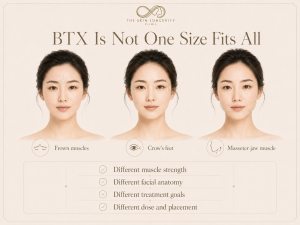
Natural looking BTX results depend on assessment, dose, placement and anatomy.
How to avoid an unnatural looking or “frozen” result from BTX injections
Many patients worry about looking frozen. This usually happens when treatment is excessive, poorly placed or not matched to the patient’s facial anatomy.
A natural result should soften lines while preserving expression. The face should look calmer and more rested, rather than stiff or surprised.
This requires a doctor to assess how the muscles interact. The forehead, frown muscles, brow and eyelids work together. The lower face and jawline also depend on balance between opposing muscles. Treating one muscle without understanding the surrounding anatomy can create heaviness, asymmetry or an unnatural look.
At The Skin Longevity Clinic, Dr Rachel Ho’s approach is conservative and anatomy led. The aim is to improve the specific concern while preserving facial character.
Botulinum Toxin vs Dermal Fillers
| Feature | Botulinum toxin or BTX | Dermal fillers |
|---|---|---|
| Main action | Relaxes selected muscles | Restores selected volume or support |
| Best suited for | Movement lines and muscle bulk | Hollowing, contour and structural support |
| Common areas | Frown, forehead, crow’s feet, masseter | Cheeks, temples, chin, under eyes, folds |
| Onset | Gradual over days | Often visible soon after treatment |
| Duration | Often around three to four months | Varies by product, area and patient |
| Main limitation | Does not restore volume or resurface skin | Does not relax muscle movement |
Botulinum toxin versus dermal fillers: What are the differences?
Botulinum toxin and dermal fillers are often discussed together, but they are different treatments.
Botulinum toxin relaxes muscles. It is best for movement related wrinkles and selected muscle related concerns such as masseter bulk or jaw clenching.
Dermal fillers restore selected volume or structural support. They may be used for hollowing, contour support or facial balance when volume loss is part of the concern.
A patient with frown lines may benefit from BTX. A patient with under eye hollowing or cheek flattening may need a different assessment. A patient with deeper folds may have both movement and structural causes.
Choosing between BTX and fillers should therefore begin with diagnosis. In some patients, both may be relevant. In others, one may be unnecessary.
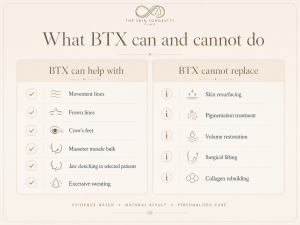
BTX works best when the concern is driven by muscle activity or selected sweat gland activity.
Who is suitable for botulinum toxin treatments?
Botulinum toxin may be suitable for patients who have dynamic wrinkles, strong facial muscle activity, masseter enlargement, jaw clenching, selected lower face concerns or excessive sweating.
It may also suit patients who want subtle refinement without downtime. Working professionals often appreciate that treatment is quick and recovery is usually minimal.
Suitability depends on facial anatomy, medical history, treatment goals and expectations. Patients seeking dramatic lifting, major skin tightening or correction of deep static wrinkles may need other treatment options.
What to Ask Before BTX Treatment
| Question to ask | Why it matters |
|---|---|
| Which muscle is causing my concern? | Ensures the treatment follows anatomy |
| Is my line dynamic or static? | Clarifies whether BTX alone is likely to help |
| How much movement should be preserved? | Helps avoid a stiff or frozen look |
| What can BTX not correct? | Sets realistic expectations |
| When should I review the result? | Allows safe adjustment if needed |
| What risks are relevant to my face? | Personalises consent and safety planning |
Why choose The Skin Longevity Clinic for botulinum toxin in Singapore?
Patients comparing aesthetic clinics in Singapore should look beyond price and product names. Botulinum toxin treatment depends heavily on anatomy, dose, placement and judgment.
A good consultation should explain which muscles are being treated, why the treatment is suitable, what outcome is realistic and what risks should be considered. It should also explain what botulinum toxin cannot do.
Dr Rachel Ho has more than 16 years of clinical experience in Singapore and is the Founder of The Skin Longevity Clinic. Her approach to injectable treatments is clear, measured and anatomy based. The aim is to help patients achieve natural looking results that fit their facial structure and lifestyle.
For discerning patients, this matters. The right BTX treatment should not make the face look treated. It should help the face look more relaxed, balanced and refreshed.
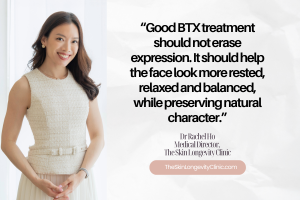
Dr Rachel Ho on preserving expression with botulinum toxin treatment.
Final thoughts from Dr Rachel Ho on botulinum toxin treatments in Singapore
Botulinum toxin can be a useful aesthetic treatment when the concern is driven by muscle movement or muscle bulk. It can soften frown lines, forehead lines and crow’s feet. It may also help selected patients with jawline slimming, jaw clenching, neck bands or excessive sweating. The treatment is familiar to many patients, but familiarity should not make it feel routine.
In my practice, I see botulinum toxin as a treatment that requires precise control, anatomy and judgment. Each face moves differently. Some patients need softening of strong frown lines. Some need only a very small amount around the eyes. Others may benefit more from improving skin quality, collagen support or facial structure before considering injectable muscle relaxation.
Good BTX treatment should not erase expression. It should help the face look more rested, relaxed and balanced, while preserving the patient’s natural character. This is why I prefer to begin with a proper facial assessment rather than a fixed injection pattern.
For patients searching for botulinum toxin, BTX or aesthetic treatments in Singapore, my advice is to choose a doctor who can explain what the treatment can do, what it cannot do, and why it is suitable for your face. A clear plan should feel measured, safe and specific to you.
At The Skin Longevity Clinic, our approach to botulinum toxin is doctor led and anatomy based. The aim is not to chase a frozen or overcorrected look. It is to help patients make informed decisions and achieve natural looking refinement that fits their face, lifestyle and stage of ageing.
References
1. Regulation of Advertisements for Aesthetic Treatments. Ministry of Health Singapore. 2024.
2. Regulating Do It Yourself Aesthetic Injectable Kits. Ministry of Health Singapore. 2023.
3. Botulinum Toxin Injection for Facial Wrinkles. Small R. American Family Physician. 2014. Volume 90, Issue 3.
4. Botulinum Toxin Type A for Facial Wrinkles. Camargo CP, Xia J, Costa CS, Gemperli R, Tatini MD. Cochrane Database of Systematic Reviews. 2021. Issue 7.
5. Botulinum Toxin A for Reducing the Appearance of Facial Wrinkles: A Literature Review of Clinical Use and Pharmacological Aspect. Satriyasa BK. Clinical, Cosmetic and Investigational Dermatology. 2019. Volume 12.
6. A Systematic Review and Comparative Analysis of Botulinum Toxin Type A Products in Aesthetic Medicine. Meretsky CR, et al. Aesthetic Surgery Journal Open Forum. 2024. Volume 6.
7. Bruxism and Botulinum Injection: Challenges and Insights. Malcangi G, et al. Journal of Clinical Medicine. 2023. Volume 12, Issue 14.
8. The Role of Botulinum Toxin for Masseter Muscle Hypertrophy and Related Conditions. Ferrillo M, et al. Toxins. 2025. Volume 17, Issue 2.
9. Vascular Complications After Facial Filler Injection. Sito G, Manzoni V, Sommariva R. Journal of Clinical and Aesthetic Dermatology. 2019. Volume 12, Issue 6.
10. The Facial Aging Process From the Inside Out. Swift A, Liew S, Weinkle S, Garcia JK, Silberberg MB. Aesthetic Surgery Journal. 2021. Volume 41, Issue 10.