


04 May Best Aesthetic Clinic Singapore? How to Choose Safely
By Dr Rachel Ho | Aesthetic Doctor, Founder, The Skin Longevity Clinic, Singapore
People searching for the best aesthetic clinic in Singapore are rarely looking for the clinic with the longest treatment menu. Most want a doctor they can trust, a clear explanation of what is causing their concern and a treatment plan that will not leave them looking overdone.
There is no single best clinic for every person. A suitable aesthetic clinic should be properly licensed, use appropriately registered medical practitioners, begin with a diagnosis, explain alternatives and limitations, provide clear information about costs and aftercare, and be willing to advise against treatment when it is unnecessary.
Singapore’s healthcare advertising rules require aesthetic treatment advertisements to be accurate and truthful, and they must not encourage unnecessary use of healthcare services. For that reason, the phrase “best aesthetic clinic Singapore” is best treated as a patient’s question rather than a claim made by any clinic1.
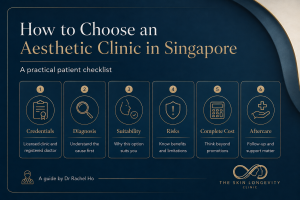
A practical checklist for choosing an aesthetic clinic in Singapore: verify the clinic and doctor, understand the diagnosis, assess suitability and risks, compare the complete treatment cost and ask about follow-up care.
How do you choose an aesthetic clinic in Singapore?
A reliable clinic should help you understand six things before treatment begins:
Factors for choosing an aesthetic clinic in Singapore
| What to assess | What good care should include | A useful question to ask |
|---|---|---|
| Clinic and doctor credentials | A licensed healthcare provider and an appropriately registered doctor | How can I verify the clinic and doctor? |
| Diagnosis | An explanation of what is causing the concern | What is the diagnosis? |
| Treatment suitability | Reasons for recommending one option over another | Why is this suitable for me? |
| Risks and limitations | Common side effects, important complications and what the treatment cannot achieve | What are the limitations? |
| Complete cost | Expected sessions, maintenance, consumables and follow-up | What is the likely total cost? |
| Aftercare | Written instructions, review arrangements and a contact pathway | Who should I contact if I am concerned? |
The answers should be specific to your skin, face, medical history and goals. A generic package does not become personalised simply because your name has been added to it.
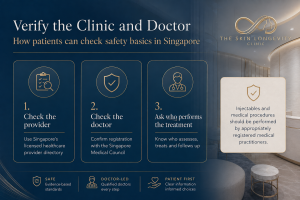
Patients can check whether a healthcare provider is licensed and whether a doctor is registered in Singapore. They should also ask who will assess, perform and review each part of the proposed aesthetic treatment.
1. Check that the clinic and doctor are properly registered
Aesthetic procedures performed by licensed healthcare providers are medical services regulated under Singapore’s Healthcare Services Act. All doctors practising medicine in Singapore must also be registered with the Singapore Medical Council and hold a valid Practising Certificate2.
Patients can check:
- The clinic or healthcare provider through the HealthHub directory of licensed healthcare service providers
- The doctor through the Singapore Medical Council’s Professional Search
- Whether a claimed specialist title appears on the Register of Specialists
MOH specifically encourages the public to use these directories when checking healthcare providers and professionals. Its public watchlist also records selected enforcement actions against unlicensed providers and individuals who have performed aesthetic injections without being registered as medical practitioners3.
Injectable medical procedures such as dermal filler and botulinum toxin injections must be performed by Singapore Medical Council registered medical practitioners through appropriately licensed healthcare providers4.
Credentials alone do not guarantee that a particular treatment is right for you. They are the minimum starting point before clinical judgement, communication and continuity of care are considered.
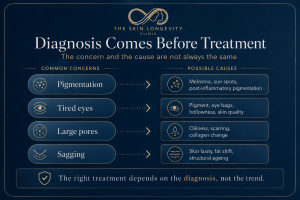
Diagnosis should come before treatment. Pigmentation, tired-looking eyes, enlarged pores and facial sagging can each have several causes, so the appropriate treatment depends on an individual medical and facial assessment rather than the latest trend.
2. The consultation should begin with a diagnosis
A patient may arrive asking for a laser, skin booster, filler or tightening treatment because that is what she has seen online. The consultation should still begin with the concern and its cause, rather than with the requested product or machine.
Pigmentation may represent melasma, post-inflammatory pigmentation, sun spots or a combination of conditions. A tired-looking face may be influenced by skin dullness, eye bags, hollowness, facial tension, pigmentation or changes in facial support. Large pores may be associated with oil production, acne scarring, sun damage or declining skin elasticity.
These concerns do not respond to the same treatment. A doctor should explain the working diagnosis before discussing what is available.
A useful question to ask your doctor
What do you think is causing my concern, and what would change your diagnosis?
A clear answer should involve more than naming a device. It should show that the doctor has considered your skin behaviour, anatomy, medical history, previous treatment and tolerance for downtime.
3. Ask who will assess and perform each part of the treatment
A clinic may involve doctors, nurses and therapists, each working within an appropriate role. Patients should be told who will perform the consultation, procedure and aftercare.
For injectables and other medical procedures that require a registered medical practitioner, the treating doctor should be clearly identified. For facials, skincare programmes or selected device-based steps, ask who will perform them, what training that person has and who is responsible for medical oversight.
The clinic should also be able to tell you:
- The exact name of the proposed treatment
- The product or device being used
- Whether treatment is performed by a doctor
- Who manages complications
- Who will review the result
Unclear answers are a reason to pause before proceeding.
4. Do not choose a clinic by device name alone
Devices and products are important, but they do not make treatment decisions by themselves. The same laser, injectable or energy-based platform may be used differently depending on the diagnosis, treatment settings, anatomy and experience of the person operating it.
Two clinics can own the same machine and still recommend different treatment plans. One patient may benefit from that device, while another may need skincare, medical treatment, an injectable, a different technology or no procedure at all.
A newer or more expensive machine is not automatically the better choice. The more useful question is:
Why is this treatment suitable for my condition, skin type and goals?
A good explanation should include why alternative treatments were not selected.
5. Ask what the treatment cannot achieve
A treatment discussion should include limitations as clearly as benefits. This is particularly important in aesthetic medicine, where disappointment often comes from a mismatch between what a procedure does and what the patient expected it to do.
Botulinum toxin can reduce selected movement-related lines, but it does not rebuild skin that has developed fixed creases. A skin booster may improve hydration or skin quality, but it does not produce the structural effect of a filler or surgery. A tightening device may create gradual improvement, but it cannot reproduce a surgical facelift.
The doctor should also explain whether the result is expected to be subtle or substantial, temporary or longer lasting, and whether several sessions may be required. Rare but serious complications can occur with some minimally invasive aesthetic procedures, which is why appropriate patient selection, informed consent and prompt access to medical care remain important5.
Dr Rachel Ho’s clinical perspective
I find that the most useful consultation question is often not “What can this treatment do?” but “What will it not do?” Clear limitations help patients compare their options properly and reduce the risk of doing too much in pursuit of the wrong result.
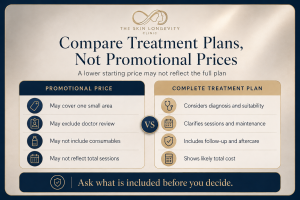
An advertised aesthetic treatment price may cover only one area or session. A complete plan should clarify diagnosis, suitability, consumables, expected sessions, maintenance, follow-up, aftercare and the likely total cost.
6. Compare complete treatment plans, not promotional prices
A low advertised price may refer to one small area, one session or an entry-level version of a treatment. It may not reflect the full course needed to address the concern.
Before agreeing to treatment, ask whether the quotation includes:
- Doctor consultation and assessment
- The full treatment area
- Product quantity or device consumables
- Numbing or medication
- Review appointments
- Aftercare
- GST
- The expected number of sessions
- Future maintenance
A more expensive single treatment may cost less over time if fewer sessions are needed. The opposite may also be true. The relevant comparison is the likely complete plan, not the first number shown in an advertisement.
A legitimate clinic should also be comfortable giving you time to consider the recommendation. Consultation does not require same-day treatment, especially if you are uncertain as a patient.
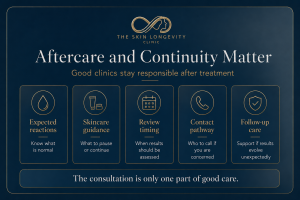
Good aesthetic care continues after the procedure. Patients should receive clear information about expected reactions, skincare, review timing, who to contact with concerns and how unexpected results or complications will be assessed.
7. Look closely at aftercare and continuity
The quality of an aesthetic clinic is often most apparent after treatment. Patients should know which reactions are expected, how long they usually last and which symptoms require medical review.
Before leaving, you should understand:
- What skincare to stop or continue
- Whether exercise, heat, alcohol or sun exposure should be avoided
- When the result should be reviewed
- How to contact the clinic
- What happens if the result is uneven or unexpected
- Who will assess a possible complication
Follow-up is particularly important where results evolve gradually or where treatment is part of a staged plan. A clinic should remain responsible for the care it has provided rather than treating the appointment as a one-off transaction.
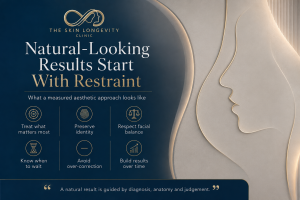
Natural-looking aesthetic results depend on diagnosis, anatomy and clinical judgement. A measured approach prioritises the main concern, preserves facial identity, avoids over-correction and allows results to develop gradually.
8. Consider whether the clinic values restraint
Natural-looking aesthetic treatment is not simply a question of using less product. It requires accurate diagnosis, anatomical judgement, appropriate dosing and an understanding of which features should be left alone.
A measured doctor should be able to tell you:
- Which concerns are worth treating
- Which changes may be normal and do not require correction
- Which treatment should come first
- What can safely wait
- When adding more may make the result worse
The aim should be to improve the concern while preserving identity, balance and normal expression. A treatment plan becomes less natural when every line, hollow or asymmetry is viewed as a defect that requires correction.
9. Match the clinic’s experience to your concern
An aesthetic clinic does not have to be equally focused on every possible treatment. The more relevant question is whether the doctor regularly assesses and manages your particular concern.
Common patient concerns in aesthetic clinics
| Main concern | What the clinical/ doctor's assessment should distinguish |
|---|---|
| Pigmentation | Melasma, sun spots, post-inflammatory pigmentation and deeper pigment |
| Acne | Comedonal, inflammatory, hormonal and treatment-resistant acne |
| Acne scars | Tethered, rolling, boxcar, ice-pick and volume-related changes |
| Dark eye circles | Pigment, visible vessels, hollows, eye bags and thin skin |
| Wrinkles | Dynamic muscle-related lines and static skin changes |
| Large pores | Oiliness, scarring, texture and collagen-related changes |
| Sagging | Skin laxity, fat shift, ligament changes and structural ageing |
| Dull or reactive skin | Barrier disruption, inflammation, dehydration and unsuitable skincare |
The clinic should be able to direct you to the appropriate treatment category or advise when another medical professional would be more suitable.
10. Recognise consultation red flags
A single issue does not always mean that a clinic is unsuitable, but repeated warning signs deserve attention.
Warning and resassuring signs for clinics
| Reassuring signs | Warning signs |
|---|---|
| The skin and face are examined before treatment is recommended | A package is recommended before an assessment |
| Alternatives and limitations are discussed | Only benefits are described |
| Risks are explained in proportionate language | Results are guaranteed |
| The doctor is willing to advise against treatment | Every concern is converted into a procedure |
| Costs and likely sessions are clear | The initial price excludes important components |
| Follow-up arrangements are explained | Responsibility after treatment is unclear |
| You are given time to decide | A discount depends on immediate payment |
Pressure is not evidence that a treatment is urgent. Most elective aesthetic decisions allow time for questions and reflection.
What should happen at a first aesthetic consultation?
A first consultation should clarify your concern, medical history, previous procedures, skincare routine and desired outcome. The doctor should then assess the relevant skin or facial features and explain the likely causes.
The discussion should cover:
- The working diagnosis
- Whether treatment is necessary
- Reasonable alternatives
- Expected degree of improvement
- Risks and downtime
- Number of sessions
- Total estimated cost
- Maintenance and follow-up
You should leave feeling clearer, even when you decide not to proceed. A consultation that creates more confusion than understanding has not achieved its purpose.
Dr Rachel Ho’s clinical perspective: “There is no single best clinic for every patient. The safer choice is a properly licensed clinic with a registered doctor who starts with diagnosis, explains limitations clearly and treats with restraint
Why patients consider Dr Rachel Ho and The Skin Longevity Clinic
Dr Rachel Ho is the founder of The Skin Longevity Clinic and has more than 16 years of clinical experience in Singapore. Her published clinical approach brings together skin science, facial anatomy and longer-term treatment planning, with an emphasis on refined rather than obvious change.
The clinic’s Skin Longevity Assessment reviews barrier health, pigment stability, inflammation, collagen support, facial structure and lifestyle factors before treatment recommendations are made. The purpose is to identify what needs attention, what can wait and whether the skin is ready for a proposed procedure.
The Skin Longevity Clinic is located at 9 Scotts Road, #06-05 Scotts Medical Center at Pacific Plaza, Singapore 228210. Patients should still independently verify any clinic and medical practitioner through Singapore’s official directories before undergoing treatment.
Frequently asked questions about aesthetic clinics in Singapore
Is there one best aesthetic clinic in Singapore?
There is no objective clinic that is best for every patient, concern and treatment. A more reliable approach is to compare licensing, the doctor’s experience, quality of assessment, safety processes, treatment suitability, costs and follow-up.
The right clinic should also match your priorities. A patient seeking acne-scar treatment may assess different experience and technology from someone seeking conservative facial balancing or pigmentation management.
How can I verify an aesthetic clinic and doctor in Singapore?
Search for the provider in the HealthHub directory of licensed healthcare service providers. The doctor can be checked through the Singapore Medical Council’s Professional Search, which provides information on registered medical practitioners.
A doctor must be registered with the Singapore Medical Council and hold a valid Practising Certificate before practising medicine in Singapore.
Should I choose an aesthetic clinic because it owns a particular device?
A device may be relevant, but it should not be the only deciding factor. Diagnosis, patient selection, treatment settings, technique, safety procedures and follow-up all influence the result.
Ask the doctor why that device is preferable to skincare, medication, injectables, another technology or no treatment. The answer should relate directly to your condition.
How can I avoid being pressured into a package?
Ask for a written treatment plan and complete price before paying. You can also request time to consider the recommendation or seek another opinion.
A clinic should be able to explain which treatment is the priority and which options are optional. Several procedures should not be presented as essential without a clear reason.
Is the cheapest aesthetic clinic a good choice?
Price alone does not establish quality or poor quality. The quoted fee should be considered alongside who performs the treatment, what is included, the expected number of sessions, follow-up and the clinic’s ability to manage complications.
The lowest introductory price may not be the lowest overall cost. The most expensive option is not automatically the most suitable either.
Final takeaway on choosing the best aesthetic clinic for yourself
Searching for the best aesthetic clinic in Singapore is understandable, but “best” is not a medical standard. The safest choice is usually a properly licensed clinic with a registered doctor who starts with diagnosis, explains alternatives and limitations, gives clear information about cost and aftercare, and treats with restraint.
A good consultation should help you understand what your skin or face needs, what it does not need and which decisions can wait. That clarity is more valuable than an extensive treatment menu or a limited-time package.
References
- Ministry of Health Singapore. Regulation of Advertisements for Aesthetic Treatments. 2024.
- Singapore Medical Council. Register of Medical Practitioners and Practising Certificate Requirements.
- Ministry of Health Singapore. Health Regulation Watchlist and Official Verification Directories. Updated March 2026.
- Ministry of Health Singapore. Non-Licensed Healthcare Entities Not Permitted to Make Advertising Claims. 2023.
- De-Pablo-Gómez-de-Liaño L, et al. Ophthalmological Complications of Aesthetic Medicine Procedures: A Narrative Review. Journal of Clinical Medicine. 2025. PMID 40807018.
- Arlette JP. Soft Tissue Filler Therapy and Informed Consent. Dermatologic Surgery. 2022. PMID 34310242.
- Specialists Accreditation Board Singapore. Recognised Specialist Titles and Specialist Registration.