

17 May XERF vs Ultherapy in Singapore: Which Skin Tightening Treatment Is Right for You?
By Dr Rachel Ho | Aesthetic Doctor, Founder, The Skin Longevity Clinic, Singapore
XERF vs Ultherapy in Singapore: Which Skin Tightening Treatment Is Right for You?
Patients often compare XERF and Ultherapy when they are looking for skin tightening in Singapore. Both are non surgical aesthetic treatments used for firmness, lifting and collagen support. Both are commonly discussed for the lower face, jawline, neck and mild skin laxity. The key difference is that they use different forms of energy and suit different ageing patterns.
At The Skin Longevity Clinic, XERF is assessed as a dual frequency radiofrequency treatment for selected patients with skin laxity and collagen loss. Ultherapy is a microfocused ultrasound treatment with visualisation that is used to deliver focused ultrasound energy into selected tissue depths. Treatment choice should be guided by skin thickness, facial volume, ageing pattern, inflammation, pigment risk and recovery capacity.
In this review, we will discuss the technologies and benefits of XERF vs Ultherapy; and which treatment would suit different patients better.
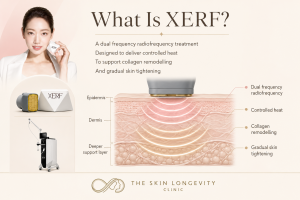
XERF uses radiofrequency energy to deliver controlled heat that may support collagen remodelling and skin tightening in suitable patients.
What is XERF?
XERF is a non surgical skin tightening treatment that uses dual frequency monopolar radiofrequency. The system combines 6.78 MHz and 2 MHz radiofrequency energy to deliver controlled heat into different tissue depths. The aim is to support collagen remodelling, skin firmness and gradual tightening in suitable patients.
Radiofrequency has been used in aesthetic medicine for many years. In skin tightening, controlled heating can cause collagen contraction and stimulate a wound healing response that supports new collagen formation over time. Studies on monopolar radiofrequency have reported improvement in facial laxity and skin firmness in selected patients.
XERF is often considered for mild to moderate laxity, early jawline softening, reduced skin firmness and patients who prefer a needle free treatment with minimal social downtime.
What is Ultherapy?
Ultherapy uses microfocused ultrasound with visualisation. The system delivers focused ultrasound energy into selected tissue depths, including deeper support layers beneath the skin. It is used for non-invasive lifting of the brow, neck and under chin area, and for improving lines and wrinkles on the décolletage, according to official device indications.
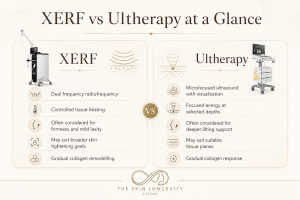
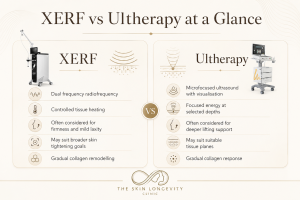
XERF uses radiofrequency, while Ultherapy uses microfocused ultrasound with visualisation.
XERF vs Ultherapy: how do they differ?
XERF uses radiofrequency energy VS Ultherapy uses microfocused ultrasound energy.
Radiofrequency generally works through controlled tissue heating across treatment areas. It is commonly discussed in relation to skin firmness, collagen remodelling and tissue tightening. XERF’s dual frequency design allows energy delivery across different depths, which may be useful when both dermal and deeper soft tissue firmness are part of the concern.
Ultherapy delivers focused ultrasound energy only at selected depths. The treatment is often discussed for lifting support, especially when the concern involves deeper tissue laxity rather than mainly skin surface quality.
A simple way to think about the difference is this. XERF may be preferred when the concern is broader firmness and mild laxity. Ultherapy may be preferred when the concern is superficial lifting support.
What are the benefits of XERF?
XERF may help selected patients with skin firmness, mild to moderate laxity, early jawline softening and collagen support. Patients who want a needle free tightening treatment with little disruption to work or social activities may find XERF appealing.
Another reason patients ask about XERF is comfort. Radiofrequency tightening can feel warm, and patient experience varies, but XERF is often positioned as a more comfortable energy based tightening treatment.
XERF may also fit patients who need gradual support rather than a dramatic change. Results develop over time because collagen remodelling is a biological process.
What are the benefits of Ultherapy?
Ultherapy may benefit selected patients who want non surgical lifting support, especially around the brow, neck, under chin area and lower face. Its focused ultrasound energy can target deeper tissue layers with precision.
Microfocused ultrasound has published evidence for tightening mildly to moderately lax facial skin. A systematic review concluded that microfocused ultrasound treatment is effective for facial skin tightening in female patients with mild to moderate laxity, while also noting the need for better objective outcome studies.
Ultherapy may be suitable for patients who have deeper tissue laxity and want a treatment with established clinical use in non invasive lifting.
How does XERF work?
XERF works by delivering radiofrequency energy into the skin and deeper soft tissue layers. This energy is converted into controlled heat. When delivered appropriately, the heat can stimulate collagen contraction and gradual collagen remodelling.
The face has different skin thicknesses across different areas. The eye area, cheeks, jawline and neck do not tolerate energy in the same way. This is why treatment planning should consider anatomy, tissue thickness and the patient’s ageing pattern.
How does Ultherapy work?
Ultherapy works by delivering focused ultrasound energy into selected tissue layers. The energy creates small zones of thermal effect under the skin, which then stimulate the body’s healing and collagen response.
What is the XERF procedure like?
The XERF procedure begins with consultation and facial assessment. Dr Rachel Ho assesses skin laxity, skin thickness, facial volume, pigment risk, inflammation, previous treatments and treatment goals.
During treatment, the XERF handpiece is applied to the skin and radiofrequency energy is delivered in controlled pulses. Patients usually feel warmth or heat. Common areas include the cheeks, lower face, jawline, submental area and neck.
After treatment, temporary warmth, mild redness or tenderness may occur. Most patients can return to normal daily activities soon after, although individual recovery differs.
What is the Ultherapy procedure like?
Ultherapy also begins with facial assessment. The doctor assesses tissue laxity, treatment depth, facial volume and suitability. During treatment, ultrasound imaging is used to visualise tissue layers before energy is delivered.
Patients may feel heat, prickling, aching or discomfort during energy delivery. Sensation varies depending on treatment area, depth, energy settings and individual tolerance.
After treatment, redness, tenderness, swelling or transient sensitivity may occur. Some patients may feel soreness in treated areas for a period after treatment.
Both XERF and Ultherapy results usually develop gradually because collagen response takes time.
How long does it take to see results for XERF vs Ultherapy?
For XERF, some patients may notice early firmness, but collagen related improvement usually develops over weeks to months. This timing reflects the biology of collagen remodelling.
For Ultherapy, results also develop gradually. Some patients notice early changes, but visible lifting and tightening commonly evolve over several months as collagen response develops.
For both treatments, final results should not be judged too early. A review allows the doctor to assess response and decide whether maintenance or combination treatment is needed.
How long do results last for XERF vs Ultherapy?
Results vary for both XERF and Ultherapy. Duration depends on age, collagen response, degree of laxity, skin quality, weight change, sun exposure, lifestyle and maintenance treatment.
Neither treatment stops ageing. Both may be used as part of a maintenance plan. Some patients may benefit from periodic tightening treatments, while others may need a different treatment direction if their concern is mainly volume loss, pigmentation, acne scars or advanced sagging.
Is there downtime for XERF vs Ultherapy?
Both XERF and Ultherapy are generally associated with almost no recovery downtime. Patients may return to usual activities soon after treatment, depending on individual response.
Possible effects after XERF include temporary warmth, redness, tenderness or swelling. Possible effects after Ultherapy include redness, swelling, pain, tenderness and transient nerve related effects.
Can XERF and Ultherapy be combined with other treatments?
Yes, both XERF and Ultherapy may be combined or sequenced with other treatments depending on diagnosis.
Patients with pigmentation may need sunscreen, pigment control and lasers. Patients with acne scars may need RF microneedling or fractional resurfacing. Patients with facial volume loss may need dermal fillers or collagen biostimulators. Patients with dynamic wrinkles may need botulinum toxin.
Combination treatment can be useful when different layers are ageing together. Timing should be planned carefully because too many procedures performed too close together can increase irritation, swelling or pigment risk.
XERF vs Ultherapy: which is right for you?
XERF may be considered when the main concern is mild to moderate laxity, skin firmness, early jawline softening and collagen support. It may suit patients who prefer radiofrequency based tightening and a more comfortable treatment experience.
Ultherapy may be considered when mild, superficial lifting support is the main goal.
Some patients may suit neither as a first step. A patient with marked volume loss may need structural support. A patient with advanced sagging may need surgical assessment. A patient with active inflammation or unstable pigmentation may need skin stabilisation first. The best choice comes from the right diagnosis and treatment(s) that are appropriate.
Doctor Rachel’s Takeaway on XERF vs Ultherapy
XERF and Ultherapy are both useful non surgical skin tightening treatments, but they are not interchangeable.
XERF uses dual frequency radiofrequency and is often considered for firmness, mild laxity and collagen support. Ultherapy uses microfocused ultrasound with visualisation and is often considered for milder, superficial lifting support in suitable patients.
At The Skin Longevity Clinic, treatment choice is guided by skin thickness, facial volume, ageing pattern, inflammation, pigment risk and recovery capacity. The aim is to choose the treatment that fits the diagnosis, the patient’s face and the longer term plan.
References
1. XERF Structural Skin Tightening. Cynosure Lutronic. 2026.
2. Ultherapy: Non Invasive Skin Lifting Treatment. Ultherapy Official Website. 2026.
3. Ultherapy Singapore Official Device Indications. Ultherapy Singapore. 2026.
4. A Systematic Review of the Efficacy of Microfocused Ultrasound for Facial Skin Tightening. Contini M, et al. International Journal of Environmental Research and Public Health. 2023. Volume 20, Issue 2.
5. Efficacy and Safety of Monopolar Radiofrequency for Skin Tightening: A Systematic Review. Shin JM, et al. Cosmetics. 2024. Volume 11, Issue 3.
6. Radiofrequency Based Treatments for Facial Rejuvenation: A Systematic Review. Kumar N, et al. Aesthetic Surgery Journal Open Forum. 2025.