

06 Aug PDLLA-HA Skin Boosters Explained: How PDLLA and Hyaluronic Acid Work Together
By Dr Rachel Ho | Aesthetic Doctor, Founder, The Skin Longevity Clinic, Singapore
PDLLA-HA Skin Boosters Explained: How PDLLA and Hyaluronic Acid Work Together
One of the most common points of confusion in Singapore aesthetic medicine is what, exactly, a PDLLA-HA skin booster is. The name combines two very different ingredients with two very different jobs. Understanding how they work together, and how that differs from a conventional filler, is the clearest way to set the right expectations before treatment.
This article looks under the bonnet of the PDLLA-HA skin booster. For the broader overview of uses, cost and safety, see our complete guide to PDLLA skin boosters in Singapore.
What “PDLLA-HA” Means
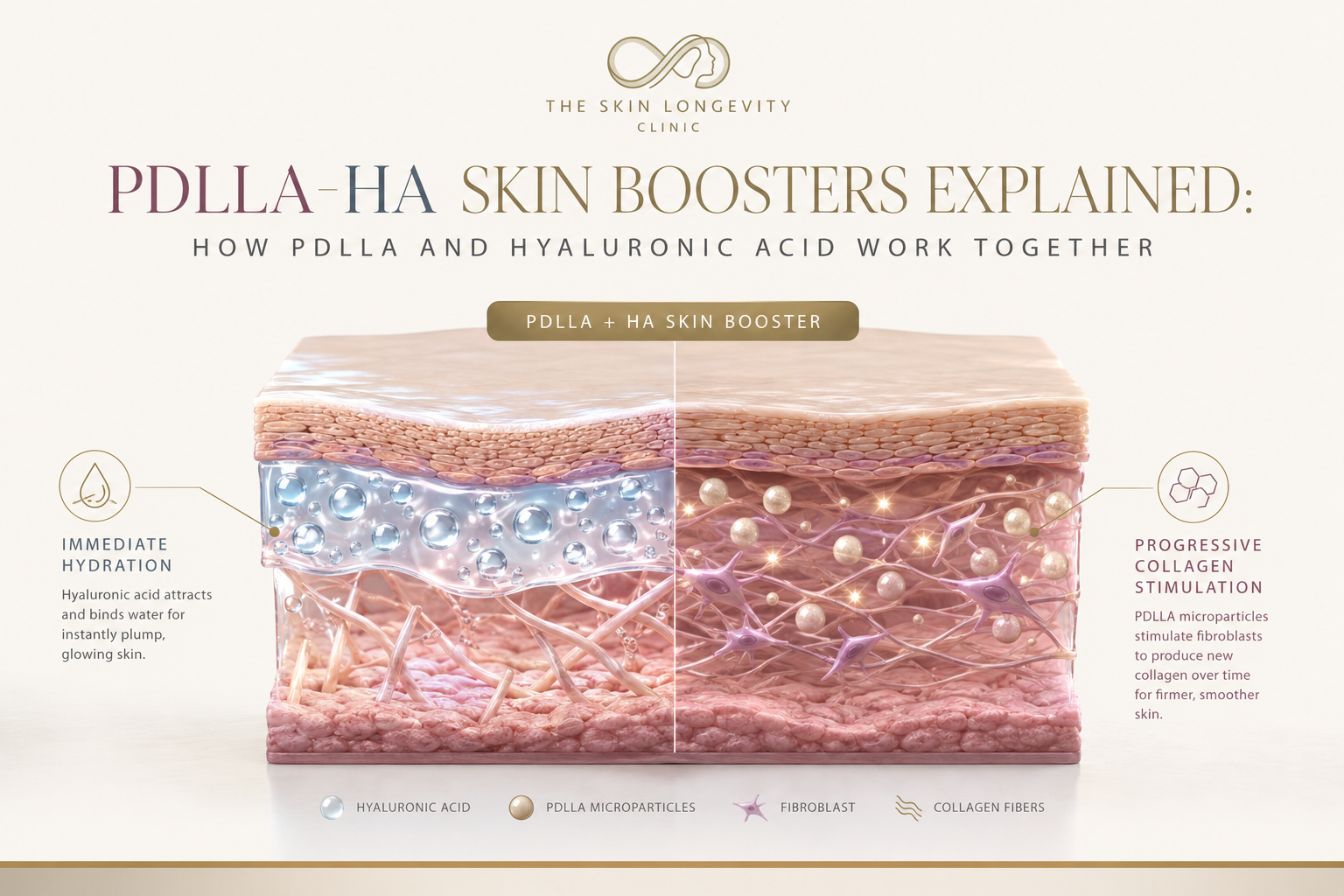
A PDLLA-HA skin booster is a hybrid injectable. It contains poly-D,L-lactic acid, a biodegradable, biocompatible collagen-stimulating polymer, suspended in a gel that also contains hyaluronic acid, the water-binding molecule found naturally in skin.
The logic of the combination is straightforward. Hyaluronic acid works immediately but temporarily. PDLLA works slowly but durably. Pairing them means a patient is not left with nothing visible while they wait for collagen to build, and the skin receives both hydration and progressive biostimulation from a single treatment.
The Hyaluronic Acid Component: Immediate Hydration
Hyaluronic acid is a humectant; it draws and holds water. In a PDLLA-HA skin booster, the hyaluronic acid is present in a relatively small quantity and its role is to give the skin an early lift in hydration, smoothness and light. This is the part of the result that patients can often notice within the first week or two.
Crucially, this hydration is not the lasting outcome. The hyaluronic acid component is gradually metabolised by the body over weeks. By the time it has gone, the PDLLA component should be well into its work, so the early hydration effect hands over to the slower collagen-driven improvement rather than simply fading.
The PDLLA Component: The Science of the Microparticles
The lasting result of a PDLLA-HA skin booster comes from the PDLLA microparticles. PDLLA is an amorphous polymer, a racemic mixture of D- and L-lactic acid units, and its particles are small, with a median size in the region of 20 micrometres, smaller than the particles of its crystalline cousin PLLA. Once placed in the dermis, they set up a controlled, low-grade foreign-body response.
That response is the engine of the treatment. It encourages fibroblasts, the skin’s collagen-producing cells, to ramp up activity and lay down new collagen, a process called neocollagenesis, while also supporting elasticity and broader tissue regeneration. Over the following months the PDLLA itself is biodegraded and cleared by the body. What remains is the patient’s own new collagen. A 2024 review of PDLLA in dermatology by Lee and colleagues, published in the journal Polymers, gathered the clinical evidence for improved firmness, elasticity and wrinkle reduction following this mechanism.
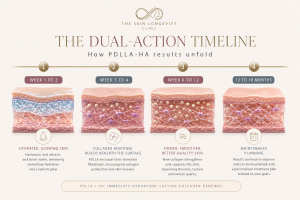
How PDLLA-HA skin boostser results unfold: early hydration appears first, followed by gradual collagen renewal, firmer skin and longer-term skin quality improvement.
What Happens to PDLLA in the Skin Over Time
It reassures many patients to understand that a PDLLA skin booster does not leave a permanent foreign material in the skin. PDLLA is biodegradable. Once injected, the microparticles are gradually broken down by the body and cleared through normal metabolic pathways, the same broad principle behind dissolvable surgical sutures, which have been used safely for decades.
The sequence, then, is straightforward. In the early phase, the particles are present and act as a stimulus, signalling fibroblasts to produce collagen. Over the following months, the PDLLA itself is steadily resorbed and disappears. What remains is not the product but the patient’s own newly formed collagen. This is why the result of a PDLLA skin booster is sometimes described as “the treatment leaves but the collagen stays”, and why the improvement is biological rather than a matter of stored material.
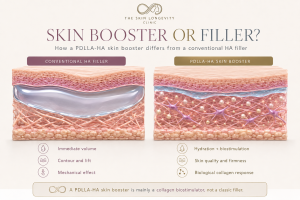
PDLLA skin booster vs filler: PDLLA skin booster is used mainly for hydration, collagen stimulation and skin quality, while conventional fillers are used more for structure and volume.
Is a PDLLA Skin Booster a Filler?
This is the question patients ask most, and the honest answer is: mostly not. A conventional hyaluronic acid dermal filler works by physical replacement. It is a gel that occupies space beneath the skin, lifts a fold or builds a contour, and is visible the moment it is injected. Its effect is mechanical and immediate.
A PDLLA-HA skin booster works mainly by biological stimulation. The lasting change is collagen that the skin grows itself, prompted by the PDLLA. It improves the quality and firmness of the skin rather than primarily adding contour. The small hyaluronic acid component does provide a brief, filler-like hydration effect, but that is the supporting act, not the main event.
One nuance is worth noting. PDLLA is manufactured in different formulations: some, used as dermal fillers, provide a degree of immediate volume restoration alongside biostimulation, while a standard PDLLA-HA skin booster is used chiefly for skin quality and is best thought of as a collagen biostimulator. So PDLLA can sit anywhere on a spectrum from biostimulator to hybrid filler, depending on the product. We compare PDLLA against other biostimulators in our guide to PDLLA vs PLLA vs ECM skin boosters.
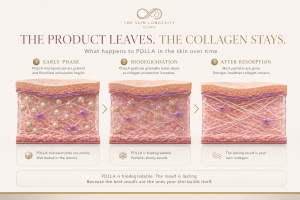
What happens after treatment: PDLLA particles gradually biodegrade, while the collagen response they stimulate helps support firmer, healthier-looking skin over time.
The Dual-Action Timeline of PDLLA-HA skin boosters
Because two ingredients act on two timescales, it helps to picture the result unfolding in stages. In the first one to two weeks, the hyaluronic acid delivers an early hydration and smoothness effect, while any initial swelling or small bumps from the injections settle. From around the third or fourth week, as a second session is often given, the collagen response is building beneath the surface even though the change is not yet dramatic.
Between roughly six and twelve weeks, new collagen becomes the visible story, with firmer, smoother, better-quality skin. The result continues to refine for some months after the final session and then holds, typically for twelve to eighteen months, before a maintenance session is considered. Our PDLLA skin booster FAQ sets out this timeline in practical detail.
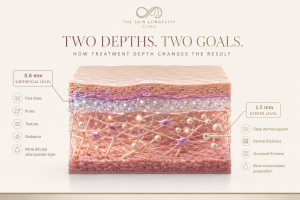
Why treatment depth matters: PDLLA skin booster can be tailored to different skin-quality goals, from superficial texture and pores to deeper dermal support and firmness.
How The Skin Longevity Clinic Works With PDLLA at Two Depths
Dr Rachel Ho describes the craft of a PDLLA-HA treatment as working the product at the right depth, and matching its dilution, and sometimes the product itself, to that depth. She works to two main levels. The superficial level sits at a depth of around 0.8 millimetres and targets fine lines, pores and wrinkles; the deeper level sits at roughly 1.5 millimetres and builds the thickness of the deep dermis.
When treatment is carried out skin-booster style at the superficial 0.8-millimetre depth, the PDLLA is often mixed with hyaluronic acid and other ingredients chosen for radiance and glow, and prepared as a more diluted mixture, made up to around 6 millilitres. The aim at this level is skin quality: brighter, smoother, more refined skin.
When the goal is deeper structural support, the product is placed at around 1.5 millimetres. Here a more concentrated preparation is used, and a PDLLA, or a PLLA with a higher particle size, is selected to build dermal thickness. Matching depth, dilution and even the choice of polymer to the goal is, in Dr Ho’s experience, what allows this family of biostimulators to address both surface quality and deep structural support.
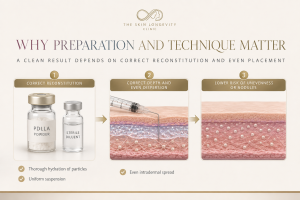
Preparation and technique are key: correct reconstitution and even placement help PDLLA skin booster perform as intended and reduce the risk of irregularity or nodules.
Why Preparation and Technique Matter for PDLLA-HA skin boosters
Two things determine whether a PDLLA-HA skin booster behaves as it should: the product and the hands delivering it. PDLLA skin boosters frequently arrive as a powder that must be reconstituted with sterile water and allowed to hydrate before use. This step is more than a formality. Because PDLLA is amorphous, its particles tend to aggregate and deform once dispersed, so thorough, correct reconstitution is what produces an even, predictable suspension. Incomplete reconstitution is a recognised contributor to nodule formation.
Injection technique is equally decisive. The product must be placed at the correct depth, in the correct plane, and spread evenly, because PDLLA clustered in one spot or placed too superficially is the main avoidable cause of small nodules. Appropriate massage after treatment helps the suspension settle smoothly, and newer delivery methods, including needle-free injection systems studied for even intradermal dispersion, are part of the same effort to place product uniformly. These are not incidental details; they are the difference between a clean result and a complication.
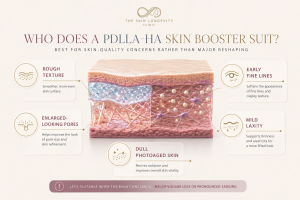
Who PDLLA-HA skin boosters suits best: patients with rough texture, pores, early lines, mild laxity and dull, photoaged skin rather than major reshaping.
Who a PDLLA-HA Skin Booster Suits
Because of how it works, a PDLLA-HA skin booster suits patients whose main concern is the condition of their skin rather than its shape: rough or uneven texture, early fine lines, mild laxity, dullness, enlarged-looking pores and generally photoaged skin. The pairing of early hydration with progressive collagen building also suits people who want a degree of immediate freshness alongside a slower, structural gain. PDLLA has additionally been studied for moderate correction of folds such as the nasolabial folds, where a 2024 randomised trial by Ting and colleagues, in Aesthetic Surgery Journal, found it non-inferior to hyaluronic acid over 52 weeks.
It is a weaker first choice where the dominant problem is major volume loss or pronounced sagging, which a single biostimulating skin booster is not designed to correct, and it is deferred during pregnancy and breastfeeding and used with extra care in patients with a history of keloid scarring or an autoimmune condition. Suitability, in the end, is a clinical decision, and it is one that should be made in a consultation rather than from a treatment menu.
Why the Combination Suits Skin-Quality Concerns
The PDLLA-HA design is particularly well matched to concerns that are about the condition of the skin itself rather than its shape: rough or uneven texture, enlarged-looking pores, early fine lines, crepiness and a tired, dull appearance. By improving the firmness and collagen content of the dermis, the treatment addresses the foundation those concerns sit on. Our article on PDLLA for enlarged pores and skin texture is a good example of the mechanism applied to a specific concern.
Whether a PDLLA-HA skin booster is the right tool for your skin is a clinical judgement, not a marketing one. At The Skin Longevity Clinic, that judgement follows a proper assessment, in keeping with the clinic’s evidence-based approach. To discuss your skin, you are welcome to arrange a consultation.
Continue Reading: More From Our PDLLA Skin Booster Series
These guides form one connected series. The articles below have already been published, and you may find them useful alongside this one: