

04 Aug Loose Skin After Weight Loss: RF Skin Tightening Options
By Dr Rachel Ho | Aesthetic Doctor, Founder, The Skin Longevity Clinic, Singapore
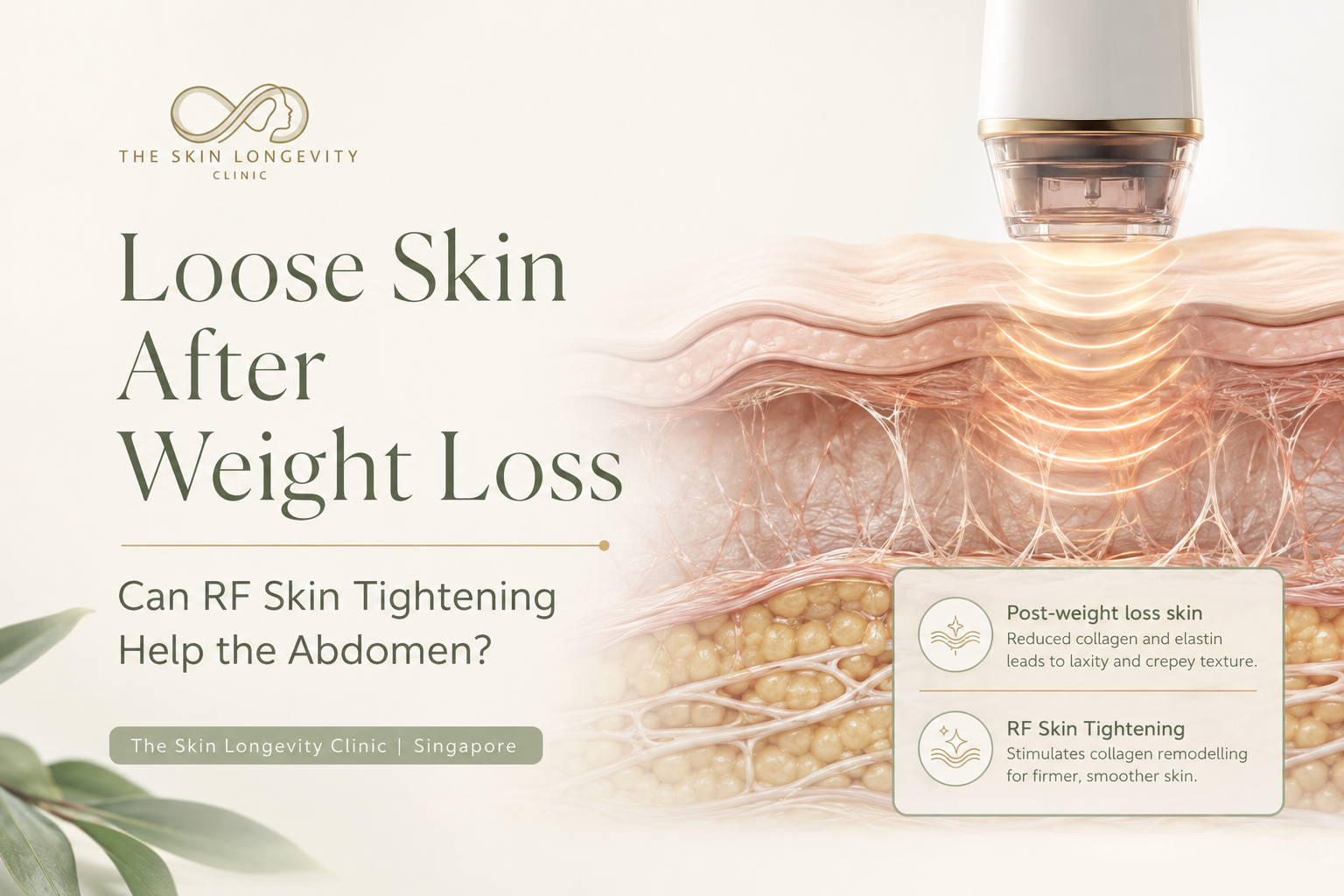
Loose Skin After Weight Loss: Can RF Skin Tightening Help the Abdomen?
Loose skin after weight loss is one of the most common and most frustrating outcomes of a major body-composition change. The work of losing weight is real; the loose belly skin that often follows can feel like a result you did not expect or sign up for. This guide explains why skin does not always retract after weight loss, what the mild, moderate and severe ranges of laxity look like in practice, and where non-surgical options such as RF skin tightening and XERF can — and cannot — help.
If you are at the start of working out which treatment is right for you, see our guide to loose skin on the stomach for context, and our complete guide to XERF in Singapore for the underlying technology.
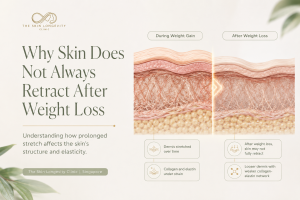
Loose belly skin can remain after weight loss because stretched collagen and elastin do not always retract in proportion to the reduction in body volume.
Why Skin Does Not Always Retract After Weight Loss
When you gain weight, the dermis stretches to accommodate the larger volume. The collagen and elastin network is loaded for as long as the volume is there. When the volume reduces — sometimes substantially — the dermal architecture does not always retract proportionally. Younger skin with more elastin and less cumulative sun damage tends to recover better. Older skin, skin that has been stretched for longer or skin that was repeatedly stretched through fluctuating weight tends to recover less. The result is loose belly skin that does not respond to continued dieting or exercise, because the change is in the skin itself, not in fat.
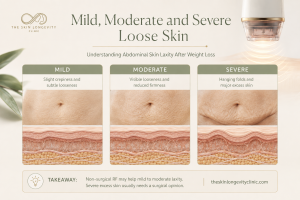
The degree of abdominal skin laxity determines treatment suitability. Non-surgical body tightening may help mild to moderate looseness, while severe hanging skin usually requires a surgical opinion.
Mild, Moderate and Severe Loose Skin: The Practical Difference
The most important question for treatment planning is which range your laxity sits in.
Mild loose skin includes slight crepiness, a soft change in texture and a lower-abdomen overhang that disappears when standing tall. Non-surgical treatment is realistic in this range.
Moderate loose skin includes visible looseness when sitting or bending, a clear loss of firmness, often with some crepey surface texture. Non-surgical treatment can still help in many cases, but expectations need to be tempered.
Severe loose skin includes hanging folds even at rest, skin that drapes when standing, often with stretch marks. This is the range where a surgical opinion is usually more honest, because no non-invasive device can remove excess skin.
A clear-eyed read of your own laxity is what separates a useful treatment plan from a disappointing one.
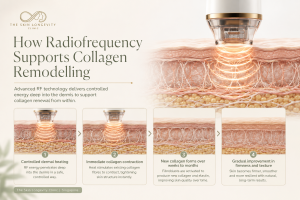
RF skin tightening for the abdomen uses controlled dermal heating to contract existing collagen and stimulate gradual collagen and elastin remodelling.
How Radiofrequency Supports Collagen Remodelling
RF skin tightening uses radiofrequency energy to heat the dermis in a controlled way. The heat causes a small immediate collagen contraction and triggers a wound-healing response that drives new collagen formation over the following weeks and months. Cleveland Clinic notes that RF results typically develop gradually and that RF is not as effective for severely sagging skin — which is the right frame for thinking about whether it will help your specific case.
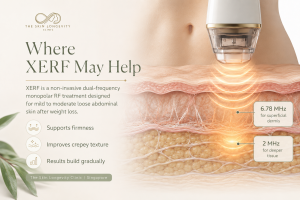
XERF combines 6.78 MHz and 2 MHz monopolar radiofrequency to work at different tissue depths, supporting firmness and crepey abdominal skin texture in suitable patients.
Where XERF Can Help With Texture and Firmness
XERF is a non-invasive dual-frequency monopolar radiofrequency treatment. Its dual-frequency design — 6.78 MHz for the more superficial dermis and 2 MHz for deeper tissue — lets the operator address both surface crepiness and deeper laxity. For mild-to-moderate loose skin after weight loss, this can translate into a gradual improvement in firmness and skin texture across the treated abdominal zone. It is the same biology used on the face, applied to the abdomen, with the same gradual timeline.
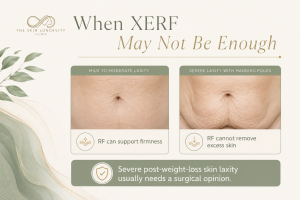
XERF can support collagen and firmness, but it cannot remove excess skin. Severe post-weight-loss abdominal folds are more appropriately assessed for body-contouring surgery.
When XERF May Not Be Enough
If your skin hangs in folds, if there is a substantial skin overhang after a large weight loss (for example, after bariatric surgery), or if there is also abdominal wall separation, XERF is not the answer. RF skin tightening can support firmness but cannot remove skin. A surgical opinion — usually an abdominoplasty, sometimes combined with diastasis recti repair — is the honest answer at that point. A reputable clinic will tell you this rather than push a non-surgical treatment beyond its useful range.
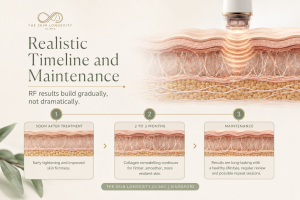
XERF abdomen results develop gradually. Early firmness may be followed by more visible collagen remodelling over two to three months, with maintenance guided by individual response.
Realistic Timeline and Maintenance for XERF abdomen and body skin tightening
RF results, including XERF, build over weeks and months. A small early firming effect from collagen contraction is typically visible soon after a session; the more meaningful change becomes clearer as new collagen forms. A two-to-three-month review interval is the right time to evaluate the response and decide whether further sessions or maintenance are appropriate.
Dr Rachel Ho, MBBS, MMed(ENT), Founder and Medical Director of The Skin Longevity Clinic, frames non-surgical skin tightening for weight-loss patients the same way she does for facial laxity: results build gradually rather than dramatically, and the right candidate is someone whose laxity sits within the range RF can realistically support. Patients with mild-to-moderate loose skin after weight loss often find a planned RF course useful; patients with severe laxity are guided towards a surgical opinion rather than a longer course of non-invasive treatment.
At The Skin Longevity Clinic, every consultation for loose skin after weight loss begins with the same doctor-led skin longevity assessment used for facial laxity. The assessment evaluates skin quality, dermal thickness, laxity severity, residual volume, pigment risk and recovery capacity, then asks the honest question: is XERF the right tool for this patient’s laxity, or is another treatment — or a surgical opinion — more appropriate? Treatment is only planned when the answer is yes. If you are unsure where to begin, a skin longevity assessment is a sensible first step.
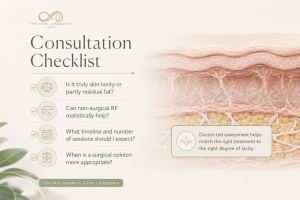
A doctor-led assessment distinguishes loose abdominal skin from residual fat and determines whether XERF body tightening, another non-surgical treatment or a surgical opinion is more appropriate.
Consultation Checklist for Loose Skin After Weight Loss
- whether the visible change is genuinely skin laxity or partly residual fat
- whether non-surgical RF skin tightening can realistically help in your range of laxity
- the expected timeline, number of sessions and likely maintenance plan
- what the limits of treatment are, and at what point a surgical opinion makes more sense
Frequently Asked Questions about XERF treatments for abdomen and body
Can RF skin tightening help loose skin after weight loss?
For mild to moderate laxity, yes, in suitable candidates. For severe laxity with excess skin, a surgical opinion is usually more appropriate.
Is XERF good for stomach skin after weight loss?
XERF can be used for mild to moderate post-weight-loss abdominal skin laxity. It does not remove excess skin and is not a substitute for an abdominoplasty when laxity is advanced.
How long does it take to see results from RF skin tightening after weight loss?
The more meaningful change usually becomes visible at the two-to-three-month mark, as new collagen forms.
Will XERF help if I have a lot of loose skin after major weight loss?
If the laxity is severe, with hanging folds, XERF is not the right treatment. A surgical opinion is the honest answer for that range.
Related XERF and Skin Tightening Guides
For the broader picture, see our guide to loose skin on the stomach, and the dedicated treatment article on XERF for abdominal skin tightening. For more about the technology and science behind XERF, see our complete guide to XERF in Singapore.
Loose Skin After Weight Loss at The Skin Longevity Clinic
The Skin Longevity Clinic is a doctor-led practice in the Orchard area of Singapore. Patients with loose skin after weight loss are assessed honestly: when XERF or another non-surgical option can realistically help, that is what is recommended; when a surgical opinion is more appropriate, that is the answer.
If you would like to understand which treatment fits your skin, you can contact The Skin Longevity Clinic to arrange a consultation.