

24 May PDLLA Skin Boosters in Singapore: A Complete Evidence-Based Guide
By Dr Rachel Ho | Aesthetic Doctor, Founder, The Skin Longevity Clinic, Singapore
PDLLA Skin Boosters in Singapore: A Complete Evidence-Based Guide
Over the past few years, collagen-stimulating injectables have changed how aesthetic doctors in Singapore think about skin quality. Among them, the PDLLA skin booster has drawn particular attention, because it offers something that hydration-only treatments cannot: a gradual, structural improvement in the skin, built largely from the patient’s own collagen. This guide explains what a PDLLA skin booster actually is, how the science works, what it can realistically treat, and what it costs in Singapore, without the marketing gloss.
It is the central reference for our wider library on PDLLA and collagen skin boosters, linking out to deeper guides on cost, safety, treatment areas and specific skin concerns. At The Skin Longevity Clinic, every injectable decision begins with a clinical assessment rather than a treatment menu, an approach explained in our piece on Dr Rachel Ho’s skin longevity philosophy.
What Is a PDLLA Skin Booster?
PDLLA stands for poly-D,L-lactic acid, a biodegradable, biocompatible synthetic polymer from the same chemical family as the materials used for decades in dissolvable surgical sutures. A PDLLA skin booster is an injectable suspension of microscopic PDLLA particles, placed into the skin to stimulate the body’s own production of collagen. Over the weeks that follow, the particles are gradually broken down and the new collagen remains, which is why results appear progressively rather than instantly.
This is the key distinction that confuses many patients. A traditional hyaluronic acid filler physically occupies space beneath the skin and is visible immediately. A PDLLA skin booster works primarily as a collagen biostimulator, prompting the skin to rebuild its own scaffolding. The result is an improvement in skin quality, firmness and texture rather than added volume or contour. We explain the full mechanism, and answer the common question of whether PDLLA is a filler, in our guide to the PDLLA-HA skin booster.
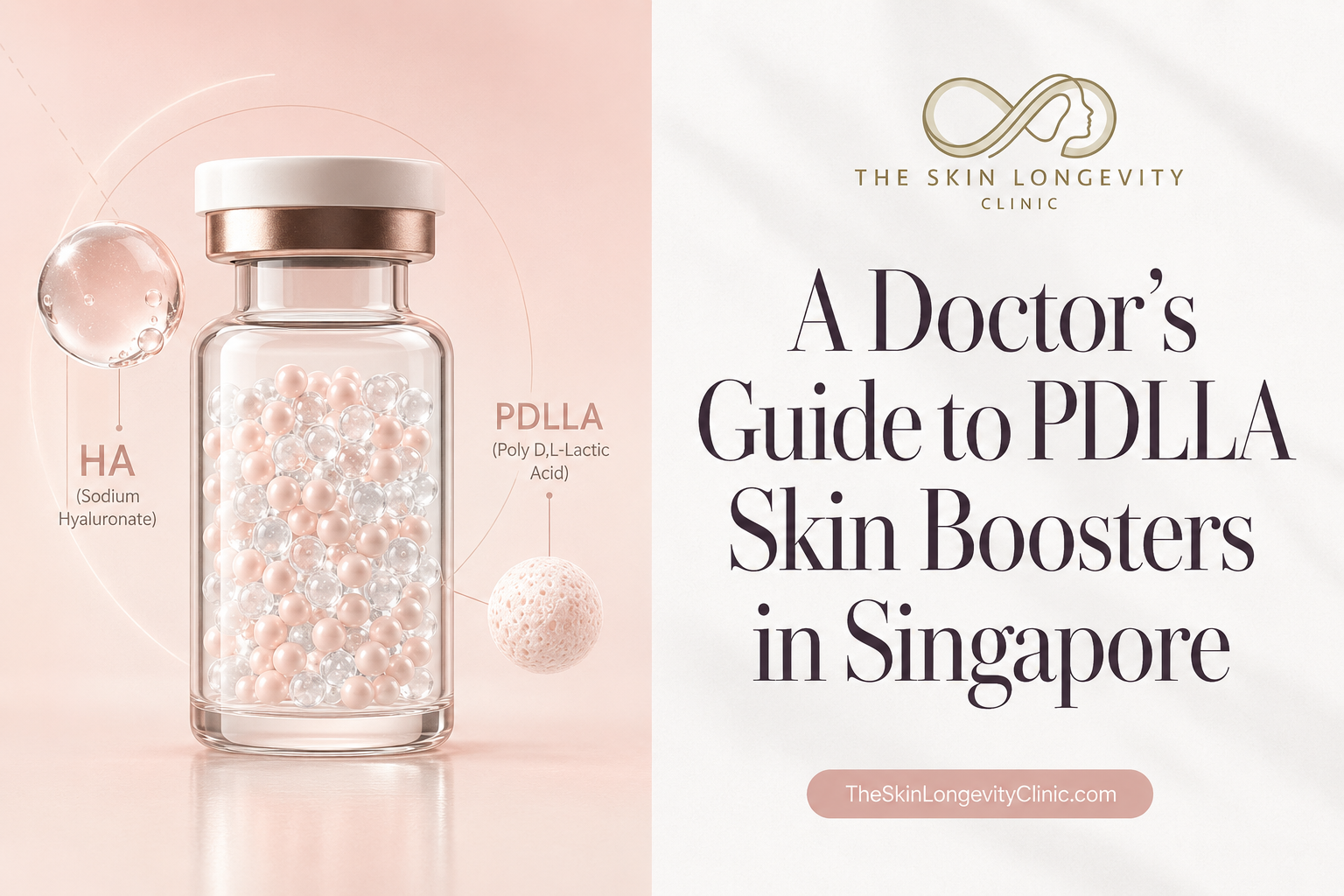
Several PDLLA products are used in aesthetic practice in Singapore. The form most often discussed as a skin booster in Singapore is a South Korean-developed injectable that combines PDLLA microparticles with a small amount of hyaluronic acid; the hyaluronic acid provides immediate, light hydration while the PDLLA works gradually in the background. Whichever product is used, patients should always confirm that the material is registered with Singapore’s Health Sciences Authority and administered by a licensed doctor.
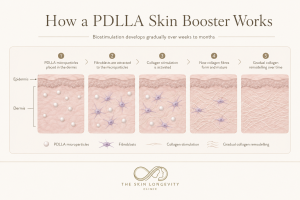
PDLLA skin boosters work gradually by stimulating fibroblasts and supporting new collagen formation over time.
The Science: How PDLLA Builds Collagen
The behaviour of a PDLLA skin booster comes down to the chemistry of its particles. PDLLA is an amorphous polymer, a racemic mixture of D- and L-lactic acid units, and its microparticles are small, with a median size in the region of 20 micrometres. Once suspended and injected into the dermis, these particles set up a controlled, low-grade foreign-body response, and it is that measured response which switches on the skin’s repair machinery.
That repair response is the treatment. The particles prompt fibroblasts, the cells responsible for building connective tissue, to increase their activity and lay down fresh collagen, a process known as neocollagenesis. As the PDLLA is slowly metabolised and cleared, the newly formed collagen remains as the lasting result. A 2024 review of PDLLA in dermatology by Lee and colleagues, published in the journal Polymers, drew together clinical studies reporting improved skin elasticity and firmness, reduced wrinkles and broader tissue regeneration following this mechanism.
Because this is a biological process, time matters. Collagen remodelling unfolds over weeks and months, which is why a realistic expectation is essential before starting. Our guide to how PDLLA and hyaluronic acid work together covers the cellular detail for readers who want it.
It is worth being clear about what this mechanism does not do. PDLLA does not paralyse muscles, it does not lift sagging tissue, and it does not replace lost facial volume in the way a structural filler would. Its main effect is mediated through collagen. That is a strength when the concern is genuinely one of skin quality, and a limitation when the concern is something else. Matching the treatment to the problem is the single most important decision in the whole process, and it is why a proper assessment comes before any needle.
PDLLA skin boosters work gradually by stimulating fibroblasts and supporting new collagen formation over time.
What PDLLA Skin Boosters Can Treat
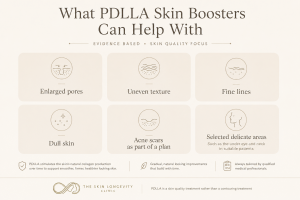
PDLLA skin boosters are best understood as a skin-quality treatment. They are not a contouring tool, and they are not a substitute for sun protection or good skincare. Within their proper scope, however, they address several of the most common concerns seen in a Singapore aesthetic practice, and the supporting evidence is steadily growing.
Enlarged pores and uneven texture
By improving the firmness of the skin around each pore opening, collagen stimulation can make pores appear less prominent and the overall surface smoother. Our article on PDLLA for enlarged pores and skin texture explains what the clinical evidence shows, and what it does not.
Fine lines and dull, tired-looking skin
Early lines and a loss of natural radiance often reflect thinning collagen and slower cell turnover. A collagen-led approach addresses the underlying structure rather than only the surface, as we discuss in our guide to PDLLA for fine lines and dull skin.
Acne scars
Atrophic, or indented, acne scars are an area of strong patient interest. PDLLA can contribute to smoother skin and is often combined with other techniques, but it is not a stand-alone cure. We set out an honest assessment in PDLLA for acne scars in Singapore.
Delicate areas: the under-eye and neck
Thin-skinned regions such as the lower eyelid and neck demand particular caution and an experienced injector. Our dedicated guide to PDLLA for the under-eye and neck explains how these areas are treated safely.
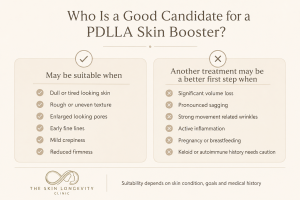
PDLLA skin boosters may suit patients with skin quality concerns, while other treatments may be more appropriate for volume loss, sagging or active inflammation.
Who Is a Good Candidate for a PDLLA Skin Booster?
PDLLA skin boosters tend to suit adults who are bothered by the quality of their skin rather than its shape: dullness, rough or uneven texture, enlarged-looking pores, early fine lines, mild crepiness and a general loss of firmness. They also suit patients with photoaged skin and those who want both a degree of immediate freshness and progressive biostimulation. Many are in their thirties, forties and fifties, although suitability is about skin condition and goals, not age alone.
PDLLA is less appropriate as a first choice where the dominant concern is significant volume loss, pronounced sagging or strong movement-related wrinkles, each of which is better served by a different treatment. It is also deferred during pregnancy and breastfeeding, and used with extra care in patients who have a history of keloid scarring or an autoimmune condition. The honest position is that PDLLA is excellent for the right concern and the wrong tool for others; establishing which applies to you is the purpose of a consultation.
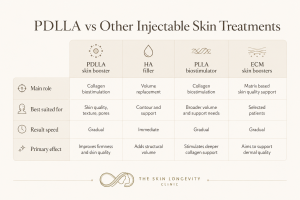
Different injectable skin treatments support different concerns, so selection should be guided by the main skin issue and treatment goal.
How PDLLA Compares With PLLA and ECM Skin Boosters
PDLLA is one of several collagen-stimulating injectables available in Singapore. Poly-L-lactic acid, or PLLA, is a closely related but semicrystalline biostimulator. Extracellular matrix, or ECM, boosters are a different and more varied category again, and one where safety depends heavily on what the product actually contains. Each has its place, and the right choice depends on the concern being treated and the patient’s skin. We compare all three side by side, including the important safety differences, in PDLLA vs PLLA vs ECM skin boosters.
What to Expect From a Course of PDLLA Skin Booster Treatment
A PDLLA skin booster is delivered as a short in-clinic procedure. After cleansing and the application of numbing cream, the product is injected across the treatment area using a fine needle or a blunt cannula; needle-free delivery systems, designed to disperse product evenly with minimal trauma, are also emerging. Most patients describe the discomfort as mild and the appointment itself takes around thirty to forty-five minutes.
Because collagen building is gradual, a course rather than a single session is the norm. Most protocols involve two to four sessions spaced roughly three to four weeks apart, with visible change developing over the following two to three months and continuing to refine thereafter. Downtime is generally limited to minor redness, small injection bumps or mild swelling that settle within a few days. Our PDLLA skin booster FAQ answers the practical questions on downtime, session numbers, results timeline and aftercare in full.
Is a PDLLA Skin Booster Safe?
PDLLA is made from a well-characterised, biodegradable material with a long track record in medicine, and PDLLA skin boosters are generally well tolerated. The most common side effects are temporary: redness, swelling, tenderness, bruising and small palpable bumps at injection points. These typically resolve within several days.
The side effect that warrants the most attention is the formation of nodules or, very rarely, granulomas. The overall risk is low, but it is influenced by technique. Because PDLLA particles are amorphous and tend to aggregate once dispersed, thorough reconstitution and even placement genuinely matter, which is why injector experience is not an optional extra. We discuss safety, contraindications and how to reduce risk in our guide to PDLLA cost, side effects and what to know before booking.
Dr Rachel Ho on What a PDLLA Skin Booster Really Is
One distinction matters more than any other, and it is the one Dr Rachel Ho, founder of The Skin Longevity Clinic, finds patients most often get wrong. Patients tend to assume these treatments are fillers, or even ordinary hydrating skin boosters, she explains. They are neither. They are biostimulators: their purpose is to stimulate the skin to produce its own collagen.
In her clinical experience, it helps to picture the effect at two depths. Worked at the superficial layer, a PDLLA biostimulator improves fine lines, pores and wrinkles; placed more deeply, it builds the thickness of the deep dermis. Understanding that two-layer effect, Dr Ho says, is the key to setting realistic expectations and to choosing the right depth for each concern, and it is why she treats the word “booster” as a description of the result rather than the mechanism.
Choosing the Right Clinic in Singapore
A PDLLA skin booster is a medical treatment, and the outcome depends heavily on the assessment and technique behind it. Before committing, patients should look for a doctor-led consultation, HSA-registered products, a candid discussion of whether PDLLA is genuinely the right choice for their concern, and a clear aftercare pathway. A clinic that is willing to say a treatment is not suitable is often the one worth trusting.
At The Skin Longevity Clinic, PDLLA skin boosters are offered within a broader, evidence-based approach to healthy skin ageing rather than as a one-size-fits-all package. To discuss whether a PDLLA skin booster suits your skin, you are welcome to arrange a consultation. For the thinking behind our approach, see Dr Rachel Ho on skin longevity.