

02 Jun PDLLA Skin Booster Singapore: Cost, Side Effects and What to Know Before You Book
By Dr Rachel Ho | Aesthetic Doctor, Founder, The Skin Longevity Clinic, Singapore
If you are considering a PDLLA skin booster, two questions usually come first: how much will it cost, and is it safe? Both deserve a straight answer. This guide sets out indicative PDLLA pricing in Singapore, explains why quotes vary so widely, and gives an honest, evidence-based account of the side effects and safety considerations, so you can walk into a consultation already well informed.
For the wider picture of how the treatment works, start with our complete guide to PDLLA skin boosters in Singapore. This article focuses on the practical decision: cost, risk and how to choose well.
PDLLA Skin Booster Cost in Singapore
There is no single PDLLA price in Singapore. Clinics use different brands, volumes and protocols, and pricing reflects the doctor as much as the material. The figures below are indicative market ranges observed across Singapore aesthetic clinics, intended as a planning guide rather than a quotation. Always ask for a written price after a consultation.
| Treatment Scenario | Indicative Singapore Price |
| Single PDLLA skin booster session | S$380 – S$1,200 |
| Typical recommended course (2 – 4 sessions) | S$1,500 – S$4,000 |
| Full-face, higher-volume protocol (per session) | S$900 – S$1,200 |
| Targeted single-area session | S$380 – S$700 |
| Maintenance or top-up session | S$380 – S$900 |
These ranges are wide for a reason, and understanding the drivers protects you from both overpaying and, just as importantly, underbuying a course too small to produce a result.
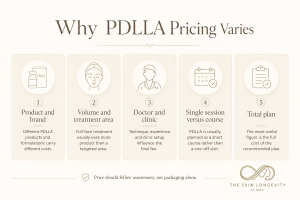
PDLLA pricing depends on product choice, treatment area, injector experience and whether the plan is a single session or full course.
Why PDLLA Pricing Varies So Much
Product and brand of PDLLA skin booster and filler
Different PDLLA products carry different costs. Even within the PDLLA category there are formulations intended for skin-quality work versus more volumising applications. We explain those differences in our guide to the PDLLA-HA skin booster.
Volume and treatment area for PDLLA skin boosters
A full-face protocol uses more product than a single targeted region such as the under-eye area or a narrow band of the neck. The amount of material needed is set by your skin and your goals, not by a fixed package, which is why an honest assessment should precede any quote.
The doctor and the clinic
Reusult of PDLLA skin boosters is very technique-sensitive. The reconstitution of the product, the depth and spread of injection, and the massage afterwards all influence both the result and the risk of complications. An experienced injector commands a higher fee, and for a biostimulator that is generally money well spent. Clinic overheads and location also feed into the headline price.
Single sessions versus a course
Per-session pricing only tells part of the story. Because collagen builds gradually, PDLLA is designed to be delivered as a short course. The figure that matters is the total cost of the plan that fits your concern, not the cost of one visit.
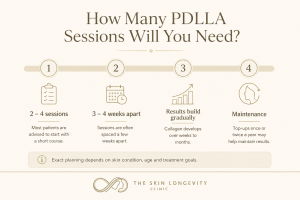
Most PDLLA treatment plans involve a short course, with results building gradually over weeks to months.
How Many Sessions Will You Need?
Most patients are advised to have two to four PDLLA skin booster sessions spaced roughly three to four weeks apart, with the exact plan determined by the patient’s skin condition, age and the concern being treated. Maintenance sessions once or twice a year are common once the initial course is complete due to the results wearing off. Because results last in the region of twelve to eighteen months, the ongoing cost is modest compared with the initial investment. Our PDLLA skin booster FAQ covers session planning, longevity and results timelines in detail.
Be wary of any clinic that quotes a large, fixed package without examining your skin. The number of sessions you genuinely need is a clinical judgement, and an honest plan may turn out to be smaller, not larger, than a standard package. Equally, be cautious of a quote that looks unusually low: an under-dosed course, too little product spread too thinly, can fail to produce a meaningful result, which makes it poor value in the only sense that matters.
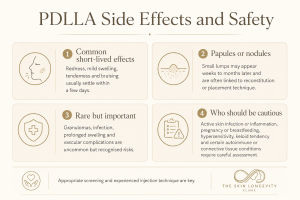
PDLLA skin boosters are generally well tolerated in suitable patients, but side effects and suitability should be discussed before treatment.
PDLLA Side Effects: An Honest Account
PDLLA skin boosters are generally well tolerated, but no injectable is free of side effects, and a responsible clinic explains them plainly. Thankfully, most reactions from PDLLA skin boosters are mild and temporary.
Common, short-lived effects of PDLLA skin boosters
Redness, mild swelling, tenderness and bruising at the injection points are expected and usually settle within a few days. Small palpable bumps where the product was placed are also common in the first day or two and typically smooth out as any hyaluronic acid component settles and gentle massage is carried out.
Nodules and papules
The side effect that most warrants attention is the formation of small lumps, known as nodules or papules, weeks to months after treatment. They are usually palpable rather than visible, often symptomless, and frequently resolve on their own. The literature is consistent that they tend to arise from suboptimal product reconstitution or placement. This matters for PDLLA injectables in particular: because PDLLA is amorphous and its particles tend to aggregate once dispersed, thorough reconstitution is essential, and incomplete reconstitution is a recognised contributor to nodule formation. It is the single strongest argument for choosing an experienced injector.
Granulomas and less common reactions
True inflammatory granulomas are the most serious biostimulator complication but are very rare; in the poly-lactic-acid literature their incidence is estimated at roughly 0.01 to 0.1 per cent, and they can appear months or even years after treatment. Infection, prolonged swelling and, rarely, vascular complications are recognised risks of any injectable. All are uncommon with careful technique, sterile practice and proper patient selection, which is why the consultation is as important as the procedure itself, and why your doctor should explain in advance how a complication would be managed.
Is PDLLA Safe? Who Should Be Cautious
PDLLA is a biodegradable polymer from the same chemical family as long-used dissolvable sutures, and its safety profile in skin-booster use is reassuring when treatment is properly screened and delivered. “Safe”, however, always depends on the right patient and the right hands.
A PDLLA skin booster is generally deferred or avoided in the presence of active skin infection or inflammation in the treatment area, a known hypersensitivity to the product, and during pregnancy or breastfeeding, where it is avoided as a precaution because data are limited. Patients with a history of keloid or hypertrophic scarring, with autoimmune or connective tissue conditions, or with unrealistic expectations, should be assessed especially carefully. A thorough medical history is part of every responsible consultation.
Is a PDLLA Skin Booster Worth It?
Value is best judged against the alternative. The most expensive PDLLA skinbooster course is not the highest-priced one; it is a course that does not match the concern, whether that means too few sessions to produce a visible change or a treatment chosen when something else would have served the patient better. For genuine skin-quality concerns, firmness, texture, early lines and dullness, a well-planned PDLLA skin booster course can deliver a durable result that surface treatments cannot. For concerns rooted in volume loss or facial structure, a different approach may be more appropriate, and a good clinic will tell you so. Our comparison of PDLLA, PLLA and ECM skin boosters can help you weigh the options.
It also helps to think of PDLLA skin booster as a treatment with a running cost rather than a one-off purchase. The initial course builds the result; periodic maintenance sustains it. Budgeting for a maintenance session once or twice a year, rather than being surprised by it later, is part of a sensible decision. Viewed over two or three years, a well-planned PDLLA skin booster programme is a steady, moderate investment in skin quality, and that long horizon is exactly how it should be assessed.
What a Good PDLLA Skin Booster Consultation Should Cover
The consultation is where most of the value of PDLLA skin booster treatment is either created or lost, and it is also your best opportunity to judge a clinic. A thorough consultation should include an assessment of your skin and the concern you want addressed, a candid discussion of whether PDLLA is the right treatment or whether something else would serve you better, an explanation of the realistic result and how long it will take, and a clear account of the risks and the aftercare involved.
You should leave the consultation with a specific plan and a written quote, not a vague sense that you have been sold something. The following questions are worth asking before you commit:
- Is the product registered with the Health Sciences Authority, and which product will be used?
- How many sessions do you recommend for my skin, and why that number?
- What result is realistic for my concern, and what will it not achieve?
- Who will perform the treatment, and how experienced are they with PDLLA?
- What are the risks, and how would a complication such as a nodule be managed?
- What is the full cost of the recommended plan, and what does it include?
A clinic that answers these openly is demonstrating the transparency you want. A clinic that is evasive, or that pushes a decision on the day, is telling you something too.
The Skin Longevity Clinic’s Assessment-First Approach
At The Skin Longevity Clinic, no patient is taken straight into the treatment room. Every patient is first assessed to determine whether they are genuinely suitable for a biostimulator before any treatment is carried out, a step Dr Rachel Ho regards as non-negotiable rather than a formality.
Not every skin is a good candidate, she explains. Skin that is inflamed or acne-prone, in particular, is often not suitable for a PDLLA biostimulator, and identifying that at the assessment stage protects the patient from a treatment that would not serve them. In Dr Ho’s view, that judgement, the willingness to say a treatment is right, or to say plainly that it is not, is part of what a patient should be paying for.
Where to Get PDLLA Skin Boostser in Singapore Safely
PDLLA skin booster is a medical treatment. It should be administered only by a licensed doctor, in a licensed clinic, using a product registered with the Health Sciences Authority. Treatments offered informally by non-doctors like beauticians or therapists, or products bought online for self-injection, carry serious and avoidable risk and should never be considered. When choosing where to go, look for a doctor-led consultation, a candid discussion of suitability, transparent pricing and a clear aftercare plan.
At The Skin Longevity Clinic, PDLLA skin boosters are assessed and delivered by a doctor as part of a considered, evidence-based plan. You are welcome to book a consultation to receive a personalised assessment and a quote, or to read more about the clinic’s approach to skin longevity first.
Continue Reading: More From Our PDLLA Skin Booster Series
These guides form one connected series. The articles below have already been published, and you may find them useful alongside this one: