



27 May Botulinum Toxin Treatment in Singapore: BTX for Wrinkles and Natural Looking Results
By Dr Rachel Ho | Aesthetic Doctor, Founder, The Skin Longevity Clinic, Singapore
Botulinum toxin, often shortened to BTX, is one of the most established injectable treatments in aesthetic medicine. In Singapore, patients commonly ask about BTX when frown lines, forehead lines or crow’s feet begin to remain visible even when the face is relaxed.
At The Skin Longevity Clinic, botulinum toxin treatments by Dr Rachel Ho are planned through facial anatomy, muscle movement and skin quality. The aim is to soften excessive movement while preserving natural expression. A good BTX result should make the face look calmer and more rested, without making it look stiff.
What is botulinum toxin?
Botulinum toxin is a purified injectable medicine that temporarily reduces selected muscle activity. In aesthetic medicine, it is commonly used for dynamic wrinkles, which are lines caused by repeated facial movement. Common examples include frowning, forehead lifting and squinting.
A Cochrane review of botulinum toxin type A for facial wrinkles found that treatment reduced wrinkles within four weeks, while also noting recognised risks such as eyelid drooping and the need for more long term data on repeated treatment1.

Botulinum toxin is commonly used for dynamic wrinkles caused by repeated facial movement.
What wrinkles can BTX treat?
BTX is commonly used for frown lines, forehead lines and crow’s feet.
Frown lines form when muscles between the eyebrows pull inward and downward. These lines can make the face appear tense or tired. BTX can reduce selected frown muscle activity and soften the crease.
Forehead lines form when the forehead muscle lifts the brows repeatedly. Treatment here requires careful dosing because the forehead also supports brow position. Excessive relaxation can cause brow heaviness.
Crow’s feet form around the outer corners of the eyes when smiling or squinting. BTX can soften these lines while keeping the smile natural when the dose and placement are planned carefully.
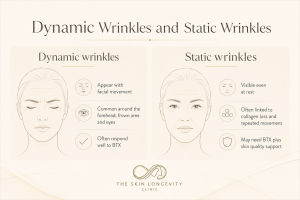
Dynamic wrinkles appear with facial movement, while static wrinkles remain visible at rest and may need skin quality support.
Dynamic wrinkles versus static wrinkles
A key part of consultation is deciding whether a line is dynamic or static.
Dynamic wrinkles appear during movement. They usually respond better to BTX because the treatment targets the muscle activity that creates the line.
Static wrinkles remain visible when the face is at rest. These lines may involve collagen loss, skin thinning, sun exposure, dehydration and repeated movement over time. BTX can reduce the movement component, but deeper static lines may also need skin quality treatments, collagen support, lasers, skinboosters or fillers depending on the cause.
What happens during BTX treatment?
The consultation begins with facial movement assessment. Dr Rachel Ho assesses brow position, eyelid support, forehead movement, frown strength, crow’s feet pattern, facial symmetry and the patient’s preferred level of movement.
Small injections are placed into selected muscles using fine needles. The treatment is usually quick. Mild redness, small bumps or bruising may occur at injection points.
Patients usually return to daily activity after treatment. They may be advised to avoid rubbing the treated area, strenuous exercise, alcohol or lying flat for a short period after the procedure.
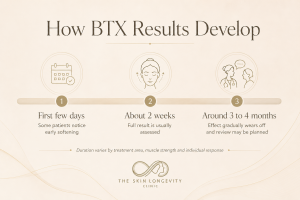
How BTX results develop over the first few days two weeks and three to four months
When will results appear?
Some patients notice early changes after a few days. Full results are usually assessed around two weeks after treatment.
BTX results commonly last around three to four months, although duration varies with dose, muscle strength, metabolism, treatment area and individual response2.
BTX Safety and Side Effects
| Possible effect | Typical explanation |
|---|---|
| Redness or small bumps | Usually temporary after injection |
| Bruising | Can occur at injection points |
| Headache or tightness | May occur in some patients after treatment |
| Brow heaviness | Can happen if forehead dosing affects brow support |
| Eyelid droop | Less common, usually temporary, and should be discussed during consent |
| Asymmetry | May occur if muscle response differs between sides |
What are the risks?
Common side effects include temporary redness, swelling, tenderness, bruising, tightness or headache. Less common effects may occur if the treatment affects nearby muscles. These include brow heaviness, eyelid droop, asymmetry, dry eyes or excessive weakness in the treated area1,2.
Patients who are pregnant, breastfeeding, have certain neuromuscular conditions or have active infection at the injection site may not be suitable.
BTX vs Fillers
| Feature | BTX | Fillers |
|---|---|---|
| Main action | Reduces selected muscle movement | Restores volume or structural support |
| Common use | Dynamic wrinkles | Hollowing, volume loss or contour support |
| Result timing | Gradual onset over days | Often more immediate |
| Duration | Often around 3 to 4 months | Varies by product, area and patient |
| Best suited for | Movement related lines | Volume or support related concerns |
BTX versus fillers
BTX relaxes muscle movement. Fillers restore selected volume or structural support.
A patient with frown lines may benefit from BTX. A patient with under eye hollowing or cheek flattening may need volume assessment. A patient with deep folds may have both movement and structural causes.
This distinction is important because one injectable cannot correct every ageing concern.
Read next
Patients who are interested in lower face shaping can read BTX Jaw Slimming and Bruxism in Singapore. Patients who want a broader planning guide can read BTX Treatment Planning in Singapore: Wrinkles, Jaw Slimming, Bruxism and What BTX Cannot Do.
Dr Rachel’s takeaway
Botulinum toxin is useful when wrinkles are driven by repeated muscle movement. Treatment should be planned according to facial anatomy, muscle strength and the patient’s natural expression.
At The Skin Longevity Clinic, BTX treatment begins with movement assessment. The goal is to soften lines, preserve facial character and avoid an over treated appearance. For patients considering BTX in Singapore, another consideration would be whether the skin also requires structural support to prolong the longevity of their results. To understand the specific considerations for your skin and wrinkles, schedule a consultation with us at The Skin Longevity Clinic.
References
- Botulinum Toxin Type A for Facial Wrinkles. Camargo CP, Xia J, Costa CS, Gemperli R, Tatini MD. Cochrane Database of Systematic Reviews. 2021. Issue 7.
- Botulinum Toxin Injection for Facial Wrinkles. Small R. American Family Physician. 2014. Volume 90, Issue 3.
- Botulinum Toxin A for Reducing the Appearance of Facial Wrinkles: A Literature Review of Clinical Use and Pharmacological Aspect. Satriyasa BK. Clinical, Cosmetic and Investigational Dermatology. 2019. Volume 12.
- The Facial Aging Process From the Inside Out. Swift A, Liew S, Weinkle S, Garcia JK, Silberberg MB. Aesthetic Surgery Journal. 2021. Volume 41, Issue 10.