


07 Jun XERF Treatment: How the Procedure Works- A Comprehensive Step by Step Guide to the Science of Structural Skin Tightening
By Dr Rachel Ho | Aesthetic Doctor, Founder, The Skin Longevity Clinic, Singapore
If you are considering XERF treatments in Singapore, it helps to know exactly what the treatment involves before you book. A XERF treatment is more than the time spent with the handpiece on your skin. It is a sequence that begins with an assessment, moves through preparation and the procedure itself, and continues into aftercare and a review. This guide walks through each step and explains the science behind why the treatment is delivered the way it is.
For the wider picture of what XERF is and who it suits, see our complete guide to XERF in Singapore. This article focuses on the XERF procedure itself.
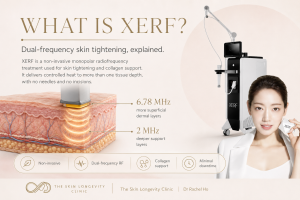
XERF uses dual-frequency monopolar radiofrequency energy to deliver controlled heat at different tissue depths for skin tightening and collagen support.
What XERF Treatment Actually Means
XERF is a non-invasive monopolar radiofrequency treatment for skin tightening, lifting and collagen support. It uses a dual-frequency design, delivering energy at 6.78 MHz and 2 MHz so that controlled heat can be directed at more than one depth in the skin and the deeper support layers. There are no needles and no incisions needed with XERF. XERF works by warming tissue in a controlled way using dual frequency radiofrequency energy, not by cutting or puncturing it.
Because it is non-invasive, XERF is often described as a lunchtime treatment. That is somewhat fair, but it should dimissed as a simple or risk free procedure. It is still a medical procedure that delivers real energy into the skin, and it deserves the same care in planning as any other medical treatment for patient safety and results.

A doctor-led consultation assesses skin thickness, laxity, facial ageing pattern, pigment risk and whether radiofrequency tightening fits the diagnosis.
Step One: Consultation for XERF and Facial Assessment
Every XERF treatment should begin with a consultation with Dr Rachel Ho. The assessment examines skin thickness, facial volume, the pattern of ageing, any active inflammation, pigment risk and your general recovery capacity. It also clarifies your goal and whether radiofrequency tightening is appropriate for your skin skin and expectations.
A detailed medical consultation matters because XERF is not the right treatment every concern. Sagging and laugh lines, for example, can come from skin laxity, collagen loss, volume loss, fat distribution or deeper structural change like bone resorption. XERF treatments help when laxity and collagen loss are the main causes of the patient’s concern. However, if the concerns is due to volume loss like hollow cheeks or hollow temples, tightening treatments alone will disappoint the patient as the treatment does not address the pathology. The assessment is what separates a treatment that fits the diagnosis from one that does not.
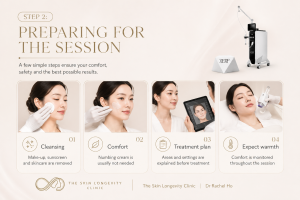
Preparation for XERF includes cleansing the treatment area, explaining comfort expectations and confirming the treatment plan before energy is delivered.
Step Two: Preparing for the XERF Session
Preparation for XERF is straightforward. The treatment area is cleansed to remove make-up, sunscreen and skincare products. Most patients do not need numbing cream, because the treatment is designed to be tolerable, although comfort is always discussed beforehand. Dr Rachel Ho will explain to you the treatment plan, the areas to be covered and what the session will feel like, so there are no surprises once it begins.
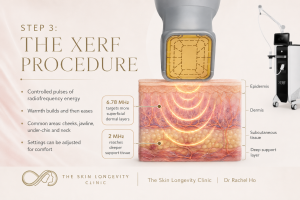
During XERF, controlled radiofrequency pulses warm the tissue. The 6.78 MHz and 2 MHz frequencies allow treatment to be tailored across different tissue depths.
Step Three: The XERF Procedure Itself
During the procedure, the XERF handpiece is applied to the skin and radiofrequency energy is delivered in controlled pulses. As the energy passes through the tissue, the skin’s natural resistance converts it into heat. You feel this as warmth that builds with each pulse and then eases, and the provider works methodically across the treatment area.
The dual-frequency design is relevant here. By using 6.78 MHz for the more superficial layers and 2 MHz for deeper tissue, the treatment can be tailored to where your laxity actually sits. Common areas include the cheeks, lower face, jawline, the area under the chin and the neck. A session usually takes somewhere in the region of thirty minutes to an hour depending on how much area is treated, though this varies between patients.
Comfort varies between people and between areas. Thinner skin, such as the neck, tends to feel the heat more than the cheeks. The treatment should never be genuinely painful, and you should tell your provider if it becomes uncomfortable, because the settings can be adjusted while still delivering an effective treatment.

Recovery after XERF is usually short. Mild warmth or redness may occur, and gentle hydration, sunscreen and avoidance of harsh actives support skin recovery.
Step Four: Aftercare and Recovery
One of the practical advantages of XERF is the short recovery. Immediately afterwards, the treated skin may feel warm and look mildly red, and there can be some tenderness. These effects are usually mild and settle quickly, and most people return to their normal day soon after.
Sensible aftercare helps. It is wise to keep the skin gently hydrated, to use sunscreen diligently given Singapore’s strong year-round sun, and to avoid adding harsh skincare actives for a few days unless your provider advises otherwise. If you have pigment-prone skin, careful sun protection is especially important in the period after treatment.
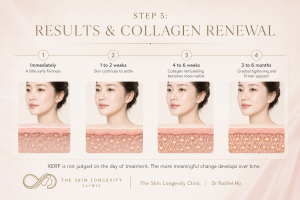
XERF results develop gradually. Some early firmness may be noticed, while collagen remodelling and firmer support usually build over weeks to months.
The Science: Why XERF Is Delivered This Way
The structure of the treatment follows directly from the biology. Radiofrequency heat does two things in the skin. It causes existing collagen fibres to contract, which gives a modest and fairly immediate firmness. It also creates a controlled stress that triggers a wound-healing response, prompting fibroblasts to produce new collagen over the following weeks and months.
This second process is gradual, and it explains why XERF is not judged on the day of treatment. A 2024 study of dual-frequency monopolar radiofrequency examined treated skin under the microscope and reported changes consistent with collagen remodelling, including increased collagen and elastic fibre density. The earlier 2004 histometric analysis by Zelickson and colleagues in Dermatologic Surgery similarly found measurable collagen changes after monopolar radiofrequency. The treatment is delivered as a controlled stimulus precisely because the skin needs time to respond, repair and remodel.
How Many XERF Treatments and How Often Should XERF Treatments Be Peformed?
There is no fixed number of XERF sessions for each patients. Some patients do well with a single treatment and occasional maintenance, while others benefit from a planned course, depending on the extent of their sagging and skin laxity. Because collagen remodelling unfolds over months, sessions are spaced to allow the skin to respond, and the plan is reviewed rather than fixed rigidly in advance.
Maintenance is part of an honest picture. XERF supports collagen, but ageing continues, so results are maintained over time rather than being permanent. How often you return depends on your age, your skin and how your collagen responds. If you would like to understand the likely cost of a course, our guide to XERF price in Singapore explains the factors involved.
Who Should and Should Not Have XERF Treatment
The XERF procedure is only worthwhile for the right patient. XERF treatment is generally suitable for patients with mild to moderate skin laxity, early sagging of the jawline or lower face, and mild neck laxity, who still have reasonable facial volume and hold realistic expectations. XERF is also suitable for patients who want a non-invasive lifting and tightening treatments with no downtime at all.
XERF treatments, however, are not suitable for everyone. Patients with advanced sagging are usually better served by a surgical facelifts or a combination of non-surgical lifting and tightening treatments, including collagen biostimulators and radiofrequency microneedling. Patients whose main issue is volume loss need volume support rather than tightening. Patients with active inflammation, reactive hyperpigmentation, or conditions such as rosacea or eczema in the treatment area need these addressed first. A careful doctor treats this screening as part of the procedure, not as an obstacle to it.
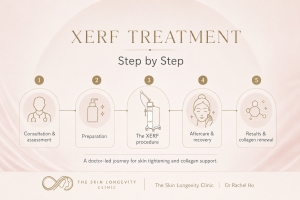
A XERF session begins with assessment, followed by preparation, the procedure, aftercare and review as collagen renewal develops gradually.
The Review Appointment after XERF
A XERF treatment is not finished when you leave the clinic. Because the result develops gradually, a review appointment some weeks or months later is an important final step. At the review, your provider can assess how your skin has responded, compare it against your starting point, and decide whether the result is adequate, whether maintenance is appropriate, or whether a different treatment would better address what remains. A treatment plan without a review is incomplete, because nobody has checked whether it worked.
Frequently Asked Questions about XERF Treatments in Singapore
How long does a XERF treatment in Singapore take?
A XERF session usually takes somewhere between thirty minutes and an hour, depending on how much area is treated. A focused lower face and jawline treatment is quicker than a full face and neck treatment. The consultation with Dr Rachel Ho beforehand adds time on your first visit but is essential to a treatment that fits your skin.
Is there any downtime after XERF treatments?
Downtime is usually minimal to none for most patients. Temporary warmth, mild redness and slight tenderness are the most common effects, and they generally settle quickly. Most people return to normal activity soon after. As with any energy-based treatment, occasional reactions such as prolonged swelling can occur, which is one reason proper assessment and technique matter.
Will I see results immediately after the XERF treatment?
Some patients notice a little early firmness soon after a session, from the immediate contraction of existing collagen. The more meaningful change is gradual and develops over weeks to months as new collagen forms. It is best not to judge the final result too early, which is why a review appointment is sensible.
Can XERF be combined with other treatments?
Yes, XERF can be sequenced with other treatments when the diagnosis calls for it, for example collagen biostimulators for structural support or other treatments for pigmentation or volume loss. The sequence and timing matter, because doing too much too quickly can increase irritation. This is a decision best made within an overall plan rather than added on impulse.
Related XERF and Skin Tightening Guides
These articles form a connected library on XERF and skin tightening at The Skin Longevity Clinic. You may also find the following guides helpful:

To Dr Rachel Ho, XERF treatment is more than the procedure itself. Assessment, preparation, aftercare and review are all part of a complete treatment plan.
XERF Treatment at The Skin Longevity Clinic
At The Skin Longevity Clinic, XERF is delivered as a planned treatment rather than a routine add-on, with a doctor-led assessment at the start and a review built in. If you would like to find out what a XERF treatment plan would look like for your skin, you can contact the clinic to arrange a consultation.