


22 May XERF in Singapore: A Complete Guide to Dual-Frequency Skin Tightening
By Dr Rachel Ho | Aesthetic Doctor, Founder, The Skin Longevity Clinic, Singapore
XERF has quickly become one of the most discussed skin tightening treatments in Singapore. It is non-invasive, it relies on a newer form of radiofrequency technology, and it is most often talked about for the lower face, jawline and neck, the areas where early ageing tends to show first. If you are trying to understand what XERF actually is, who it genuinely helps and how to judge whether it is right for you, this guide is the place to start. It is the central reference for our wider library of XERF and skin tightening articles.
At The Skin Longevity Clinic, XERF is offered within a doctor-led practice built around skin longevity, which means every treatment begins with an assessment rather than a booking. This guide explains the technology, the evidence behind it and the honest limits of what radiofrequency tightening can do. For the clinic’s dedicated treatment page, see XERF in Singapore.
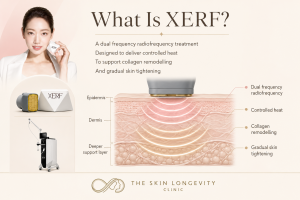
XERF uses radiofrequency energy to deliver controlled heat that may support collagen remodelling and skin tightening in suitable patients.
What Is XERF?
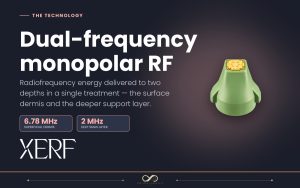
XERF is a non-invasive monopolar radiofrequency treatment designed for skin tightening and collagen support. Its defining feature is a dual-frequency design. The system delivers radiofrequency energy at two frequencies, 6.78 MHz and 2 MHz, and this allows controlled heating at more than one depth within the skin and the deeper support layers beneath it.
That dual-frequency approach is what distinguishes XERF from older single-frequency radiofrequency devices. The higher 6.78 MHz frequency acts on the more superficial layers of the skin, while the lower 2 MHz frequency reaches deeper tissue. Because facial ageing rarely happens at a single depth, being able to direct energy across more than one layer is a practical advantage when laxity involves both the dermis and the deeper structures that support it.
It is equally important to be clear about what XERF is not. It is not surgery, and it does not produce a surgical result. It is not a dermal filler, so it does not restore lost facial volume. It is not a pigment laser, so it does not treat pigmentation. XERF is a collagen support and skin tightening treatment, and its value depends entirely on whether tightening is the right answer for your particular concern.
How XERF Works: The Science of Radiofrequency Tightening
Radiofrequency is not a new idea in aesthetic medicine. It has been studied and used for skin tightening for more than two decades. Radiofrequency works by passing a high-frequency alternating electrical current through the skin. The tissue’s natural resistance to the movement of charged particles converts that energy into heat, and it is the heat, not the current itself, that produces the treatment effect.
When the dermis is heated into the correct range, two things happen. Existing collagen fibres contract, which gives a modest and fairly immediate tightening. The controlled heat also creates a mild, intentional stress that triggers a wound-healing response. Over the following weeks and months, fibroblasts in the skin lay down new collagen. This second process, known as neocollagenesis, is where most of the visible improvement comes from, which is why radiofrequency results build gradually rather than appearing overnight.
This is not only a theoretical model. A 2011 review by El Domyati and colleagues in the Journal of the American Academy of Dermatology examined the evidence for radiofrequency facial rejuvenation and described measurable changes in the skin’s collagen. A 2004 histometric analysis by Zelickson and colleagues in Dermatologic Surgery, one of the earlier studies of monopolar radiofrequency for facial laxity, found changes in collagen within treated skin when samples were examined under the microscope. The underlying biology of radiofrequency tightening is therefore reasonably well described.
Why Skin Loses Its Firmness
Understanding XERF is easier once you understand why skin becomes lax in the first place. Skin loses roughly one percent of its collagen each year from the mid-twenties onwards. The loss is gradual at first, then becomes more noticeable through the forties and beyond. For women, the decline accelerates around menopause, when a significant proportion of skin collagen can be lost within a few years.
In Singapore, this natural decline is compounded by the climate. Year-round sun exposure is one of the strongest external drivers of collagen breakdown, and cumulative ultraviolet exposure speeds up the loss of both collagen and elastin. The result, for many people, is a slow softening of the jawline, a loss of definition in the lower face and early laxity in the neck.
This matters for expectations. A treatment like XERF works with a biological process that is already in decline. It can support collagen and improve firmness, but it does not stop ageing. It is best understood as a way to manage and slow visible laxity, which is also why results are gradual and why maintenance is part of the picture. The clinic’s page on sagging skin and facial laxity explains the causes of laxity in more detail.
Who Is XERF Suitable For?
XERF may be a reasonable option for patients with mild to moderate skin laxity, reduced firmness, early softening of the jawline, lower face heaviness or mild neck laxity. It tends to suit patients who still have good facial volume, who hold realistic expectations and who prefer a needle-free treatment with little disruption to daily life.
It is not suitable for everyone. Patients with significant sagging or heavy jowls are usually better served by a surgical opinion, because no non-invasive device can match the result of a facelift when laxity is advanced. Patients whose main problem is volume loss rather than laxity may need volume support first, since tightening loose skin over a deflated face does not address the actual cause. Patients with active skin inflammation, unstable pigmentation or pigment-prone skin need careful assessment before any energy-based treatment.
The most useful way to think about candidacy is this. The right candidate for XERF is not simply the person who wants tighter skin. It is the person whose particular pattern of ageing is likely to respond to radiofrequency tightening. Establishing that is the purpose of a proper consultation.
What XERF Can and Cannot Do
What XERF can and cannot do
| Concern | Is XERF likely to help? |
|---|---|
| Mild to moderate skin laxity | Often a reasonable option |
| Early jawline and lower face softening | Often a reasonable option |
| Mild neck laxity | May help in selected patients |
| Significant sagging and heavy jowls | Unlikely, a surgical opinion is more appropriate |
| Volume loss and facial deflation | No, volume support is a different treatment |
| Pigmentation, acne scars or active acne | No, these need other treatments |
What to Expect From XERF Treatment
A XERF treatment begins with a consultation and facial assessment rather than the procedure itself. The assessment looks at skin thickness, facial volume, the pattern of ageing, any inflammation, pigment risk and your recovery capacity, because all of these affect whether the treatment is appropriate and how it should be delivered.
During the session, the skin is cleansed and the XERF handpiece is applied to the treatment area, delivering radiofrequency energy in controlled pulses. Most patients feel warmth or heat that builds and then eases with each pulse. Comfort varies between individuals and between areas, with thinner skin tending to feel more. Common treatment areas include the cheeks, lower face, jawline, the area under the chin and the neck.
Downtime is usually minimal. There may be temporary warmth, mild redness or some tenderness afterwards, and most people return to normal activity soon after. Results follow the biology described earlier. Some patients notice a little early firmness, but the more meaningful change develops over the weeks and months that follow as new collagen forms. A review appointment is the sensible way to judge whether the response has been adequate.
Choosing a XERF Provider in Singapore
Singapore has a large and competitive aesthetic market, and XERF is now offered widely. The technology matters less than the judgement behind it. A handpiece in careless hands is not a good treatment, and a thoughtful assessment is worth more than any single device.
A few signs point to a careful provider. The first is an assessment-first approach, where treatment is recommended only after your skin and ageing pattern have been examined properly. The second is honesty about suitability, including a willingness to tell you that XERF is not the right treatment when that is the truthful answer. The third is a clear explanation of what the treatment can realistically achieve, so that you are not relying on before-and-after images alone.
At The Skin Longevity Clinic, XERF is delivered as part of a doctor-led practice in which the treatment is positioned within a wider plan rather than offered as a routine add-on. If you are unsure where to begin, a skin longevity assessment is a sensible first step.
Frequently Asked Questions
Is XERF treatment painful?
Most patients describe XERF as warmth rather than painful. The handpiece delivers heat in controlled pulses, and the sensation builds and then eases with each one. Comfort varies between people and between areas, and thinner skin such as the neck tends to feel more than the cheeks. You should always tell your provider if the heat becomes uncomfortable, as settings can be adjusted during the session.
How many XERF sessions will I need?
This depends on your skin, the degree of laxity and how your collagen responds. Some patients are treated in a single session with periodic maintenance, while others benefit from a planned course. Because radiofrequency results build gradually, the number of sessions is best decided after an assessment and reviewed as your skin responds, rather than fixed in advance from a package price.
Is XERF safe for Asian skin?
Radiofrequency has a useful characteristic for skin of colour. Unlike some light-based treatments, it does not target melanin, so the risk of pigment-related side effects is comparatively low. This makes it a reasonable option for many Asian patients. It is not risk-free, however, and patients with pigment-prone skin, active inflammation or conditions such as rosacea or eczema still need careful assessment first.
How is XERF different from HIFU?
XERF uses radiofrequency, which heats the dermis and deeper support layers through electrical resistance. HIFU, or high-intensity focused ultrasound, uses focused sound energy to create heat at set depths. Both stimulate collagen, but they reach tissue differently and suit different patterns of laxity. You can read about the clinic’s HIFU treatment page for comparison.

XERF at The Skin Longevity Clinic
The Skin Longevity Clinic is a doctor-led practice in the Orchard area of Singapore, built around the idea that skin should be treated as a functional system rather than a surface to be corrected. XERF is one of several tools the clinic uses for skin laxity, and it is recommended only when radiofrequency tightening genuinely fits the diagnosis.
If you are considering XERF, the most useful next step is an assessment rather than a booking. You can contact The Skin Longevity Clinic to arrange a consultation and find out whether XERF, or another approach, is the right fit for your skin.