


15 May XERF in Singapore: Is It the Right Skin Tightening Treatment for Your Face?
By Dr Rachel Ho | Aesthetic Doctor, Founder, The Skin Longevity Clinic, Singapore
A doctor led guide to XERF in Singapore for skin tightening, collagen support and facial firmness. Learn who may be suitable, what XERF can and cannot do, and how The Skin Longevity Clinic assesses treatment fit.
XERF in Singapore: Is It the Right Skin Tightening Treatment for Your Face?
XERF has recently entered the conversation in Singapore as a skin tightening treatment for patients who want firmer skin, improved facial definition and collagen support without surgery. It has attracted interest because it uses radiofrequency energy, has a reputation for comfort and is often discussed as a newer Korean skin tightening option.
A new treatment name, however, should not be the starting point. The better question is whether the treatment matches the concern, the skin and the face in front of us.
At The Skin Longevity Clinic, XERF is assessed as a dual frequency radiofrequency treatment for selected patients with skin laxity and collagen loss. It should be considered as part of a broader plan that looks at skin thickness, facial volume, ageing pattern, inflammation, pigment risk and recovery capacity.
This guide explains what XERF is, how it works, who may benefit, what its limits are and how to decide whether it is the right skin tightening treatment for your face.
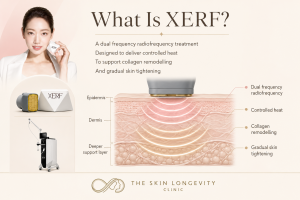
XERF uses radiofrequency energy to deliver controlled heat that may support collagen remodelling and skin tightening in suitable patients.
What is XERF?
XERF, or eXperience Exponential RF, is a radiofrequency skin tightening treatment. It uses energy to generate controlled heat within the skin and deeper soft tissue layers. This heat can stimulate collagen remodelling and tissue tightening over time.
Radiofrequency treatments have been used in aesthetic medicine for many years. The principle is that controlled heating can contract existing collagen fibres and encourage new collagen formation as the skin repairs. Published studies on monopolar radiofrequency have shown improvement in facial laxity, wrinkles and skin quality in selected patients, although results vary with device type, settings, patient selection and operator experience.
XERF is described as a dual frequency monopolar radiofrequency system. It uses two frequencies, commonly described as 6.78 MHz and 2 MHz, to deliver energy at different depths. The clinical aim is to support tightening across superficial and deeper tissue layers while keeping the skin surface protected.
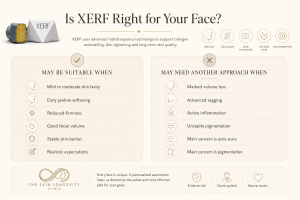
XERF may suit selected patients with mild to moderate laxity, but it is not the right treatment for every ageing concern.
What does XERF treat?
XERF is usually considered for patients with mild to moderate skin laxity, early lower face softening, reduced firmness, jawline blurring, cheek laxity or neck concerns. It may also be considered for patients who want collagen support without needles or a resurfacing procedure.
The treatment is not only about lifting. It is better understood as a skin tightening and collagen support procedure. For the right patient, this may translate into firmer skin, improved contour definition and a more supported appearance over time.
Results are gradual because collagen remodelling takes time. Some patients may notice early tightening, while more meaningful changes usually develop over weeks to months.
How does XERF work?
Radiofrequency energy creates heat in the treated tissue. When this heat is delivered at appropriate temperatures and depths, it can trigger collagen contraction and remodelling. Over time, the skin may feel firmer and more resilient.
XERF’s dual frequency design aims to treat different tissue depths. This is relevant because the face is not uniform. The skin around the eyes is thinner. The cheeks are thicker. The lower face may have more laxity, fat movement and structural change. A good treatment plan should therefore consider where the concern sits and how much tissue support is needed.
Some systems also use feedback technology to monitor tissue response during treatment. This matters because skin hydration, thickness and tissue density can influence how radiofrequency energy behaves.
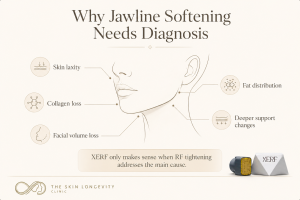
A blurred jawline can come from several causes. Treatment choice should follow the diagnosis.
Who may be suitable for XERF?
XERF may suit patients who have early to moderate facial laxity, reduced firmness or mild jawline softening. It may also suit patients who want a non surgical option for collagen support and skin tightening with minimal disruption to work or social activities.
It may be useful for busy professionals who want gradual improvement rather than visible downtime. This is especially relevant for patients who prefer subtle changes and do not want a procedure that requires peeling, bruising or prolonged recovery.
Suitability depends on the consultation. Skin thickness, facial volume, age related fat changes, pigment tendency, previous treatments, pain tolerance and expectations all matter.
XERF VS Collagen building treatments
| Treatment | Energy type | Often considered for | Main limitation |
|---|---|---|---|
| XERF | Dual frequency radiofrequency | Firmness, mild laxity, collagen support | Does not replace fillers or surgery |
| HIFU | Focused ultrasound | Deeper lifting support in suitable patients | May not address surface texture or volume loss |
| RF microneedling | Microneedling with radiofrequency | Pores, acne scars, texture, dermal remodelling | Involves needles and downtime varies |
| Dermal fillers | Injectable structural support | Volume loss, hollowing, contour support | Does not tighten skin or treat pigmentation |
| Collagen biostimulators | Injectable collagen stimulation | Gradual firmness and collagen support | Results take time and require planning |
Who may need a different approach from XERF?
XERF may not be the best treatment if the main issue is significant facial volume loss. When the cheeks, temples or under eye areas have deflated, tightening alone may not restore balance. Dermal fillers or collagen biostimulators may be more relevant, depending on the diagnosis.
It may also be insufficient for advanced sagging. Patients with marked jowling, loose neck skin or heavy tissue descent may need surgical assessment for a more definitive lift.
XERF is not also fat reduction treatment. It should not be used with the expectation of removing facial fat or dramatically changing facial shape. It also does not treat pigmentation, acne scars, redness or surface texture in the same way as lasers or resurfacing treatments.
For patients with active inflammation, eczema, rosacea flares, uncontrolled acne or unstable melasma, treatment timing should be considered carefully. A stable skin barrier and controlled inflammation may improve treatment tolerance and reduce avoidable irritation.
XERF versus HIFU
XERF and HIFU are both used in non surgical tightening, but they are different technologies.
HIFU uses focused ultrasound energy. It delivers energy into specific deeper points, often used when the aim is lifting support in selected tissue planes.
XERF uses radiofrequency heat. It is often discussed in relation to broader tissue heating, skin firmness and collagen remodelling. Some patients may prefer the treatment experience of RF based tightening, while others may be better suited to ultrasound based lifting. The choice should depend on facial anatomy, laxity pattern, skin thickness, pain tolerance, prior treatments and the desired degree of lift or firmness.
XERF versus RF microneedling
RF microneedling is different because it uses needles to deliver radiofrequency energy into the dermis. It is often chosen for acne scars, pores, skin texture and dermal remodelling.
XERF is a needle free radiofrequency treatment. It may be more suitable when the main concern is firmness or mild laxity rather than scars or texture.
A patient with acne scars and pores may need RF microneedling. A patient with early jawline laxity and reduced firmness may be more suited to XERF or another lifting treatment. Some patients may eventually benefit from both, but timing and skin readiness can differ.
XERF versus dermal fillers or collagen biostimulators
Dermal fillers restore selected volume and structural support. They are useful when hollowing, flattening or loss of projection contributes to facial ageing. Collagen biostimulators encourage gradual collagen production and can support firmness and skin quality in selected patients.
XERF uses energy based heating to support tightening and collagen remodelling. It does not restore volume in the way fillers do. It also does not replace biostimulators when diffuse collagen support or facial deflation is the main issue.
This is why diagnosis is essential in determining treatments for the best results in patients. A loss of jawline definition may come from skin laxity, volume loss, fat distribution, muscle pull or deeper support changes. XERF only makes sense when RF tightening addresses the main contributor.
What happens during XERF treatment?
During consultation, the doctor assesses skin quality, laxity, facial volume, treatment history and goals. The treatment area may include the cheeks, lower face, jawline, submental area or neck, depending on suitability.
During treatment, the device delivers radiofrequency energy through a handpiece placed on the skin. Patients may feel warmth and pulses of heat. Treatment comfort varies, but XERF is often chosen by patients seeking a more tolerable energy based tightening option.
There may be mild redness, warmth or temporary tenderness after treatment. Most patients can return to normal activities shortly after, although individual recovery varies.
How many sessions of XERF are needed?
The number of sessions depends on age, laxity, treatment area, collagen response and desired outcome. Some patients may start with one session and review the response. Others may need a planned series or maintenance sessions.
A realistic discussion is important for patient expectations. Collagen based treatments do not behave like instant contouring procedures. The aim is gradual tightening and firmness, not sudden transformation.
What XERF Can and Cannot Do
| XERF may help with | XERF does not replace |
|---|---|
| Mild to moderate laxity | Surgery for advanced sagging |
| Skin firmness | Fillers for volume loss |
| Early jawline softening | Lasers for pigmentation |
| Collagen support | RF microneedling for scars |
| Subtle contour definition | Medical assessment |
What are the risks and limitations of XERF?
XERF is non surgical, but it is still an energy based medical aesthetic procedure. Possible side effects include redness, warmth, swelling, tenderness and temporary discomfort. Burns, pigment change, contour irregularity or unwanted tissue effects are uncommon but possible with energy based treatments, especially if settings are inappropriate or skin suitability is not assessed properly.
The biggest limitation is expectation. XERF may improve mild to moderate laxity, but it cannot replace surgery for advanced sagging. It does not create the same effect as fillers when volume has been lost. It does not resurface acne scars like RF microneedling or fractional laser. It does not remove pigmentation like pigment laser.
Good outcomes depend on choosing the right patient and placing XERF correctly within the treatment plan.
How The Skin Longevity Clinic assesses XERF suitability
At The Skin Longevity Clinic, XERF is not approached as a stand alone trend. It is assessed within the context of skin biology and facial anatomy. Dr Rachel Ho considers skin thickness, collagen loss, facial volume, laxity pattern, inflammation, pigment risk and recovery capacity before recommending treatment. The goal is to decide whether radiofrequency tightening is appropriate, whether another treatment would be more suitable, or whether XERF should be combined or sequenced with other options.
For example, a patient with mild jawline softening and good facial volume may be a suitable XERF candidate. A patient with marked cheek deflation may need volume support first. A patient with unstable melasma or active inflammation may need skin stabilisation before energy based treatment.
This approach helps patients make clearer decisions. It also avoids using one treatment to solve every ageing concern.
FAQ about XERF
Is XERF suitable for all skin types?
XERF may be suitable for many patients, but suitability depends on skin thickness, inflammation, pigment risk, treatment area and medical history. A consultation is needed before treatment.
Is XERF painful?
Most patients describe radiofrequency tightening as warm or uncomfortable rather than sharply painful. Sensation varies with settings, treatment area and individual tolerance.
Can XERF lift the face?
XERF improves mild to moderate laxity and firmness in patients. It should not be presented as a substitute for surgery when sagging is advanced.
Can XERF slim the face?
XERF is a skin tightening treatment, not a facial fat reduction procedure. A slimmer looking face may occur if firmness and contour improve, but it should not be used as a fat removal treatment.
Can XERF be combined with other treatments?
Yes, in suitable patients. It may be combined or sequenced with skincare, lasers, skinboosters, collagen biostimulators, dermal fillers or other tightening treatments. Timing should be planned medically.
How soon will I see results?
Some patients notice early firmness, but collagen remodelling usually develops gradually over weeks to months. Results can vary between patients.
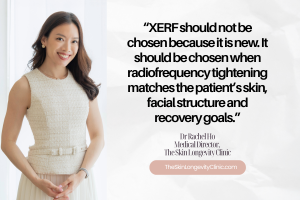
Dr Rachel Ho on assessing XERF as part of a broader skin tightening plan.
Final thoughts on XERF
XERF is a promising radiofrequency option for selected patients seeking skin tightening and collagen support in Singapore. Its appeal lies in its dual frequency RF technology, gradual firming effect and non surgical treatment experience. The most important decision, however, is not whether XERF is new or popular. The important question is whether it matches your face.
Skin tightening should be planned around skin thickness, facial volume, ageing pattern, inflammation, pigment risk and recovery capacity. At The Skin Longevity Clinic, Dr Rachel Ho assesses these factors before recommending XERF or any other aesthetic treatment.
For patients who are considering XERF, HIFU, radiofrequency lifting, RF microneedling, dermal fillers or collagen biostimulators, a doctor led consultation can help clarify what your skin and face actually need.
References
1. Radiofrequency Facial Rejuvenation: Evidence Based Effect. El Domyati M, El Amar A, Medhat W, Moawad O, Brennan D, Mahoney MG, Uitto J. Journal of the American Academy of Dermatology. 2011. Volume 64, Issue 3.
2. Efficacy and Safety of Monopolar Radiofrequency for Skin Tightening: A Systematic Review. Shin JM, et al. Cosmetics. 2024. Volume 11, Issue 3.
3. Monopolar Radiofrequency for Dermal Prejuvenation. Kilmer SL, et al. Dermatologic Surgery. 2025.
4. Evaluation of Improvement in Skin Laxity and Oiliness After Monopolar Radiofrequency Treatment. Suh DH, et al. Journal of Cosmetic Dermatology. 2025.
5. XERF Structural Skin Tightening. Cynosure Lutronic. 2026.
6. Skin Tightening Following Multisource, Phase Controlled Radiofrequency Treatment. Tanaka Y, et al. Journal of Clinical and Aesthetic Dermatology. 2019.