

20 Aug Acne Marks vs Acne Scars | PIH Treatment in Singapore and When Pico Laser Helps
By Dr Rachel Ho | Aesthetic Doctor, Founder, The Skin Longevity Clinic, Singapore
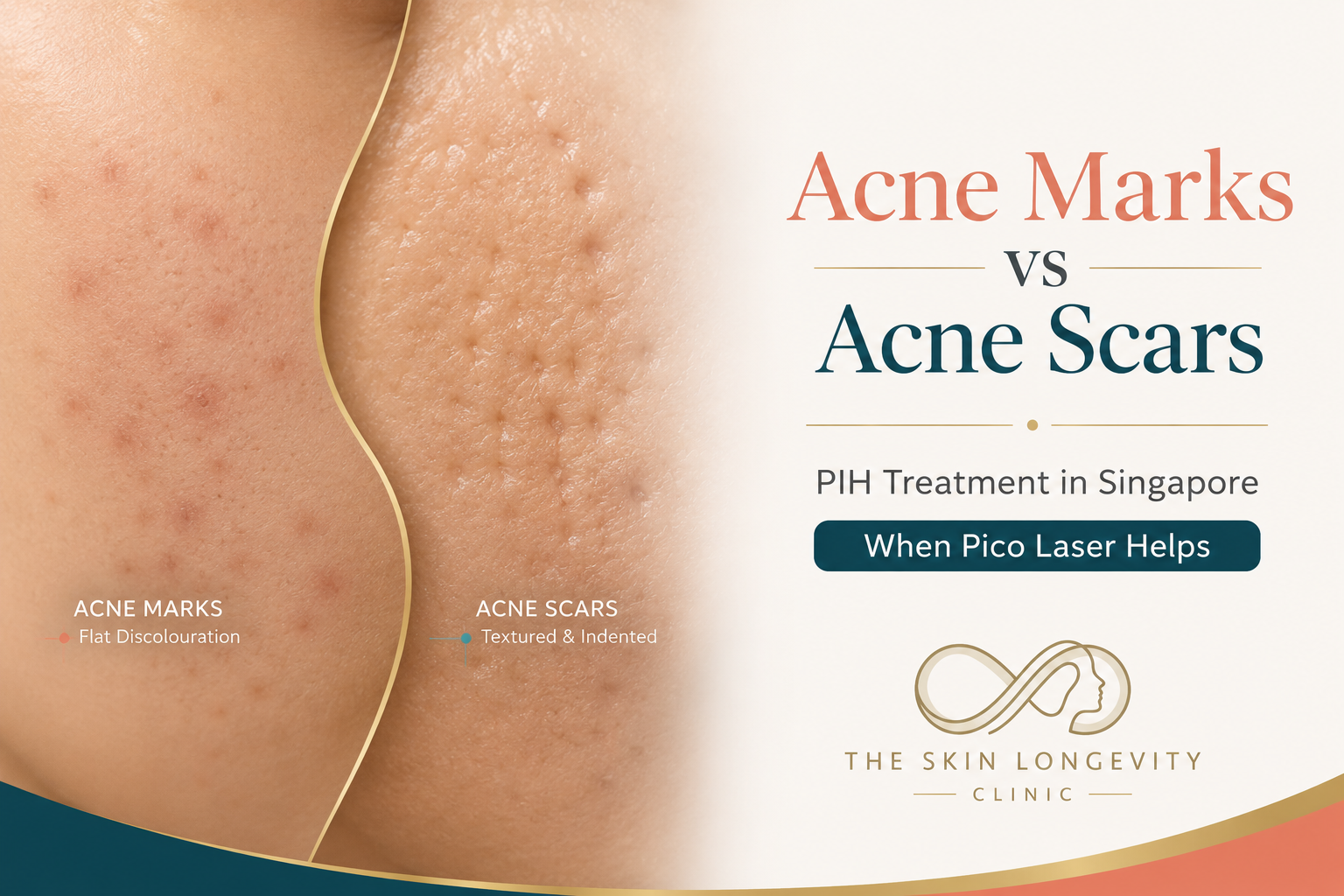
Acne marks and acne scars are different problems needing different treatments. Marks are flat discolouration, either brown from excess pigment or red from lingering blood vessels, and they fade or respond to pigment focused treatment. Scars are changes in texture, where the skin surface is depressed or raised, and they need collagen remodelling treatments. Pico laser in Singapore helps brown marks and some shallow scars, but the first step is always telling these apart and controlling active acne.
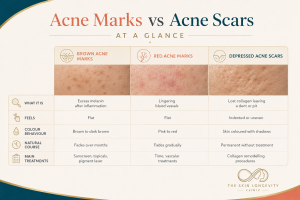
Not every mark after acne is a scar. Knowing whether you have pigmentation, redness or textural scarring is the first step to choosing the right treatment plan.
Acne marks versus acne scars, the fundamental difference
Acne marks (PIH, PIE) VS acne scars
| Feature | Brown acne marks i.e. post inflammatory hyperpigmentation (PIH) | Red acne marks i.e. post inflammatory erythema (PIE) | Depressed acne scars |
|---|---|---|---|
| What it is | Excess melanin after inflammation, called PIH | Dilated or lingering blood vessels, sometimes called PIE | Lost collagen leaving a dent or pit |
| Feels | Flat | Flat | Indented or uneven |
| Colour behaviour | Brown to dark brown, darkens with sun | Pink to red, flushes with heat or pressure | Skin coloured, shadows change with lighting |
| Natural course | Fades over months if untriggered | Fades gradually as vessels regress | Permanent without treatment |
| Main treatments | Sunscreen, topicals, pigment laser | Time, vascular treatments | Collagen stimulation, fractional lasers, scar procedures |
Run a fingertip over the area. If the skin feels flat and the problem is purely colour, you are looking at a mark. If you can feel a dip, a pit or a raised bump, you are looking at a scar.
Asian skin produces brown marks readily. Darker skin tones carry more reactive melanocytes, so any inflammation, including a single squeezed pimple, can leave pigment that outlasts the original blemish by months.
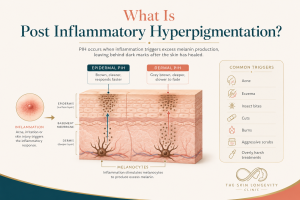
Brown and red acne marks have different causes. Brown marks usually reflect post inflammatory hyperpigmentation, while red marks reflect vascular change, so treatment selection should differ.
What is post inflammatory hyperpigmentation?
Post inflammatory hyperpigmentation, or PIH, is pigment produced in response to inflammation or injury. Acne is the leading cause in Singapore, but eczema, insect bites, cuts, burns, aggressive scrubs and even previous laser or peel treatments can all leave PIH. Inflammation releases signalling molecules that push melanocytes into overdrive, and the excess melanin either stays in the epidermis, where marks look brown and clear faster, or drops deeper into the dermis, where marks look grey brown and linger far longer.
That depth distinction matters clinically. Epidermal PIH responds well to topicals and pigment laser. Dermal PIH is slower and needs realistic expectations, a theme we expand on in stubborn pigmentation in Asian skin.
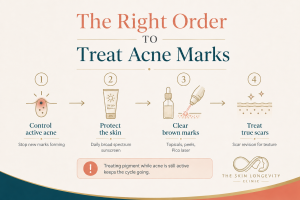
The order of treatment matters. Active acne should be stabilised first, followed by skincare for pigmentation and, when needed, procedures such as lasers for more stubborn marks.
Why treating active acne comes first
Treating pigmentation while breakouts continue is like mopping the floor with the tap running. Every new inflamed pimple can mint a new mark, and some acne treatments themselves irritate skin enough to worsen PIH if not managed carefully.
A sensible sequence looks like this. Control the acne medically first, using the approaches on our acne treatment page and in our comprehensive guide to acne treatments. Protect the skin daily with sunscreen so existing marks stop darkening. Then clear the residual pigment with topicals and, where appropriate, pigment laser. Finally address any true scars with dedicated procedures from our scar treatments page.
How brown acne marks are treated in Singapore
Sunscreen, non negotiable
Ultraviolet light deepens PIH and stretches its lifespan. Daily broad spectrum sunscreen is the cheapest and most effective part of the whole plan. If texture puts you off sunscreen, this independent sunscreen review guide is a practical place to find one you will wear.
Topical treatment
Doctors combine ingredients that slow pigment production and speed cell turnover. Options include azelaic acid, which helps both acne and PIH, retinoids, vitamin C, niacinamide, alpha arbutin, cysteamine and supervised courses of hydroquinone. Guidance on lightening ingredients appears in this article on skincare for pigmentation and dark spots.
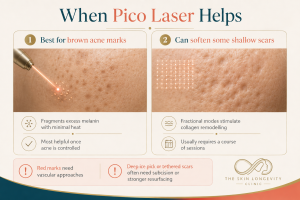
Pico laser can help selected acne marks, especially stubborn pigmentation. It is most useful when tailored to the type of mark and skin tone rather than used as a one size fits all treatment.
Pico laser for PIH
Once acne is controlled, Pico laser fragments the excess melanin in brown marks with ultra short pulses and minimal heat, a meaningful advantage in Asian skin where heat itself can provoke new pigment. Treatment is delivered over a spaced course, with marks fading progressively between sessions. Gentle settings matter, because over treating PIH can ironically create more PIH.
Chemical peels and adjuncts
Superficial chemical peels accelerate the turnover of pigmented cells and complement laser work, while brightening treatments such as PRX-Plus support overall tone.
Ingredients and treatments the evidence supports
Several options for brown marks are backed by solid evidence when acne is under control. Chemical peels are safe and effective for facial pigment, with glycolic acid the most established agent, and salicylic acid a useful choice for acne prone skin because it is oil loving and works within the pores. Stronger peels reach deeper but carry a higher risk of pigment rebound in darker skin, so they are used with caution. Among topical actives, tranexamic acid calms the inflammation and blood vessel activity that drive pigment, and it pairs well with niacinamide, which reduces the transfer of pigment into surface skin cells while supporting the barrier. Combining a lightening ingredient with careful sun protection consistently outperforms relying on any single product.
Red acne marks are a different problem
Red or pink marks, sometimes called post inflammatory erythema or PIE, are about blood vessels rather than melanin. A pigment laser aimed at redness misses the target. Red marks fade as the vessels regress naturally, and persistent redness is treated with vascular approaches. Many patients have both red and brown marks at once, which is another reason assessment matters before booking any laser package.
When Pico laser helps true acne scars
Fractional picosecond modes deliver energy in a grid of microscopic zones that stimulate collagen remodelling beneath the surface. This can soften shallow rolling and boxcar scars and improve overall texture over a course of sessions. Deeper ice pick scars and tethered scars need additional techniques such as subcision or stronger resurfacing. Our dedicated article on Pico laser for acne scars and acne marks sets out where it fits, and our comparison of Pico laser vs Q-switched laser vs IPL vs chemical peel explains the alternatives.
In Asian skin I let the endpoints I see during treatment and the patient’s skin colour guide my energy, and I would always rather go slow. Chasing fast clearance is how pigment treatment causes fresh pigment, so patience protects the result.
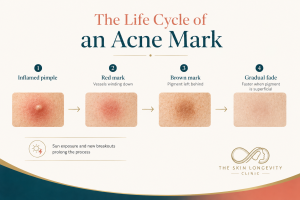
Preventing new acne marks starts with controlling active acne early. Consistent treatment, avoiding picking and daily sun protection help reduce the risk of lingering post acne pigmentation.
How long does PIH take to fade?
Untreated epidermal PIH commonly fades over months, while dermal PIH can persist for years. Treatment shortens this course substantially, but the honest variables are the depth of the pigment, your skin tone, how well sun exposure is controlled and whether new breakouts keep seeding new marks. Expect progressive lightening across a treatment course rather than a single dramatic reveal, a rhythm described in our Pico laser results timeline article. Aftercare between sessions, covered in our Pico laser aftercare guide, protects each increment of progress.
Preventing new marks while you clear old ones
PIH prevention is mostly about denying inflammation its opening, and it is far cheaper than treatment.
Hands off is the first rule. Squeezing, picking and scratching convert a short lived pimple into a months long mark. If extraction is genuinely needed, it belongs in a clinic, not a mirror.
Treat breakouts early rather than heroically. A single dab of prescribed treatment on a new pimple beats a weekend of aggressive home remedies that inflame the surrounding skin. Harsh scrubs, high strength acids layered together and abrasive devices all trade short term smoothness for long term pigment in Asian skin.
Sunscreen daily, even indoors near windows, because ultraviolet exposure deepens every existing mark and extends its life. And keep your acne plan under review, since the most effective PIH strategy of all is skin that has stopped breaking out. Our comprehensive guide to acne treatments covers the medical options for getting there.
What to ask your doctor about acne marks
- Are my marks pigment, redness, scars or a mixture, and in what proportion?
- Is my acne controlled enough to start treating the marks?
- Which topicals should I use between sessions, and which should I stop?
- How many Pico laser sessions does my pattern of PIH realistically need?
- What is the risk the laser itself causes pigmentation in my skin tone, and how will you minimise it?
- If I have both marks and scars, in what order will we treat them and what will the combined plan cost?
The life cycle of an acne mark
Understanding the natural arc helps you time treatment sensibly. A pimple resolves and leaves behind a red or pink patch as the local blood vessels wind down. In lighter skin that redness may simply fade over weeks. In Asian skin the inflammation has usually also switched on melanocytes, so as the redness settles a brown stain emerges beneath it, which is why marks often seem to change colour over their first weeks. The brown then fades on its own timetable, quickly if the pigment stayed epidermal and sun exposure is controlled, slowly across many months if pigment dropped deeper or the area keeps catching sun. Treatment at the brown stage shortens the tail dramatically, while treatment during the red stage targets vessels instead. Matching the tool to the stage, not just the mark, is what a doctor’s assessment adds.
Frequently asked questions
What is the difference between acne marks and acne scars?
Marks are flat colour changes, brown from pigment or red from vessels, and they respond to pigment or vascular treatment. Scars are texture changes from collagen damage and need remodelling treatments. Feel for flatness to tell them apart.
Should active acne be treated before acne marks?
Yes. Ongoing breakouts keep creating new marks, so acne control comes first, then pigment clearance, then scar work if needed.
Is Pico laser good for acne marks?
For brown marks, yes, once acne is controlled. It fragments the excess melanin with minimal heat. For red marks it is not the right target, since redness is vascular.
Is Pico laser good for acne scars?
Fractional Pico modes help shallow depressed scars and texture. Deeper or tethered scars usually need combined approaches such as subcision or fractional resurfacing.
Why do my acne marks last so long?
Usually a combination of darker skin tone, sun exposure without protection, continued breakouts and pigment that has dropped into the dermis. Each of these is addressable, which is why assessment beats guesswork.
Do acne marks fade on their own?
Brown epidermal marks generally do, over months, provided sun exposure is controlled and nothing re inflames the area. Deeper dermal PIH can linger for years. Treatment is about compressing that timeline rather than achieving something the skin could never do.
Does vitamin C help acne marks?
As a supporting player, yes. Vitamin C inhibits part of the pigment production pathway and pairs well with sunscreen by day. It works best alongside a structured plan rather than as a lone fix for established marks.
Can I cover marks with makeup during treatment?
Yes, outside the immediate post laser window. Non comedogenic formulas matter for acne prone skin, and thorough gentle removal at night matters even more. Concealer usage quietly declining is also one of the most honest progress markers you have.
Can PIH come back after treatment?
Cleared marks do not return by themselves, but new inflammation creates new marks. Keeping acne controlled and wearing sunscreen daily is what keeps skin clear long term.
Map your marks before treating them
If your cheeks carry a mix of brown marks, red patches and uneven texture, a single package will not fit all three. Book an assessment at The Skin Longevity Clinic near Orchard Road, and we will separate marks from scars, control what is active and sequence treatment so every session counts toward clearer skin. Our full framework is in the guide to pigmentation treatment in Singapore.
Related reading
- Pigmentation Treatment in Singapore for Asian Skin
- Pico Laser Singapore for Pigmentation
- Pico Laser Price in Singapore
- Melasma Treatment in Singapore
About Dr Rachel Ho
Dr Rachel Ho is an aesthetic physician with more than 16 years of clinical experience and the founder of The Skin Longevity Clinic near Orchard Road in Singapore. She graduated with an MBBS from the National University of Singapore and went on to complete a Master of Medicine, and she is certified by the Ministry of Health to perform lasers for pigmentation removal. She has treated over 2000 pigmentation cases, with extensive experience using both picosecond and Q-switched lasers in Asian and Caucasian skin. Alongside clinical practice she is active in education, media commentary and advisory work across beauty, skincare and aesthetic medicine. You can read more about Dr Rachel Ho or book a consultation.
References
- StatPearls, NCBI Bookshelf. Postinflammatory hyperpigmentation
- Postinflammatory hyperpigmentation, a review of epidemiology, clinical features and treatment options in skin of color
- European Society of Laser in Dermatology, position statement on laser treatment of hyperpigmented lesions