


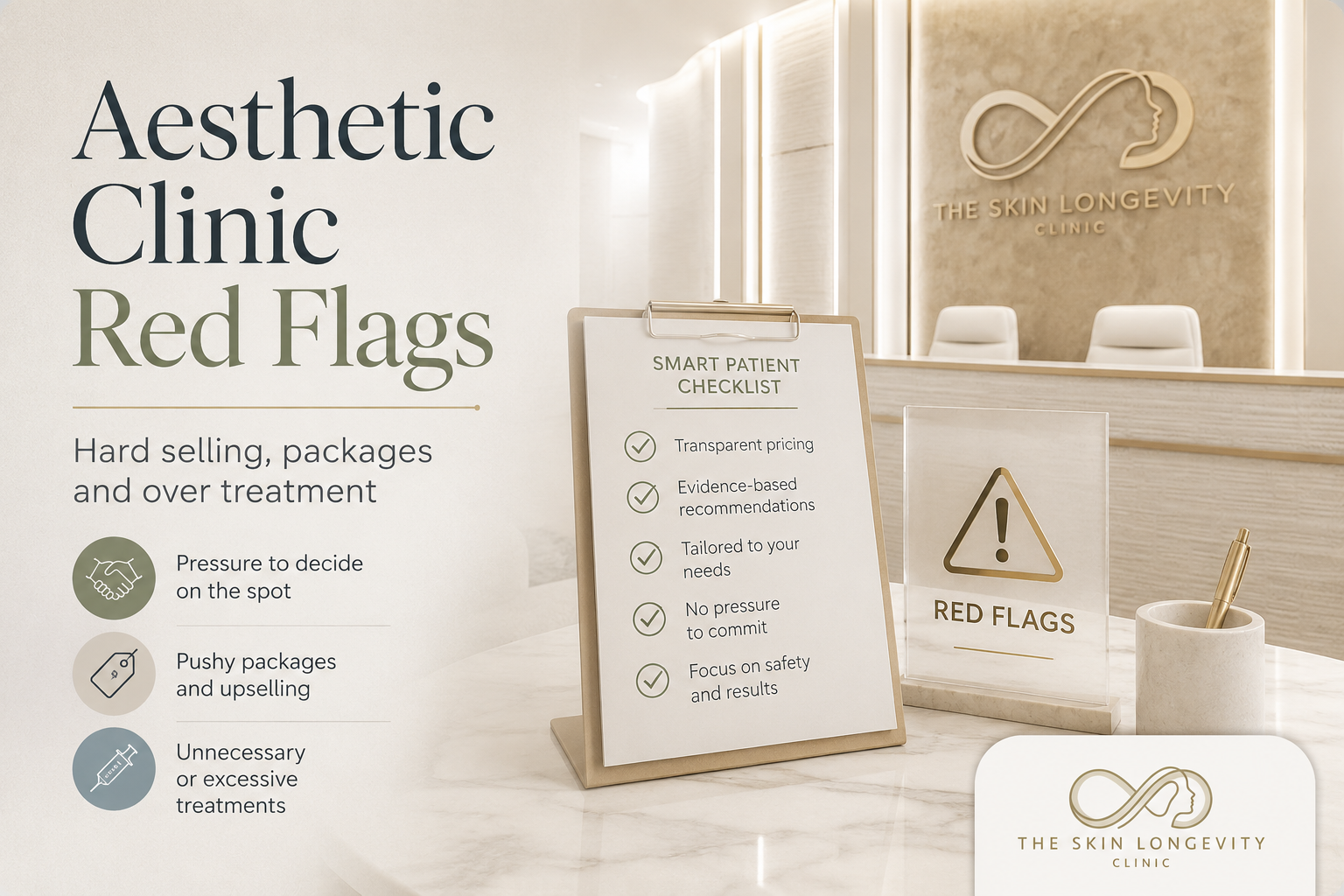
23 Aug Aesthetic Clinic Red Flags Singapore: Hard Selling and Packages
Red Flags During an Aesthetic Clinic Consultation in Singapore
By Dr Rachel Ho | Aesthetic Doctor, Founder, The Skin Longevity Clinic, Singapore
Medically reviewed by Dr Rachel Ho, MBBS, MRCS, MMed (ENT), August 2026.
People searching for the best aesthetic clinic in Singapore often compare reviews, technology and prices. The consultation itself can be more revealing, because it shows whether the clinic begins with diagnosis and informed choice or moves directly towards selling a treatment.
Patients concerned about aesthetic clinic hard selling in Singapore are usually trying to avoid two outcomes. They do not want to pay for treatment they do not need, and they do not want to accept risks they were never given a fair opportunity to understand.
A single promotion or package does not prove that a clinic provides poor care. A course of treatment can be clinically sensible, combination treatment can be appropriate and a genuine promotion can lower cost. Concern arises when commercial pressure replaces examination, informed consent and a clear explanation of priorities.
Quick answer to aesthetic clinc red flags in Singapore
Common aesthetic clinic red flags include recommending treatment before examining the patient, offering the same package to almost everyone, creating urgency around a discount, avoiding discussion of alternatives, minimising possible side effects and promising guaranteed results.
Further warning signs include recommending several procedures without explaining which one is most important, being unable to identify the device or injectable product, leaving responsibility for complications unclear and offering no planned review after treatment.
In Singapore, aesthetic procedures delivered by licensed healthcare providers are medical services regulated under the Healthcare Services Act. Advertising must be accurate and truthful and should not encourage unnecessary use of healthcare services. Singapore Medical Council guidance also expects doctors to obtain an adequate history, perform an appropriate examination and give patients sufficient information about benefits, limitations, material risks, complications and alternatives before treatment.

What should you notice before committing to treatment? A recommendation made before examination, the same package for every patient, pressure to sign immediately, side effects being brushed aside and no clear review plan all deserve further questions.
1. Treatment is recommended before you are examined
A treatment should follow an assessment of the concern. Pigmentation can represent melasma, sun spots, post inflammatory pigmentation or deeper dermal pigment, while a tired lower face can result from laxity, volume loss, muscle pull or several factors occurring together.
The Singapore Medical Council states that a doctor should have sufficient information from history taking, clinical examination and other relevant sources before offering an opinion, management plan or treatment. A recommendation made before the concern has been properly examined deserves clarification.
A useful question is:
What do you think is causing my concern, and what did you find on examination?
The answer should be more specific than ageing, dullness or collagen loss. It should explain why the proposed treatment fits the diagnosis.
When does an aesthetic package become a red flag? Concern rises when a limited-time discount rushes the decision, several procedures are sold before diagnosis or the patient is not given time to understand and compare the options.
2. Most patients appear to receive the same package
A package can make sense when a condition commonly needs several sessions. Pigment treatments, acne scar procedures and collagen remodelling often build results gradually, so planning a course is not inherently problematic.
A generic package becomes concerning when every patient is offered the same treatment, session number and interval regardless of skin tone, diagnosis, severity or previous response. Clinical evaluation should shape the management plan, rather than a package determining the treatment before the examination has taken place.
Ask why that number of sessions has been recommended and whether the course can change if the skin responds sooner, reacts poorly or requires a different approach. The clinic should also explain the validity period, review schedule and what happens to unused sessions.
For a fuller guide to comparing session prices and complete treatment costs, read Aesthetic Treatment Prices in Singapore.
3. A limited time discount is used to rush the decision
Promotional pricing is not automatically a sign of unsafe care. The concern is the use of urgency to shorten the assessment or prevent a patient from considering the recommendation calmly.
Elective treatment should allow time for questions and informed decision making. Singapore Medical Council guidance states that consent should be obtained early enough for patients to consider their decision and clarify doubts. More invasive aesthetic procedures also require a reasonable cooling off period proportionate to their invasiveness.
A consultation should remain useful even when you choose not to pay that day. You should be able to request the proposed plan and complete quotation, leave the clinic and decide later.
4. Alternatives and the option of waiting are not discussed
A clinician can have a preferred treatment, but should still explain the reasonable alternatives. These could include skincare, medication, another procedure, referral to a different practitioner, monitoring or choosing no treatment for the present.
Informed consent includes the purpose of the treatment, its expected benefits, significant limitations, material risks, possible complications and alternatives. The patient should also understand who will perform an invasive or higher risk procedure.
Ask:
What are my other options, and what happens if I wait?
A balanced answer helps you compare benefit, risk, downtime and cost. Refusing to discuss alternatives turns a medical consultation into a product presentation.
5. Side effects are minimised or mentioned only after payment
Every medical aesthetic treatment has limitations and possible adverse effects. The risk profile differs between a superficial peel, an injectable, a pigment laser and an energy based tightening procedure, but none should be described as entirely risk free.
A reassuring explanation can still be honest. It should cover common temporary reactions, less common but important complications, individual risk factors, aftercare and the plan if an unexpected outcome occurs. Singapore Medical Council guidance specifically requires discussion of significant limitations, material risks and possible complications as part of consent.
Phrases such as completely safe, zero downtime and no side effects deserve further questions. The aim is not to frighten patients, but to help them make a proportionate decision.
6. Results are guaranteed
Aesthetic outcomes vary with anatomy, skin biology, diagnosis, treatment settings, technique, healing and adherence to aftercare. Even an appropriately selected treatment cannot promise an identical result for every patient.
Singapore medical advertising standards require public information to be factual, accurate, verifiable and not misleading or unduly persuasive. They also prohibit extravagant or sensational claims.
A guarantee should prompt questions about what is actually being guaranteed. Improvement should be described in realistic terms, including what the treatment cannot change and how response will be assessed.
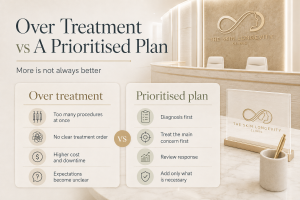
How can patients avoid aesthetic overtreatment? Begin with the diagnosis, treat the main concern first, review the response and add another procedure only when it has a clear clinical purpose.
7. Several treatments are recommended without prioritisation
Combination treatment can be appropriate because many concerns have more than one cause. Acne scars, for example, can require separate approaches for tethering, surface texture and dermal support.
The red flag is a long treatment list without a clear hierarchy. You should understand which treatment addresses the main problem, which additions are optional, what can wait and why the sequence has been chosen.
Ask:
If I start with only one treatment, which one should come first and why?
A clear answer protects against over treatment. It also makes it easier to judge whether the first stage worked before more procedures are added.
The Skin Longevity Assessment explains how barrier health, pigmentation, inflammation, collagen support, facial structure and recovery capacity can be assessed before a longer plan is built.
8. The clinic cannot clearly identify the device or injectable
Patients should be able to ask for the exact name of the treatment, device or injectable product. Relevant details can include the manufacturer, product quantity, treatment area, single use consumables and who will perform the procedure.
Descriptions such as medical grade laser, Korean skin booster or premium collagen treatment provide too little information for an informed comparison. The Health Sciences Authority provides searchable registers for medical devices and therapeutic products through its Infosearch service.
Registration alone does not prove that a treatment is suitable for you. It does, however, support product and device traceability and allows patients to verify what is being discussed.
Counterfeit products, poor sterility and injections by people who are not doctors are the main causes of botched treatments. In Singapore, injections and surgery by non-doctors are illegal.
For location, opening hours and first-visit details, see the aesthetic clinic in Orchard, Singapore.
9. Responsibility for complications is unclear
The consultation should identify who is assessing you, who will perform each part of the procedure and who remains responsible for your follow up. This is especially important when a clinic uses a team involving doctors, nurses, therapists or other staff.
Singapore Medical Council guidance states that a doctor who delegates part of a patient’s care retains overall responsibility and should take reasonable care to ensure that the person carrying it out is capable of providing the required standard. Patients should also be informed about the people performing invasive or higher risk procedures.
Ask who will review you if a problem develops in the evening or over a weekend. A named contact pathway is more reassuring than a general instruction to message the clinic.
10. There is no planned review or follow up
A review is not necessary after every minor treatment, but the clinic should explain whether one is recommended and what should trigger an earlier assessment. Injectables, energy based procedures and treatments carrying pigment or healing risks often benefit from a defined review plan.
A clinic that focuses only on the next package payment can miss the more important question of whether the previous treatment worked. Review also allows the plan to be adjusted, paused or stopped when the expected benefit is not appearing.
A good follow up process should tell you what is normal, what needs attention, how to contact the clinic and who is responsible for managing a complication.
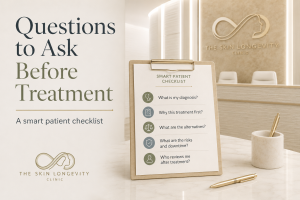
What should you ask before an aesthetic procedure? Ask what the diagnosis is, why this treatment should come first, what the reasonable alternatives are, what risks and downtime to expect and who will review you afterwards.
How to protect yourself when you feel pressured
You can pause the consultation without rejecting treatment permanently. Ask for the diagnosis, proposed treatment sequence, complete nett cost, expected number of sessions, risks, aftercare and review plan in writing.
Verify that the healthcare provider appears in the HealthHub directory and that the doctor is listed on the Singapore Medical Council register. HealthHub specifically advises patients to check both the clinic and the healthcare professional before undergoing medical procedures.
A second opinion is reasonable when the recommendation is expensive, invasive or difficult to reverse. You do not owe a clinic an immediate decision simply because time has been spent on the consultation.
Patients who are unhappy with care should usually raise the concern with the clinic first. Singapore’s Ministry of Health provides further routes for unresolved service, billing, professional conduct and healthcare disputes, including MOH and the Singapore Medical Council according to the nature of the complaint.
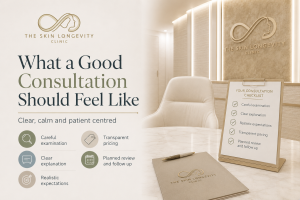
What should a good aesthetic consultation feel like? It should feel clear, calm and unhurried, with an examination, realistic expectations, transparent costs and a planned review rather than pressure to proceed.
What a clear, patient centred consultation should feel like
A good consultation should leave you clearer than when you entered. The doctor should examine the concern, explain the likely cause and connect each recommendation to that diagnosis.
You should understand which treatment is the priority, which options are optional and which concerns are unlikely to improve with the proposed procedure. Risks, downtime, limitations, maintenance and the likely complete cost should be discussed before payment.
The conversation should also leave room for restraint. A clinician should be comfortable advising skincare, monitoring, referral, a second opinion or no procedure at present when those choices are more appropriate.
At The Skin Longevity Clinic, the consultation approach begins with the skin, facial anatomy, medical history and patient priorities rather than with a fixed treatment package. Readers who are new to aesthetic medicine can review What to Expect at Your First Aesthetic Clinic Consultation and How to Choose an Aesthetic Clinic in Singapore Safely before booking.
Dr Rachel Ho’s clinical perspective
The most valuable part of an aesthetic consultation is often deciding what should not be done. A patient rarely needs every available treatment at once, and clarity about priorities protects both the result and the patient’s budget.
I prefer to explain what is driving the concern, what each option can realistically change and what can wait. A good plan should still make sense after the excitement of a promotion has passed.
Frequently asked questions
Is hard selling at an aesthetic clinic a red flag?
Hard selling becomes a warning sign when it replaces proper examination, limits time for decision making or makes a patient feel unable to decline. A calm explanation of treatment and cost is different from repeated pressure to purchase on the same day.
Are aesthetic treatment packages always a red flag?
A package can be appropriate when several sessions are clinically expected and the terms are clear. The clinic should explain why the course is recommended, when progress will be reviewed and what happens if the plan needs to change.
Can I leave an aesthetic consultation without treatment?
Elective treatment should allow patients to consider the information and decide freely. Singapore Medical Council guidance recognises the patient’s right to accept, decline, withdraw or modify consent and expects sufficient time for questions before treatment.
How can I avoid over treatment at an aesthetic clinic?
Ask the doctor to identify the main diagnosis and choose one priority. Request an explanation of what can wait, what is optional and how the response will be reviewed before another treatment is added.
Should the clinic tell me which device or injectable it uses?
You can ask for the exact device, product, manufacturer, quantity and person performing the procedure. Clear product and device identification supports informed consent, traceability and meaningful comparison between quotations.
Final takeaway
A good aesthetic consultation is not the one that produces the longest treatment list. It is the one that gives you enough information to decide whether to proceed, wait, seek another opinion or decline.
When comparing aesthetic clinics in Singapore, look beyond décor, discounts and device names. Diagnosis, consent, realistic expectations, transparent costs, complication planning and continuity of care reveal far more about how a clinic approaches its patients.
Related reading at TheSkinLongevityClinic.com
- Best Aesthetic Clinic Singapore: How to Choose Safely
- First Aesthetic Clinic Consultation Singapore: What to Expect
- Aesthetic Treatment Prices Singapore: Cost Guide for 2026
- Skin Longevity Assessment in Singapore
References
- Ministry of Health Singapore. Regulation of Advertisements for Aesthetic Treatments. 2024.
- Singapore Medical Council. Ethical Code and Ethical Guidelines. 2016 edition.
- HealthHub Singapore. Protect Yourself from Unlicensed Healthcare Services and Professionals.
- Ministry of Health Singapore. Healthcare Services Act Summary of Requirements. Updated August 2026.
- Health Sciences Authority Singapore. Infosearch for Medical Devices and Therapeutic Products. Updated June 2026.
- Ministry of Health Singapore. Inquiries and Complaints Guide. Updated December 2025.