

22 Aug Dynamic vs Static Wrinkles: How to Tell the Difference | Skin Longevity Clinic
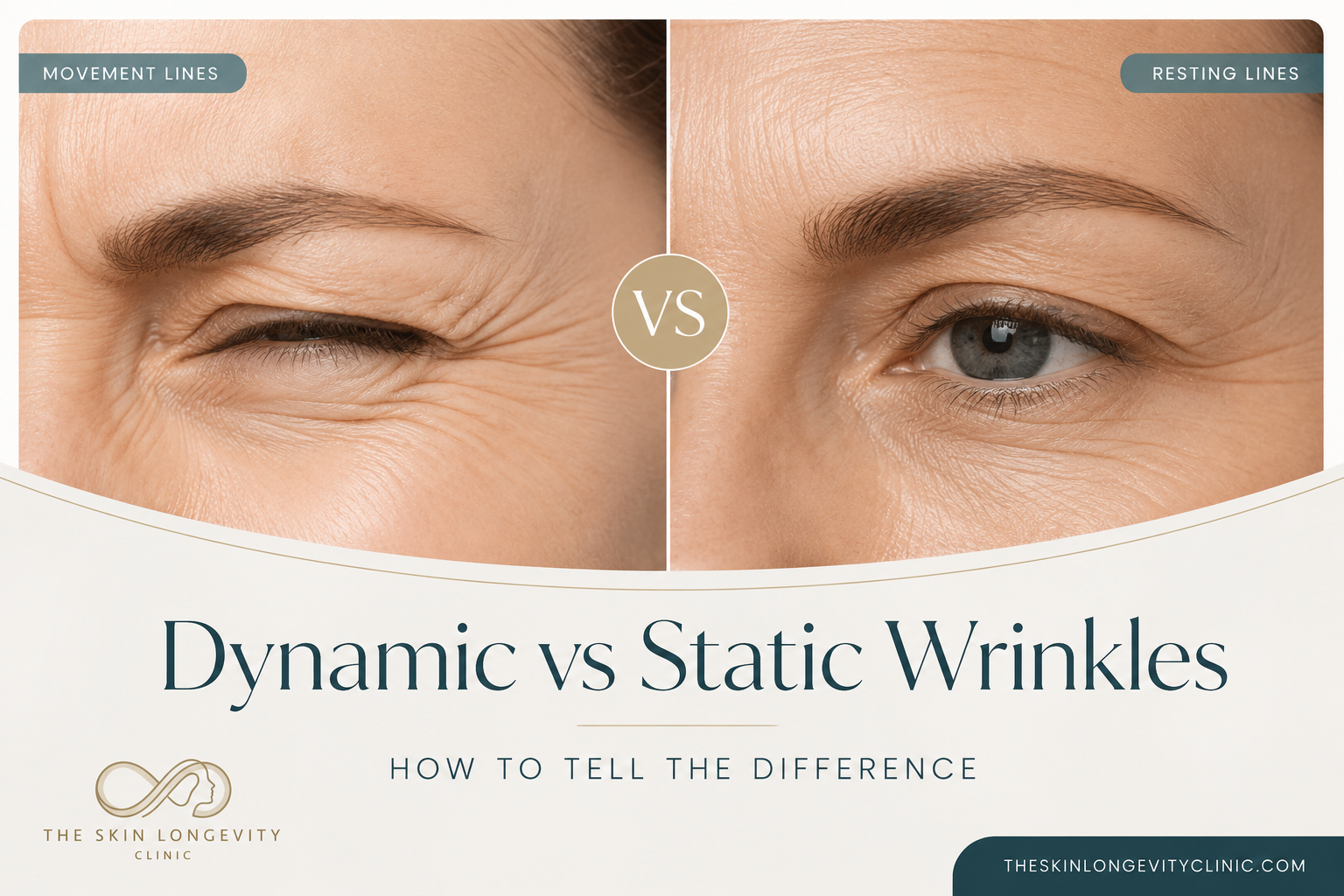
Understanding the difference between dynamic and static wrinkles is the key to understanding wrinkle treatment. It explains why some lines respond well to relaxing a muscle while others do not, and why a clinician spends time watching how a face moves before suggesting anything. This article sets out how to tell the two apart, why they form, and why the distinction shapes the approach.
For the broader overview of wrinkle treatment, see wrinkle treatment in Singapore, and for the full picture of areas and results, see the patient guide to botulinum toxin in Singapore.
Medically reviewed by Dr Rachel Ho, MBBS, MRCS, MMed (ENT), 17 July 2026.
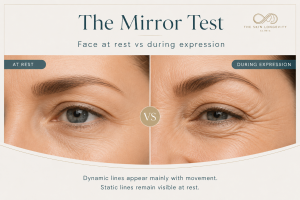
The mirror test: if a line appears mainly with movement, it is usually dynamic. If it remains visible at rest, it is more static.
A simple test you can do in the mirror for your wrinkles
The quickest way to tell the two apart is to look at your face at rest and then during expression. Relax completely and note which lines remain visible. Then raise your eyebrows, frown or smile and note which lines appear or deepen. Lines that show mainly during movement are dynamic. Lines that stay when the face is still are static. Many people find they have a mixture, and that mixture is exactly what an assessment is designed to read.
For treatment options for both wrinkle types, see wrinkle treatment in Singapore.
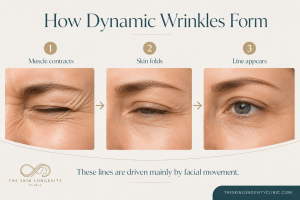
How dynamic wrinkles form: repeated facial movement folds the skin and creates expression lines over time.
Dynamic wrinkles: some wrinkles or lines appear only during expression
Dynamic lines appear because the muscles of facial expression are attached to the skin. When a muscle contracts, it folds the skin above it, and that fold is the line you see. Relax the muscle and the fold eases. Because these lines are produced by movement, reducing the movement tends to soften them, which is why dynamic lines are the ones most clearly helped by a muscle-focused approach.
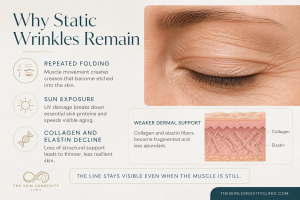
Why static wrinkles remain: skin quality, sun exposure and repeated folding all contribute to lines that stay visible even at rest.
Static wrinkles: Why other lines remain at rest
Static lines remain because the skin itself has changed. With time and repeated folding, and under the influence of sun exposure and the natural decline in collagen and elastin, the skin loses some of its ability to spring back1. A crease that once appeared only on movement becomes etched into the surface. At that point the line is present even when the muscle is still, because it is held by the condition of the skin rather than by muscle activity alone.
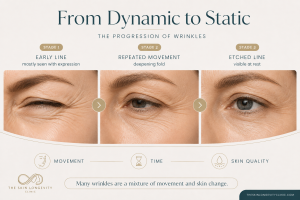
From dynamic to static: many wrinkles begin as movement lines and gradually become etched into the skin with time
How muscle movement and skin quality interact
The two contributors are not separate stories but stages of the same one. Early on, a line is largely dynamic and driven by movement. Repeated movement over years, combined with declining skin quality, gradually converts part of that line into a static one. This is why the same person can have a frown line that is mostly dynamic in their thirties and partly static later. It is also why prevention and skin care are discussed alongside treatment, since both movement and skin quality shape the outcome4 .
Dr Rachel Ho’s clinical perspective: When I assess a line, I am really asking how much of it is movement and how much is skin. That single question guides everything that follows. It keeps expectations honest, and it stops a person being treated for muscle when the real issue is skin quality, or the reverse.
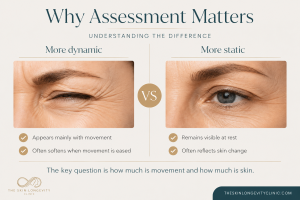
Why wrinkle assessment matters: understanding how much of a line is caused by movement versus skin change helps guide the right treatment approach in Singapore.
Why established lines may require a different approach
Because a static line is held by the skin, relaxing the muscle beneath it may soften it only partly, if at all. An established line often needs attention to the skin itself, through approaches aimed at texture and quality rather than movement, and sometimes a combination over time. Recognising that a line has become static is what prevents disappointment, because it sets a realistic expectation of what any single approach can achieve.
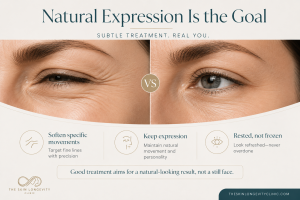
Natural expression is the goal: good wrinkle treatment should soften specific lines while keeping the face looking like you.
Why completely removing facial movement is not the goal
It is tempting to think that stopping all movement would prevent all lines, but that is neither achievable nor desirable. Facial movement is how we express ourselves, and a face that cannot move looks unnatural. The aim of careful treatment is to ease specific movements that drive a particular line while preserving natural expression, because the effect is graded rather than a complete block3 . A good result looks like a rested version of the same face, not a still one.
Frequently asked questions
How do I know if my wrinkle is dynamic or static?
Look at your face at rest and then during expression. Lines that appear mainly with movement are dynamic, and lines that remain when the face is still are static. Many people have a mixture.
Can a dynamic wrinkle become static?
Yes. Over time, repeated movement combined with declining skin quality can turn part of a dynamic line into a static one that is visible at rest.
Do static wrinkles respond to muscle-focused treatment?
Often only partly, because they are held by skin changes rather than by muscle activity. They may need approaches aimed at the skin itself.
Is it better to treat lines early?
Reducing repeated movement earlier may slow the point at which dynamic lines become static, though the long-term evidence for prevention is limited and the decision is an individual one.
Should the goal be no facial movement?
No. The aim is to soften specific movements while keeping natural expression, not to remove movement altogether.
Related articles in this series
This article is part of an eleven-part patient education series on botulinum toxin. The suggested reading and publishing order is:
- Botulinum Toxin in Singapore: Areas, Results, Safety and Medical Assessment
- Masseter Hypertrophy and Jaw Slimming in Singapore: Causes and Treatment Options
- Wrinkle Treatment in Singapore: Forehead Lines, Frown Lines and Crow’s Feet
- Dynamic vs Static Wrinkles: How to Tell the Difference (this article)
About the author
Dr Rachel Ho holds an MBBS from the National University of Singapore and a Master of Medicine in Otolaryngology. She is the founder of The Skin Longevity Clinic, a doctor-led practice at Scotts Medical Center, Pacific Plaza, and has more than 16 years of clinical experience in Singapore. Her clinical focus includes skin longevity and quality, facial harmony and proportion, and evidence-based aesthetic medicine. She maintains active continuing professional development, including attendance at the Aesthetic and Anti-Aging Medicine World Congress (AMWC) in Monaco in 2026, and is recognised for her work in education, media commentary and advisory roles across aesthetic medicine. She has contributed commentary and features for publications including Her World, ELLE (ELLE Beauty Awards 2026) and L’Officiel Singapore. Dr Rachel Ho is a registered medical practitioner in Singapore.
Read more about Dr Rachel Ho at drrachelho.com and on her profile at The Skin Longevity Clinic.