

23 Aug Dry Skin in Humid Singapore?
By Dr Rachel Ho | Aesthetic Doctor, Founder, The Skin Longevity Clinic, Singapore
Quick answer to dry skin in Singapore: why does this occur?
Skin can feel dry in humid Singapore because the moisture in the outside air does not control what happens inside your skin barrier. Air-conditioning dries indoor air for most of the day and night, repeated washing after sweating strips protective oils, ultraviolet exposure degrades the barrier, and popular active ingredients increase water loss. The humidity outdoors sits on the surface, while the barrier underneath can still be leaking water faster than it is replaced.
For signs, causes and repair of barrier damage, see the guide to a damaged skin barrier in Singapore.
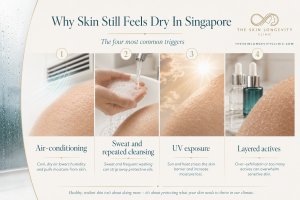
Outdoor humidity does not cancel out the drying effect of long hours in air-conditioning.
Key takeaways on dry skin in Singapore
- What is happening. Outdoor humidity does not guarantee a healthy, well-hydrated barrier, especially with heavy air-conditioning.
- Who it affects. Office workers, frequent exfoliators and acne-active users are the groups who most often report tight, dry-feeling skin here.
- What to change first. Simplify the routine, cleanse more gently and support the barrier before adding any in-clinic treatments
Outdoor humidity does not cancel out the drying effect of long hours in air-conditioning.
Humidity does not guarantee a healthy skin barrier
Ambient humidity is the water content of the air around you. Skin hydration is the water content held inside the skin and the rate at which it escapes, known as transepidermal water loss. These are related but not the same. You can stand in humid air and still lose water through a barrier that is short of lipids or has been stripped by cleansing and actives. The humidity paradox is therefore common in Singapore, and a humid climate does not automatically produce well-hydrated skin. If dryness persists despite good habits, the dry skin and hydration treatments page sets out the medical options.
How prolonged air-conditioning affects water loss
Air-conditioning is the single biggest local reason skin feels dry. Cooling air also dries it, and most people spend the working day in an air-conditioned office and the night in an air-conditioned bedroom. That is a large share of every twenty-four hours spent in low-humidity air that steadily pulls moisture from the skin surface. The effect is gradual and easy to miss. Products are therefore often blamed when the environment is the larger contributor.
Heat, sweat and repeated cleansing
The tropical routine of sweating outdoors then washing indoors is hard on the barrier. Sweat feels refreshing but is mildly irritating as it evaporates, and the instinct to wash it off with a foaming cleanser removes protective oils along with it. Repeat this several times a day, add a hot shower, and the barrier loses lipids faster than it can rebuild them. Tightness immediately after cleansing is one of the clearest signs that a cleanser or water temperature is too stripping.
Ultraviolet exposure and barrier stress
Singapore sits close to the equator, so ultraviolet levels are high throughout the year. Beyond pigmentation and ageing, ultraviolet exposure degrades barrier lipids and generates low-level inflammation that makes skin more reactive and less able to hold water. Daily sunscreen is therefore part of hydration, not just pigment control, because a protected barrier retains moisture better than a sun-stressed one.
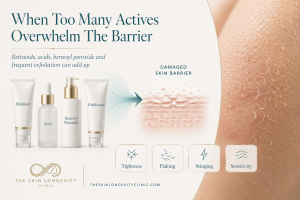
Layering too many active ingredients can overwhelm the skin barrier and worsen dryness
Retinoids, acids, benzoyl peroxide and layered actives
Active ingredients are powerful and useful, but layering too many at once is a frequent cause of tight, flaky, sensitised skin. Retinoids speed cell turnover, exfoliating acids loosen surface cells, and benzoyl peroxide dries oil-rich skin, and each increases water loss to some degree. Used together without recovery time, they overwhelm the barrier. Many people arrive convinced they have naturally dry skin when they actually have an over-treated barrier that improves within weeks of simplifying the routine.
Why frequent facials or exfoliation may worsen sensitivity
Regular scrubs, strong peels and frequent facials can feel productive but repeatedly remove the outermost protective layer before it has fully recovered. Over time this thins the barrier, increases stinging and makes previously comfortable products feel harsh. Less is often more, and spacing out exfoliation allows the barrier to rebuild between sessions.
Travel, long flights and sleep disruption
Frequent flyers notice that skin feels especially tight in the air, because cabin humidity is very low. Long flights, jet lag and broken sleep all raise water loss and lower the skin ability to repair itself. Travel-heavy months are a common trigger for a run of dry, dull skin, and they respond to extra humectants and occlusives around the trip rather than to a permanent change in routine.
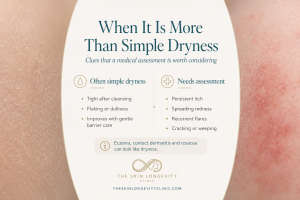
Persistent itch, redness or cracking can suggest more than simple dryness.
Medical conditions that can resemble simple dryness
Not every dry patch is simple dryness. Eczema, contact dermatitis and rosacea can all present as rough, flaky or tight skin while needing very different treatment, which may include medications, LED light, intradermal drug delivery or injectable moisturisers. Clues that point beyond ordinary dryness include itch, spreading redness, recurrent flares in the same areas and stinging that does not settle with gentle care. When these features are present, the priority is a diagnosis, and the guide toe dry versus dehydrated skin comparison help sort out which is which.
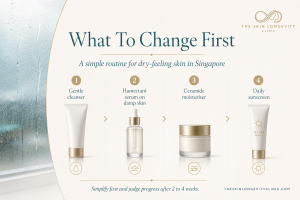
Four step skincare routine for dry-feeling skin in Singapore featuring a gentle cleanser, humectant serum, ceramide moisturiser and daily sunscreen.
What to change first: skincare for dry skin
Before adding anything, take things away. Switch to a gentle cleanser and lukewarm water, reduce the number of active ingredients to one at a time, add a humectant and a barrier moisturiser, and wear sunscreen daily. Give this two to four weeks. Most tight, dry-feeling skin in Singapore improves substantially with this alone, which also makes it far easier to judge whether an in-clinic treatment is really needed.
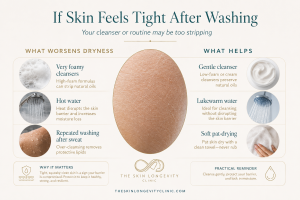
If skin feels tight after washing, your cleanser or cleansing habits could be too harsh.
When to seek a clinical assessment for dry skin
See a doctor if the dryness is persistent despite gentle care, if the skin becomes broken, painful or weeping, if a rash is spreading, if there are signs of infection, or if itch is disturbing sleep. These features suggest an inflammatory or infective cause rather than environmental dryness, and they should be assessed before any aesthetic treatment is considered.
How to hydrate skin for the Singapore climate
A routine that suits this environment leans on humectants that hold water at the surface, a barrier moisturiser that replaces lost lipids, and daily sunscreen that protects both. In practice this means applying a glycerin or hyaluronic acid serum to slightly damp skin so there is water to bind, following with a ceramide-containing moisturiser, and reapplying a lighter product midday if the skin feels tight after hours in the aircon. Keeping a small moisturiser at the desk, lowering shower temperature and cleansing less aggressively after sweat all reduce the daily water loss that the climate encourages. None of this is dramatic, but consistency beats intensity for skin that is fighting a drying indoor environment.
Who tends to notice dry skin in Singapore the most?
Certain groups report the humidity paradox more than others. Office workers who spend eight or more hours in air-conditioning, frequent travellers exposed to dry cabin air, people using acne or pigmentation actives, and those who exfoliate often all sit at higher risk of tight, dry-feeling skin. Age matters too. Detailed analysis of skin lipids shows that ageing not only reduces the amount of barrier lipids but also shifts the balance of ceramide types in a way that disturbs how the skin holds water, so the same air-conditioned environment tends to affect mature skin more, a process linked to inflammaging. Recognising which of these applies to you points to the most useful change, whether that is a desk moisturiser, spacing out actives or protecting skin around travel.
What Singapore’s environmental dryness cannot explain
Environment accounts for a great deal, but it does not explain everything. If skin is intensely itchy, if redness is spreading, if the same patches flare repeatedly, or if there is cracking, weeping or crusting, the cause is more likely an inflammatory or infective skin condition than the aircon. Blaming the climate in these situations can delay a diagnosis. The honest position is that Singapore life genuinely dries skin, and that some dry-looking skin is a medical problem wearing the same disguise, so persistent or severe cases deserve a proper look.
Evidence at a glance
Dry skin: what do the studies and evidence show?
| Evidence | What it found | Main limitation |
|---|---|---|
| Barrier lipid reviews | Ceramide-containing formulations improve water retention and reduce water loss | Formulations and study designs vary |
| Controlled xerosis study | A ceramide cream improved dryness and barrier function | Single product and setting |
| Photobiomodulation reviews | Support for barrier repair and calming, weaker for direct hydration | Outcomes measured differ between studies |
Dr Rachel Ho’s Clinical Takeaway on Dry Skin
The humidity paradox comes up in my clinic in Singapore every week. People assume a humid country like Singapore equates to having hydrated skin, but they spend most of the day in dry, cooled air and often layer one active too many. The fix is rarely a “stronger” or thicker moisturiser, serum or face mask. It is usually a gentler cleanser, fewer actives and consistent sunscreen, and only then, if the skin is stable and still dull, a hydration treatment. If the skin is itchy or inflamed, that is a medical question first.
Frequently Asked Questions
Why is my face so dry in Singapore?
Facial skin is thin and heavily exposed to air-conditioning, cleansing, sunscreen and active ingredients, so it loses water quickly. Moving between outdoor heat and cool interiors adds stress. A gentle routine, moisturiser on damp skin and less time in direct air-conditioning usually help.
Does air-conditioning cause dry skin?
Yes. Cooled indoor air is dry air, and spending most of the day and night in it steadily increases water loss from the skin. A humidifier, moisturiser on damp skin and short breaks from direct airflow reduce the effect.
Does air-conditioning cause dry skin?
It is one of the biggest contributors in Singapore. Cooled air is dry air, and long hours in it steadily increase water loss from the skin surface, which can leave skin tight and dull despite humid weather outdoors.
Why does my skin feel tight after washing?
Tightness right after cleansing usually means the cleanser or water temperature is stripping too much oil. Switching to a gentle cleanser and lukewarm water often resolves it.
Can sweating make skin more dehydrated?
Sweat itself is mildly irritating as it dries, and the repeated washing that follows removes protective oils. The combination can leave skin drier rather than more hydrated.
Why did my skin suddenly become sensitive to skincare?
Sudden stinging with familiar products often reflects a stressed barrier, commonly from too many actives or too much exfoliation. Pausing actives and focusing on barrier care usually settles it.
Considering a consultation for your dry skin?
If tight, dry-feeling skin persists despite simplifying your routine, a consultation with Dr Rachel Ho can identify whether the cause is environmental, barrier-related or medical.
References
- Williams SF, and colleagues. The impact of age on the lipidomic profile of the stratum corneum and associated effects on structure, function and overall skin health in adults predisposed to atopic dermatitis. Experimental Dermatology, 2025. https://doi.org/10.1111/exd.70192
- Draelos ZD, and colleagues. The effect of a ceramide-containing product on stratum corneum lipid levels in dry legs. Journal of Drugs in Dermatology, 2020. https://doi.org/10.36849/JDD.2020.4796
- Kono T, and colleagues. Clinical significance of the water retention and barrier function improving capabilities of ceramide containing formulations, a qualitative review. The Journal of Dermatology, 2021. https://onlinelibrary.wiley.com/doi/10.1111/1346-8138.16175
- Lueangarun S, and colleagues. The 24 hour, 28 day and 7 day post moisturising efficacy of a ceramide containing cream compared with a hydrophilic cream on skin dryness and barrier disruption in senile xerosis. Dermatologic Therapy, 2019. https://onlinelibrary.wiley.com/doi/abs/10.1111/dth.13090
- American Academy of Dermatology. Dry skin, diagnosis, treatment and everyday care guidance. https://www.aad.org/public/everyday-care/skin-care-basics/dry/dermatologists-tips-relieve-dry-skin
- Mayo Clinic. Dry skin, diagnosis and treatment. https://www.mayoclinic.org/diseases-conditions/dry-skin/diagnosis-treatment/drc-20353891
- DermNet. Dry skin, or xeroderma, causes and management. https://dermnetnz.org/topics/dry-skin