

29 Aug Damaged Skin Barrier Singapore: Signs, Repair and Treatments
By Dr Rachel Ho | Aesthetic Doctor, Founder, The Skin Longevity Clinic, Singapore
Medically reviewed by Dr Rachel Ho, MBBS, MRCS, MMed (ENT), August 2026.
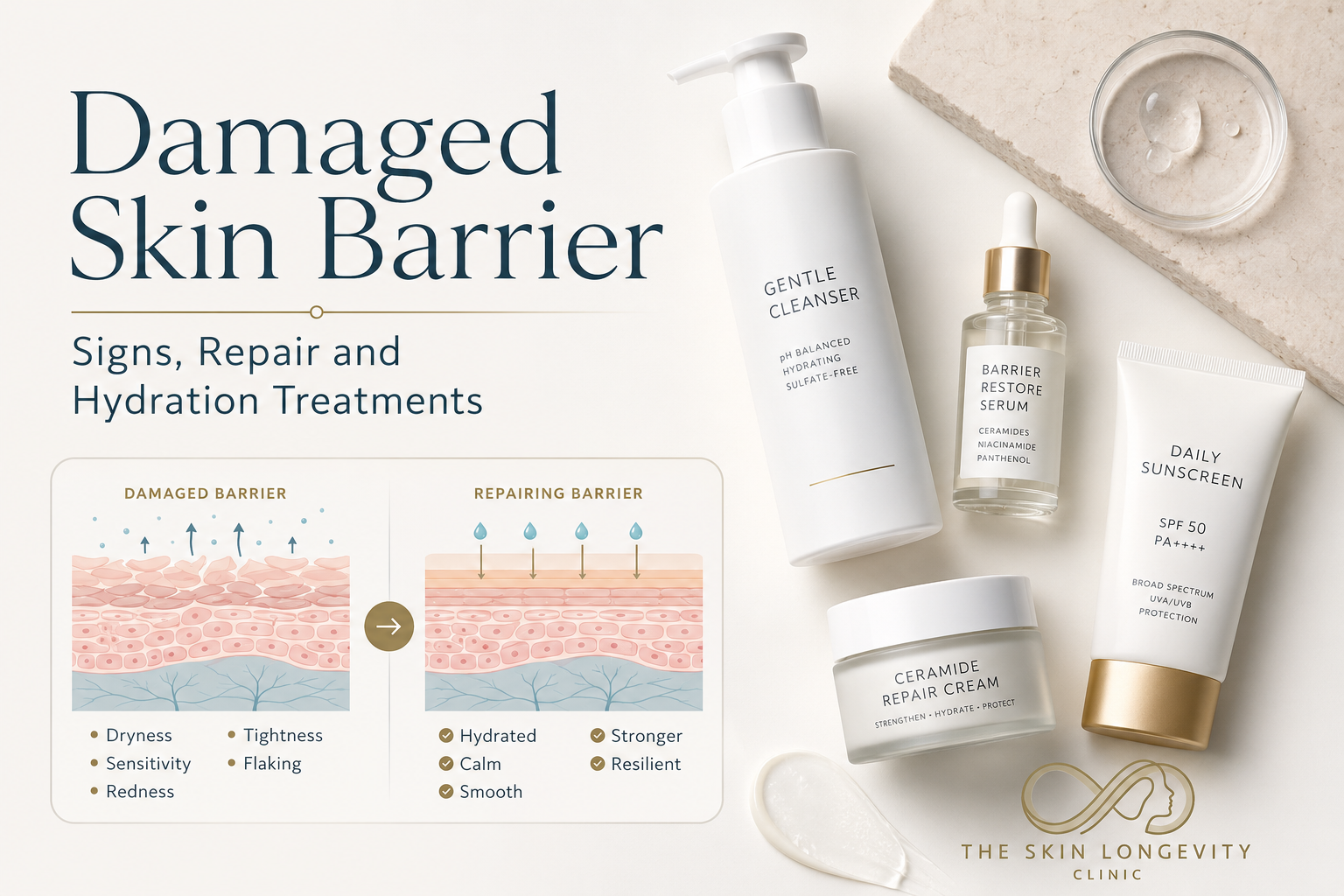
When a moisturiser you have used for months suddenly burns, the answer is rarely another active serum. Stinging, flaking, redness and a raw feeling often indicate that the skin’s outer protective layer has become disrupted.
A damaged skin barrier is different from naturally dry skin and temporary dehydration. It represents an acute loss of barrier integrity, commonly after excessive exfoliation, several active ingredients, repeated cleansing or an aggressive treatment. Recovery begins by removing the trigger and restoring tolerance, while devices and injectable hydration treatments are considered according to the stage of recovery.
The sequence of treating the skin barrier is simple: Calm an actively damaged barrier first. Once the skin no longer stings, peels or flushes easily, treatments such as LDM, LED, a Hybrid Cooperative Complex Injectable Moisturiser, hyaluronic acid skin boosters or an ECM skin booster can be considered for residual dehydration and dermal skin quality.
Damaged skin barrier at a glance
Damaged skin barrier and symptoms
| Concern | What is happening | Typical clues | First priority |
|---|---|---|---|
| Dry skin | The skin is persistently low in protective lipids | Roughness, flaking and tightness that recur regularly | Lipid rich moisturiser and gentle cleansing |
| Dehydrated skin | The skin is temporarily short of water | Dullness, tightness and fine surface lines, sometimes with oiliness | Humectants and reduction of water loss |
| Damaged skin barrier | The outer protective layer has been acutely disrupted | Stinging, burning, redness, flaking and sudden product sensitivity | Pause irritants and rebuild barrier tolerance |
| Eczema or contact dermatitis | An inflammatory skin condition is present | Itch, recurrent rash, spreading redness or defined areas of inflammation | Medical diagnosis and condition specific treatment |
| Rosacea | Vascular and inflammatory processes affect the central face | Persistent redness, flushing, heat sensitivity and sometimes bumps | Medical assessment before aesthetic treatment |
Dryness, dehydration and barrier damage often overlap. A person can have chronically dry skin, become dehydrated after a week of air conditioning and then develop barrier injury after introducing a retinoid and exfoliating acid at the same time.
What is the skin barrier?
The skin barrier is mainly formed by the stratum corneum, the outermost part of the epidermis. Flattened skin cells sit within an organised lipid matrix containing ceramides, cholesterol and free fatty acids.
This structure is often compared with bricks and mortar. The cells provide the bricks, while the lipids form the mortar that limits water loss and reduces the entry of irritants, allergens and microorganisms.
When these lipid layers become disorganised, transepidermal water loss increases and substances that were previously well tolerated can penetrate more easily. The result is skin that feels tight, reactive and unexpectedly sensitive.
A controlled study of a ceramide containing moisturiser found improvements in visible dryness and discomfort, together with increased levels of ceramides, cholesterol and fatty acids in the stratum corneum after four weeks1. The result applies to the formulation studied, but it supports the wider principle that barrier lipids can do more than temporarily coat the skin.
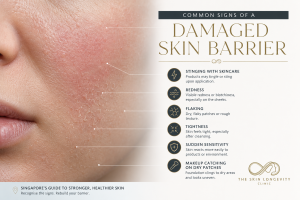
What are the signs of skin barrier damage? Familiar skincare that suddenly stings, new redness, flaking, tightness and widespread sensitivity are common clues. Makeup can also cling unevenly to dry or inflamed areas.
What does skin barrier damage look and feel like?
The strongest clue is a change in how the skin behaves. Products that were once comfortable begin to sting, and the face can feel tight or raw shortly after cleansing.
Other signs include:
- New redness or flushing
- Patchy flaking
- Burning after moisturiser or sunscreen
- Fine rough bumps
- Sudden intolerance to several products
- Makeup collecting around flaky areas
- Skin that feels oily on the surface but tight underneath
- Increased sensitivity after a peel, facial or laser treatment
Barrier damage often follows a recognisable period of product escalation. A new retinoid is added, an exfoliating toner remains in the routine, vitamin C is increased and a facial is performed before the skin has adapted. Each step can be reasonable by itself, while the combined irritation becomes too much.
Why is skin barrier damage common in Singapore?
Singapore’s outdoor humidity does not guarantee hydrated skin. Many people spend most of the working day and night in air conditioned rooms, where lower humidity encourages water loss from the surface.
The daily transition from outdoor heat to cool interiors adds another pattern. Sweating leads to repeated cleansing, and strong foaming cleansers can remove protective lipids several times in one day. Tightness immediately after washing is a useful sign that the cleanser, water temperature or cleansing frequency is too aggressive.
Skincare routines create another common route to damage. Retinoids, exfoliating acids, benzoyl peroxide and low pH vitamin C can all be useful, but using several together without recovery time increases cumulative irritation. Scrubs, cleansing brushes, frequent peels and closely spaced facials can add a second layer of physical or chemical stress.
Damaged skin barrier versus dry skin
Dry skin, also called xerosis, is usually a longer term tendency towards insufficient surface lipids. It often feels rough and flaky even when the routine is stable, and it generally benefits from richer moisturisers containing barrier lipids and occlusive ingredients.
Barrier damage is more abrupt. It can occur in naturally dry, combination or oily skin, and stinging or burning is often more prominent than flaking.
The two can coexist. Naturally dry skin has less reserve when exposed to strong actives, so it can progress into barrier disruption more readily.
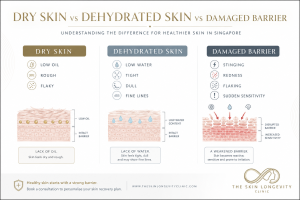
Dry, dehydrated or barrier damaged? Dry skin is mainly short of protective lipids, dehydrated skin is short of water, while a damaged barrier adds stinging, redness, flaking and sudden sensitivity. These concerns can overlap but require different first steps.
Damaged skin barrier versus dehydrated skin
Dehydrated skin is short of water rather than oil. It can look dull, feel tight and show fine surface lines, yet still become shiny across the forehead and nose later in the day.
Dehydration usually improves when water loss is reduced and humectants are used consistently. Barrier damage requires an additional step because the triggers causing inflammation and reactivity also need to be removed.
Read Dry Skin and Dehydrated Skin in Singapore for a more detailed comparison, including oily dehydrated skin and why the popular pinch test is unreliable.
Could this be eczema, contact dermatitis or rosacea?
A disrupted barrier can look similar to an inflammatory skin condition, and both can be present at the same time. Eczema commonly itches and recurs in familiar areas, while contact dermatitis often develops after exposure to a specific ingredient or product.
Rosacea more often produces persistent redness, flushing, heat sensitivity and inflammatory bumps across the centre of the face. A heavier moisturiser alone will not address these underlying conditions.
Symptoms that are itchy, spreading, recurrent or resistant to a simple barrier routine deserve medical assessment. The skin allergies and dermatitis guide explains when irritation can represent more than skincare overuse.
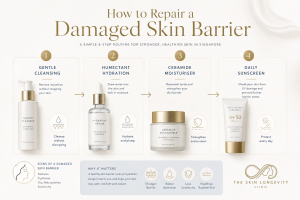
How do you repair a damaged skin barrier? Start with gentle cleansing, add humectant hydration, replace barrier lipids with a suitable moisturiser and protect the skin from ultraviolet stress. Retinoids, exfoliating acids and scrubs are usually paused until stinging and flaking settle.
How to repair a damaged skin barrier
Barrier repair works best when the routine becomes shorter and more predictable. The objective for the first phase is comfort, rather than brightness, exfoliation or rapid transformation.
1. Cleanse gently
Use lukewarm water and a gentle cleanser once or twice daily. A morning water rinse can be sufficient when the skin is very dry and there is no heavy overnight product to remove.
Cleansing should leave the face comfortable. Persistent tightness immediately afterwards suggests that the cleanser, water temperature or frequency needs adjustment.
2. Add water with a simple humectant
Glycerin and hyaluronic acid draw water into the upper skin layers. Apply a simple humectant to slightly damp skin, then follow promptly with moisturiser to reduce evaporation.
A serum is optional while the skin is very reactive. Even a usually gentle product can sting because of preservatives, fragrance or other ingredients in the formula, so a plain moisturiser alone can be the safer starting point.
3. Replace barrier lipids
Look for moisturisers containing ceramides, cholesterol and fatty acids. The whole formulation is more important than seeing one ceramide near the end of an ingredient list.
A randomised crossover study in 51 volunteers with dry skin found that an emollient combining glycerol and petrolatum both increased hydration and reduced transepidermal water loss. Glycerol contributed mainly to hydration, while petrolatum provided the stronger occlusive effect2.
4. Seal very dry areas where needed
Petrolatum or another suitable occlusive can be applied as a thin final layer over very dry areas at night. Oily or acne prone skin may only need this around the corners of the nose, mouth or other flaky areas.
Occlusion reduces water loss, but it does not treat infection, allergic contact dermatitis or rosacea. Persistent inflammation still requires diagnosis.
5. Continue daily sun protection
Use a broad spectrum sunscreen that does not sting. Ultraviolet exposure can add inflammation and prolong recovery, while a highly irritating sunscreen formula can undermine adherence.
The best choice during recovery is the product the skin can tolerate in an adequate amount. New high strength actives and fragranced products should remain out of the routine until comfort returns.
Which skincare ingredients should be paused?
Retinoids, glycolic acid, salicylic acid, strong vitamin C, benzoyl peroxide, exfoliating masks and physical scrubs are commonly paused while the skin is burning, red or flaking.
Niacinamide can also sting when the barrier is actively disrupted, especially in a concentrated serum. Its reputation as a barrier ingredient does not mean every damaged face needs a 10 or 20 percent formulation.
Once the skin is comfortable, reintroduce one active at a time. Begin around twice weekly, keep the rest of the routine unchanged and wait roughly two weeks before adding another product. A return of stinging or persistent redness means the pace is too fast.
How long does a damaged skin barrier take to recover?
Mild disruption often improves noticeably within two to four weeks of a simplified routine. More severe damage, repeated exposure to the trigger or an underlying inflammatory condition can extend that timeline considerably.
Recovery should be judged by behaviour rather than the calendar. The skin should tolerate cleansing, moisturiser and sunscreen without burning, while redness and flaking should be steadily settling.
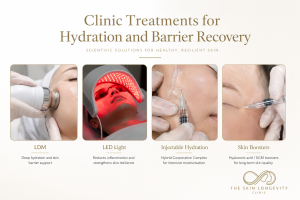
Which in-clinic treatments can support dry or dehydrated skin? LDM and red LED can be considered as gentle recovery adjuncts in selected patients. Once active stinging and inflammation have settled, Hybrid Cooperative Complex, hyaluronic acid skin boosters or an ECM skin booster can be considered for persistent dermal dehydration, crepiness or reduced skin quality.
In-clinic treatments for damaged skin barrier
The order is more important than the menu. A stinging, broken or actively inflamed barrier first needs gentle skincare and, where appropriate, medical treatment.
LDM and LED can be considered as low disruption support when the skin is suitable. Injectable hydration belongs later, once the epidermal barrier is stable and the remaining concern is deeper dehydration, crepiness or reduced dermal quality.
LDM hydration and skin recovery
Bellasonic LDM treatment uses rapidly alternating ultrasound frequencies and is positioned as a gentle, non invasive treatment for hydration, calming and recovery support. It can suit selected patients with dehydrated, mildly reactive or post procedure skin, with little visible downtime.
The published evidence should be described accurately. Laboratory research found that ultrasound stimulated proliferation and migration in human dermal fibroblasts and increased fibronectin and collagen production, but this was an in vitro wound model rather than a clinical trial for facial dehydration3. A clinical study after rhinoseptoplasty reported shorter duration of swelling and bruising with dual frequency ultrasound, which supports a recovery role but does not prove direct repair of the stratum corneum4.
LDM is therefore best viewed as a supportive treatment. It does not replace barrier lipids, prescription treatment for eczema or rosacea, or a hydration injectable when the problem lies within the dermis.
LED light treatment
LED light treatment uses selected wavelengths for photobiomodulation. Red light is commonly used around inflammation calming and tissue repair signalling, while the experience is non invasive and usually involves minimal recovery.
Direct evidence for repairing a damaged facial barrier remains mixed. A porcine skin model found faster barrier recovery after specific red light exposure parameters5, while a placebo controlled human study after fractional carbon dioxide laser found no significant improvement in healing or transepidermal water loss6.
LED can be a comfortable adjunct for selected reactive or recovering skin. Its role should remain supportive rather than being presented as a replacement for moisturiser or medical treatment.
Hybrid Cooperative Complex Injectable Moisturiser
A Hybrid Cooperative Complex Injectable Moisturiser combines high and low molecular weight hyaluronic acid in stable complexes. It is designed to spread through the tissue and support dermal hydration, elasticity and skin quality without aiming to reshape the face.
A split face study involving 24 women compared Hybrid Cooperative Complex injections with another hyaluronic acid skin quality injectable. Three treatment sessions were performed, and both sides showed improvements from baseline in surface hydration, elasticity and transepidermal water loss, with no significant difference between the two products7.
This treatment acts within the dermis. It can improve persistent dehydration and early crepiness after the skin has stabilised, but it does not replace ceramides, cholesterol and fatty acids in the outer epidermal barrier.
Hyaluronic acid skin boosters
Hyaluronic acid skin boosters place low viscosity hyaluronic acid as small deposits within the dermis. Their main role is improving hydration, smoothness, fine dehydration lines and overall skin quality.
A multicentre randomised study compared an intradermal hyaluronic acid skin quality treatment with an untreated control. At one month, treated participants had substantially higher responder rates for cheek smoothness and fine lines, together with measured hydration improvement that persisted through the six month follow up8. The study assessed one defined product and should not be used to assume that all skin boosters perform identically.
Common effects include temporary bumps, swelling, redness and bruising. Rare vascular complications can occur with any injectable hyaluronic acid procedure, which is why product traceability, anatomical knowledge and emergency readiness remain important.
ECM skin booster
An ECM skin booster contains processed extracellular matrix material intended to support the dermal environment. It is more relevant when dehydration overlaps with thin, crepey skin, textural change or reduced dermal support.
A 2026 randomised split face study involved 20 adults with moderate cheek roughness. The particulated human acellular dermal matrix side showed greater improvements than the hyaluronic acid side in skin density, elasticity, wrinkle depth, hydration and barrier related measurements over 20 weeks9.
The study is encouraging, although it remains small, product specific and relatively short. One author also served as an adviser during development of the product, which should be considered when interpreting early evidence9
ECM treatment is not a first response to an actively damaged barrier. It becomes a possible option after inflammation has settled and the remaining concern involves dermal skin quality rather than surface injury alone.
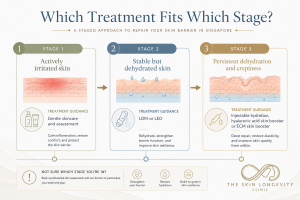
When should each skin treatment be considered? Actively irritated skin needs gentle skincare and diagnosis first. LDM or LED can be considered when the skin is stable but dehydrated, while injectable hydration or selected skin boosters belong later when persistent dermal dehydration or crepiness remains.
Which treatment fits each stage of skin barrier symptoms?
Skin barrier symptoms and treatments
| Symptoms | Direction | Treatments that can be considered | Main limitation |
|---|---|---|---|
| Burning, flaking or raw skin | Gentle cleansing, barrier lipids, occlusion and diagnosis where needed | Selected LDM or LED only after assessment | Devices do not replace epidermal lipid repair |
| Stable skin with temporary dehydration | Humectants and consistent moisturising | LDM, LED or a hyaluronic acid based injectable | Injection is unnecessary when skincare already controls the concern |
| Stable skin with persistent dehydration and fine crepiness | Dermal hydration and skin quality support | Hybrid Cooperative Complex or HA skin booster | These do not treat eczema or active dermatitis |
| Stable skin with reduced dermal quality and texture | Treatment chosen according to skin thickness and structure | ECM skin booster or another skin quality treatment | ECM evidence is newer and product specific |
| Itching, spreading rash or recurrent inflammation | Medical assessment and condition specific treatment | Elective treatments are delayed | Hydration treatment can obscure or aggravate an untreated condition |
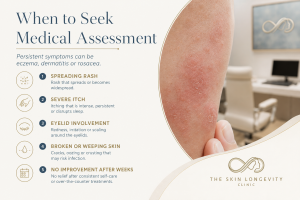
When should dry or reactive skin be assessed by a doctor? Seek medical review when a rash spreads, itch disrupts sleep, the eyelids are affected, skin becomes broken or weeping, or symptoms persist despite several weeks of gentle care. These features can indicate eczema, contact dermatitis, rosacea or infection rather than simple dehydration.
When should you see a doctor for your skin barrier symptoms?
Arrange an assessment when the skin is broken, painful, crusted or weeping. Increasing warmth, swelling, pus or spreading redness can indicate infection rather than simple barrier disruption.
Severe itch, recurrent flares, eyelid involvement or symptoms that disturb sleep also deserve medical review. Skin that remains reactive after several weeks of gentle care can reflect eczema, allergic contact dermatitis, rosacea or another condition requiring specific treatment.
Dr Rachel Ho’s clinical perspective on skin barrier treatments
I commonly see barrier damage after a patient has tried to improve several concerns at once. Retinol, acids, vitamin C, acne medication and frequent facials can each have a place, but the skin does not always tolerate them together.
The first treatment is usually restraint. I simplify the routine, restore comfort and establish whether an inflammatory condition is present before deciding whether LDM, LED or an injectable hydration treatment adds value.
Skin boosters can improve dermal hydration once the epidermis has recovered. Injecting actively inflamed skin reverses the correct treatment order and does not rebuild the outer lipid barrier.
Frequently asked questions
How do I know whether my skin barrier is damaged?
Sudden stinging with familiar products, new redness, flaking and broad sensitivity are characteristic clues. The timing often follows increased exfoliation, new active ingredients or a strong procedure.
Can oily skin have a damaged barrier?
Yes. Oil reflects sebum production, while barrier integrity and water retention are separate functions. Oily skin can feel shiny yet tight, irritated and dehydrated.
Can hyaluronic acid repair a damaged skin barrier?
Topical hyaluronic acid can help surface hydration, while injectable hyaluronic acid improves hydration within the dermis. Neither replaces the ceramides, cholesterol and fatty acids required by the outer epidermal barrier.
Is LDM good for a damaged skin barrier?
LDM can provide gentle hydration and recovery support for selected patients whose skin is intact and suitable for treatment. It does not replace medical care for eczema, infection, rosacea or severe inflammation.
Can LED light repair the skin barrier?
Red LED has plausible photobiomodulation effects, but direct human evidence for barrier repair is inconsistent. It is better described as a calming and recovery adjunct than as a stand alone barrier treatment.
Which skin booster is best for dehydrated skin?
A hyaluronic acid skin booster or Hybrid Cooperative Complex is more directly focused on dermal hydration. ECM treatment becomes more relevant when dehydration overlaps with crepey texture or reduced dermal support, although its clinical evidence is newer.
When can I restart retinol or exfoliating acids?
Restart once cleansing, moisturiser and sunscreen no longer sting and the skin has stopped flaking or flushing. Introduce one product around twice weekly, then wait before adding another.
Skin Barrier Repair and Dry Skin Guides in Singapore
- Dry skin and skin hydration treatments in Singapore: causes of xerosis and in-clinic hydration options
- Dry skin vs dehydrated skin: how to tell lipid loss from water loss
- Dry skin in humid Singapore: why air-conditioning dries the skin
- Acne and a damaged skin barrier: treating breakouts without irritation
- Chemical peel aftercare: barrier recovery, moisturiser, makeup and sun protection
- Dull skin treatment in Singapore: why skin looks flat or grey and which treatment suits each cause
In-clinic treatments for skin barrier repair and hydration
- Bellasonic LDM treatment for hydration and recovery
- LED light treatments in Singapore
- Hybrid cooperative complex injectable moisturiser
- Hyaluronic acid skin booster in Singapore
- ECM skin boosters in Singapore
Barrier function is one of the areas measured in the skin longevity assessment in Singapore.
About Dr Rachel Ho
Dr Rachel Ho is a Singapore registered medical practitioner and the founder of The Skin Longevity Clinic. She has more than 16 years of clinical experience, with a clinical focus that includes skin longevity, barrier health, hydration, injectables and evidence based skincare.
The Skin Longevity Clinic is located at 9 Scotts Road, #06-05 Scotts Medical Center at Pacific Plaza, Singapore 228210, near Orchard Road. A consultation assesses barrier stability, inflammation, hydration, pigment tendency, skin quality and readiness for treatment before a procedure is recommended.
References
- Draelos ZD, et al. The Effect of a Ceramide Containing Product on Stratum Corneum Lipid Levels in Dry Legs. Journal of Drugs in Dermatology. 2020. PMID 32272513.
- Vaillant L, et al. Combined Effects of Glycerol and Petrolatum in an Emollient Cream: A Randomized, Double Blind, Crossover Study in Healthy Volunteers With Dry Skin. Journal of Cosmetic Dermatology. 2020. PMID 31532576.
- Lee JY, et al. Non Pharmacological High Intensity Ultrasound Treatment of Human Dermal Fibroblasts to Accelerate Wound Healing. Scientific Reports. 2021. PMID 33510199.
- Ahn TH, et al. Application of Dual Frequency Ultrasound for Reduction of Perilesional Edema and Ecchymosis After Rhinoseptoplasty. Journal of Cosmetic Dermatology. 2024. PMID 37877460.
- Abe Y, et al. Red Light Promoted Skin Barrier Recovery. PLOS One. 2019. PMID 31291308.
- Le Duff F, et al. Assessment of Skin Healing Under Light Emitting Diode Photobiomodulation After Fractional Carbon Dioxide Laser. 2022. PMID 34529859.
- de Wit A, et al. A Split Face Comparative Performance Evaluation of Injectable Hyaluronic Acid Based Preparations HCC and CPM HA20G in Healthy Females. Journal of Cosmetic Dermatology. 2022. PMID 35699361.
- Alexiades M, et al. A Randomized, Multicenter, Evaluator Blind Study to Evaluate the Safety and Effectiveness of VYC 12L Treatment for Skin Quality Improvements. Dermatologic Surgery. 2023. PMID 37163665.
- Lee YI, et al. Injectable Particulated Human Acellular Dermal Matrix Booster for Skin Restoration: An Integrated Randomized, Split Face, Double Blinded Clinical Trial and Preclinical Study. International Journal of Molecular Sciences. 2026. PMID 41828422.