

05 Sep XERF for Men in Singapore: Skin Tightening for the Male Face
XERF for Men in Singapore: Skin Tightening for the Male Face
By Dr Rachel Ho | Aesthetic Doctor, Founder, The Skin Longevity Clinic, Singapore
Men increasingly ask about aesthetic treatments that can improve facial ageing while preserving the features that make their face recognisably masculine. Research confirms that male facial anatomy, skin characteristics and patterns of ageing differ from those seen in women, which means treatment planning should take these differences into account2-3.
XERF is a non invasive monopolar radiofrequency treatment used for skin tightening and collagen remodelling. The system delivers 6.78 MHz and 2 MHz radiofrequency energy and is designed to create controlled heating at different tissue depths while cooling and monitoring the skin surface4-6.
For men considering XERF in Singapore, the most important question is whether skin laxity is actually responsible for the change they are seeing. A softer jawline can arise from skin laxity, changes in facial fat, skeletal ageing, submental fullness or a combination of these factors, and radiofrequency tightening addresses only part of this spectrum1,2,7.
XERF for men at a glance
FAQ about XERF for male patients
| Question about XERF | Evidence based answer |
|---|---|
| What is XERF? | XERF is a non invasive monopolar radiofrequency system using 6.78 MHz and 2 MHz frequencies for controlled tissue heating and collagen remodelling.4,5,6 |
| Why might men consider it? | Men may consider radiofrequency tightening when mild facial or neck laxity is contributing to reduced definition or changes in skin firmness.1,3,8 |
| Does XERF specifically build a masculine jawline? | XERF tightens soft tissue rather than adding bone or volume, so any improvement in jawline definition depends on laxity being part of the problem.4,7 |
| Does XERF remove facial fat? | XERF is primarily used as a radiofrequency tightening treatment. Treatment planning should account for existing facial volume because excessive loss of facial volume can contribute to an aged appearance.1,4,7 |
| Is there male specific XERF research? | The published XERF clinical study available in August 2026 involved 16 women, so male specific clinical efficacy has yet to be established in a dedicated study.9 |
| Does radiofrequency skin tightening have broader evidence? | A 2025 systematic review of 15 radiofrequency studies involving 1,230 participants found improvements in facial firmness and texture, although the studies varied considerably in devices, methods and outcome measures.8 |
| Is there downtime? | Published studies of non invasive radiofrequency generally report transient redness and swelling as common short term effects, although downtime reporting remains inconsistent across studies.8,9 |
Why male facial ageing needs a different assessment
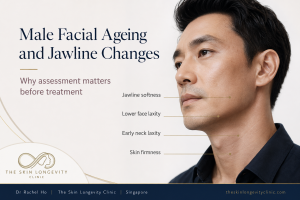
Male faces differ anatomically from female faces in several clinically relevant ways. Men generally have a larger and squarer facial skeleton, a broader and more angular jaw, greater facial muscle mass and differences in the distribution of subcutaneous tissue1,2.
Male skin is also generally thicker, while patterns of wrinkle formation and facial ageing differ between sexes2,3. These differences help explain why simply applying the same aesthetic plan to every face can produce a result that does not suit the patient’s underlying structure1,2.
Jawline definition is particularly relevant in male aesthetics because the lower face contributes strongly to perceived masculine facial shape1,3. Ageing can gradually alter this definition through changes in skin, connective tissue, facial fat and skeletal support1,3,7.
Readers who want a broader overview can read my guide to male aesthetic treatments in Singapore, which discusses male facial anatomy, wrinkles, acne scars, pigmentation and facial contouring in more detail.
How does XERF work?
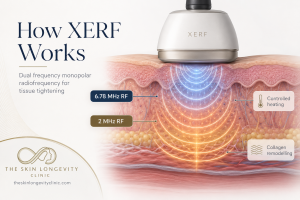
Radiofrequency produces electrical resistance within tissue, converting energy into heat8,10. Controlled thermal exposure can produce immediate changes in collagen structure and initiate subsequent collagen remodelling over time5,8,10.
XERF differs from conventional single frequency monopolar radiofrequency systems because it incorporates 6.78 MHz and 2 MHz frequencies4,5. Experimental work has shown that these frequencies create different thermal distributions within tissue, providing a biological basis for treatment at different depths4-6.
A porcine XERF study demonstrated controlled heating and histological changes in collagen after treatment5. Another histological study examined dual frequency radiofrequency at 6.78 MHz and 2 MHz and reported treatment effects extending from the dermis into deeper tissue layers4.
These studies help explain the mechanism of the device, although animal and histological studies cannot by themselves establish the magnitude of visible improvement a patient should expect4,5.
For a more detailed explanation of the technology, read our complete guide to XERF in Singapore and our step by step guide to the XERF treatment.
What could XERF treat in a male face?
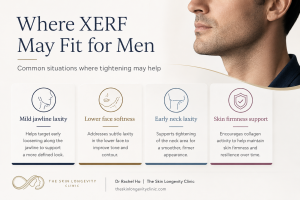
Mild jawline laxity
A man’s jawline can gradually appear softer as ageing alters skin elasticity, connective tissue support, facial fat and skeletal contours1,3,7.Radiofrequency treatment may improve definition when laxity of the overlying soft tissue contributes meaningfully to this change8.
XERF does not create a larger mandible or replace deficient skeletal projection. Men whose jawline concern arises mainly from bone structure, facial volume or submental fat require a different assessment1,2,7.
Lower face laxity
Collagen and other structural components of the face change with age, contributing to progressive soft tissue descent and changes in facial contour7,10. Non invasive radiofrequency has evidence for improving facial firmness in appropriately selected patients8.
The expected change should remain proportionate to what an energy based treatment can achieve. More substantial tissue descent may require other approaches, including surgical assessment where appropriate7,8.
Neck laxity
Radiofrequency treatments have also been studied for facial and neck rejuvenation.8 Men with early neck skin laxity may therefore be candidates for treatment after assessment of skin quality, fat distribution and the degree of tissue descent7,8.
Overall skin firmness
The broader radiofrequency literature supports improvements in skin firmness and texture following non invasive RF treatment.8 A 2025 systematic review found reported improvement in firmness in 52.9 to 100 per cent of patients across the two studies evaluating this outcome, although differences between devices and study designs prevent these figures from being applied directly to XERF8.
This distinction is important when evaluating any aesthetic device. Evidence supporting radiofrequency as a treatment category does not mean every RF system produces identical results8.
What does the clinical evidence for XERF show?
The most recent clinical study specifically evaluating XERF was published in Lasers in Medical Science in August 2026.9 It retrospectively evaluated 16 women who underwent one XERF session and were followed for three months9.
Three dimensional imaging showed changes consistent with facial tissue redistribution, while measurements demonstrated progressive eyebrow and upper eyelid elevation during follow up9. Computerised assessment also reported improvements in wrinkles, skin evenness, pore size and oiliness, while pigmentation did not change significantly9.
Treatment related effects in that small cohort were mild and transient, consisting mainly of short lived redness and mild swelling9. The authors described the findings as preliminary because the study was retrospective, included only 16 participants and had three months of follow up9.
The study also included women only9. It therefore provides direct preliminary evidence for XERF as a facial radiofrequency treatment but does not establish that men respond differently or better than women9.
What does the wider radiofrequency evidence show?
A 2025 systematic review evaluated 15 studies involving 1,230 people treated with radiofrequency based facial rejuvenation technologies.8 Improvements in skin texture were reported in 71 to 100 per cent of participants in the studies measuring texture, while studies evaluating firmness reported improvement in 52.9 to 100 per cent of participants8.
Patient satisfaction ranged from 82 to 100 per cent across the included studies8. Reported adverse effects were predominantly transient redness and swelling, with no serious complications reported in the studies reviewed8.
The authors nevertheless highlighted important methodological limitations, including differences between devices, study designs, treatment parameters and outcome measures8. The review therefore supports radiofrequency as a treatment category while reinforcing the need to judge each individual device from its own evidence8.

Is XERF particularly suitable for men?
There is a reasonable anatomical rationale for considering skin tightening in men whose concern is genuine soft tissue laxity, because ageing affects the connective tissue and contours of the male face as well as the female face1-3. Male treatment planning should still account for the broader jaw, larger facial skeleton, thicker skin and different distribution of facial tissue that characterise the male face1,2.
Current published XERF clinical data do not allow us to conclude that the device works better in men or produces a uniquely masculine result9. The masculine appearance comes from anatomy and treatment planning rather than from the radiofrequency technology itself1,2.
For this reason, the patient’s facial features and laxity should be assessed first before deciding whether XERF fits the concern. A man with early laxity and preserved facial volume presents a different problem from someone whose jawline is obscured primarily by submental fat, skeletal shape or substantial tissue descent1,7.
XERF versus dermal fillers for a male jawline
XERF and dermal fillers perform different functions1,8. Radiofrequency treatment is used to improve skin firmness through controlled tissue heating and collagen remodelling, while fillers add volume and can alter facial contours through strategic placement1,8.
A man whose jawline has softened because of mild skin laxity may be considered for tightening8. A man with limited chin or mandibular projection may instead require structural assessment because tightening cannot add skeletal projection1,2.
Combination treatment is sometimes appropriate, although more treatment is not automatically better. The sequence and extent of treatment should follow the anatomy and the concern being treated1,2.
XERF versus Ultherapy for men
XERF uses monopolar radiofrequency while Ultherapy uses microfocused ultrasound4,11. The devices therefore produce their effects through different forms of energy and should not be regarded as interchangeable simply because both appear within the skin tightening category4,11.
The better option depends on facial anatomy, skin thickness, tissue distribution, degree of laxity and treatment goals. Readers considering both can continue with our detailed guide to XERF versus Ultherapy in Singapore.
Does XERF make a man’s face look thinner?
Changes in facial contour following tightening may make some areas appear more defined, but XERF should not be presented as a predictable facial slimming treatment8,9. Facial shape depends on bone, muscle, fat and skin, and each of these contributes differently to the appearance of the lower face1,2,7.
This becomes particularly important in lean men because preserving appropriate facial volume can be important for maintaining a healthy appearance1,7. A tightening treatment should therefore be planned with the existing facial volume in mind rather than treating every soft jawline in the same way1,7.
Is XERF suitable for acne scars or pigmentation in men?
Acne scars, pigmentation and skin laxity arise from different structural and biological processes12,13. XERF is primarily considered for tightening and collagen remodelling rather than as a dedicated pigment or acne scar treatment 4.
Men with acne scars may require resurfacing, fractional devices, radiofrequency microneedling, subcision or other scar specific treatments depending on scar morphology 12. Pigmentation similarly requires assessment of the pigment type and cause before treatment is selected 13.
This distinction is useful because male patients often arrive asking for a device when the more important question is which condition needs to be treated.
What should men expect during XERF treatment?
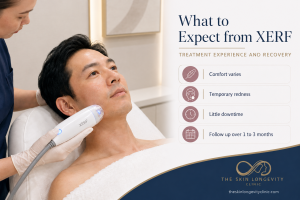
XERF uses a treatment applicator that delivers radiofrequency energy while its cooling system protects the skin surface 5,9. Treatment energy can be adjusted according to the treatment area, tissue response and patient tolerance9.
The 2026 clinical study reported a mean pain score of 4.31 out of 10, although individual responses ranged from mild to severe discomfort9.Four of the 16 participants requested topical anaesthetic, illustrating that treatment experience varies between individuals9.
Temporary warmth, redness or swelling can occur after non invasive radiofrequency treatment8,9. In the XERF study, the recorded adverse effects resolved within one or two days9.
When do XERF results appear?
Radiofrequency treatment can produce both an immediate thermal effect on collagen and a subsequent remodelling response that develops with time8,10. The XERF clinical study documented progressive changes during follow up at one and three months after a single treatment9.
The durability of XERF results remains less certain because the direct clinical study followed patients for only three months9. Claims about a precise duration should therefore be interpreted cautiously until longer term clinical data are available9.
Who may be a poor candidate for XERF?
Aesthetic radiofrequency treatment requires individual medical assessment because treatment suitability depends on the device, treatment area and medical history8,9. The published XERF study excluded patients with implanted electronic devices, active infection or inflammatory skin disease in the treatment area, pregnancy, uncontrolled systemic illness and other conditions considered unsafe by the treating doctor9.
Men with substantial facial volume loss, significant tissue descent or concerns caused principally by skeletal anatomy may also find that tightening alone does not address their main concern1,7. Accurate assessment is therefore more useful than choosing treatment from a device name alone.
Dr Rachel Ho’s perspective on XERF for men
Men often tell me that they want to look fresher without appearing visibly treated. Preserving the proportions and definition of the male face is therefore an important part of treatment planning.
XERF can be considered when genuine skin laxity or reduced firmness is contributing to a softer jawline, lower face or neck. Its role becomes much less compelling when the main issue is facial volume loss, submental fat, acne scarring or another condition that requires a different treatment.
The evidence for radiofrequency tightening as a category is reasonably established, while the direct clinical literature for XERF itself remains relatively new8,9. The newest XERF study is encouraging, but its small female cohort and short follow up mean that further prospective studies, including studies involving men, would strengthen what we know about the treatment9.
Frequently asked questions about XERF for men
Is XERF suitable for men?
Men with mild facial or neck laxity may be considered for radiofrequency skin tightening after appropriate assessment1,8. Treatment planning should account for the anatomical differences between male and female faces and for the actual cause of reduced facial definition1,2.
Can XERF sharpen a man’s jawline?
XERF may improve the appearance of a jawline when soft tissue laxity contributes to reduced definition8. It cannot create additional mandibular bone projection or correct every cause of a poorly defined jawline1,2.
Does XERF work better on thicker male skin?
Male skin is generally thicker than female skin, but current XERF clinical evidence does not establish superior outcomes in male skin2,9.Treatment parameters therefore need to be selected according to the individual rather than sex alone1,2.
Is XERF a facelift?
XERF is a non invasive radiofrequency treatment used for tissue tightening and collagen remodelling4,8. Surgical lifting produces a different degree and type of anatomical correction and remains relevant for more advanced tissue descent7.
Can men have XERF without looking different?
Radiofrequency treatment does not add facial volume or deliberately change the dimensions of the jaw in the way structural filler can1,8. The degree of visible change still depends on the treatment plan, baseline anatomy and response to treatment1,8.
How many XERF sessions do men need?
The published 2026 clinical study evaluated outcomes after one treatment, while other clinical use may involve different protocols9. Current evidence does not establish one universal number of XERF sessions for every patient, so treatment frequency should be determined after assessment and review9.
How long do XERF results last?
Direct XERF clinical data currently extend to three months in the recently published retrospective study.9 Longer term durability requires further clinical study before a precise evidence based duration can be stated.9.
Conclusion
XERF is a dual frequency monopolar radiofrequency treatment that can be considered for men with facial or neck laxity who want a non invasive approach to improving firmness and contour.4,8 Male anatomy matters because the jaw, facial skeleton, muscle mass, skin and soft tissue distribution differ from those of women and influence how treatment should be planned1-3.
The wider evidence for radiofrequency facial rejuvenation supports improvements in skin firmness and texture, although study methods and devices vary considerably8. Direct XERF evidence is newer, with a small 2026 retrospective study reporting objective improvements after one treatment but including women only and following participants for three months9.
Men considering treatment should therefore start with the concern rather than the device. Our complete XERF Singapore guide explains the technology in greater detail, while our guide to XERF versus Ultherapy explains how the two energy based approaches differ. Readers who want the broader male perspective can also my guide to male aesthetic treatments in Singapore.
Scientific references
- Farhadian JA, Bloom BS, Brauer JA. Male Aesthetics: A Review of Facial Anatomy and Pertinent Clinical Implications. Journal of Drugs in Dermatology. 2015;14(9):1029 to 1034.
- Keaney TC. Aging in the Male Face: Intrinsic and Extrinsic Factors. Dermatologic Surgery. 2016;42(7):797 to 803.
- Sadick NS. The Pathophysiology of the Male Aging Face and Body. Dermatologic Clinics. 2018;36(1):1 to 4.
- Hong J, Ryu HG, Park C, et al. Efficacy of Dual Frequency Noninvasive Monopolar Radiofrequency in Skin Tightening: Histological Evidence. Skin Research and Technology. 2024;30(6):e13821. Correction published 2026.
- Park C, Hong J, Ryu HG, et al. Monopolar Radiofrequency for Dermal Temperature Regulation and Remodeling: A Porcine Model Study. Journal of Cosmetic Dermatology. 2024;23(12):3955 to 3960.
- Ko K, Ryu HG, Park J, et al. Computational Modeling and Histologic Analysis of 6.78 and 2 MHz Monopolar Radiofrequency Induced Thermal Reactions. Lasers in Medical Science. 2025;40:501.
- Cotofana S, Fratila AA, Schenck TL, Redka Swoboda W, Zilinsky I, Pavicic T. The Anatomy of the Aging Face: A Review. Facial Plastic Surgery. 2016;32(3):253 to 260.
- Kumar N, Suh DH, Lee SJ, Ryu HJ. Radiofrequency Based Treatments for Facial Rejuvenation: A Systematic Review of Efficacy, Safety, and Patient Centered Outcomes. Aesthetic Surgery Journal Open Forum. 2025;7:ojaf159.
- Erlich G, Dahan E, Wolf Y. Objective and Subjective Retrospective Evaluation of XERF, a Novel Single Shot Dual Frequency Non Invasive Monopolar Radiofrequency. Lasers in Medical Science. 2026;41:194.
- El Domyati M, El Amar A, Medhat W, et al. Radiofrequency Facial Rejuvenation: Evidence Based Effect. Journal of the American Academy of Dermatology. 2011;64(3):524 to 535.
- Fabi SG. Noninvasive Skin Tightening: Focus on New Ultrasound Techniques. Clinical, Cosmetic and Investigational Dermatology. 2015;8:47 to 52.
- Connolly D, Vu HL, Mariwalla K, Saedi N. Acne Scarring: Pathogenesis, Evaluation, and Treatment Options. Journal of Clinical and Aesthetic Dermatology. 2017;10(9):12 to 23.
- Passeron T, Picardo M. Melasma, a Photoaging Disorder. Pigment Cell and Melanoma Research. 2018;31(4):461 to 465.