

02 Sep Non-Surgical Facelift in Singapore: What It Means and What Actually Works
By Dr Rachel Ho | Aesthetic Doctor, Founder, The Skin Longevity Clinic, Singapore
Medically reviewed by Dr Rachel Ho, MBBS, MRCS, MMed (ENT), August 2026.
The phrase non-surgical facelift is everywhere in Singapore aesthetic marketing, and it is one of the most misunderstood terms in the field. It sounds like a single treatment. It is not. This guide explains what a non-surgical facelift actually is, what it can and cannot achieve, the treatments involved and how a doctor builds a sensible plan.
What a Non-Surgical Facelift Actually Means
There is no single procedure called a non-surgical facelift. The phrase is an umbrella term for a combination of non-invasive and minimally invasive treatments used together to firm, lift and refresh the face without surgery.
Understanding this matters, because the term sets an expectation. The word facelift suggests a surgical result, while the word non-surgical promises to avoid surgery. No combination of treatments delivers both fully. A more honest way to read the phrase is as a coordinated plan that improves the face meaningfully, within limits, and without an operation.
The Honest Ceiling: Non-Surgical Versus Surgical
It is worth being direct about the limits. A surgical facelift physically removes excess skin and repositions deeper tissue. For advanced sagging and heavy loose skin, nothing non-surgical matches it.
A non-surgical approach works differently. It tightens skin, stimulates collagen, restores some volume and softens lines, and the combined effect can be a genuine improvement. But it works with the tissue you have rather than removing any, so its ceiling is lower. For mild to moderate ageing, that ceiling is often more than enough. For advanced sagging, it is not, and recognising this early prevents wasted time and money.
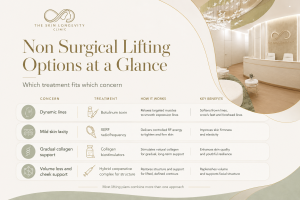
Different signs of facial ageing require different treatment categories. A coordinated plan may include botulinum toxin for movement related lines, radiofrequency for laxity, collagen biostimulators for gradual support and an injectable treatment for selected volume loss.
The Non-Surgical Facelift Toolbox
A non-surgical facelift plan draws on several treatments, each addressing a different aspect of ageing.
- Energy-based tightening. Radiofrequency treatments such as XERF, and focused ultrasound treatments such as HIFU, heat the skin to tighten collagen and stimulate new collagen. These address laxity. Our guide to RF skin tightening in Singapore covers the radiofrequency options.
- Collagen biostimulators. Injectable biostimulators prompt the skin to build its own collagen gradually, supporting structure and skin quality from within.
- Dermal fillers. Where the face has lost volume, fillers restore support in specific areas. This addresses deflation, which tightening alone cannot.
- Botulinum toxin. This relaxes specific muscles to soften expression lines, which is a different problem from laxity but often part of an overall plan.
No single treatment on this list is a non-surgical facelift on its own. The result comes from choosing and combining them sensibly for synergistic and safe results.
Why the Cause of Ageing Decides the Treatment Plan
The face ages in more than one way at once. The skin loses collagen and becomes lax. The deeper tissues lose volume and the face deflates. Muscles create lines through repeated expression. These are different problems, and they need different tools.
This is why a non-surgical facelift cannot be bought as a fixed package. Tightening a face whose real problem is volume loss will disappoint. Adding volume to a face whose real problem is laxity will not lift it, and can look heavy. The plan has to follow the diagnosis. Our guide to skin tightening in Singapore explains how to tell laxity and volume loss apart.
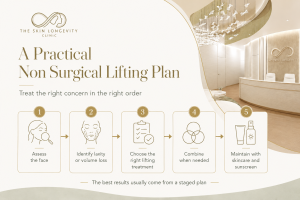
A considered non surgical lifting plan begins with diagnosis. At The Skin Longevity Clinic in Singapore, treatment is staged by first assessing the face, separating laxity from volume loss, choosing the appropriate approach and allowing each result to settle before further refinement.
How a Doctor Sequences a Non-Surgical Facelift Plan
At The Skin Longevity Clinic, a non-surgical facelift plan begins with a layer-based diagnosis: skin quality, collagen loss, volume loss, laxity, muscle pull, facial proportions and recovery tolerance are each assessed. Treatments such as XERF and collagen biostimulators are then staged across skin quality, lifting, volume support, collagen stimulation and longer-term maintenance, rather than performed all at once. This staged sequencing is what allows results to look natural and to build over time. For the clinic’s dedicated treatment page, see XERF in Singapore, and for the underlying concern see sagging skin and facial laxity.
A considered non-surgical facelift is sequenced, not stacked. A doctor begins by assessing which elements of ageing are present and which matter most to you. Volume support and tightening may be staged over separate visits rather than done all at once. The order matters, because the foundation, often structural support, is usually addressed before more superficial refinements.
Sequencing also protects the skin. Doing too much too quickly can increase irritation, swelling and pigment risk, particularly in pigment-prone skin. A plan spread sensibly over time is both safer and more likely to look natural.
What the Evidence Shows about Non-Surgical Facelifts
The individual treatments behind a non-surgical facelift have reasonable evidence. A 2024 systematic review by Shin and colleagues in the journal Cosmetics supported monopolar radiofrequency for mild to moderate laxity. Systematic reviews of microfocused ultrasound have reported measurable tightening. The evidence is consistent in two ways. Each treatment produces a real but modest effect, and none of them, alone or combined, reproduces a surgical facelift. A non-surgical facelift is best understood as meaningful improvement within honest limits.
When Surgery Is the Best Option for a Facelift
A good clinic will sometimes advise that a non-surgical facelift is not the right choice. When sagging is advanced, when there is a large amount of loose skin, or when the result you want genuinely requires removing tissue, a surgical opinion is the honest recommendation. This is not a failure of the non-surgical approach. It is simply matching the treatment to the problem, which is the principle behind every article in this library.
What a Realistic Non-Surgical Facelift Timeline Looks Like
Because a non-surgical facelift is a plan rather than a single procedure, it unfolds over time, and it helps to know what that looks like. The process begins with an assessment that identifies which elements of ageing are present, laxity, volume loss and lines, and which matter most to you.
From there, treatments are usually staged. A structural foundation, such as volume support or collagen biostimulation, may be addressed first, because it is difficult to refine a face whose support has not been considered. Energy-based tightening such as XERF or HIFU is worked into the plan where laxity is the issue, and its result builds gradually over the following months. Finer refinements are added once the foundation has settled.
This means a non-surgical facelift is not an event with a single before-and-after date. It is a sequence, often spread over several months, with the full effect visible only once each element has had time to work. Patients who understand this from the start tend to be far happier than those expecting an immediate, surgical-style change.
Natural Results from Non-Surgical Facelift: Why Restraint Matters
Dr Rachel Ho, MBBS, MMed(ENT), Founder and Medical Director of The Skin Longevity Clinic, describes her philosophy as non-surgical rejuvenation that is undetectable but noticeable. The patient should still be recognisably themselves, balanced and mobile, without any distortion of their appearance. When laxity or sagging is advanced, when skin excess is significant, or when a patient genuinely wants a surgical degree of lifting, the honest answer is that surgery is more likely to deliver what they have in mind.
One of the quiet risks of a non-surgical facelift is doing too much. Because each individual treatment is non-surgical and seems modest, it is tempting to add more, and then more again, in pursuit of a bigger change. The result can be a face that looks treated rather than refreshed.
A well-judged non-surgical facelift is often defined by restraint. The aim is to look like a rested, slightly younger version of yourself, not like a different person. This is another reason sequencing and review matter. By spacing treatments and assessing the effect of each, a careful provider can stop at the point where the face looks natural, rather than pressing on past it. The best outcome is usually the one where others notice you look well, without being able to say exactly what changed.
Choosing a Clinic for a Non-Surgical Facelift
If you are unsure where to begin, a skin longevity assessment is a sensible first step.
Because the term covers so many treatments, the choice of clinic matters more than the choice of any single device. A few signs point to a clinic worth trusting. The first is an assessment that looks at the whole face and names the actual causes of ageing, rather than starting from a treatment it wants to sell. The second is a willingness to stage and sequence treatments sensibly, rather than offering everything at once. The third is honesty about limits, including a readiness to recommend a surgical opinion when that is genuinely the better answer.
A doctor-led practice that treats a non-surgical facelift as an individualised plan, reviewed and adjusted as your skin responds, is far more likely to give you a natural, lasting result than a clinic selling a fixed package under an appealing name. The treatments matter, but the judgement that combines them matters more.
Frequently Asked Questions about Non-Surgical Facelift
What is a non-surgical facelift?
It is not a single procedure. It is a combination of non-invasive and minimally invasive treatments, such as energy-based tightening, biostimulators and fillers, used together to firm and refresh the face without surgery. The exact combination depends on the individual.
How long does a non-surgical facelift last?
Results are not permanent, because ageing continues. Depending on the treatments used, improvements are typically maintained over months to a couple of years with periodic top-ups, rather than lasting indefinitely.
Is a non-surgical facelift as good as surgery?
No, and it is not meant to be. For advanced sagging, surgery remains more effective. For mild to moderate ageing, a well-planned non-surgical approach can give a genuine, natural improvement without the downtime and risk of an operation.
How much does a non-surgical facelift cost in Singapore?
Because it is a combination of treatments rather than one procedure, the cost varies widely with the plan. It is generally less than surgery, but a meaningful figure can only follow an assessment. Our guide to XERF price in Singapore explains how energy-based treatments are priced.
Related XERF and Skin Tightening Guides
These articles form a connected library on XERF and skin tightening at The Skin Longevity Clinic. You may also find the following guides helpful:
- XERF in Singapore: a complete guide
- XERF price in Singapore
- XERF treatment: the procedure explained
- XERF review: an evidence-based look
- XERF before and after results
- RF skin tightening in Singapore
- Skin tightening in Singapore: your options
- XERF vs Ultherapy compared
Non-Surgical Facelift Planning at The Skin Longevity Clinic
The Skin Longevity Clinic is a doctor-led practice in the Orchard area of Singapore that approaches a non-surgical facelift as a planned, individualised process rather than a fixed package. The clinic assesses how your face is ageing, then recommends the combination, sequence and, where appropriate, the surgical opinion that genuinely fits. You can contact the clinic to arrange a consultation.