



04 Sep Can Acne Return After Oil Gland Treatment?
By Dr Rachel Ho | Aesthetic Doctor, Founder, The Skin Longevity Clinic, Singapore
Medically reviewed by Dr Rachel Ho, MBBS, MRCS, MMed (ENT), September 2026.
When breakouts settle after treatment, it is natural to wonder how long that improvement might last. You may also want to know whether another spot means the procedure has failed or whether your regular skincare still has a role.
Our selective sebaceous gland ablation service page explains the procedure and practical treatment considerations. Here, the focus is what the research can tell us about results, recurrence and care afterwards.
Does improvement mean acne will stay away permanently?
Human studies have reported improvement after selective sebaceous gland electrothermolysis, but their findings do not establish a permanent acne cure for every patient1,2. In the initial pilot, two of 12 participants had clinically evident relapse at the one year follow up1.
That small study cannot tell an individual patient their exact probability of recurrence. Its useful message is that improvement and complete permanence are different outcomes.
What did the studies actually measure?
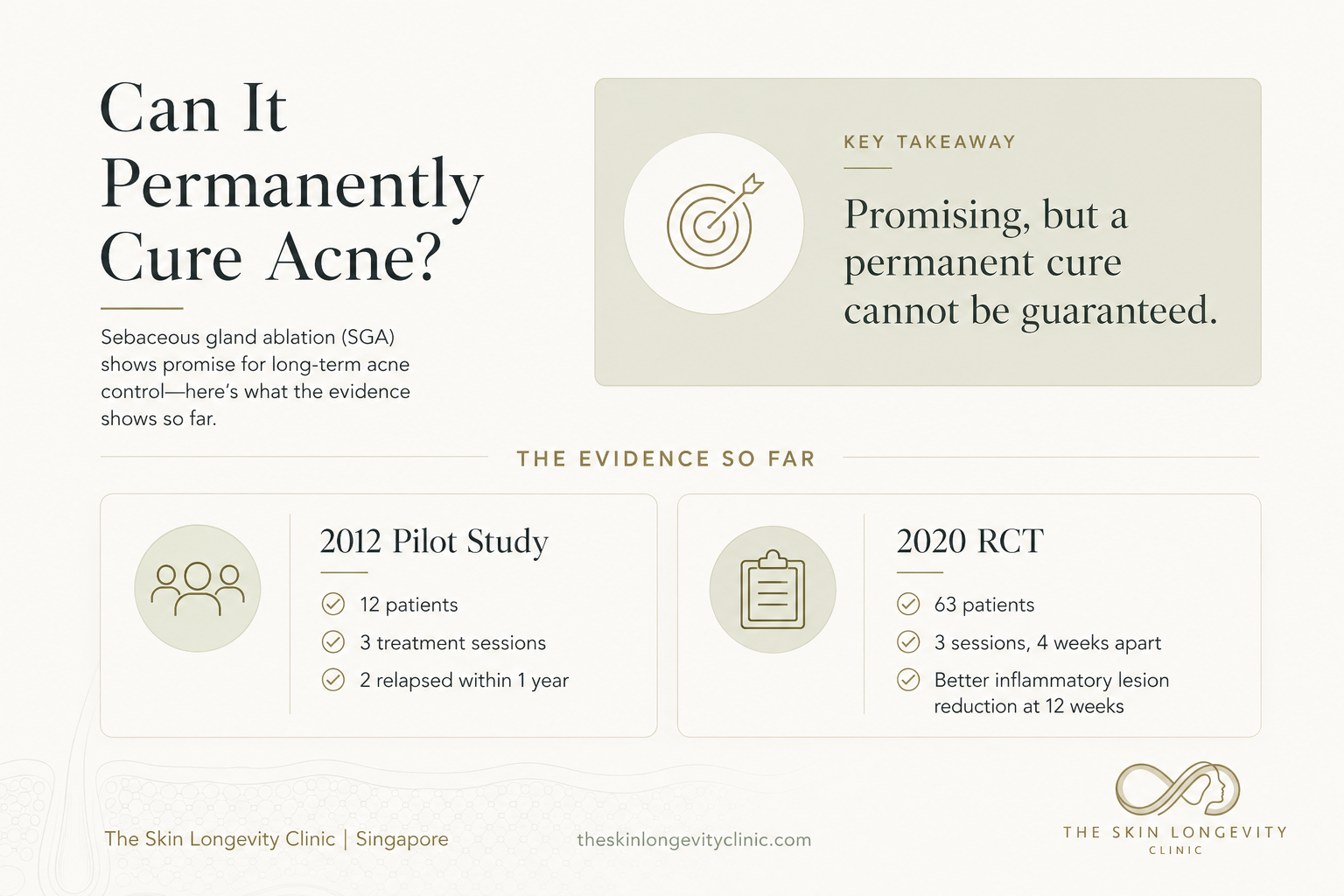
The evidence includes human clinical outcomes, laboratory observations and a review of different RF techniques1,2,3,4. Reading them separately helps clarify which findings relate to acne improvement and which describe a possible mechanism.
| Evidence | What was measured | What it contributes to the discussion |
|---|---|---|
| Lee and colleagues, 2012 | Twelve patients received three sessions; improvement and subsequent relapse were assessed1. | All participants improved after treatment, but relapse was recorded in two at one year; the small uncontrolled study cannot establish a universal result1. |
| Ahn and colleagues, 2020 | Sixty three participants completed a randomised comparison, with inflammatory acne assessed at 12 weeks2. | Improvement exceeded the control involving microneedling and extraction, but this outcome does not establish lifelong remission2. |
| Kwon and colleagues, 2017 | Sebaceous gland changes were examined in a rabbit ear model3. | The tissue findings support the proposed target, rather than proving permanent benefit in human acne3. |
| Zhang and colleagues, 2024 | A review considered several radiofrequency approaches for acne4. | Findings concern different techniques, so they should not be presented as one uniform protocol or guaranteed result4. |
The distinction between these outcomes matters when discussing repeat treatment. A favourable early response is useful information, while continued observation addresses whether the improvement lasts.
Why might another breakout appear?
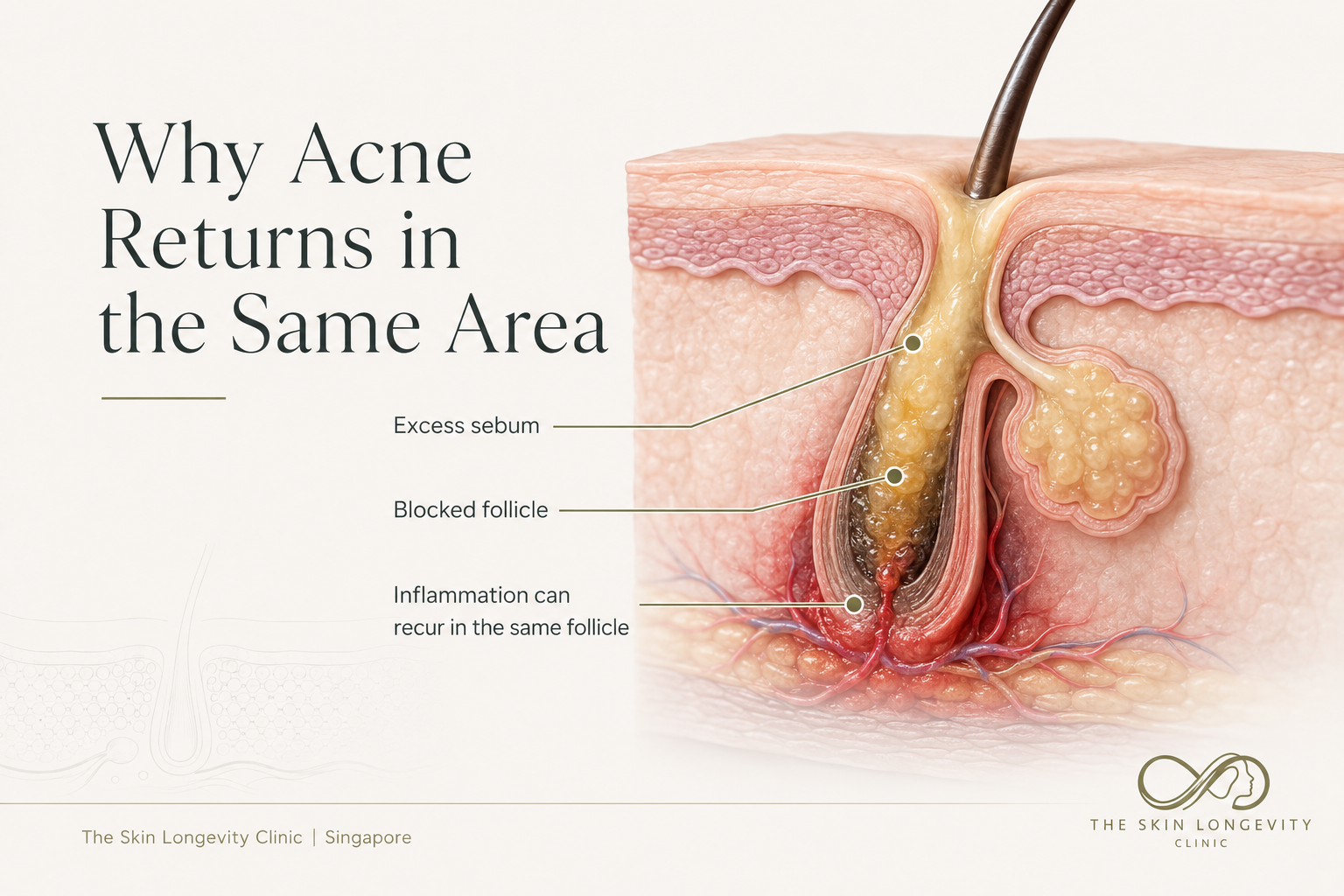
Acne involves more than sebaceous gland activity, and treatment may need to address several mechanisms5. Selective treatment also leaves other follicles untreated; the pilot described remaining small lesions in untreated skin1.
A new spot therefore needs context, including its location, timing and the wider acne pattern. Bring those details to review rather than assuming that every later breakout has the same explanation.
What can local treatment realistically address?
The intended target is selected glands associated with active acne, rather than every cause of breakouts across the face2. Medicines may still have a role within a plan that combines appropriate approaches5.
For the broader treatment decision, read our acne assessment and treatment guide. Ask which concern each part of the plan addresses before stopping an existing medicine or adding another procedure.
What if the acne improves but marks or scars remain?
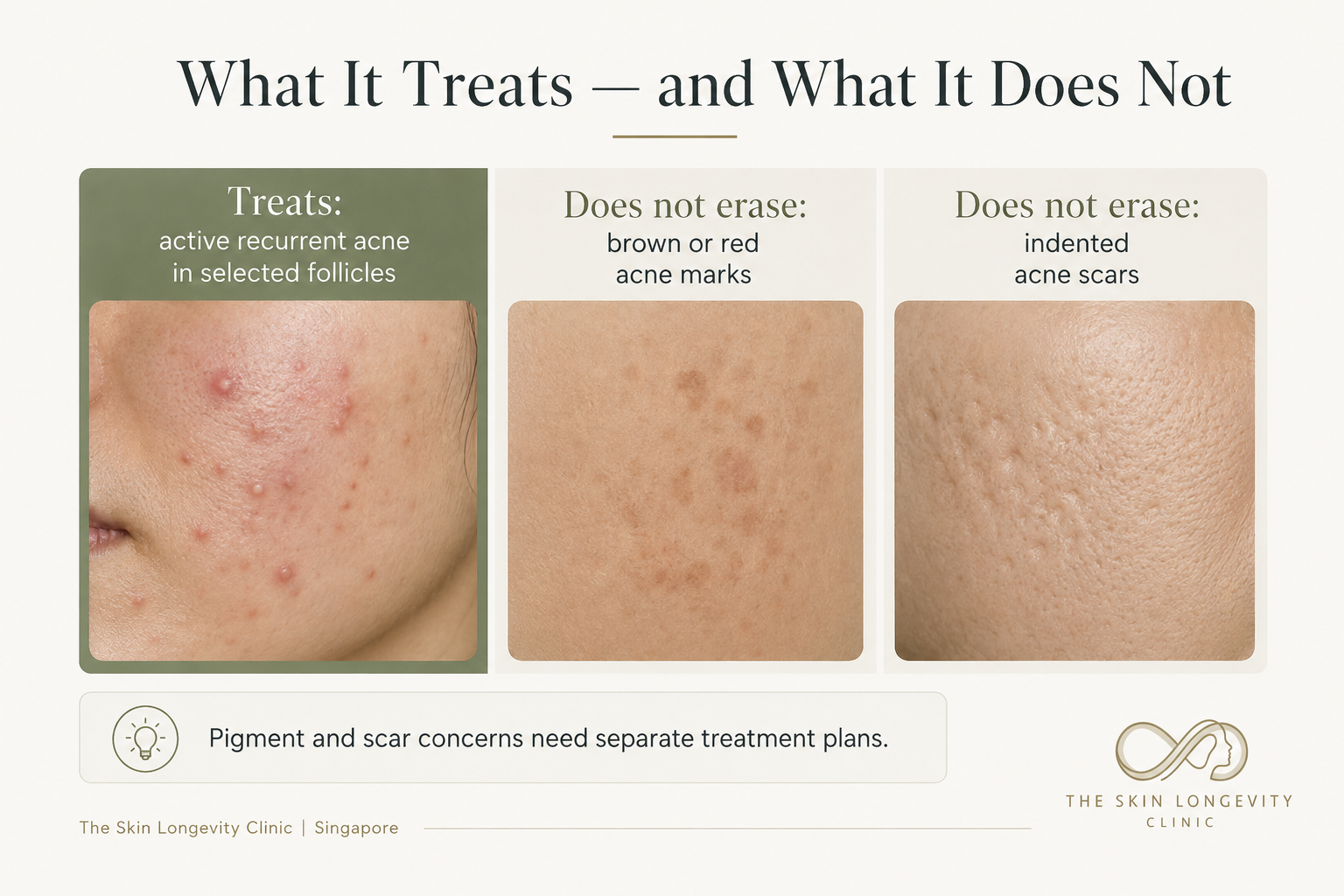
A flat colour change and an indentation are different findings from an active inflammatory spot7. These residual concerns need to be identified separately when judging the outcome of treatment.
Our acne marks and acne scars guide explains the distinction. For persistent changes in texture, the acne scar treatment guide covers the separate assessment and planning discussion.
How should progress be reviewed?
At review, explain whether the treated areas are forming fewer inflamed lesions, whether breakouts are appearing elsewhere and how the skin has recovered. Mention changes in your medicines or skincare, together with any difficulty following the earlier instructions.
Agree on what would count as useful improvement and when another review is appropriate. The aim is to make the next decision from the overall response rather than from a single photograph or one new pimple.
When should you contact the clinic earlier?
Unexpected or concerning symptoms after an RF procedure deserve medical review6. Contact the treating clinic when recovery is worsening or you are unsure whether a change is expected, rather than waiting solely for the routine appointment.
The service page contains the fuller recovery and risk discussion. Follow the instructions for your own treatment and ask before resuming products that have been temporarily paused.
Understanding your result
Useful treatment planning distinguishes the response of active acne from the persistence of marks, scars or acne elsewhere. It should also explain what care continues after the procedure and how later breakouts will be assessed.
Bring your questions and previous treatment details to The Skin Longevity Clinic. A review can then focus on what improved, what remains and the most appropriate next step.
In this series: acne care
- Acne treatment in Singapore: assessment and ongoing care
- Teenage acne
- Adult acne
- Hormonal acne
- Acne during pregnancy, IVF and egg freezing
- Cystic acne
- Back and body acne
- Acne and a damaged skin barrier
- Retatrutide and acne breakouts
- Selective sebaceous gland ablation
- Chemical peels for acne
- Chemical peel aftercare
- LED light treatment
References
-
Lee JW, Kim BJ, Kim MN, Ahn GY, Aso H. Selective sebaceous gland electrothermolysis as a treatment for acne: a prospective pilot study. International Journal of Dermatology. 2012;51(3):339 to 344. https://doi.org/10.1111/j.1365-4632.2011.05255.x
-
Ahn GR, Kim JM, Park SJ, Li K, Kim BJ. Selective Sebaceous Gland Electrothermolysis Using a Single Microneedle Radiofrequency Device for Acne Patients: A Prospective Randomized Controlled Study. Lasers in Surgery and Medicine. 2020;52(5):396 to 401. https://doi.org/10.1002/lsm.23152
-
Kwon TR, Choi EJ, Oh CT, et al. Targeting of sebaceous glands to treat acne by micro insulated needles with radio frequency in a rabbit ear model. Lasers in Surgery and Medicine. 2017;49(4):395 to 401. https://doi.org/10.1002/lsm.22599
-
Zhang X, Zhou M, Liu Y, Zeng R. Recent advances in the treatment of acne using radiofrequency techniques. Lasers in Medical Science. 2024;39:92. https://doi.org/10.1007/s10103-024-04039-6
-
Reynolds RV, Yeung H, Cheng CE, et al. Guidelines of care for the management of acne vulgaris. Journal of the American Academy of Dermatology. 2024;90(5):1006.e1 to 1006.e30. https://doi.org/10.1016/j.jaad.2023.12.017
-
US Food and Drug Administration. Potential Risks with Certain Uses of Radiofrequency (RF) Microneedling. Safety Communication. 15 October 2025. https://www.fda.gov/medical-devices/safety-communications/potential-risks-certain-uses-radiofrequency-rf-microneedling-fda-safety-communication
-
Fabbrocini G, Annunziata MC, D’Arco V, et al. Acne Scars: Pathogenesis, Classification and Treatment. Dermatology Research and Practice. 2010;2010:893080. https://doi.org/10.1155/2010/893080