

06 Sep Pico Laser vs Q-Switched vs Yellow Laser: Which One for Your Skin?
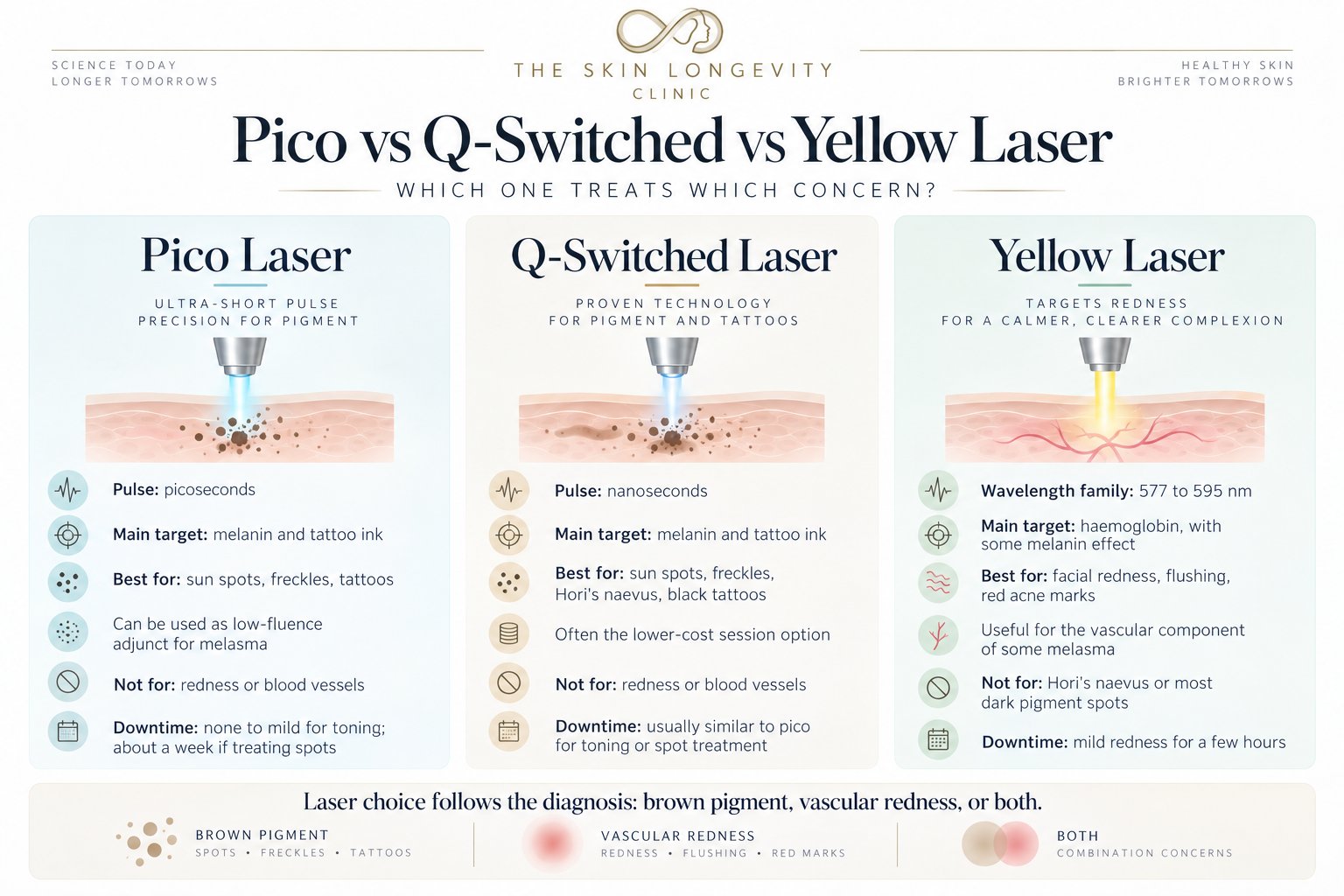
Three lasers are offered for pigmentation in almost every Singapore clinic, and their names are used loosely. Pico laser and Q-switched laser both target melanin and ink with very short pulses and differ mainly in pulse length. Yellow laser targets haemoglobin as well as melanin and belongs to a different family. This guide compares what each does, what the trials show, and which suits which concern. It supports our page on pico laser in Singapore, which covers what the laser treats and what it costs.
Medically reviewed by Dr Rachel Ho, MBBS, MRCS, MMed (ENT), 7 October 2026.
The short answer
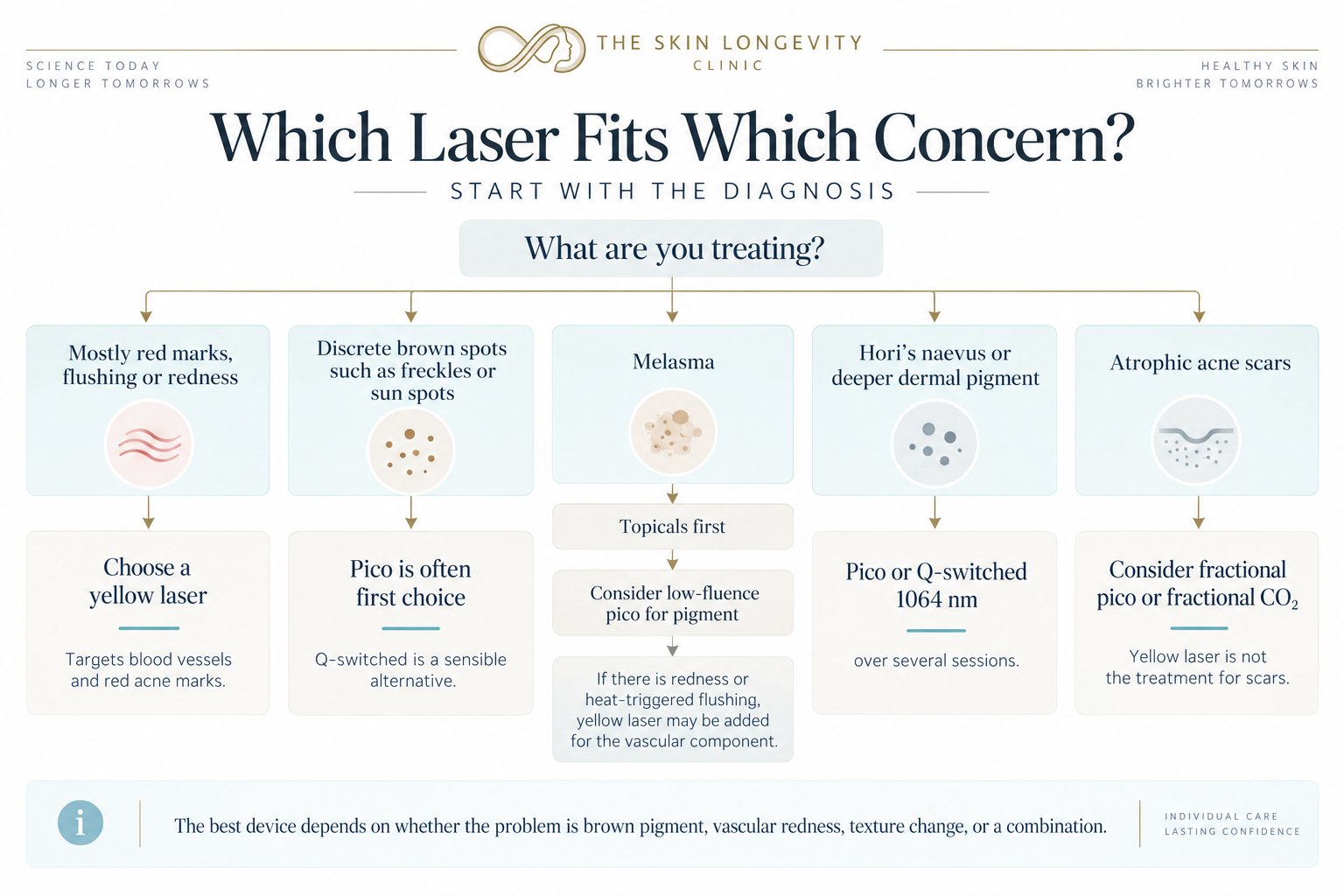
Sun spots, freckles and tattoos: pico or Q-switched; pico clears faster with less discomfort in Asian skin1,2, and Q-switched costs less per session. Melasma: topical therapy first, with low-fluence 1064 nm pico laser as an adjunct3; yellow laser when redness accompanies the melasma. Redness, flushing and red acne marks: yellow laser, not pico. Atrophic acne scars: fractional pico or fractional CO24. Hori’s naevus: Q-switched or pico 1064 nm over several sessions5.
Pulse duration: why picoseconds matter
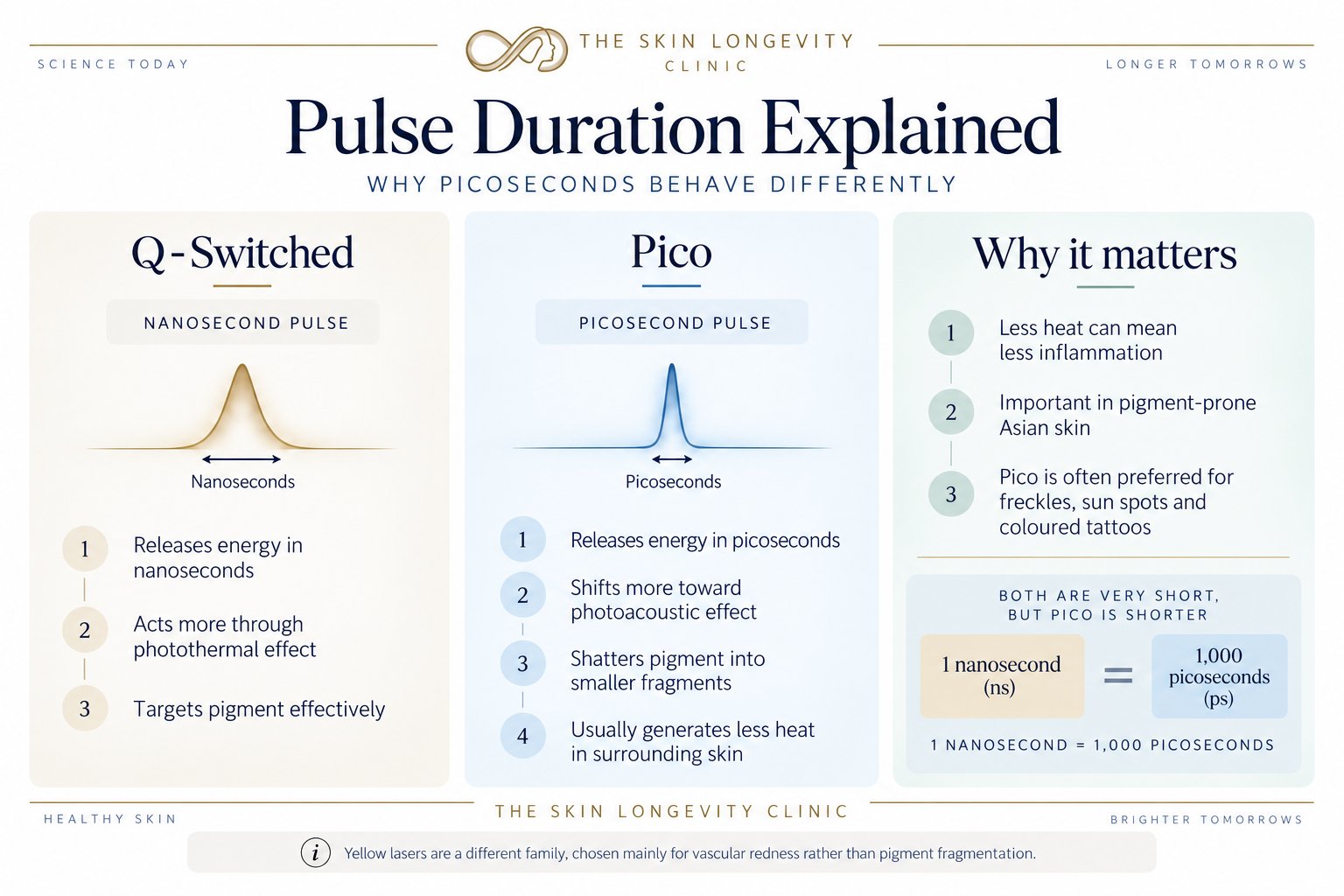
A Q-switched laser releases its energy in nanoseconds, a billionth of a second. A pico laser releases it in picoseconds, a trillionth. Both are far shorter than the time heat takes to leave a melanin granule, which is why both can target pigment without burning the surrounding skin. The difference is the balance between two effects. Longer pulses heat the pigment (a photothermal effect); very short pulses shatter it mechanically before much heat is generated (a photoacoustic effect)6.
Smaller fragments are cleared more readily by the skin’s immune cells, and less heat means less inflammation. In Fitzpatrick skin types III to V, where inflammation readily produces post-inflammatory hyperpigmentation, that margin is the reason picosecond lasers were adopted quickly in Asia. A 2021 systematic review of 77 studies graded the evidence for picosecond lasers as level I for tattoo removal, level I to IV for benign pigmented lesions and level II for melasma6.
Pico laser versus Q-switched laser
Sun spots and freckles. In a split-face randomised trial in Asian patients, 85.7 per cent of picosecond-treated sites showed more than 50 per cent improvement at six months against 57.2 per cent for the Q-switched side, with no difference in side effects or healing time and less discomfort with the picosecond laser1. Across clinical trials of solar lentigines, picosecond lasers cleared 67.9 to 93 per cent of lesions and Q-switched lasers 36 to 77 per cent2.
Tattoos. Both are effective for black ink. Picosecond lasers are superior for blue, green and yellow pigments7, and clear tattoos in fewer sessions.
Melasma. Neither is a first-line treatment. Low-fluence 1064 nm picosecond laser reduced melasma severity scores in a 2023 meta-analysis without significant side effects; 755 nm picosecond laser did not beat topical agents and caused post-inflammatory hyperpigmentation3. Low-fluence Q-switched 1064 nm “laser toning” has a longer history and a known risk of mottled hypopigmentation with repeated sessions, which is why session counts are limited.
Hori’s naevus. Both wavelengths at 1064 nm work over multiple sessions; a 2026 systematic review pooling 40 studies found 47.8 per cent of patients reaching at least 75 per cent clearance5.
Cost and access. Q-switched sessions are typically cheaper and the devices are more widely available. For a few discrete sun spots in a patient who tolerates a little more downtime, Q-switched remains a sensible choice. The clinic offers both; see the Q-switched Nd:YAG 1064 nm laser page.
Pico laser vs yellow laser
Pico laser and yellow laser are often compared because both are used for acne marks and melasma, but they target different chromophores. Pico laser treats brown pigment; yellow laser treats redness from blood vessels.
| Pico laser | Yellow laser | |
|---|---|---|
| Wavelength | 532 nm, 755 nm or 1064 nm | 577 to 595 nm |
| Main target | Melanin (brown and grey pigment) | Oxyhaemoglobin (blood vessels) |
| Brown spots, freckles, sun spots | First choice | Not the main tool |
| Facial redness, rosacea, broken capillaries | Does not treat vessels | First choice |
| Acne marks | Brown post-acne marks (PIH) | Red post-acne marks (PIE) |
| Melasma | Low-fluence toning for the pigment | For the vascular component when melasma flushes with heat |
| Downtime | Hours to a few days, depending on mode | Usually mild redness for hours; bruising is uncommon at standard settings |
Yellow laser refers to devices emitting at 577 to 595 nm, a wavelength absorbed strongly by oxyhaemoglobin and moderately by melanin. Its targets are blood vessels: facial redness, rosacea, red post-acne marks, the pinkness left after other lasers, and the vascular component that some melasma carries. Pico laser does not treat vessels.
The two are complementary rather than competing. A patient with red and brown acne marks may need both; a patient with melasma that flushes with heat may have yellow laser for the vascular element and low-fluence pico for the pigment. There is no head-to-head randomised trial of comparable quality between yellow and picosecond lasers for melasma, so claims that one is “better” for melasma are not evidence-based; the choice follows the diagnosis.
For melasma specifically, see our melasma treatment guide, which explains where pico laser, topical treatment and sun protection fit.
Pico laser versus fractional CO2 laser for acne scars
Fractional CO2 vaporises microscopic columns of skin and is the established resurfacing laser for deeper acne scars. Fractional pico creates columns of laser-induced optical breakdown beneath an intact surface. In a randomised split-face trial for atrophic acne scars, the two produced equivalent improvement in texture and scar volume, with no post-inflammatory hyperpigmentation after fractional pico and 24 per cent after fractional CO24. CO2 has more downtime and remains the choice, often in combination with subcision or fillers, for deep ice-pick and tethered rolling scars. See the fractional CO2 laser page.
Which laser for which concern
| Concern | First choice | Alternative | Not suitable |
|---|---|---|---|
| Freckles, sun spots | Pico 532 / 1064 nm | Q-switched | Yellow |
| Melasma | Topicals + low-fluence pico 1064 nm | Yellow (vascular type) | High-fluence any laser |
| Hori’s naevus | Pico or Q-switched 1064 nm | — | Yellow |
| PIH after acne | Low-fluence pico toning once acne is quiet | Peels | Aggressive settings |
| Red acne marks, redness | Yellow | Vascular lasers | Pico |
| Atrophic acne scars | Fractional pico | Fractional CO2 | Toning-only |
| Tattoos | Pico | Q-switched (black ink) | Yellow |
How the choice is made at The Skin Longevity Clinic
The laser is chosen after the diagnosis, not before. Dr Rachel Ho examines the pigment type and depth, skin tone, any vascular component and the patient’s tolerance for downtime, then selects the wavelength and mode. Pico and Q-switched lasers are both available at the clinic; vascular concerns are treated with the appropriate platform or referred. Our guide to what to expect at a first consultation explains how the assessment runs, and the pigmentation treatment page describes how each pigment type is identified.
Frequently asked questions
Is pico laser better than Q-switched laser?
For sun spots, freckles and coloured tattoos, trials favour pico: faster clearance and less discomfort with the same side-effect rate1,2,7. For black tattoos and single sun spots both work, and Q-switched costs less.
Is yellow laser better than pico laser for melasma?
Neither is a cure. Yellow laser addresses the redness and vessels that accompany some melasma; low-fluence pico addresses the pigment3. No high-quality trial compares them directly.
Can I have pico and yellow laser together?
Yes, in the same plan and sometimes the same session, when both pigment and redness are present. The sequence and intervals are set by the doctor.
Which laser has the least downtime?
Low-fluence pico or Q-switched toning: usually none. Yellow laser: mild redness for a few hours. Spot treatment with either pigment laser: about a week of darkening and crusting. Fractional CO2: the most, typically five to seven days.
Which is cheapest?
Q-switched sessions are usually the least expensive per session. Pico sessions cost more but may need fewer of them for sun spots and tattoos. Our pico laser price guide explains what shapes a quotation.
References
- Ungaksornpairote C, Manuskiatti W, Junsuwan N, et al. A Prospective, Split-Face, Randomized Study Comparing Picosecond to Q-Switched Nd:YAG Laser for Treatment of Epidermal and Dermal Pigmented Lesions in Asians. Dermatologic Surgery. 2020;46:1671 to 1675. https://pubmed.ncbi.nlm.nih.gov/32604235/
- Mardani G, Nasiri MJ, Namazi N, et al. Treatment of Solar Lentigines: A Systematic Review of Clinical Trials. Journal of Cosmetic Dermatology. 2025;24:e70133. https://pubmed.ncbi.nlm.nih.gov/40145274/
- Feng J, Shen S, Song X, et al. Efficacy and safety of picosecond laser for the treatment of melasma: a systematic review and meta-analysis. Lasers in Medical Science. 2023;38:84. https://pubmed.ncbi.nlm.nih.gov/36897459/
- Sirithanabadeekul P, Tantrapornpong P, Rattakul B, et al. Comparison of Fractional Picosecond 1064-nm Laser and Fractional Carbon Dioxide Laser for Treating Atrophic Acne Scars: A Randomized Split-Face Trial. Dermatologic Surgery. 2021;47:e58 to e65. https://pubmed.ncbi.nlm.nih.gov/32910030/
- Li F, Wang Y, Shen Z. Efficacy of Q-switched and picosecond lasers for acquired bilateral nevus of Ota-like macules: a systematic review and exploratory dose-response meta-analysis. Lasers in Medical Science. 2026;41:180. https://pubmed.ncbi.nlm.nih.gov/42560400/
- Wu DC, Goldman MP, Wat H, Chan HHL. A Systematic Review of Picosecond Laser in Dermatology: Evidence and Recommendations. Lasers in Surgery and Medicine. 2021;53:9 to 49. https://pubmed.ncbi.nlm.nih.gov/32282094/
- Gurnani P, Williams N, Al-Hetheli G, et al. Comparing the efficacy and safety of laser treatments in tattoo removal: a systematic review. Journal of the American Academy of Dermatology. 2022;87:103 to 109. https://pubmed.ncbi.nlm.nih.gov/32763326/