

06 Sep Nasolabial Filler Recovery: Swelling, Firmness and When to Seek Review
Swelling, tenderness, bruising and firmness can occur after hyaluronic acid filler for nasolabial folds, also called laugh lines or smile lines1. A fuller or firmer area beside the mouth can feel unfamiliar, especially when you are deciding whether to wait or arrange a review.
This guide focuses on recovery after hyaluronic acid, or HA, filler. For treatment suitability and expected results, read our guide to laugh line fillers in Singapore and Dr Rachel Ho’s review of nasolabial fillers and alternatives.
How long does swelling last after nasolabial filler?
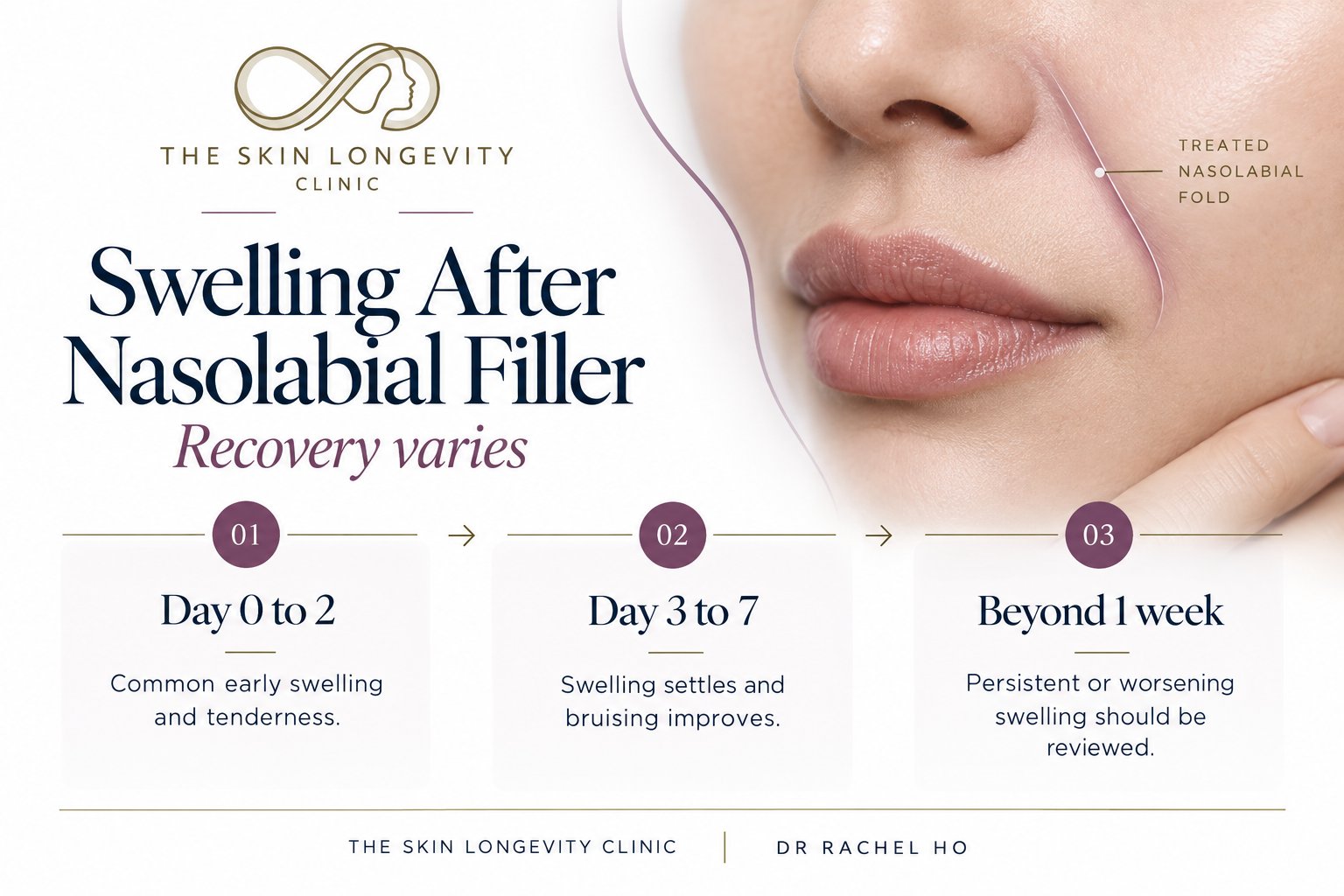
Most recorded injection reactions resolved within one week in a 2022 randomised study of 175 Chinese adults receiving nasolabial filler1. Firmness, tenderness and swelling were among the most commonly reported reactions, and most were mild or moderate1. The study compared two HA preparations and was funded by the manufacturer, so its findings describe those treatments rather than a recovery deadline for everyone1.
The amount and duration of swelling can vary with the filler, injection volume, technique and individual factors2. Swelling that persists or increases deserves assessment, particularly when accompanied by pain, redness or warmth2.
Why does nasolabial filler feel hard or lumpy?
Firmness can occur during early recovery, but a distinct lump can also relate to filler placement, excess material, inflammation or infection1,2. The appropriate response depends on the examination findings rather than how the lump feels to the touch alone2.
Contact the treating doctor about a persistent lump, especially if it becomes painful, red, warm or larger2. New nodules can also develop weeks or months after treatment, so mention previous filler when seeking advice even if the injections were some time ago2.
Should you massage nasolabial filler lumps?
Leave a lump or contour irregularity for the treating clinician to assess rather than trying to flatten it yourself3. Published consensus recommends that any massage intended to address an irregularity be performed by the injector during review3.
What aftercare is appropriate after laugh line filler?
Much of the published aftercare advice comes from expert consensus rather than trials comparing recovery routines3,4. Follow the instructions provided for your particular filler and procedure3.
Makeup and pressure on the face
Published consensus advises preferably leaving makeup off the treated area for the remainder of the treatment day3. It also recommends avoiding rubbing the area or sleeping with direct pressure on the face during the first week3.
Exercise and returning to the gym
Expert consensus recommends postponing strenuous exercise for the first twenty four hours after HA filler injections to reduce bruising and swelling4. Ask the treating doctor about returning to demanding activity if you are still experiencing symptoms that concern you.
Cool compresses
Published recommendations differ on cooling: one consensus allows brief cold compresses for mild swelling, while another advises against icing because it may obscure signs of reduced blood supply2,3. Ask your clinician whether cooling is appropriate for your symptoms rather than adopting a routine from another patient’s experience.
Pain relief and usual medicines
Ask your doctor or pharmacist which pain relief is suitable for your medical history and current medicines. Continue prescribed blood thinning treatment unless the prescribing clinician advises otherwise, rather than stopping it independently because of bruising4.
When should nasolabial filler be reviewed?
Published consensus recommends review at approximately two to four weeks for patients receiving filler in a new treatment area3. This appointment allows the doctor to assess the contour and discuss any remaining concerns, with earlier examination when symptoms warrant it3.
At review, explain whether the concern is visible at rest, during a smile or both. Describe how it has changed since treatment and whether your main concern is appearance, discomfort or a palpable lump.
Our article on your first aesthetic clinic consultation includes questions about aftercare and ongoing care. Keep the original treatment plan available when discussing whether any further correction would be appropriate.
Which symptoms need earlier assessment?
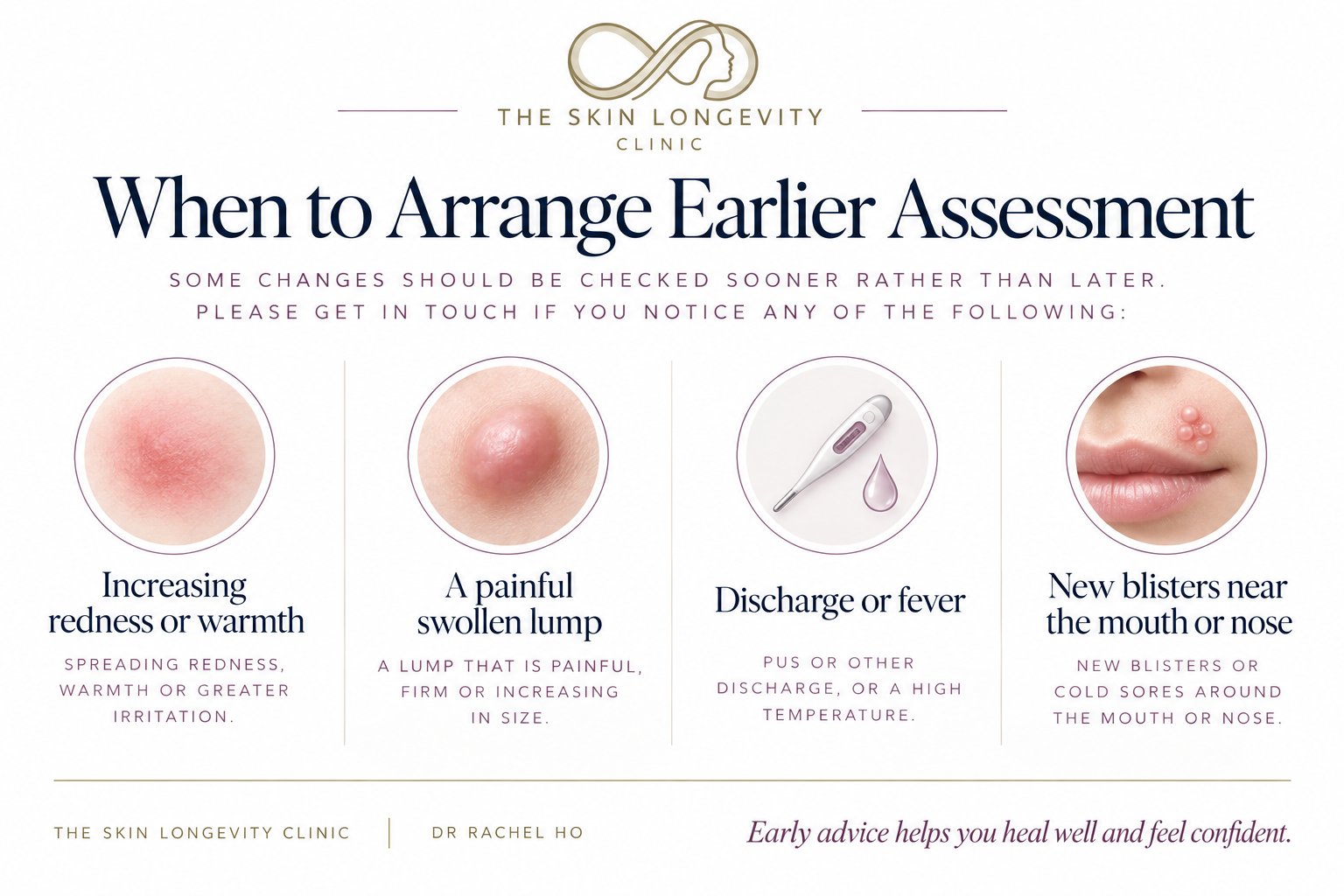
A persistent contour concern and a sudden change in symptoms may require different review arrangements2,5. The guidance below distinguishes an arranged examination from symptoms that need more immediate attention.
| What you notice | Appropriate next step |
|---|---|
| A persistent lump or uneven contour without worsening symptoms | Contact the treating doctor to arrange examination2. |
| Increasing redness, warmth, discharge, fever or a painful swollen lump | Obtain medical assessment the same day2. |
| Increasing or severe pain, or skin that becomes unusually pale, dusky or mottled | Seek immediate assessment from the treating doctor. Attend an emergency department promptly if immediate clinical help is unavailable5. |
| Sudden blurred vision, loss of vision, difficulty speaking or new weakness | Seek emergency care immediately and call 995 in Singapore6,7. |
| Difficulty breathing or swelling affecting the tongue or throat | Call 995 for emergency assistance4,7. |
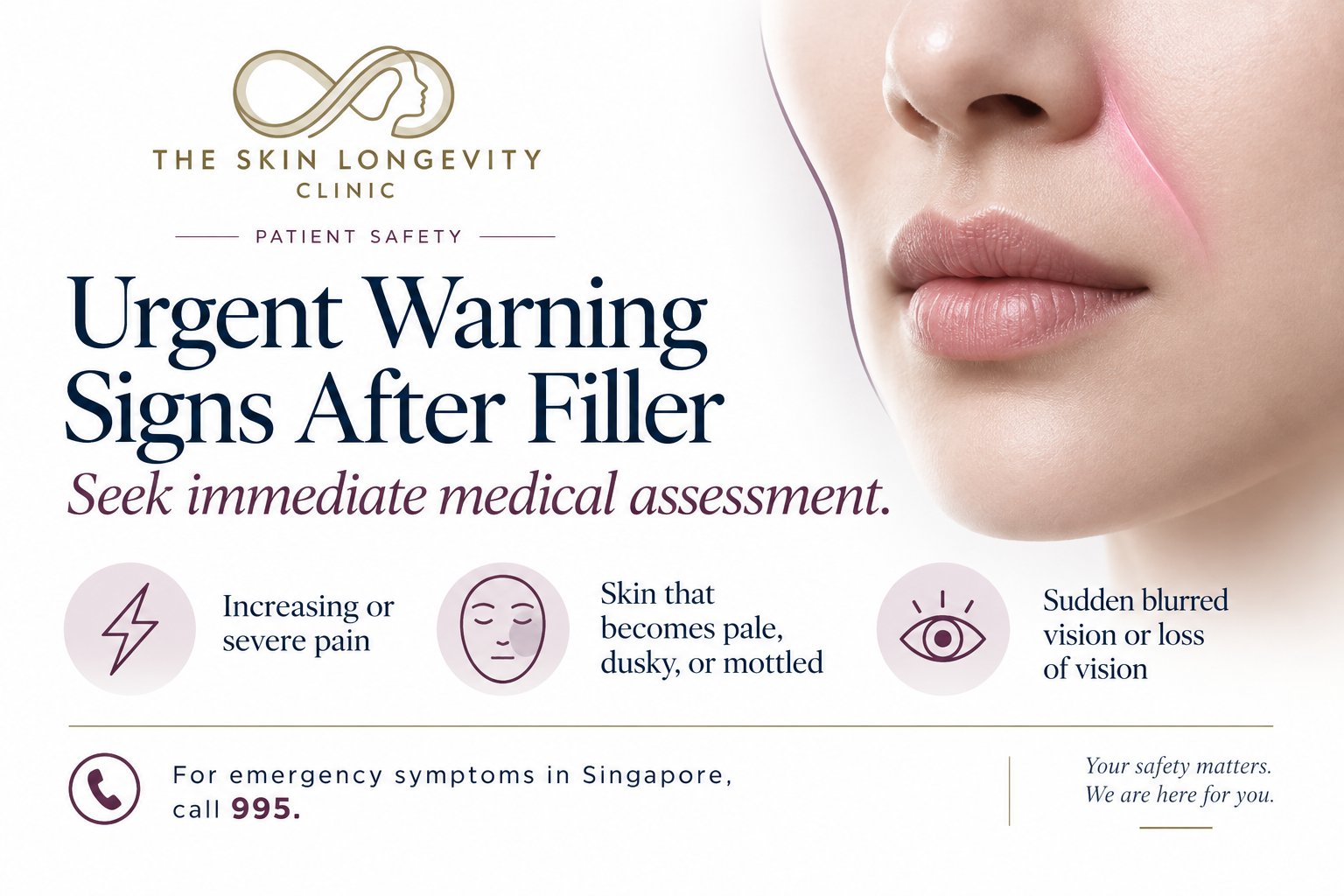
A blood supply problem can initially occur without marked pain, so an unusual colour change should be assessed even when the area feels relatively comfortable5. Explain that you recently received a facial filler injection when seeking medical help6.
What if blisters appear beside the mouth?
Herpes reactivation has been reported after filler injections, particularly around the mouth and nose2. New blisters should be examined promptly because other complications can also produce skin changes in the treated area3,5.
Does persistent firmness mean the filler needs dissolving?
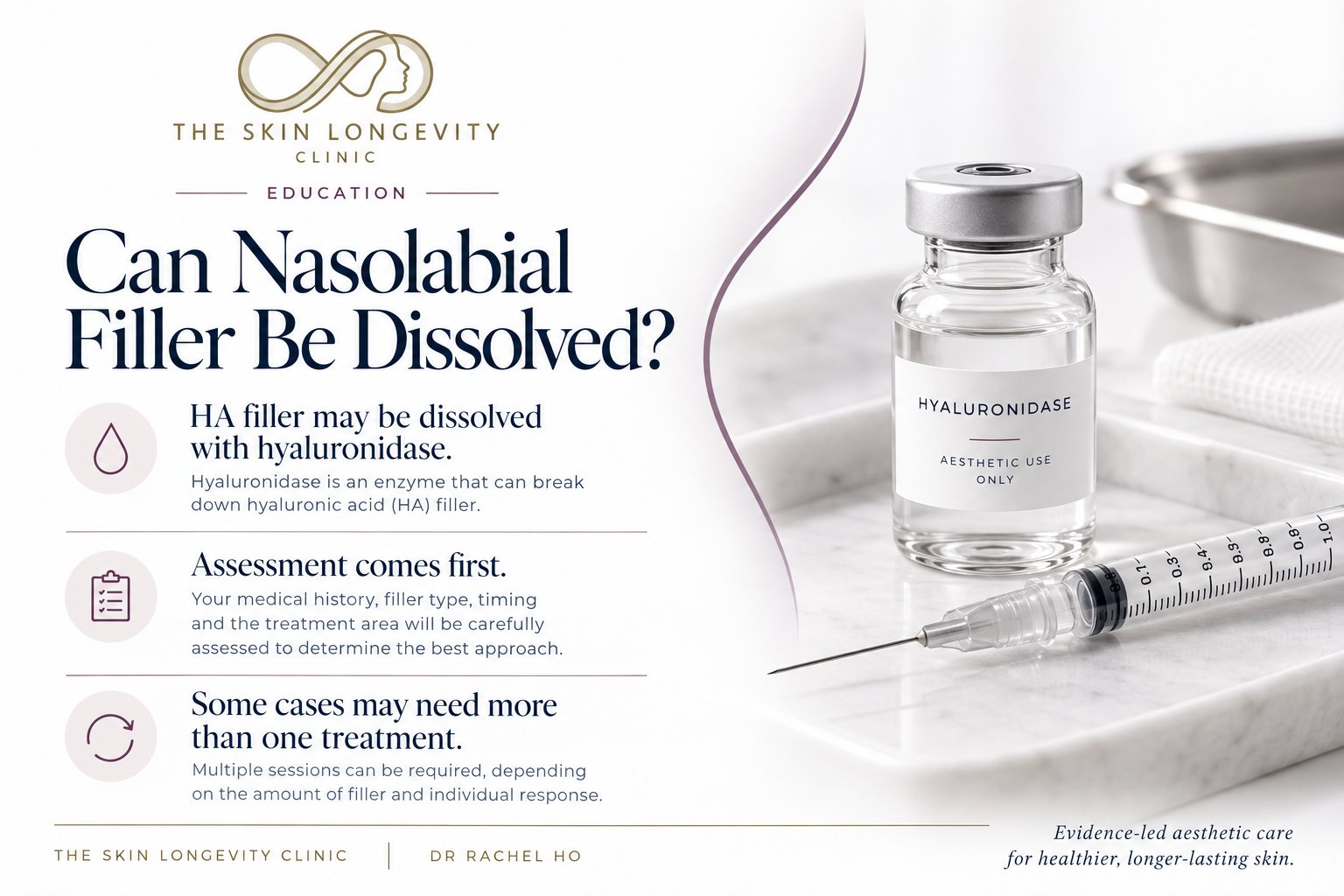
Hyaluronidase is an enzyme that breaks down HA filler and may be used for selected complications or unwanted results8. The decision depends on the injected material and the cause of the concern, rather than firmness alone8.
Some situations require more than one treatment, and hyaluronidase can itself cause adverse reactions, including allergy8. Dissolving HA filler also does not guarantee reversal of tissue injury or visual loss caused by a vascular complication8. Dr Rachel Ho’s guide to dissolving fillers with hyaluronidase explains the assessment and treatment limitations in more detail.
Contacting The Skin Longevity Clinic after treatment

For concerns following treatment at The Skin Longevity Clinic, telephone +65 6514 2688 during the published consultation hours9. When making contact, explain when treatment took place, when the symptoms began and whether they are improving or worsening. Have the filler name and any treatment records available, particularly when injections were performed elsewhere.
References
-
Xie Y, Li Q, Gao Z, et al. Juvéderm Volift, a Hyaluronic Acid Filler with Lidocaine, is Safe and Effective for Correcting Nasolabial Folds in Chinese Subjects. Clinical, Cosmetic and Investigational Dermatology. 2022;15:237 to 245. doi:10.2147/CCID.S344350.
-
Urdiales Gálvez F, Escoda Delgado N, Figueiredo V, et al. Treatment of Soft Tissue Filler Complications: Expert Consensus Recommendations. Aesthetic Plastic Surgery. 2018;42:498 to 510.
-
Goodman GJ, Liew S, Callan P, Hart S. Facial aesthetic injections in clinical practice: Pretreatment and posttreatment consensus recommendations to minimise adverse outcomes. Australasian Journal of Dermatology. 2020;61:217 to 225. doi:10.1111/ajd.13273.
-
Signorini M, Liew S, Sundaram H, et al. Global Aesthetics Consensus: Avoidance and Management of Complications from Hyaluronic Acid Fillers. Plastic and Reconstructive Surgery. 2016;137:961e to 971e.
-
Murray G, Convery C, Walker L, Davies E. Guideline for the Management of Hyaluronic Acid Filler Induced Vascular Occlusion. Journal of Clinical and Aesthetic Dermatology. 2021;14:E61 to E69.
-
Walker L, Convery C, Davies E, Murray G, Croasdell B. Consensus Opinion for the Management of Soft Tissue Filler Induced Vision Loss. Journal of Clinical and Aesthetic Dermatology. 2021;14:E84 to E94.
-
Singapore Civil Defence Force. Emergency Medical Services.
-
Kroumpouzos G, Treacy P. Hyaluronidase for Dermal Filler Complications: Review of Applications and Dosage Recommendations. JMIR Dermatology. 2024;7:e50403. doi:10.2196/50403.
-
The Skin Longevity Clinic. Contact details and consultation hours.