


07 Aug First Aesthetic Clinic Consultation Singapore: What to Expect
By Dr Rachel Ho | Aesthetic Doctor, Founder, The Skin Longevity Clinic, Singapore
People searching for the best aesthetic clinic in Singapore often compare doctors, treatments, devices, reviews and prices. The consultation itself is a more useful test. It shows whether the clinic starts with a diagnosis, explains the options clearly and is prepared to advise against treatment when it is unnecessary.
A first aesthetic consultation should leave you with a better understanding of your skin or facial concern, even when you do not undergo a procedure. You should know what may be causing the concern, which options are reasonable, what each treatment can and cannot achieve, what the risks and costs are, and what follow-up would involve.
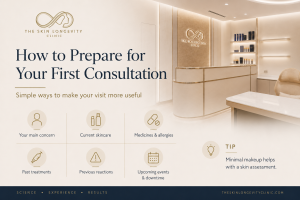
Prepare for your first aesthetic clinic consultation by bringing details of your main concern, current skincare, medicines, allergies, previous procedures, past reactions and acceptable downtime.
What happens at a first aesthetic clinic consultation?
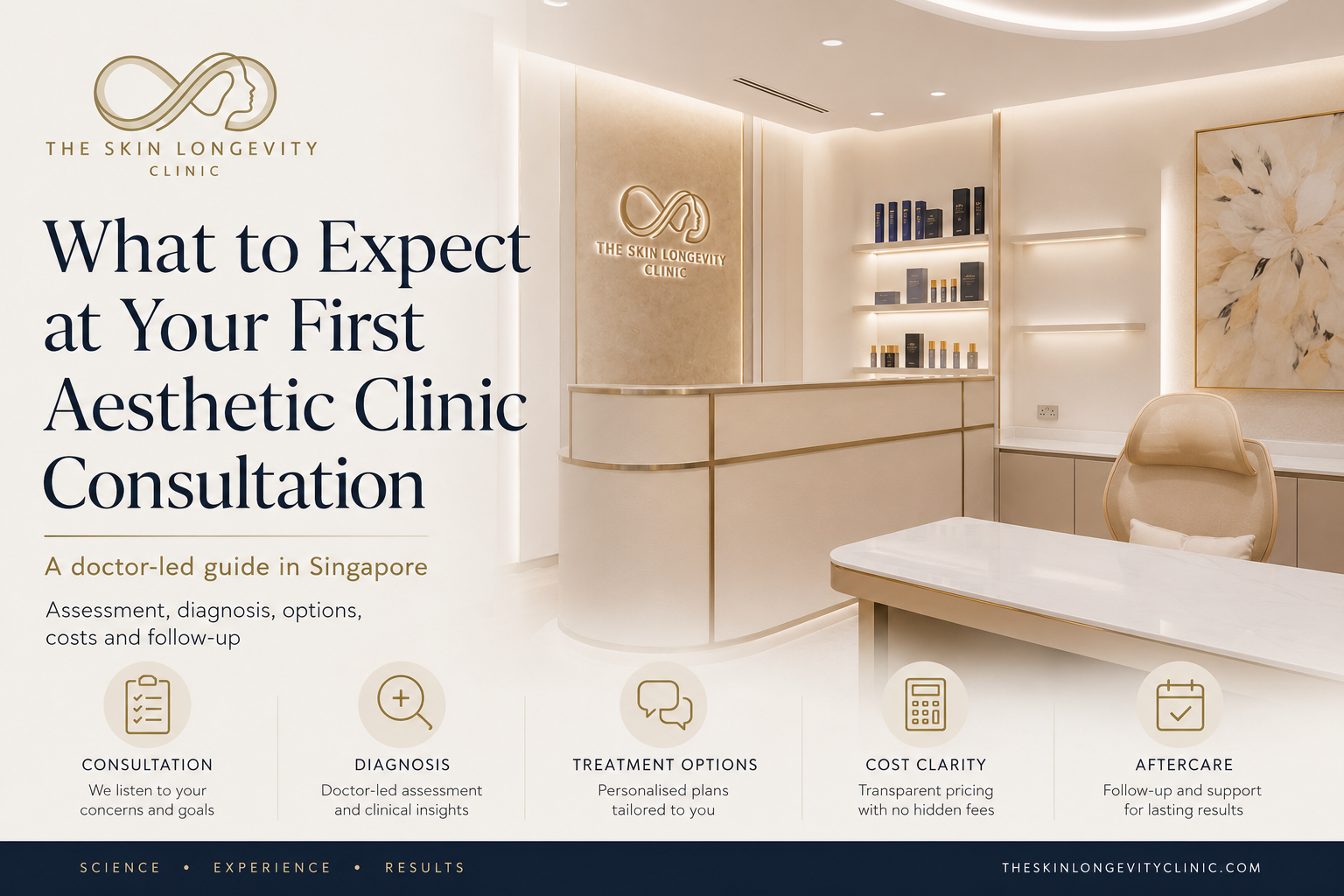
At your first aesthetic clinic consultation, expect to discuss your concerns, goals, medical history, medications, skincare and previous procedures. The doctor should then examine the relevant skin or facial features, explain the likely diagnosis, compare suitable options and discuss expected results, limitations, risks, downtime, costs and aftercare.
Treatment does not have to happen during the first visit. Singapore Medical Council guidance states that doctors should obtain sufficient information through history taking and clinical examination before offering an opinion, management plan or treatment. Patients should also have sufficient time to consider a proposed procedure and clarify their questions.
Your first consultation at a glance
| Stage | What usually happens | Why it is useful |
|---|---|---|
| Your concerns | You explain what you would like to improve | Establishes your priorities |
| Medical history | The doctor reviews health conditions, medication, allergies and previous treatments | Identifies suitability and risk |
| Skin or facial assessment | The relevant area is examined at rest and, where appropriate, during movement | Helps identify the cause |
| Working diagnosis | The doctor explains what may be contributing to the concern | Prevents treatment by trend alone |
| Treatment discussion | Reasonable options, including doing nothing, are compared | Supports an informed decision |
| Expectations | Likely improvement, limitations, sessions and maintenance are discussed | Reduces mismatched expectations |
1. You will be asked what you want to improve
The consultation usually begins with your own description of the concern. It may be pigmentation, acne scars, enlarged pores, dark eye circles, wrinkles, facial heaviness, reduced firmness or a general sense that the skin looks tired.
Try to describe the change you have noticed and the result you hope to achieve. Bringing the name of a treatment you have seen online is perfectly reasonable, but it should not replace an assessment. The treatment you initially request may not address the underlying cause.
It is also helpful to explain your preferences. Some patients prioritise minimal downtime, while others are willing to accept a longer recovery for a larger change. Some want one concern treated, whereas others prefer a staged plan covering skin quality and facial ageing over several years.
2. The doctor should review your medical and treatment history
An aesthetic procedure remains a medical procedure when it is provided by a licensed healthcare service. The consultation should therefore include relevant medical history rather than focus only on photographs or cosmetic goals. Clinical aesthetic procedures offered by licensed healthcare providers in Singapore are regulated under the Healthcare Services Act.
Information that may be relevant includes:
- Medical conditions and allergies
- Prescription medicines and supplements
- Pregnancy or breastfeeding
- Previous aesthetic procedures and how you responded
- Previous complications or unexpected results
- Acne, eczema, rosacea, melasma or sensitive skin
- Tendency to develop pigmentation or raised scars
- Current skincare and recent active ingredients
- Planned travel, important events and acceptable downtime
Not every question applies to every treatment. However, a doctor needs enough information to decide whether the procedure is suitable, whether it should be modified or whether it should be postponed.
3. Your skin and facial anatomy will be assessed
A consultation should involve examination rather than diagnosis from a questionnaire alone. Depending on the concern, the doctor may assess pigmentation pattern, inflammation, acne activity, skin texture, hydration, barrier condition, facial symmetry, muscle movement, volume distribution and skin laxity.
For facial lines, examination at rest and during expression can help distinguish movement-related wrinkles from lines that remain fixed in the skin. For facial contour concerns, the doctor may assess bone structure, muscle size, fat distribution and skin support rather than assuming that one injectable or device is appropriate.
At The Skin Longevity Clinic, a broader skin longevity assessment may also consider barrier health, pigment stability, inflammation, collagen support, facial structure and lifestyle factors. This framework is intended to identify what needs treatment, what can wait and whether the skin is ready for a proposed procedure.
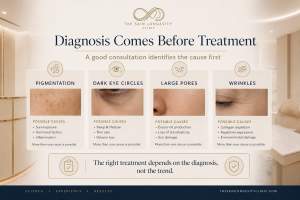
Similar-looking skin concerns can have very different causes. A doctor-led assessment helps distinguish the factors contributing to pigmentation, dark eye circles, enlarged pores and wrinkles before treatment is recommended.
4. The concern should be translated into a diagnosis
A visible concern is not always a diagnosis. Several conditions can look similar but respond differently to treatment.
Symptoms and diagnoses
| What the patient notices | Possible contributors |
|---|---|
| Brown patches or dark spots | Melasma, sun spots, freckles or post-inflammatory pigmentation |
| Dark eye circles | Pigment, visible vessels, thin skin, hollows, eye bags or fluid retention |
| Large pores | Oil production, acne scarring, sun damage or reduced skin elasticity |
| Forehead lines | Muscle movement, fixed skin changes or both |
| A wide lower face | Masseter muscle, jawbone, facial fat or skin laxity |
| Sagging or heaviness | Skin laxity, fat redistribution, ligament change or facial structure |
| Dull, reactive skin | Barrier disruption, inflammation, dehydration or unsuitable skincare |
This distinction is one of the clearest signs of a useful aesthetic consultation. The doctor should be able to explain what is likely to be causing the concern before recommending a machine, injectable or package.
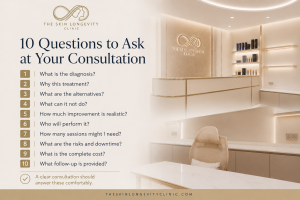
en practical questions to ask an aesthetic doctor in Singapore before treatment, covering the diagnosis, alternatives, realistic improvement, treatment limitations, risks, complete cost and aftercare.
5. More than one treatment option may be discussed
Once the working diagnosis is clear, the doctor should explain the reasonable options. These may include skincare, prescription treatment, chemical peels, lasers, resurfacing procedures, energy-based treatments, injectables, surgery, referral to another doctor or no treatment at present.
A treatment should not be recommended simply because the clinic owns the device or because it is currently popular. The discussion should relate each option to your diagnosis, skin type, anatomy, preferred degree of change, tolerance for downtime and budget.
The Singapore Medical Council requires doctors to practise on the basis of adequate clinical evaluation and accepted good clinical practice. It also states that patients should be informed of the purpose, benefits, significant limitations, material risks, possible complications and alternatives before complex or invasive treatment.
Questions worth asking your aesthetic doctor clinic
- What is the diagnosis?
- Why are you recommending this treatment?
- What are the alternatives?
- What happens if I do nothing?
- What can this treatment not achieve?
- How much improvement is realistic?
- Who will perform the procedure?
- How many sessions might I need?
- What are the risks and downtime?
- What follow-up is provided?
A clear consultation should make these questions easier to answer, not leave you more dependent on marketing language.
6. The limitations should be explained as clearly as the benefits
Every aesthetic treatment has a boundary. Knowing that boundary is important because many disappointing results come from asking one treatment to solve the wrong problem.
A skin booster may improve hydration or skin quality, but it does not produce the same structural change as filler or surgery. A movement-focused wrinkle treatment may soften dynamic lines, but it cannot fully remove deep creases caused by fixed skin changes. A radiofrequency or ultrasound device may produce gradual tightening in a suitable patient, but it does not replicate a surgical facelift.
The expected scale of improvement should also be discussed. “Better” may mean reduced pigment contrast, softer shadows, smoother texture or a modest improvement in firmness. It does not necessarily mean complete removal of the concern.
Dr Rachel Ho’s clinical perspective
The most useful first consultation is not one that produces the longest treatment list. It is one that identifies the main cause, explains what is realistically changeable and puts the options in the right order.
7. Clinical photographs should be taken
Clinical photographs can help document the starting point, assess symmetry and compare changes over time. They should be taken under consistent conditions and stored as part of the medical record where appropriate.
You may ask why photographs are being taken, how they will be stored and who can access them. The Singapore Medical Council requires specific consent if identifiable patient recordings are to be used publicly, including for advertising, talks or other media. Public use should therefore be treated separately from photography used for clinical assessment or treatment records.
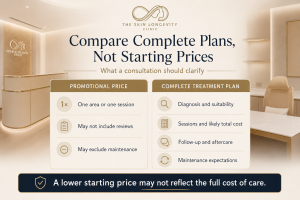
Compare the complete treatment plan rather than the advertised starting price. A clear aesthetic consultation should explain suitability, likely sessions, total cost, maintenance requirements and follow-up care.
8. You should receive a clear explanation of cost
A consultation should distinguish the price of one session from the likely cost of a complete plan. The quotation may depend on treatment area, product quantity, device consumables, number of sessions, doctor time, reviews, aftercare and maintenance.
Ask whether the quoted amount includes:
- Consultation and doctor assessment
- GST
- Numbing or medication
- The full treatment area
- Product quantity or device consumables
- Follow-up reviews
- Aftercare
- The expected treatment course
- Future maintenance
Singapore Medical Council guidance states that fees or fee ranges should be transparent and made known before services are provided.
A promotional starting price is not necessarily misleading, but it may not represent the cost of addressing your concern. Compare complete plans rather than isolated prices.
9. Consent is a discussion, not just a form
A consent form records a decision, but the consultation should provide the understanding needed to make that decision. You should know the purpose of treatment, anticipated benefit, significant limitations, relevant risks, possible complications, alternatives and who will perform the procedure.
You may ask more questions, delay treatment or change your mind. Singapore Medical Council guidance states that patients may withdraw or modify consent and, outside emergencies, should have sufficient time to think about their decision and clarify doubts.
This is especially relevant in elective aesthetic medicine. Feeling uncertain is a reasonable reason to wait.
10. Treatment may not happen during the first visit
Some patients are medically suitable, fully informed and comfortable proceeding on the same day. Others benefit from time to review the recommendation, prepare the skin, adjust medication under medical guidance or consider alternative options.
A first consultation may end with:
- A procedure scheduled for another date
- A skincare or sunscreen plan
- Treatment of active acne or dermatitis before a procedure
- Barrier repair before laser or resurfacing
- Monitoring rather than immediate intervention
- Referral to a dermatologist, plastic surgeon or another appropriate clinician
- A recommendation that no treatment is needed
A consultation that ends without a procedure is not an unsuccessful consultation. Sometimes the safest conclusion is to wait, simplify the plan or leave a well-balanced feature alone.
How to prepare for your first aesthetic consultation
You do not need to arrive knowing exactly which treatment you want. Preparing a few details can make the discussion more productive.
Bring or note:
- Your main concern and when it began
- Photographs showing how the concern has changed
- A list of medicines, supplements and allergies
- Your current skincare products
- Previous procedures, products and approximate dates
- Previous adverse reactions
- Upcoming travel or important events
- Your acceptable downtime and budget
- Questions you want answered
For a skin consultation, minimal makeup is useful because colour, texture and inflammation are easier to assess. Makeup can usually be removed at the clinic if necessary.
Warning signs during a first consultation
Pause before proceeding when treatment is recommended before a proper history or examination, risks are dismissed, results are guaranteed or the person performing the procedure is unclear. Pressure to pay immediately, unexplained packages and reluctance to provide a complete quotation also deserve caution.
Healthcare advertising in Singapore must be accurate and truthful and must not encourage unnecessary consumption of healthcare services. A consultation should follow the same principle by supporting an informed decision rather than creating artificial urgency.
Dr Rachel Ho’s clinical perspective: “The most useful first consultation is not one that produces the longest treatment list. It is one that identifies the main cause, explains what is realistically changeable and puts the options in the right order.”
What to expect at The Skin Longevity Clinic
Consultations at The Skin Longevity Clinic are structured around the patient’s goals, skin behaviour, facial anatomy and longer-term skin health. The assessment may include pigmentation, barrier function, inflammation, acne tendency, texture, collagen-related changes, facial structure and treatment tolerance.
Dr Rachel Ho’s approach is to explain what is likely to be causing the concern, which treatments may be suitable, what can safely wait and what should be avoided. The clinic describes its care as personalised and evidence based, with a measured treatment pace intended to preserve facial identity and natural expression.
The Skin Longevity Clinic is located at 9 Scotts Road, #06-05 Scotts Medical Center at Pacific Plaza, Singapore 228210, near Orchard Road.
Frequently asked questions
Do I need to undergo treatment at my first consultation?
No. A first consultation may be used solely to understand the diagnosis, compare options and decide whether treatment is appropriate. You can take time to consider the recommendation or seek another opinion.
Can I request a specific treatment?
Yes. Bring the name of the procedure or product you are considering, but expect the doctor to assess whether it addresses your actual concern. A good consultation may confirm your choice, suggest an alternative or advise that treatment is unnecessary.
How long does an aesthetic clinic consultation take?
The duration depends on the complexity of the concern. A focused review of one straightforward issue may be shorter than an assessment involving pigmentation, skin sensitivity, facial ageing and several previous treatments.
Should I attend the consultation without makeup?
Minimal makeup is helpful for a skin assessment, but it is not essential. The clinic can usually arrange for makeup to be removed so that pigment, redness, pores and texture can be examined accurately.
Will the doctor tell me the complete price at the clinic?
The clinic should explain the fee or fee range before providing services. Ask whether the quotation includes GST, consumables, the expected number of sessions, reviews, aftercare and maintenance.
What makes a good aesthetic consultation?
A good consultation provides a diagnosis, explains reasonable options, sets realistic expectations and covers limitations, risks, costs, downtime and follow-up. You should feel informed rather than pressured.
Is the “best aesthetic clinic Singapore” an official ranking?
No. “Best aesthetic clinic Singapore” is a search phrase, not a recognised medical ranking. A safer way to choose is to assess licensing, doctor registration, consultation quality, clinical reasoning, transparency and continuity of care.
Final takeaway on your first visit to an aesthetic clinic in Singapore
Your first aesthetic clinic consultation should provide clarity before it provides treatment. Expect a review of your goals and medical history, an examination, a working diagnosis and a balanced discussion of the available options.
The right clinic should be prepared to explain limitations, costs and aftercare as clearly as potential benefits. Whether you proceed immediately, return later or decide against treatment, the consultation should help you make a more informed decision about your skin and face.
References
- Singapore Medical Council. Ethical Code and Ethical Guidelines, 2016 Edition.
- Singapore Medical Council. Guidelines on Aesthetic Practices for Doctors. Updated February 2026.
- Ministry of Health Singapore. Regulation of Advertisements for Aesthetic Treatments.
- Ministry of Health Singapore. Regulation of Unlicensed Aesthetic Treatments.