

Laugh Line Fillers in Singapore: Nasolabial Fold Treatment
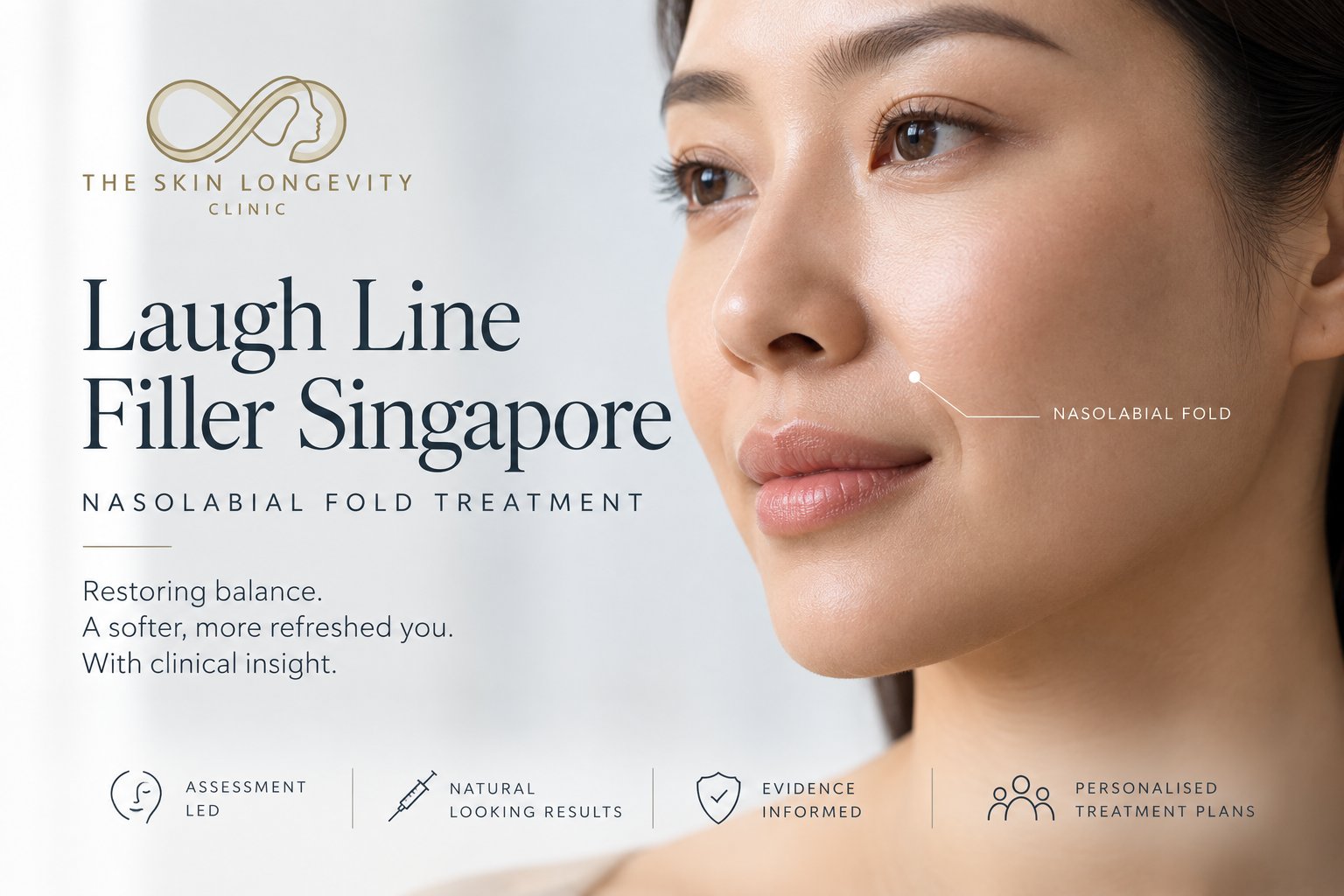
Laugh line filler adds volume to soften the folds running from the sides of the nose towards the corners of the mouth1. These nasolabial folds are also called smile lines, and this page focuses on treatment with hyaluronic acid, or HA, fillers1.
For someone considering laugh line filler in Singapore, the starting point is the change they would like to see. Explain how much the fold bothers you, how much correction you would prefer and which features you want to preserve.
Who might be suitable for nasolabial fillers?
Nasolabial filler may be considered when assessment identifies a fold or contour deficit that adding volume could improve2. Treatment planning considers the fold’s severity, underlying causes and the patient’s expectations, rather than applying the same injection pattern to every face2.
A consultation should establish what treatment could reasonably change and what would remain unchanged. Our overview of dermal fillers in Singapore explains the different injectable categories, while Dr Rachel Ho’s review of laugh lines and nasolabial fillers provides further background on this treatment area.
Should the cheeks or the nasolabial folds be treated?
Cheek filling changes volume, but a predictable lifting effect on the nasolabial fold should not be assumed3. In a photographic study, a subgroup of 37 patients with comparable facial expressions showed no visible traction between the cheek injection site and the nasolabial crease3.
The consultation should therefore explain why treatment is proposed for the fold, the cheek or both. Dr Rachel Ho’s cheek filler guide discusses the distinction between restoring cheek volume and treating nearby smile lines.
What should you discuss before treatment?
Share your medical history, allergies, medicines and details of previous filler, including treatment performed elsewhere4. Active infection or inflammation at the planned injection site warrants postponement, and published consensus advises deferring filler during pregnancy or breastfeeding4. Continue prescribed blood thinning medicines unless the prescribing clinician advises a change4.
Bring available treatment records, especially when you are unsure which filler was used previously. You can also explain any past reaction or concern about an earlier result before considering further injections.
How are laugh line filler injections performed?
Treatment begins with assessment, informed consent and skin cleansing4. The doctor selects the material and placement approach for the intended correction, using a needle, cannula or combination according to the anatomy5.
Local anaesthesia may improve comfort, although discomfort can still occur during injections5,6. Before leaving, obtain written aftercare instructions, review arrangements and information about whom to contact if concerns develop4.
Is 1 ml of nasolabial filler enough?
The amount is planned around the anatomy, extent of correction and material selected2. Published assessment approaches use different treatment strategies according to the causes and severity of the folds, rather than one standard prescription for every patient2.
When discussing 1 ml or 2 ml, clarify whether the proposed amount covers one side or both. Ask what that volume is intended to change and how the result will be reassessed before considering additional treatment.
What results does the evidence show?
A 2022 randomised trial studied 173 Chinese adults with moderate or severe nasolabial folds, treating each side with a different HA filler6. At six months, approximately 73% of participants achieved at least one grade of improvement on a wrinkle severity scale for each preparation, as assessed by a blinded evaluator6.
The study compared two active treatments and was funded by the manufacturer6. Its findings support the preparations and protocol studied, rather than an identical result from every nasolabial filler6.
How long does nasolabial filler last?
The same trial reported improvement through twelve months of follow up6. This shows that results can persist, rather than establishing a fixed duration for every patient or every preparation6.
Discuss the expected duration of the proposed filler during consultation. A maintenance decision should consider the remaining contour and whether further correction would be useful to you.
What should you expect during recovery?
Swelling, tenderness, bruising and firmness can occur after nasolabial filler injections1. Persistent lumps, increasing redness or worsening pain deserve examination rather than being assumed to be routine settling7.
Follow the instructions given for your procedure rather than massaging a lump yourself4. Published expert consensus recommends review at approximately two to four weeks for a new treatment area, with earlier assessment when concerns arise4.
For a day-by-day guide to swelling and firmness, see nasolabial filler recovery: swelling, firmness and when to seek review.
What are the risks of laugh line filler?
Possible complications include uneven contour, unwanted fullness, infection and delayed inflammatory nodules7. Nodules can appear weeks or months later, so previous filler remains relevant when a new lump or swelling develops7.
A serious complication occurs when filler obstructs blood supply, potentially causing tissue injury5,9. Vascular occlusion has been reported with both needles and cannulas, so the choice of instrument does not eliminate this risk8.
Increasing pain or skin that becomes unusually pale, dusky or mottled requires immediate medical assessment9. Sudden blurred vision or loss of vision after a filler injection requires emergency care, rather than waiting for a routine review9.
Can nasolabial filler be dissolved?
Hyaluronic acid filler can be broken down using hyaluronidase, an enzyme administered by a clinician for selected filler problems9. The response varies, some situations require repeated treatment, and hyaluronidase can itself cause adverse reactions, including allergy9. Dissolving HA filler does not guarantee reversal of tissue injury or visual loss caused by a vascular complication9.
An assessment should establish the material involved and the cause of the concern before a correction is proposed9. Dr Rachel Ho’s guide to dissolving fillers with hyaluronidase explains the treatment and its limitations in more detail.
What are the alternatives to nasolabial filler?
The alternatives depend on whether the main concern is the fold itself, surrounding volume loss or skin laxity2. For example, a systematic review found evidence that microfocused ultrasound can improve mild to moderate facial skin laxity, although the included studies involved women and used varying treatment protocols10.
Our guide to skin tightening in Singapore discusses treatments aimed at loose skin. Ask which feature an alternative would address, and consider leaving the area unchanged when the expected benefit does not justify treatment for you.
Collagen biostimulators are another option for the fold itself: a 2026 clinical study in the Journal of Craniofacial Surgery evaluated the efficacy and safety of injectable PDLLA (Juvelook) for nasolabial fold correction11.
How much does laugh line filler cost in Singapore?
Request a written quotation after assessment that identifies the filler, total volume and whether treatment covers one fold or both. Clarify consultation charges, GST, planned reviews and the cost of any further treatment or correction.
Compare the complete proposal rather than the syringe price alone. Our guide to your first aesthetic clinic consultation includes questions about fees, consent and ongoing care.
Nasolabial fold assessment at The Skin Longevity Clinic
Dr Rachel Ho is an aesthetic doctor and the founder of The Skin Longevity Clinic. Her professional profile outlines her background and approach to facial assessment and conservative treatment planning.
To arrange an assessment at Scotts Medical Center, 9 Scotts Road, Singapore, use the clinic’s contact page or telephone +65 6514 2688. The consultation is an opportunity to discuss the change you are considering and take time to decide whether to proceed.
References
-
Stefura T, Kacprzyk A, Droś J, et al. Tissue Fillers for the Nasolabial Fold Area: A Systematic Review and Meta Analysis of Randomized Clinical Trials. Aesthetic Plastic Surgery. 2021;45:2300 to 2316.
-
Li Q, Cui H, Tseng FW, et al. The Assessment, Strategy, and Treatment Protocol: Nasolabial Fold Assessment, Strategy, and Treatment With Hyaluronic Acid Fillers in Chinese Patients. Plastic and Reconstructive Surgery Global Open. 2025;13:e6792.
-
Mowlds DS, Lambros V. Cheek Volumization and the Nasolabial Fold. Plastic and Reconstructive Surgery. 2018;141:1124 to 1129.
-
Goodman GJ, Liew S, Callan P, Hart S. Facial aesthetic injections in clinical practice: Pretreatment and posttreatment consensus recommendations to minimise adverse outcomes. Australasian Journal of Dermatology. 2020;61:217 to 225.
-
Clark NW, Pan DR, Barrett DM. Facial fillers: Relevant anatomy, injection techniques, and complications. World Journal of Otorhinolaryngology Head and Neck Surgery. 2023;9:227 to 235.
-
Xie Y, Wu W, Xu J, Wang X, Hu Z, Li Q. A randomized, multicenter study on a flexible hyaluronic acid filler in treatment of moderate to severe nasolabial folds in a Chinese population. Journal of Cosmetic Dermatology. 2022;21:4288 to 4293.
-
Urdiales Gálvez F, Escoda Delgado N, Figueiredo V, et al. Treatment of Soft Tissue Filler Complications: Expert Consensus Recommendations. Aesthetic Plastic Surgery. 2018;42:498 to 510.
-
Alam M, Kakar R, Dover JS, et al. Rates of Vascular Occlusion Associated With Using Needles vs Cannulas for Filler Injection. JAMA Dermatology. 2021;157:174 to 180.
-
Kroumpouzos G, Treacy P. Hyaluronidase for Dermal Filler Complications: Review of Applications and Dosage Recommendations. JMIR Dermatology. 2024;7:e50403.
-
Contini M, Hollander MHJ, Vissink A, Schepers RH, Jansma J, Schortinghuis J. A Systematic Review of the Efficacy of Microfocused Ultrasound for Facial Skin Tightening. International Journal of Environmental Research and Public Health. 2023;20:1522.
-
Yi K-H, Rosellini I, Lim JJM, Kim H. A Clinical Study on the Efficacy and Safety of Injectable PDLLA for Nasolabial Fold Correction: Juvelook treatment for Nasolabial fold. Journal of Craniofacial Surgery. 2026. PMID 42479568.