

Temple Filler Singapore: Suitability, Results and Risks
Temple filler is an injectable treatment that adds volume to hollow or sunken temples, helping to soften the contour beside the outer brows and above the cheekbones.1 Hyaluronic acid filler can improve temple hollowing in suitable patients, with the treatment plan guided by facial anatomy, previous procedures and the intended change.13
At The Skin Longevity Clinic, treatment planning considers facial proportions and whether adding volume would address the concern. The aim is to improve the hollow while preserving the balance of the surrounding features, rather than filling every visible depression.

Temple filler is one of the treatment areas covered in the guide to dermal fillers in Singapore.
What causes hollow temples?

Temple hollowing can reflect changes in several layers, including the temporal fat, temporalis muscle, skin and underlying bone.2 These structures change with age, although hollow temples can also be present in younger adults.2 The depth and shape of the hollow therefore deserve individual assessment rather than a treatment plan based on age alone.2
Dr Rachel Ho explains these changes in Temple Fillers for Hollow Temples. When the concern also involves the cheeks or other areas, our guide to facial hollowness and contour restoration provides a broader comparison of treatment approaches.
Who is suitable for temple filler?

Temple filler may be considered when a visible volume deficit is the main concern and the expected correction matches the patient’s goals.1 Assessment should include existing asymmetry, facial proportions, skin condition, previous injectables and any history of treatment complications.3
Your doctor should also review allergies, medical conditions and medicines that could affect treatment.3 Bring details of previous fillers where possible, including the material used, treatment date and areas injected.3
Active infection at the planned injection site should be treated before elective filler injections.3 Treatment is generally postponed during pregnancy because adequate safety evidence is lacking.4 Breastfeeding and the use of blood thinning medicines also require discussion before proceeding, and prescribed medicines should only be changed with the prescribing doctor.34
What results can temple filler achieve?
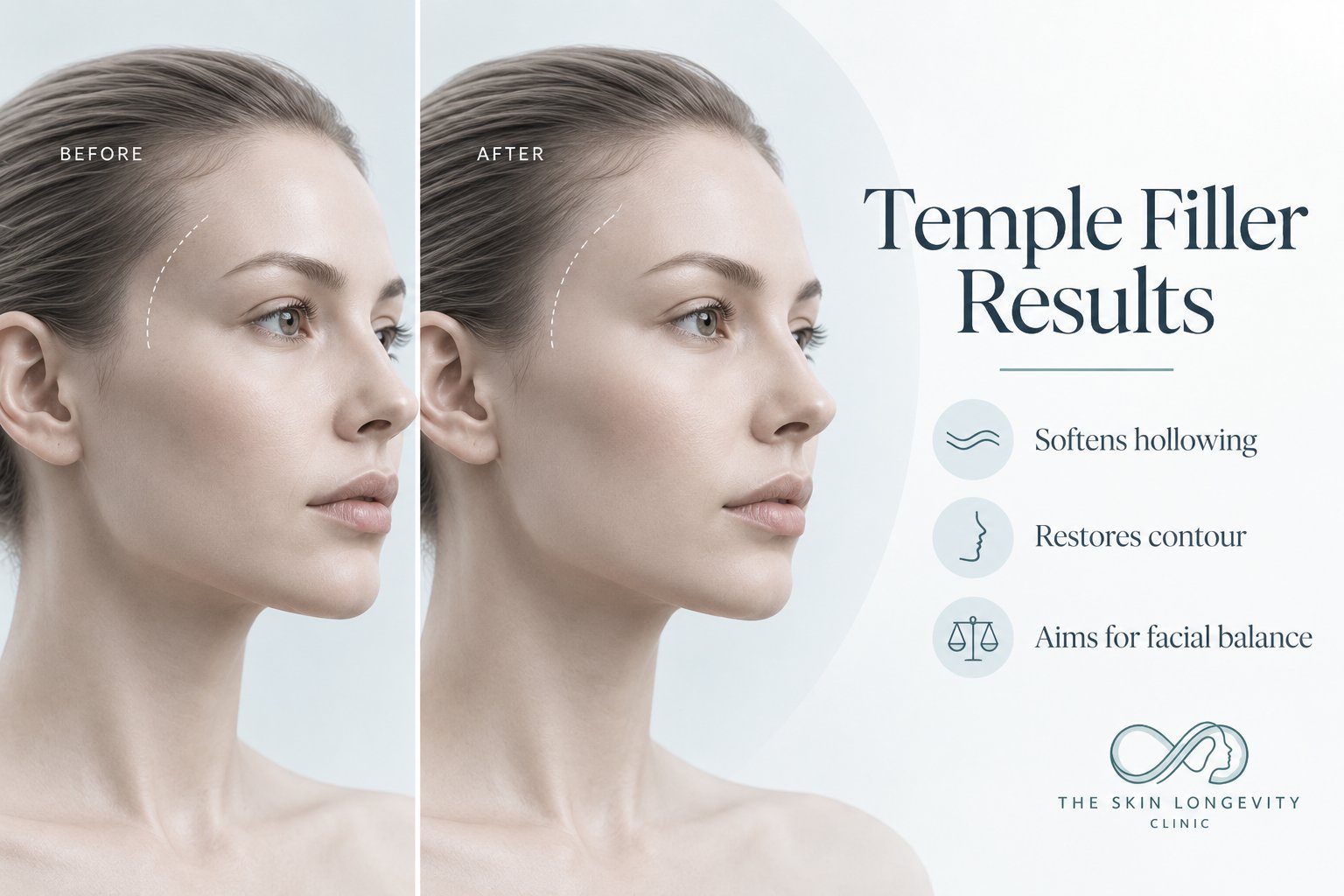
The principal result is a reduction in the depth of the temple hollow.1 In a randomised trial, 80.4 percent of treated participants achieved an improvement of at least one grade in both temples at three months, compared with 13.5 percent of untreated participants.1 These findings apply to the particular hyaluronic acid filler and treatment protocol studied, rather than guaranteeing the same outcome with every injectable.1
The treatment goal should be agreed before injections begin. A patient seeking a small change in contour may prefer a different degree of correction from someone with more pronounced hollowing, making facial assessment more useful than a standard filler quantity.2
Can temple filler lift the eyebrows or face?
A small retrospective study reported changes in eyebrow position and other facial contours after certain temple injection techniques.6 The effects differed according to the technique, and the study involved only 14 patients.6 These findings support discussing possible changes beyond the temples cautiously, rather than promising a predictable facelift effect.6
A consultation should distinguish correction of temple hollowing from treatment of brow drooping or substantial skin laxity. Our article on natural looking aesthetic treatments in Singapore explains why these concerns may require different treatment choices.
How long does temple filler last?
Published studies of particular hyaluronic acid fillers have documented improvement in temple hollowing at 12 months and at 13 months.15 These follow up results describe the materials and patients studied, rather than a fixed duration for every temple filler treatment.15
A review should assess the remaining correction before further filler is considered. Ask your doctor what change would justify another treatment, rather than assuming that a repeat injection is needed at a predetermined date.
How much filler is needed for the temples?
The amount should be determined by examination of both temples, the extent of hollowing and the intended correction.2 Published treatment studies use individualised quantities, so a figure such as 1 ml should be understood in the context of the proposed plan.25
Ask whether a quoted volume refers to one temple or both sides. The consultation should also clarify whether correction is planned in one appointment or whether reassessment may lead to a later treatment.
For volume ranges, facial balance and cost, see how much temple filler you need.
What happens during temple filler treatment?
Before treatment, the doctor should explain the proposed material, expected changes, alternatives, recovery and important risks.3 The skin is then prepared with an appropriate antiseptic, and filler is placed using a needle or cannula selected for the treatment approach.3
Discomfort can occur during injections, and numbing options should be discussed beforehand.13 Tell the doctor immediately about pain that is severe, unusual or increasing, as this requires assessment rather than being treated as a routine part of the procedure.7
What is recovery like after temple filler?
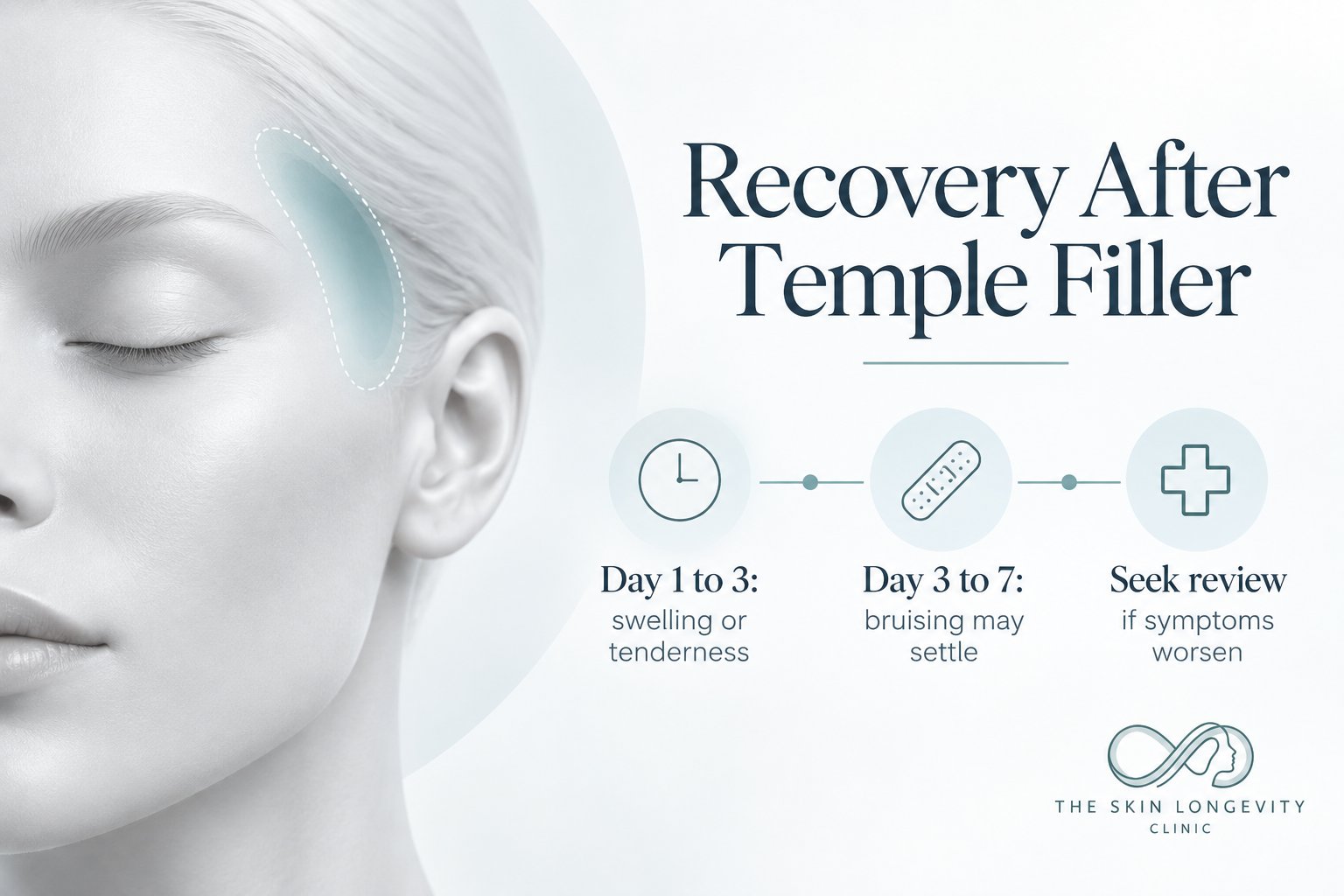
Temporary tenderness, swelling, redness and bruising can occur after treatment.3 In the randomised temple filler trial, most injection site reactions were mild or moderate and resolved within a week, although individual recovery varied.1 Headache and jaw discomfort were also reported.1
Follow the aftercare instructions provided for the particular filler and treatment performed. Published consensus guidance advises avoiding strenuous exercise for 24 hours after hyaluronic acid filler injections to reduce bruising and swelling.3
Allow recovery time when planning treatment around an important event. Persistent or worsening symptoms should prompt contact with the clinic, while the warning signs below require urgent assessment.
What are the risks of temple filler?

Possible complications include asymmetry, unwanted fullness, persistent lumps, infection and delayed inflammatory reactions.3 These may require assessment and treatment rather than simply waiting for the filler to fade.3
A less common but serious complication is vascular occlusion, where filler obstructs a blood vessel and reduces the blood supply to tissue.7 This can cause skin injury and tissue death, while filler entering vessels connected to the eye can cause permanent vision loss.78 Temple injections are among the sites documented in published reports of filler associated visual complications.8
Careful patient selection, anatomical knowledge and appropriate technique help reduce risk.3 Emergency recognition and management remain essential because precautions cannot eliminate every vascular complication.7
Which symptoms need urgent attention?
**Severe or increasing pain, pale skin or a mottled skin pattern after filler require urgent medical assessment.**7 **Sudden blurred vision or loss of vision is an emergency requiring immediate hospital assessment rather than waiting for a routine clinic review.**8
Can temple filler be dissolved?
Hyaluronic acid filler can be broken down using hyaluronidase when clinically indicated, including for selected complications or unwanted results.9 The response varies with the filler and clinical situation, and repeat treatment may be required.9
**The ability to dissolve filler does not guarantee reversal of every complication.**8 Published ophthalmology evidence shows that treatments for filler associated vision loss are often unsuccessful, so hyaluronidase should never be presented as a guaranteed safeguard against blindness.8
What are the alternatives to hyaluronic acid temple filler?

Poly L lactic acid, or PLLA, is a collagen biostimulator that produces gradual volume improvement through a tissue response around the injected material.10 A randomised trial has demonstrated improvement in temple hollowing with a particular PLLA formulation, although its results should be interpreted according to the formulation and treatment course studied.10
PLLA differs from hyaluronic acid filler in its timing and reversibility, and hyaluronidase cannot dissolve PLLA particles.910 Our guide to PLLA collagen biostimulator treatment in Singapore explains these differences and the considerations involved in choosing a gradual treatment.
Sculptra is the most widely studied PLLA formulation; its clinical-trial safety data were reviewed in 200511.
Fat transfer is another approach to restoring temple volume, with a separate procedural assessment and its own risks.810 Leaving the temples untreated is also a reasonable choice when the concern is minor or the expected benefit does not justify the risks and cost.
How much does temple filler cost in Singapore?
For current temple filler prices at The Skin Longevity Clinic, contact the clinic to discuss an assessment and individual quotation. Ask for the complete proposed cost, including the recommended filler quantity, consultation fees and any review charges.
Clarify whether GST is included and how additional treatment would be charged. Comparing the complete treatment plan is more informative than comparing a price per syringe without knowing what that price covers.
Temple filler assessment at The Skin Longevity Clinic
The Skin Longevity Clinic was founded by Dr Rachel Ho and is located at Scotts Medical Center, 9 Scotts Road, Singapore. Its approach considers facial structure, skin quality, previous treatments and the patient’s goals before a procedure is recommended.
To discuss hollow temples, arrange a consultation with The Skin Longevity Clinic. Use the appointment to clarify the expected change, alternatives, complete cost and follow up arrangements before deciding whether to proceed.
Journal references
-
Montes JR, Hooper D, Jones D, et al. Randomised trial of hyaluronic acid filler for temple hollowing. Plastic and Reconstructive Surgery. 2025;156(1):25e to 36e. PMID: 39808069.
-
Müller DS, Prinz V, Sulovsky M, et al. Study of temple volumisation in younger and older adults. Journal of Cosmetic Dermatology. 2021;20:1634 to 1642. PMID: 33773034.
-
Signorini M, Liew S, Sundaram H, et al. Global Aesthetics Consensus recommendations on avoiding and managing hyaluronic acid filler complications. Plastic and Reconstructive Surgery. 2016;137(6):961e to 971e. PMID: 27219265.
-
Trivedi MK, Kroumpouzos G, Murase JE. A review of the safety of cosmetic procedures during pregnancy and lactation. International Journal of Women’s Dermatology. 2017;3(1):6 to 10. PMID: 28492048.
-
Guo Y, Li P, Wei W, et al. Safety and efficacy of the amino acid crosslinked hyaluronic acid in the treatment of temple hollowing. Asian Journal of Surgery. Published online 13 November 2024. PMID: 39542772.
-
Casabona G, Frank K, Moellhoff N, et al. Study of facial effects following temporal volumising and lifting techniques. Journal of Cosmetic Dermatology. 2020;19(11):2830 to 2837. PMID: 32946624.
-
Murray G, Convery C, Walker L, Davies E. Guidance on identifying and managing vascular occlusion caused by hyaluronic acid filler. Journal of Clinical and Aesthetic Dermatology. 2021;14(5):E61 to E69. PMID: 34188752.
-
Foster J, Aakalu VK, Freitag SK, et al. American Academy of Ophthalmology report on visual complications of soft tissue fillers. Ophthalmology. 2025;132(8):935 to 944. PMID: 40167411.
-
Murray G, et al. Guidance on the safe use of hyaluronidase in aesthetic medicine. Journal of Clinical and Aesthetic Dermatology. 2021;14(8). PMID: 34840662.
-
Chang G, Tan Z, Ting W, et al. Randomised controlled study of PLLA filler for temporal augmentation. Aesthetic Surgery Journal. 2026;46(6):652 to 662. DOI: 10.1093/asj/sjag013.
-
Engelhard P, Humble G, Mest D. Safety of Sculptra: a review of clinical trial data. Journal of Cosmetic and Laser Therapy. 2005;7(3–4):201–205. PMID 16414909.