

19 Sep Acne and a Damaged Skin Barrier: How to Manage Both
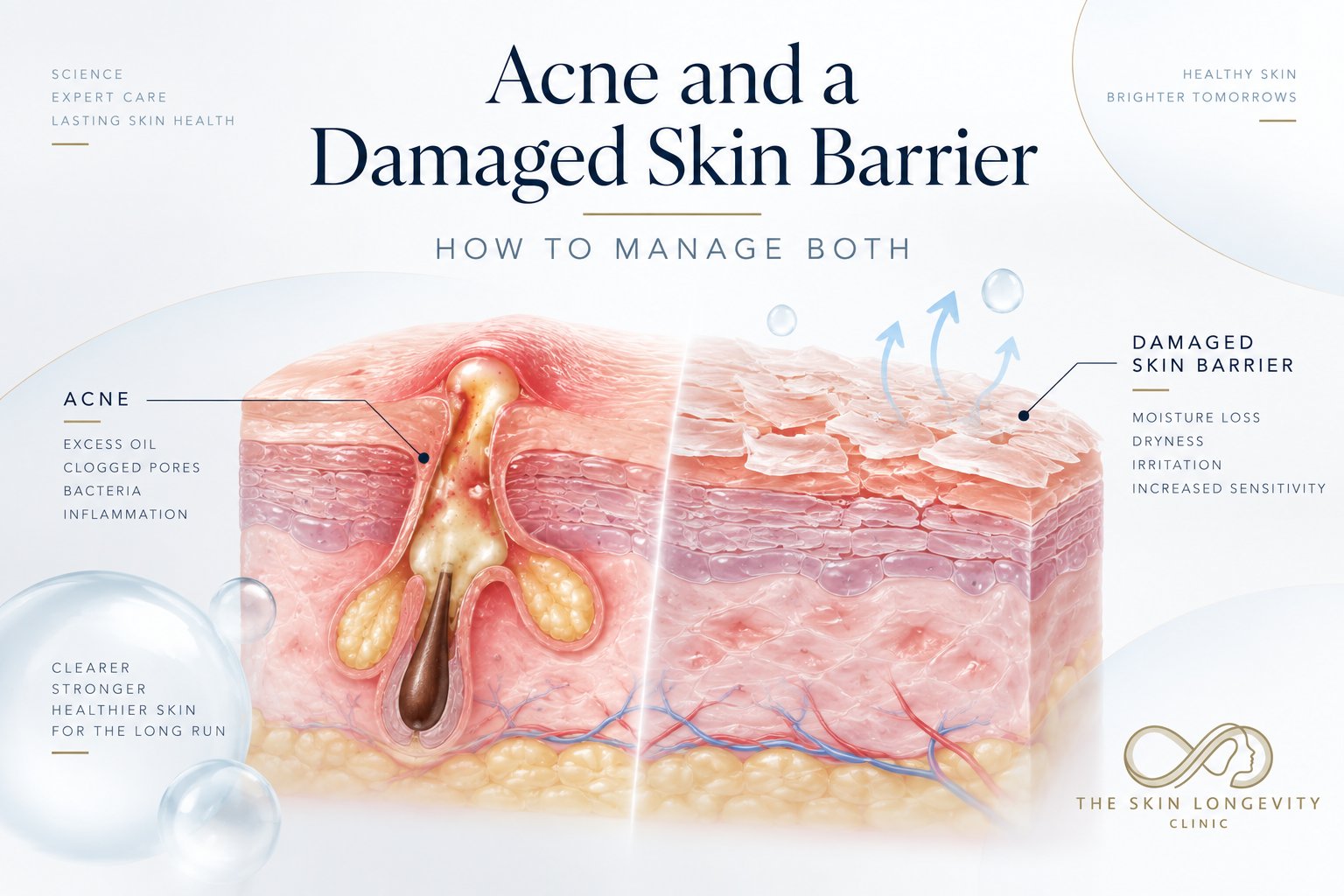
Acne and an impaired skin barrier can occur together, including in oily skin1,2. Managing both involves controlling breakouts while reducing irritation through suitable skincare and adjustments to treatment where needed3,4.
New spots alongside tightness, flaking or soreness can make it difficult to decide what to use. The next step is to review the whole routine and the skin findings, rather than choose between treating the acne and looking after the barrier.
This guide explains cleanser and moisturiser choices, how acne medicines can be adjusted, and where treatments such as LDM ultrasound and LED light may be considered. The aim is a plan that addresses inflammation while remaining comfortable enough to maintain.
Can oily skin have a damaged skin barrier?
Oil production and barrier function describe different aspects of the skin2. The outermost layer, called the stratum corneum, helps retain moisture through its organised arrangement of cells and lipids1.
A 2024 study involving 316 adults in Thailand found higher water loss through the skin in participants with acne, despite higher oil measurements2. This was an observational study, so it demonstrates an association rather than establishing why each person developed barrier changes2.
Surface shine therefore gives an incomplete picture of skin condition. Dr Rachel Ho’s skin barrier repair guide explains the structure and the roles of different moisturising ingredients.
Is it acne, irritation or a reaction to skincare?
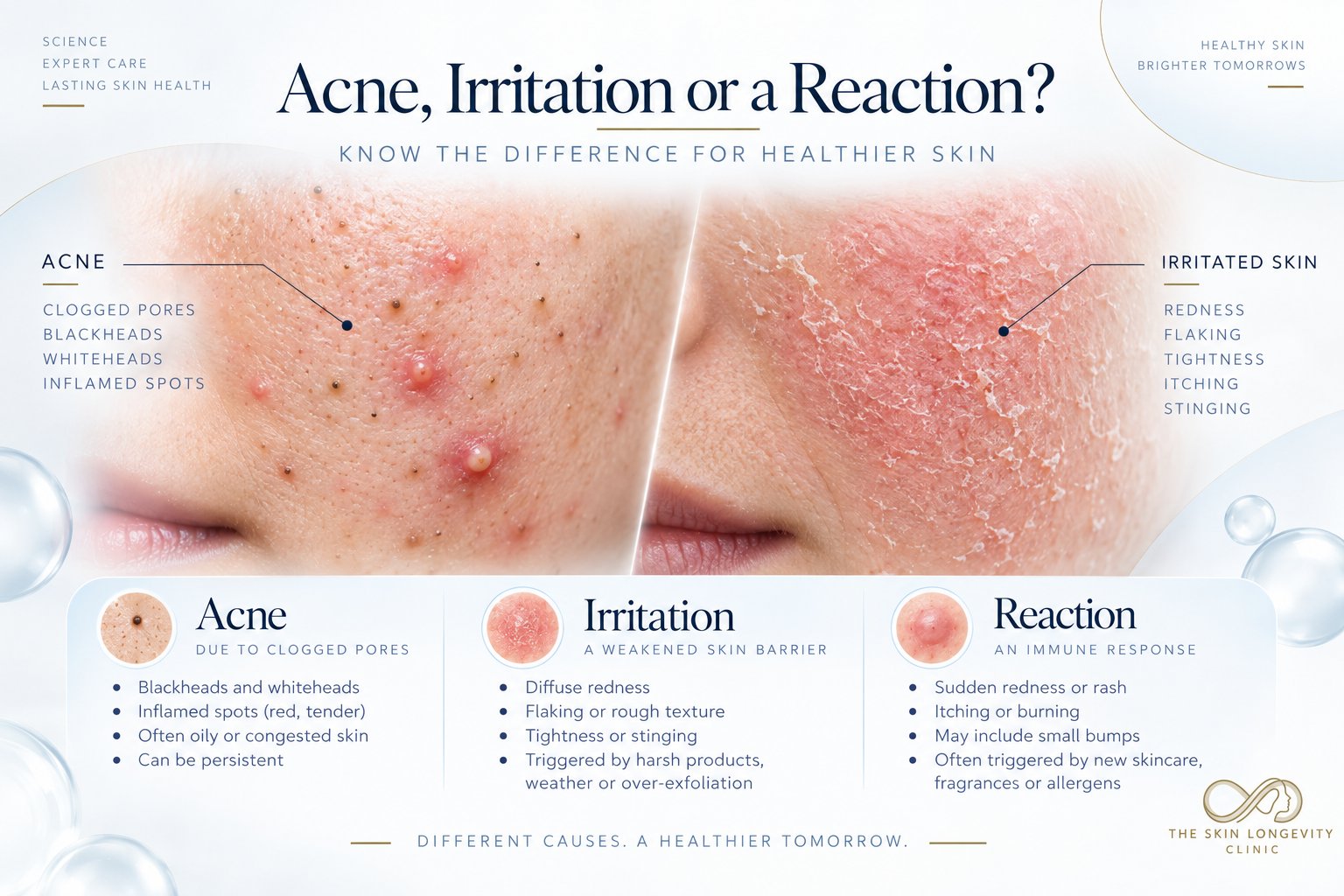
Acne can produce blackheads, whiteheads, inflamed spots and deeper nodules7. Irritant dermatitis more often involves burning, tightness, redness and scaling, sometimes extending across areas between the pimples5.
| What you notice | What needs consideration |
|---|---|
| Blackheads, whiteheads and recurring inflamed spots | Ongoing acne activity7. |
| Stinging, tightness or flaking after applying products | Irritation related to the formulation, frequency or combination of products4,5. |
| A persistent itchy rash, swelling or weeping | Dermatitis or another reaction requiring assessment5. |
These findings can overlap, so symptoms alone cannot confirm the diagnosis5. An examination and a review of recent product changes help establish which concerns need treatment.
Persistent burning deserves attention rather than being accepted as evidence that a product is working. Our skin allergy assessment guide explains why recurring reactions may need further investigation.
Should I stop acne treatment when my skin becomes irritated?
Mild dryness may improve with adjustments to treatment, while significant burning, swelling or raw skin warrants review before further application4,5. The response should reflect the severity of the reaction and the medicine involved.
Set aside unnecessary cosmetic exfoliants, scrubs and recently introduced products that may be contributing to irritation5. Keep a record of what has changed so the response is easier to assess.
For prescribed topical treatment, discuss whether a lower application frequency, another formulation or a temporary pause is appropriate3,4. Some medicines can be introduced gradually or used with a shorter contact time under the prescriber’s instructions4.
Stop applying a product that causes a significant reaction and contact the treating clinician5. A simpler routine can then be agreed while the cause is assessed.
Which cleanser is suitable for acne and a damaged skin barrier?
A mild cleanser is often a useful starting point when a separate acne medicine already provides the active treatment3. Traditional alkaline soaps and harsh cleansing can affect skin proteins and lipids, while appropriately formulated syndet cleansers can cleanse with less disruption6.
Foaming alone does not determine whether a cleanser is harsh. Surfactant selection and the complete formulation matter alongside pH6.
Use lukewarm water and your fingertips, leaving scrubs, cleansing brushes and rough cloths out of the routine6. Review whether repeated washing or several cleansing steps are necessary for the products you wear.
A cleanser should leave the skin reasonably comfortable afterwards. Persistent tightness or burning is a reason to reconsider both the product and cleansing frequency.
Which moisturiser should I use for acne prone, irritated skin?
Choose a moisturiser that supports hydration and is comfortable to use alongside acne treatment3. A noncomedogenic formulation is a reasonable starting point, with texture selected according to the skin condition and personal tolerance3.
Humectants such as glycerin and hyaluronic acid help retain water, while ingredients such as dimethicone and petrolatum reduce moisture loss1. Ceramides and other lipids may also be included to support the outer barrier1.
The complete formulation matters more than a single ingredient. Check whether the moisturiser also contains exfoliating acids or other acne ingredients that duplicate products already in the routine.
Does moisturiser interfere with acne treatment?
A randomised trial involving 120 patients compared adapalene alone with adapalene used alongside either a studied moisturiser or its vehicle8. Over eight weeks, the studied moisturiser reduced irritation without interfering with adapalene’s acne efficacy8.
This supports using appropriate moisturising care alongside acne medication rather than avoiding it because the skin is oily8. The findings concern the preparation studied, while individual product selection still depends on tolerance.
Can ceramides and niacinamide help?
A 2024 trial involving 40 patients compared a ceramide and niacinamide moisturiser with a hydrophilic cream during acne treatment9. The test preparation produced greater improvement in acne lesions, although differences between the two sides in measured barrier function were not statistically significant9.
A ceramide or niacinamide moisturiser is therefore one option within the routine. Dr Rachel Ho’s ceramide skincare review explains why the finished formulation matters alongside its ingredients.
A simple routine while acne and irritation are being managed
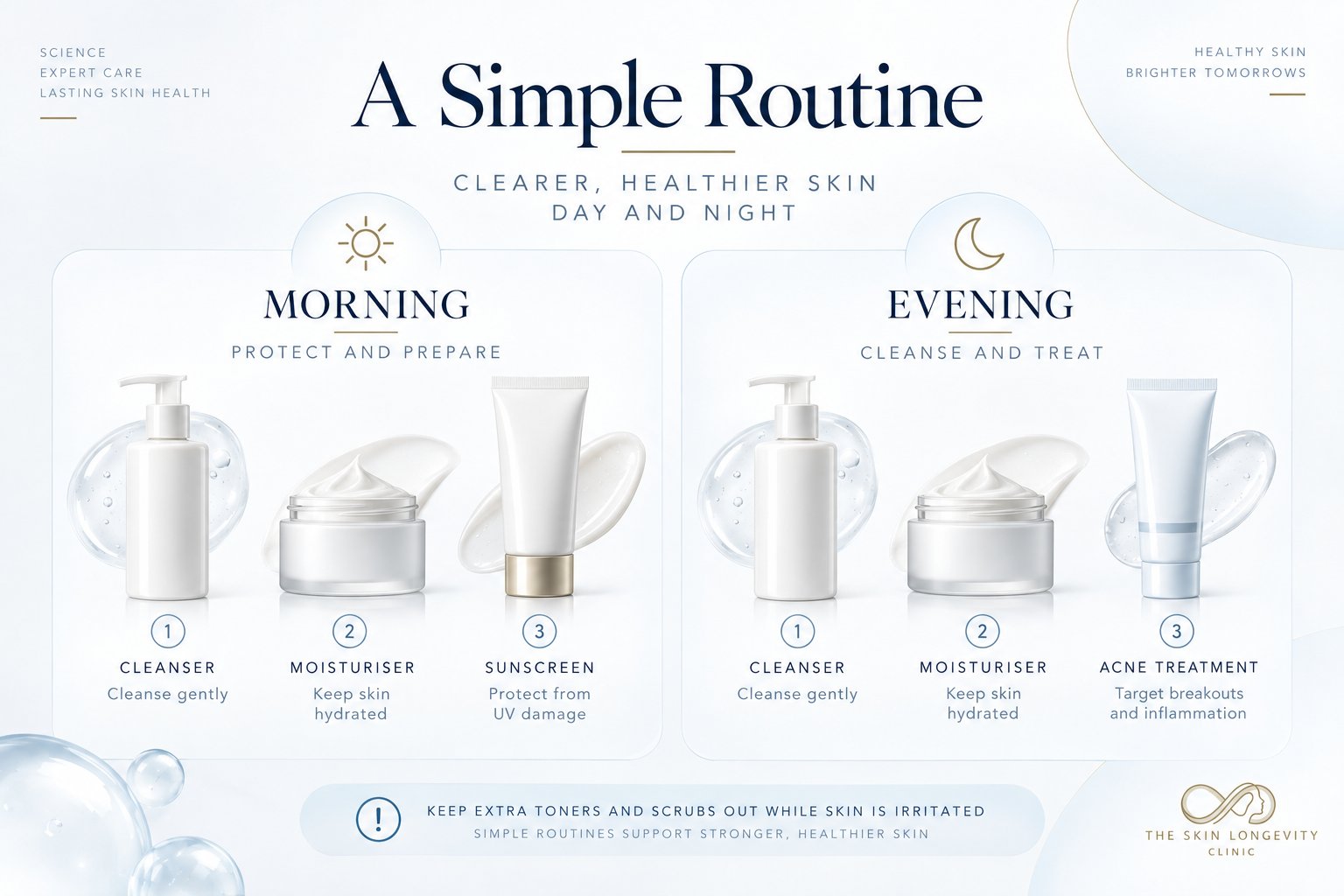
Singapore’s acne guidelines include suitable cleansing, moisturising and sun protection alongside medical treatment3. Keep the routine clear enough to distinguish the acne medicine from the products supporting comfort.
| Time | Practical routine |
|---|---|
| Morning | Gentle cleansing, a suitable moisturiser and broad spectrum sunscreen3. Include morning acne medication only as directed. |
| Evening | Gentle cleansing and the agreed moisturiser and acne treatment3. Follow the prescribed amount, application area and schedule. |
Additional toners, exfoliating masks and several serums can be left out while the routine is being reviewed. A written schedule is useful when different products are used on different evenings.
For patients in Singapore, consider how the routine fits around commuting, exercise and time indoors. Choose products that can be applied consistently, rather than a complicated regimen that becomes difficult to maintain.
Which acne medicines may need adjusting?
Topical retinoids and benzoyl peroxide are established acne treatments, often combined to address different aspects of the condition7. Both can cause irritation, particularly during introduction or when layered with other irritating products3.
The prescriber may adjust frequency, formulation or the supporting skincare while retaining appropriate acne control3,4. Applying more medicine than directed can increase irritation rather than make the treatment work faster3.
Azelaic acid is another recognised topical option, including for selected patients with acne and residual pigmentation7. More extensive or persistent inflammatory acne may require a broader medical plan rather than repeated changes between cosmetic products7.
Our acne assessment and treatment guide explains how severity and previous response influence these decisions. Mention pregnancy or plans to conceive because this changes the suitability of some medicines3.
Can LDM and LED light help calm acne prone skin?
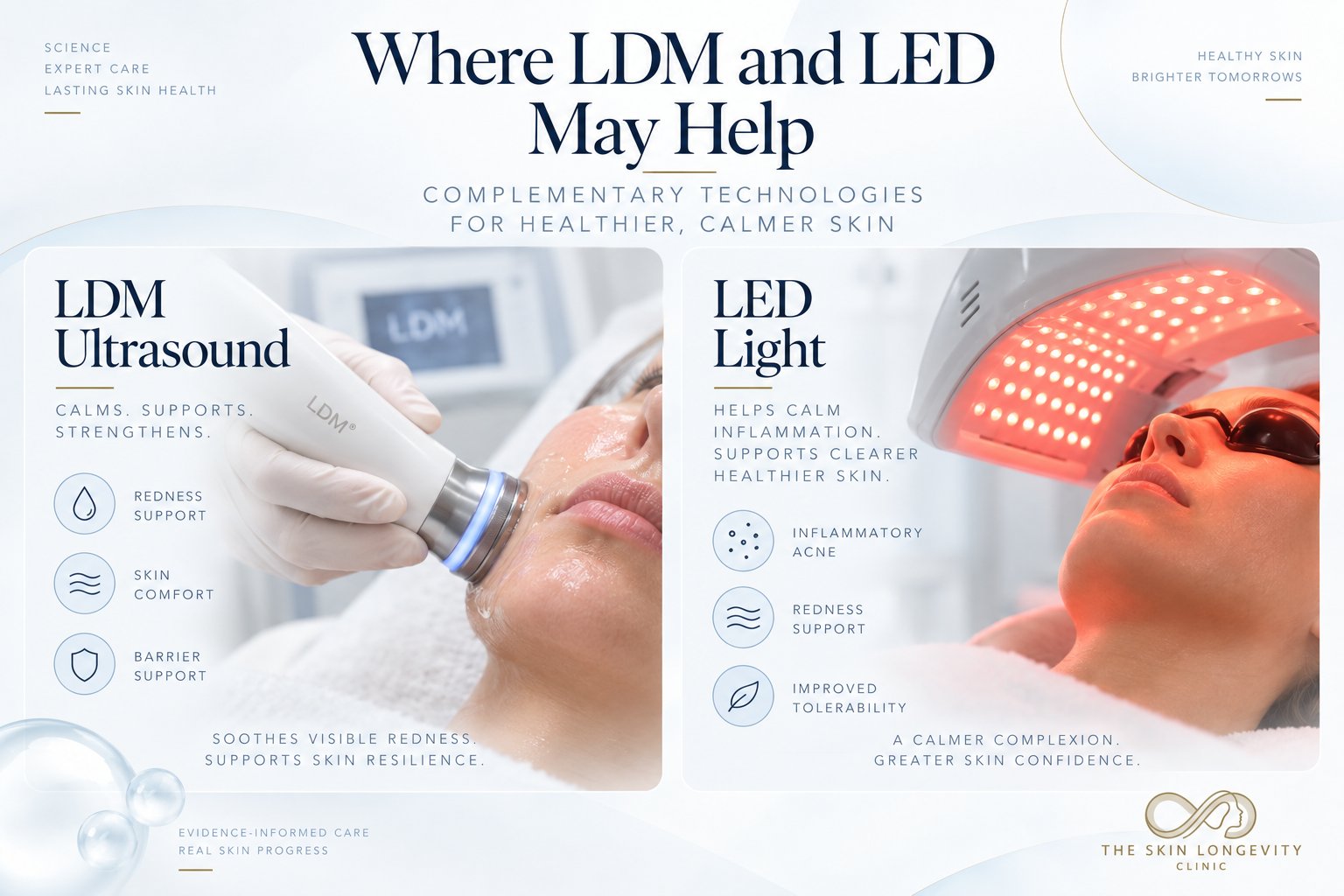
Selected ultrasound and LED treatments may be considered alongside skincare and medical treatment when redness, sensitivity or inflammatory acne remains troublesome11,12,13,14. Their role depends on the concern being treated, with hydration, redness and acne lesions assessed as separate outcomes.
The first step is to establish whether the discomfort comes from irritated skincare, active acne, dermatitis or another condition. A procedure should have a defined purpose within that plan rather than be added simply because the skin feels sensitive.
LDM ultrasound for redness and skin comfort
LDM, or Local Dynamic Micro Massage, uses rapidly alternating ultrasound frequencies applied through a handpiece on the skin12. It provides mechanical stimulation without the needle punctures used in microneedling12.
A 2021 study enrolled 26 people with facial redness associated with acne or rosacea and evaluated a related dual frequency ultrasound treatment11. Following weekly treatment over four weeks, researchers reported reduced redness and lower transepidermal water loss at the six week assessment11.
These findings are relevant to the discussion of ultrasound for redness and hydration support. A separate retrospective study of 22 patients also reported improvement in acne severity after treatment with specific triple frequency ultrasound protocols12.
LDM may be discussed when the treatment goal includes supporting skin comfort alongside acne care. The published studies used particular equipment and settings, so the proposed protocol should be considered on its own evidence rather than assumed to reproduce every ultrasound result11,12.
Our LDM ultrasound facial guide explains the treatment process. The consultation should clarify whether the intended benefit concerns redness, dryness, active acne or a combination of these concerns.
LED light for acne related inflammation
LED light treatment uses selected wavelengths of light, with different programmes studied for different skin concerns13,14. For inflammatory acne, red or combined blue and red approaches may help reduce lesion counts13.
A 2025 systematic review of six trials involving 216 participants found improvements in acne with selected home or portable LED devices compared with controls13. The studies included mild to moderate acne and used different wavelengths, treatment schedules and exposure settings13.
These results support a role for selected LED approaches in acne care, rather than establishing that every light programme provides the same benefit13. When the skin is also sensitive, the treatment discussion should consider comfort and tolerability as well as lesion improvement.
LED light for sensitive skin and redness
Research has also examined LED treatment specifically for sensitive skin14. A 2026 randomised trial involving 30 participants compared moisturiser alone with programmes using yellow light at 590 nm or combined yellow and red light at 590 and 630 nm14.
Both LED groups showed greater improvement in sensitive skin symptom scores than the control group14. The yellow light group also showed improvements in measured redness and water loss through the skin14.
The wavelength and treatment settings matter when describing LED as a calming treatment. These sensitive skin findings relate to the studied programmes rather than proving that an acne light protocol will treat every form of irritation14.
Read our LED light treatment guide for more about treatment selection. Share any history of light sensitivity and the medicines you use, and follow the eye protection instructions provided15.
How are LDM and LED incorporated into the treatment plan?
The plan should identify which concern each treatment addresses. For example, adjusting an irritating topical routine and considering a procedure for persistent acne related redness involve different decisions.
Suitable moisturising and necessary medical treatment continue to provide the foundation of care3,7. Adding a procedure should come with a clear review point, rather than an assumption that both LDM and LED are needed for everyone.
Treatment response can be assessed through changes in redness, discomfort, new acne lesions and the ability to tolerate the routine. Discuss persistent warmth, stinging or worsening symptoms during treatment so the approach can be reassessed.
What if eczema is contributing to the discomfort?
An examination may identify eczema alongside acne, in which case moisturiser alone may leave the inflammation insufficiently treated10. Appropriate topical corticosteroids or calcineurin inhibitors may be prescribed according to the affected area and clinical findings10.
These medicines serve a different purpose from acne treatment. LDM or LED should be considered separately from the prescribed treatment needed for an eczema flare.
The clinic’s damaged skin barrier guide explains the broader assessment of persistent dryness, redness and sensitivity. A recurring rash deserves that review before another facial treatment or product is added.
When can I restart retinoids, acids and other active skincare?
Restarting should follow the condition of the skin and the purpose of the product. Prescribed acne treatment may need a carefully adjusted schedule, while optional exfoliants can wait until the basic routine is comfortable4.
Agree on which product to reintroduce first and how often to apply it. Introducing one change at a time makes the response easier to interpret than returning immediately to the full previous routine.
Continue suitable moisturising during this process3. Persistent burning, scaling or rash is a reason to review the plan rather than increase exfoliation.
How long does improvement take?
Acne improvement commonly takes six to eight weeks to become noticeable, with treatment usually reviewed over a longer period4. Irritation follows a different course, influenced by continued exposure and whether dermatitis remains active5.
Assess both the frequency of new spots and how comfortably the routine can be used. Contact the clinician sooner when symptoms are worsening or treatment becomes difficult to tolerate, rather than waiting for the planned review.
LDM and LED schedules also vary according to the treatment goal and protocol11,13,14. The review should consider the response so far before deciding whether further sessions are worthwhile.
When should I seek medical advice?
Arrange an assessment for deep or painful acne, developing scars or persistent symptoms despite an appropriately used routine7. Significant swelling, blistering, weeping or a recurring rash also warrants medical review5.
For a consultation at The Skin Longevity Clinic in Singapore, bring your skincare products or photographs of their labels, medication details and a brief symptom timeline. This helps distinguish the treatment needed for active acne from the care needed for irritation.
Managing acne and skin comfort together
A useful plan leaves you clear about what to apply, what to pause and when the response will be reviewed. Skincare, medicines and selected clinic treatments should each have an identifiable role.
The goal is fewer breakouts and a routine that remains comfortable to maintain. LDM and LED can be discussed where appropriate, while the underlying acne and any accompanying dermatitis continue to receive attention.
References
-
Rajkumar J, Chandan N, Lio P, Shi V. The Skin Barrier and Moisturization: Function, Disruption, and Mechanisms of Repair. Skin Pharmacology and Physiology. 2023;36(4):174 to 185. doi:10.1159/000534136. PubMed
-
Sukanjanapong S, Ploydaeng M, Wattanakrai P. Skin Barrier Parameters in Acne Vulgaris versus Normal Controls: A Cross Sectional Analytic Study. Clinical, Cosmetic and Investigational Dermatology. 2024;17:2427 to 2436. doi:10.2147/CCID.S476004. PubMed Central (PMC)
-
Oon HH, Wong SN, Aw DCW, Cheong WK, Goh CL, Tan HH. Acne Management Guidelines by the Dermatological Society of Singapore. Journal of Clinical and Aesthetic Dermatology. 2019;12(7):34 to 50. PubMed
-
Santer M, Burden Teh E, Ravenscroft J. Managing acne vulgaris: an update. Drug and Therapeutics Bulletin. 2024;62(1):6 to 10. doi:10.1136/dtb.2023.000051. PubMed
-
Patel K, Nixon R. Irritant Contact Dermatitis: A Review. Current Dermatology Reports. 2022;11(2):41 to 51. doi:10.1007/s13671-021-00351-4. PubMed Central (PMC)
-
Mijaljica D, Spada F, Harrison IP. Skin Cleansing without or with Compromise: Soaps and Syndets. Molecules. 2022;27(6):2010. doi:10.3390/molecules27062010. PubMed
-
Reynolds RV, Yeung H, Cheng CE, et al. Guidelines of care for the management of acne vulgaris. Journal of the American Academy of Dermatology. 2024;90(5):1006.e1 to 1006.e30. doi:10.1016/j.jaad.2023.12.017. PubMed
-
Chularojanamontri L, Tuchinda P, Kulthanan K, Varothai S, Winayanuwattikun W. A double blinded, randomized, vehicle controlled study to access skin tolerability and efficacy of an anti inflammatory moisturizer in treatment of acne with 0.1% adapalene gel. Journal of Dermatological Treatment. 2016;27(2):140 to 145. doi:10.3109/09546634.2015.1079298. PubMed
-
Tempark T, Shem A, Lueangarun S. Efficacy of ceramides and niacinamide containing moisturizer versus hydrophilic cream in combination with topical anti acne treatment in mild to moderate acne vulgaris: A split face, double blinded, randomized controlled trial. Journal of Cosmetic Dermatology. 2024;23(5):1758 to 1765. doi:10.1111/jocd.16212. PubMed
-
Sidbury R, Alikhan A, Bercovitch L, et al. Guidelines of care for the management of atopic dermatitis in adults with topical therapies. Journal of the American Academy of Dermatology. 2023;89(1):e1 to e20. doi:10.1016/j.jaad.2022.12.029. PubMed
-
Kim YJ, Moon IJ, Lee HW, et al. The Efficacy and Safety of Dual Frequency Ultrasound for Improving Skin Hydration and Erythema in Patients with Rosacea and Acne. Journal of Clinical Medicine. 2021;10(4):834. doi:10.3390/jcm10040834. PubMed
-
Chervinskaya IG, Gaidash NV, Kruglikov IL. A Retrospective Pragmatic Two Center Clinical Study to Evaluate the Clinical Outcome of Triple Frequency Ultrasound in the Treatment of Mild to Severe Acne Vulgaris. Journal of Cosmetic Dermatology. 2025;24(2):e16672. doi:10.1111/jocd.16672. PubMed
-
Ershadi S, Barbieri JS. At Home LED Devices for the Treatment of Acne Vulgaris: A Systematic Review and Meta Analysis. JAMA Dermatology. 2025;161(5):552 to 555. doi:10.1001/jamadermatol.2025.0019. JAMA Network
-
He X, He M, Wang X, Zhang C, Jin S. Efficacy and Safety of 590 Nm and 590/630 Nm Light Emitting Diode Therapy for Sensitive Skin: A Prospective Randomized Controlled Trial. Photodermatology, Photoimmunology & Photomedicine. 2026;42(3):e70090. doi:10.1111/phpp.70090. Wiley Online Library
-
American Academy of Dermatology. Is red light therapy right for your skin? Patient guidance on treatment suitability, photosensitivity and eye protection. aad.org