


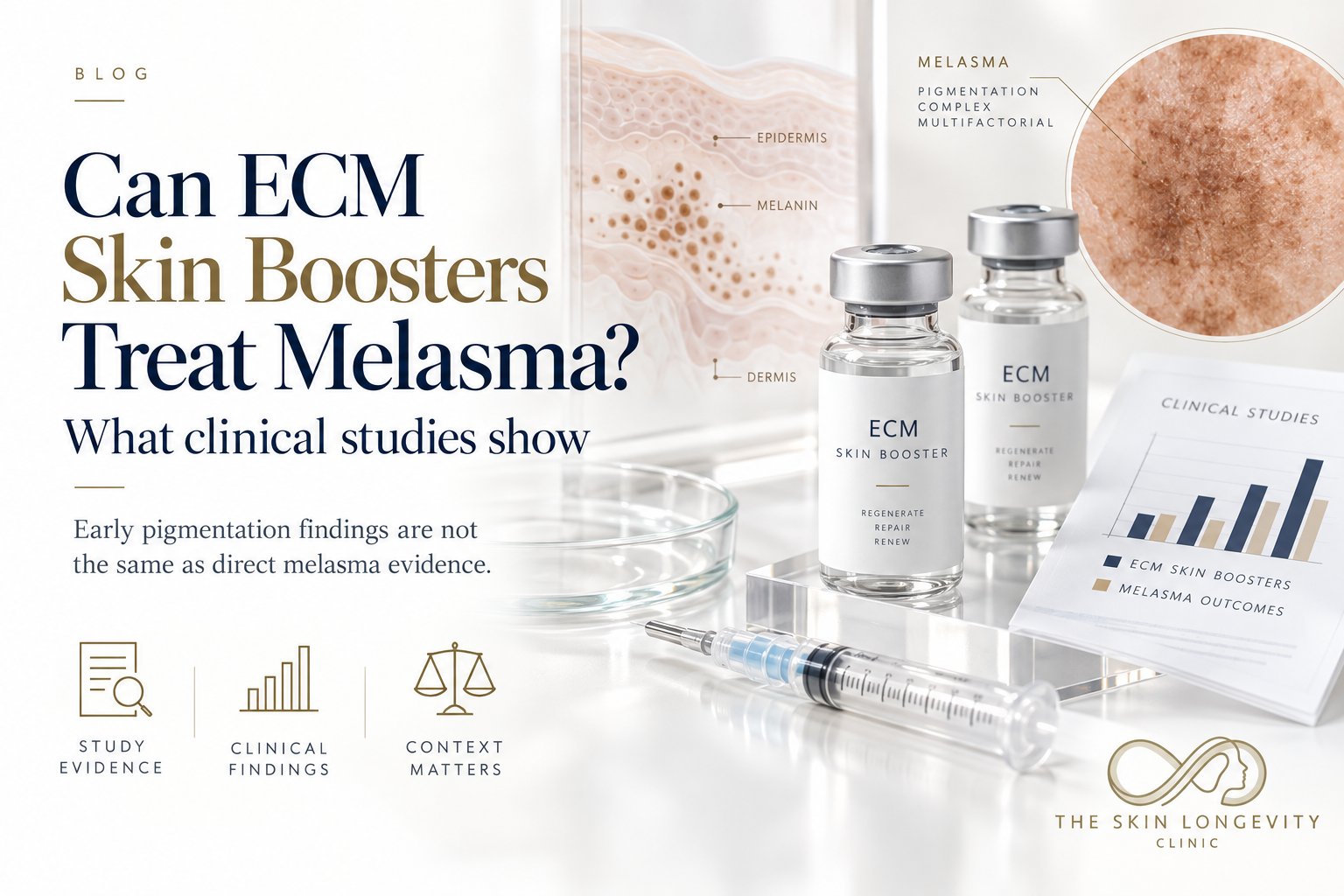
19 Sep Can ECM Skin Boosters Treat Melasma? What Clinical Studies Show
You may be considering an ECM skin booster for skin texture while wondering whether it could also fade melasma. When several concerns affect the same area of skin, understanding what a treatment has actually been studied for can make the decision clearer.
ECM skin boosters have preliminary pigmentation findings, rather than established evidence for treating diagnosed melasma1. A newer study investigated melasma directly using recombinant collagen, which is a different injectable material2.
What are ECM skin boosters?
ECM stands for extracellular matrix, the network of structural proteins and other molecules surrounding cells3. Some ECM skin boosters contain acellular dermal matrix prepared from donated human skin, processed to remove cellular components while retaining matrix material such as collagen and elastin3. This article focuses on that dermal matrix category.
The broader term skin booster includes preparations with different ingredients and biological effects3. Evidence for one material therefore needs to be considered separately from findings about another3.
For an introduction to the science, read Dr Rachel Ho’s explanation of ECM skin boosters and skin ageing. Our comparison of ECM, hyaluronic acid and other skin boosters provides further context for understanding the categories.
Why is the extracellular matrix relevant to melasma?
Melasma is a recurring pigmentation condition influenced by factors including sunlight, hormones and inherited susceptibility4. Research also describes changes in the dermis, including abnormal elastic tissue associated with accumulated sun exposure in melasma affected skin5.
These findings help explain the interest in studying the tissue surrounding pigment cells, alongside pigment production itself5. However, identifying a structural change in melasma and demonstrating that an injectable successfully treats melasma are separate scientific questions.
What did the ECM clinical trial find?
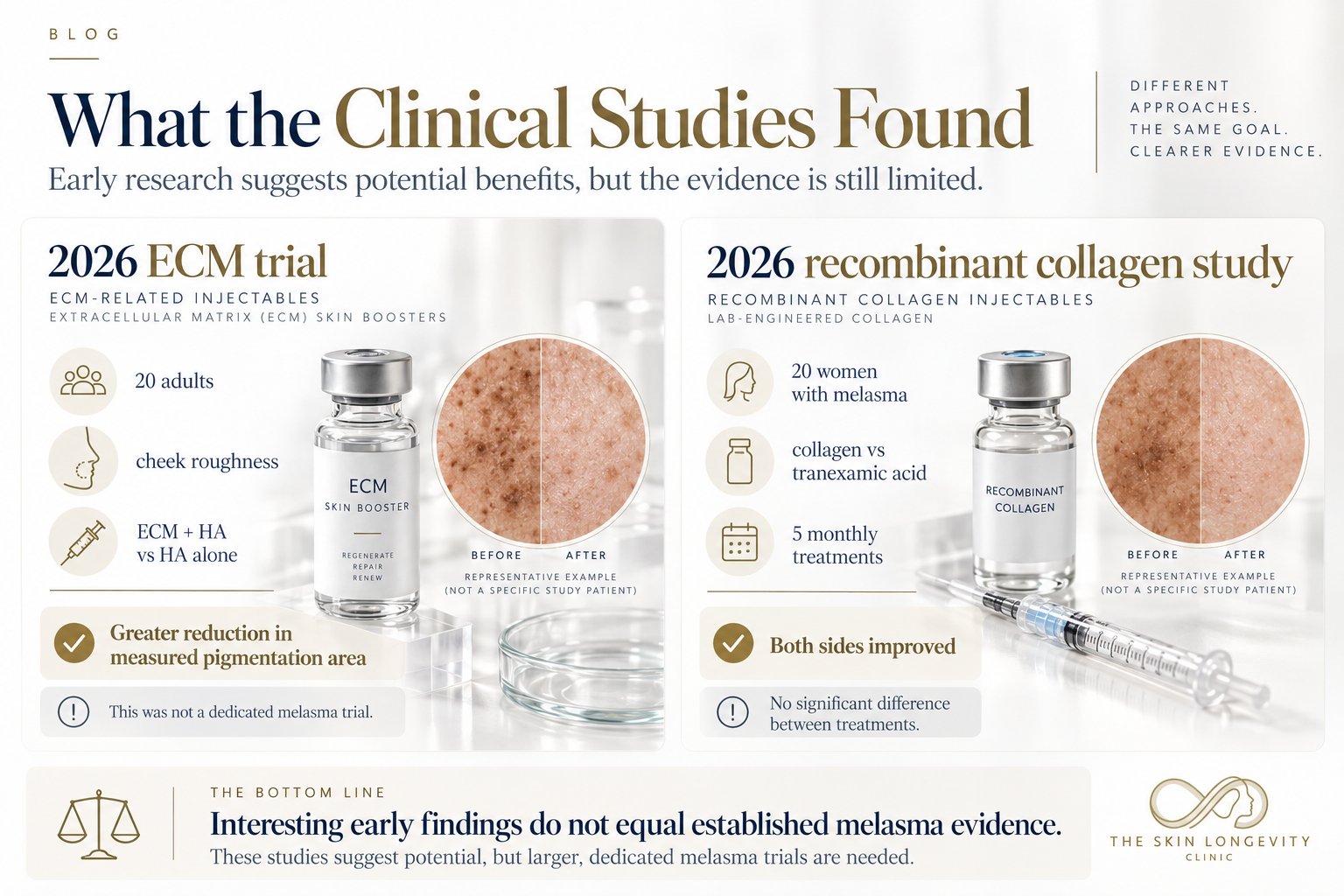
The 2026 study followed 20 adults with cheek roughness for 20 weeks1. Each received dermal matrix mixed with hyaluronic acid on one facial side, and hyaluronic acid alone on the other1.
The matrix formulation produced a greater reduction in measured pigmentation area1. However, participants were selected for cheek roughness, and melasma severity was not assessed using a dedicated melasma score1.
A reduction in general facial pigmentation cannot automatically be interpreted as improvement in melasma. The diagnosis, the outcome being measured and the comparison treatment all affect what a study can establish.
What did the laboratory experiments show?
Separate experiments in the same paper found reduced melanin production and activity of pigment related genes in cultured mouse melanoma cells1. These observations describe a possible mechanism, rather than proving a treatment effect in people with melasma.
Laboratory research is useful for deciding what deserves further investigation. A clinical recommendation requires evidence that the proposed treatment improves the condition patients are seeking help for.
What about the newer collagen study in patients with melasma?
A separate 2026 study enrolled 20 women with melasma and compared recombinant humanized type III collagen injections with tranexamic acid injections on opposite sides of the face2. Participants received five monthly treatments, with follow up extending four months after the course2.
Both sides improved on a melasma severity score, with no statistically significant difference between treatments2. The study was small and had no untreated or placebo side, which limits how confidently the improvement can be attributed to either injection2.
Recombinant collagen and donor derived acellular dermal matrix are different materials2,3. The findings support further investigation of the collagen preparation studied, rather than confirming that ECM skin boosters as a group treat melasma2.
The absence of a statistically significant difference also does not, by itself, prove that two treatments are equivalent. A small comparison study can provide useful preliminary results while leaving important questions about effectiveness and durability unanswered.
What should a convincing melasma study measure?

When reading about a treatment, start with who participated and what improved. Reviews of melasma research assess outcomes such as clinical severity scores, patient reported improvement, quality of life and adverse effects4,6.
| Question to ask | Why it matters |
|---|---|
| Did participants have diagnosed melasma? | Research on general facial pigmentation answers a broader question. |
| Were the patches assessed directly? | Hydration, smoothness and pigmentation are different outcomes. |
| Was there an appropriate comparison? | Sunscreen, skincare and other treatments can influence the result. |
| Was improvement followed over time? | Melasma can recur, so an early improvement is only part of the assessment. |
| Were adverse effects recorded? | Benefits and tolerability need to be evaluated together. |
These questions offer a practical way to interpret treatment claims rather than relying on a description of the mechanism alone. They also help distinguish an interesting early finding from evidence sufficient to guide routine care.
Which treatments have direct evidence for melasma?
Sun protection
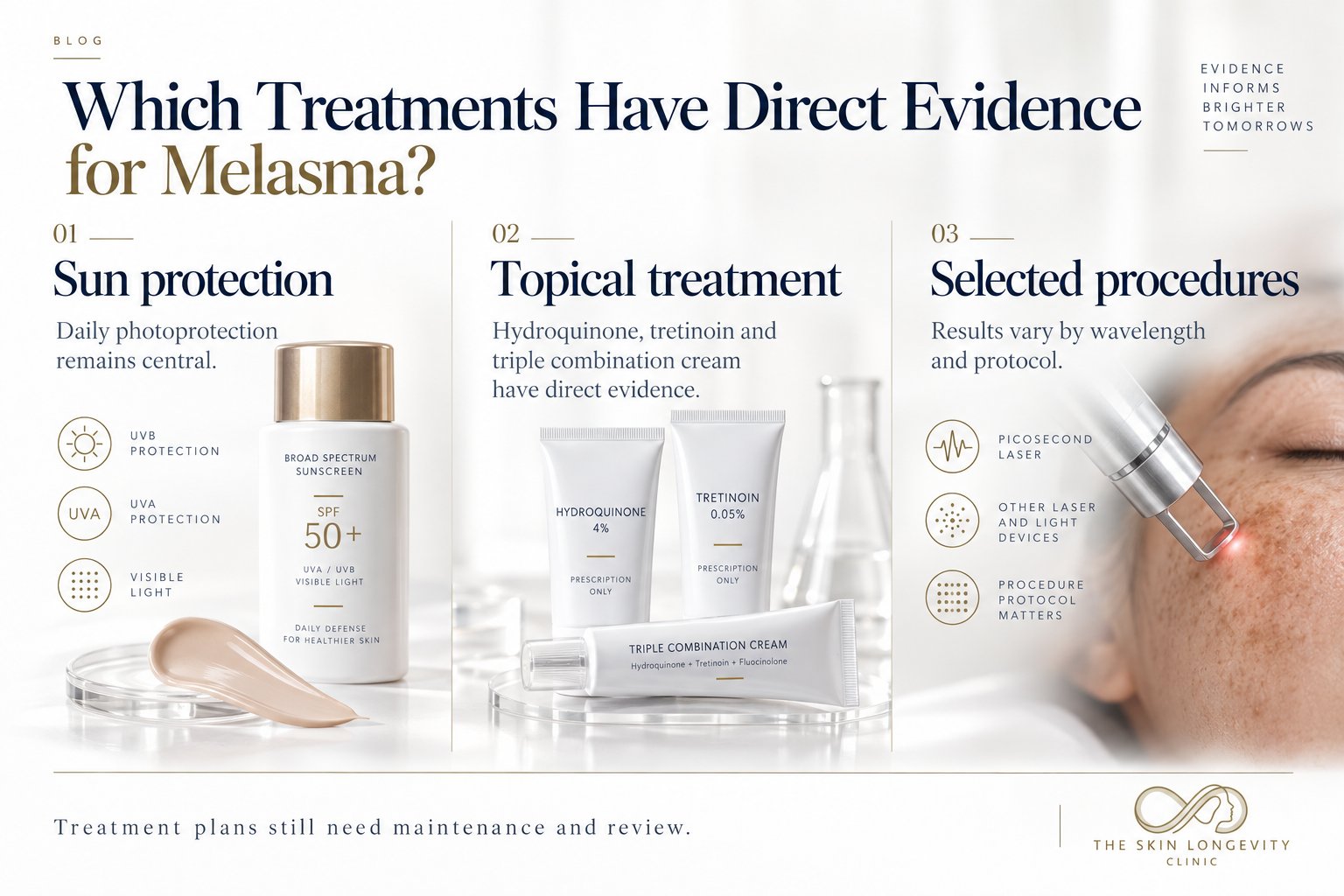
Photoprotection remains central to melasma management, including protection against ultraviolet and visible light4. In a randomised trial, an iron oxide containing sunscreen providing UV and visible light protection improved the response to hydroquinone compared with UV protection alone7.
For daily life in Singapore, consider your commute, outdoor lunches and weekend activities when reviewing your sun protection routine. Our melasma treatment guide explains how photoprotection fits alongside treatment and maintenance.
Topical treatment
A systematic review of 36 randomised studies found evidence that hydroquinone, tretinoin and prescription triple combination cream can lighten melasma6. Treatment choice and duration require individual assessment, including consideration of skin irritation, pregnancy, breastfeeding and previous treatment response4.
Azelaic acid is another topical option discussed in the clinical literature4. The appropriate choice depends on the patient and the treatment plan, rather than whether an injectable is also being considered4.
Selected procedures
Picosecond laser has been studied in patients with melasma, with results varying by wavelength and treatment protocol8. Its potential benefits need to be weighed against adverse effects, including changes in pigmentation, and the continuing need for maintenance4,8.
For a closer look at the research, read Dr Rachel Ho’s pico laser review. It provides context for discussing whether laser is appropriate for a particular pigmentation concern.
Considering an injectable when you also have melasma
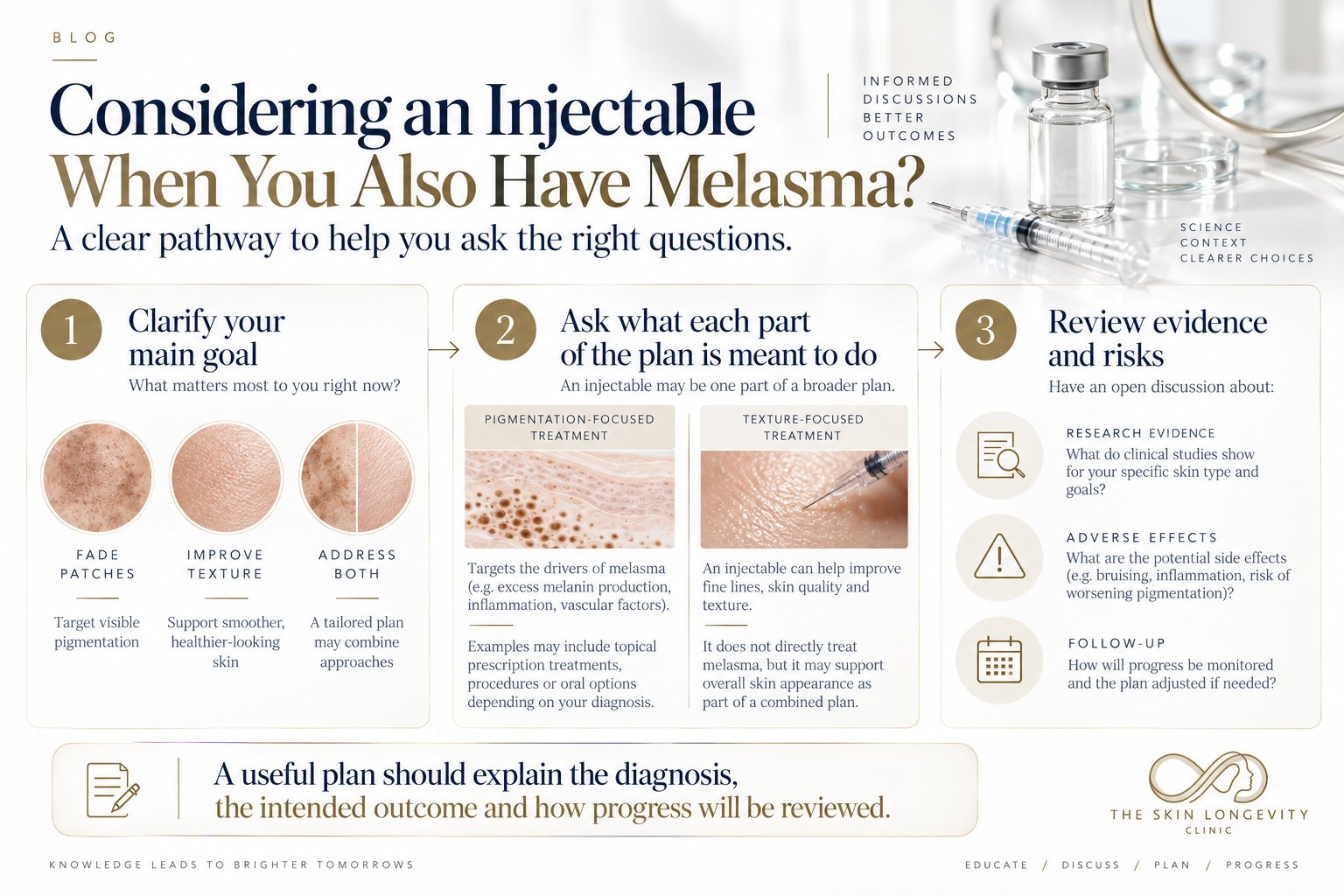
Start by identifying your priorities: fading the patches, improving texture, or addressing both. Ask which part of the proposed plan is intended to address each concern and how improvement will be assessed.
The potential benefits of an injectable also need to be considered alongside its risks. A published case report described a vascular complication following particulated dermal matrix injection; this identifies a possible adverse event, rather than establishing how frequently it occurs9.
Read Dr Rachel Ho’s discussion of ECM skin booster safety and ethics for questions about tissue sourcing, evidence and consent. Bringing details of previous procedures and your current skincare products can also make the consultation more useful.
Making an informed treatment decision
When melasma is your main concern, ask for evidence showing improvement in melasma itself. Research on skin texture, general pigmentation or a different collagen preparation can inform the discussion, but each finding needs to be interpreted within the study that produced it.
A useful treatment plan should explain the diagnosis, the intended outcome and how progress will be reviewed. That clarity matters more than whether a treatment is described as new or regenerative.
References
-
Lee YI, Chau NH, Nguyen NH, et al. Injectable Particulated Human Acellular Dermal Matrix Booster for Skin Restoration: An Integrated Randomized, Split Face, Double Blinded Clinical Trial and Preclinical Study. International Journal of Molecular Sciences. 2026;27(5):2193. doi:10.3390/ijms27052193. MDPI
-
Li W, Li J, Fan H, Cui F, Rang Z. Intradermal Recombinant Humanized Collagen Type III for Melasma: Split Face Randomized Comparison With Tranexamic Acid. Dermatologic Therapy. 2026;2026:2727867. Wiley Online Library
-
Yi KH, Kang H, Song JK, et al. Skin Boosters: 2026 Updated. Journal of Cosmetic Dermatology. 2026:e70875. Wiley Online Library
-
Gan C, Rodrigues M. An Update on New and Existing Treatments for the Management of Melasma. American Journal of Clinical Dermatology. 2024;25(5):717 to 733. Springer Link
-
Kwon SH, Hwang YJ, Lee SK, Park KC. Heterogeneous Pathology of Melasma and Its Clinical Implications. International Journal of Molecular Sciences. 2016;17(6):824. MDPI
-
Pennitz A, Kinberger M, Avila Valle G, Passeron T, Nast A, Werner RN. Self Applied Topical Interventions for Melasma: A Systematic Review and Meta Analysis of Data From Randomized, Investigator Blinded Clinical Trials. British Journal of Dermatology. 2022;187(3):309 to 317. PubMed
-
Castanedo Cazares JP, Hernandez Blanco D, Carlos Ortega B, Fuentes Ahumada C, Torres Álvarez B. Near Visible Light and UV Photoprotection in the Treatment of Melasma: A Double Blind Randomized Trial. Photodermatology, Photoimmunology & Photomedicine. 2014;30(1):35 to 42. PubMed
-
Feng J, Shen S, Song X, Xiang W. Efficacy and Safety of Picosecond Laser for the Treatment of Melasma: A Systematic Review and Meta Analysis. Lasers in Medical Science. 2023;38:84. Springer Link
-
Sung SW, Lee SY, Seok J, Kim BJ. Vascular Complication Following Injection of Particulated Human Acellular Dermal Matrix: A Case Report. Journal of Cosmetic Dermatology. 2026;25:e71049. doi:10.1111/jocd.71049. Wiley Online Library