

29 Sep Postinflammatory Hyperpigmentation: Why Dark Marks Linger and What Helps
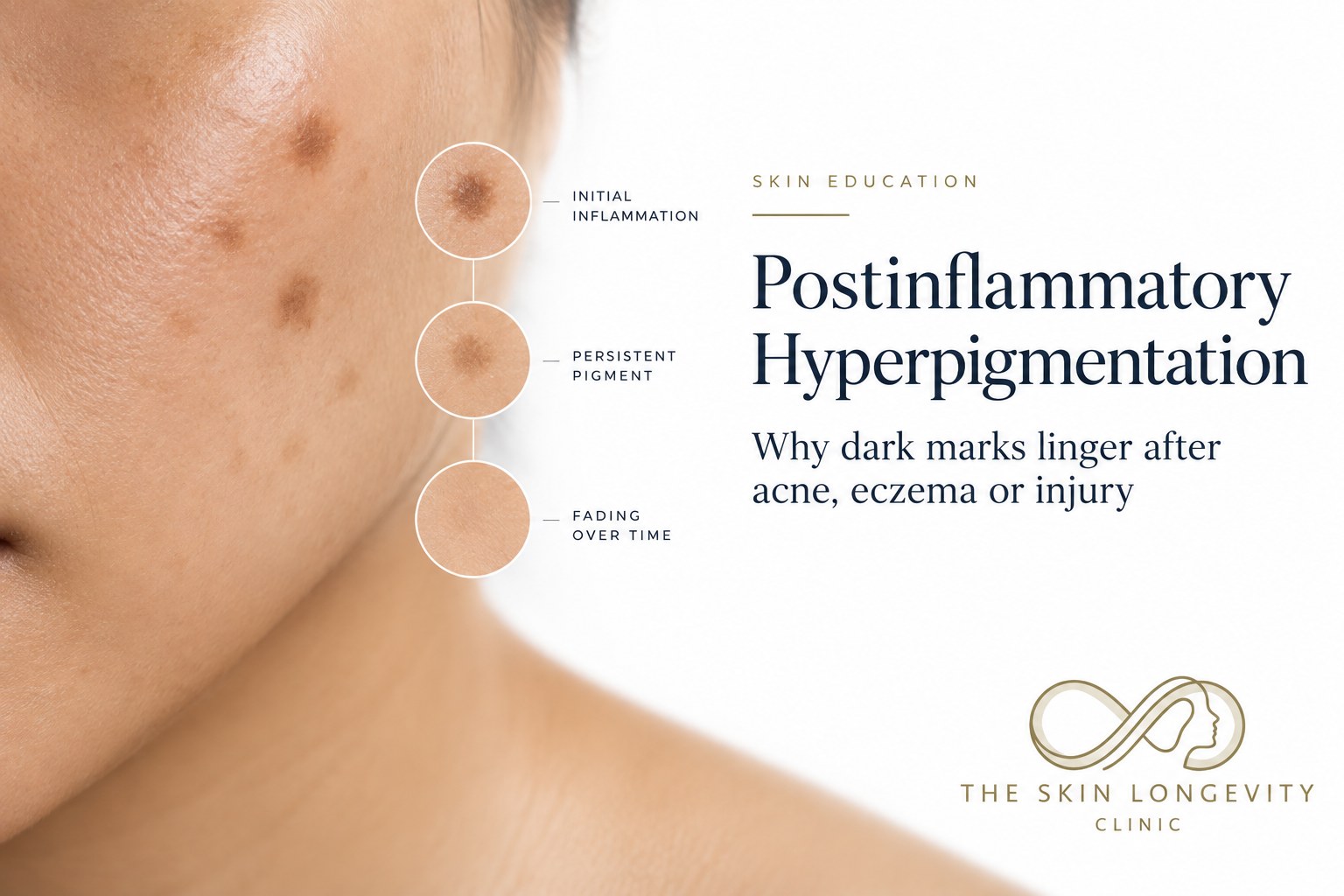
A breakout or patch of eczema can settle while the brown mark remains, making the skin look as though it is still recovering1. This is often postinflammatory hyperpigmentation, or PIH, which develops when inflammation or injury leaves excess pigment in the skin1,2.
PIH can improve with treatment, particularly when the original trigger is controlled3. Understanding why a mark has persisted helps us choose between skincare, a procedure or a combination, with the aim of lighter marks and fewer new ones3.
What is postinflammatory hyperpigmentation?
Postinflammatory hyperpigmentation describes flat brown, grey or darker patches that follow skin inflammation or injury1,2. It can affect the face or body and is often more noticeable and persistent in darker skin tones2.
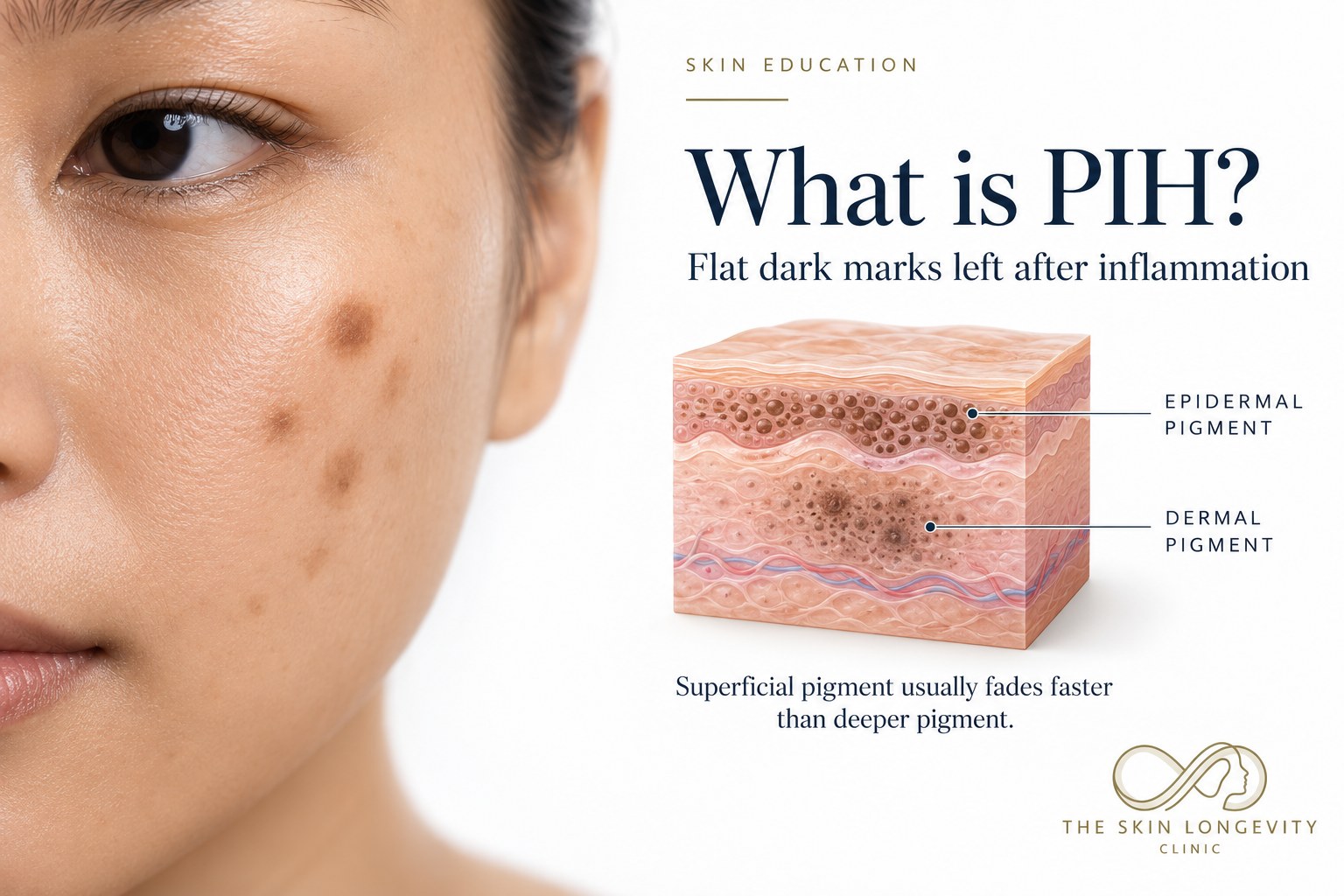
During inflammation, chemical signals stimulate melanocytes, the cells that make melanin2. Pigment can accumulate in the epidermis, while damage around the boundary between the epidermis and dermis can allow melanin to enter the deeper skin, where immune cells called melanophages retain it2.
This difference in depth matters because superficial pigment generally clears more readily than dermal pigment3. A treatment plan should therefore consider the original skin condition, the mark’s colour and its behaviour over time1,3.
What causes PIH after acne, eczema or injury?
The position of a dark mark often corresponds to where the original inflammation occurred2. The history below helps distinguish ongoing skin disease from pigmentation left after recovery1.
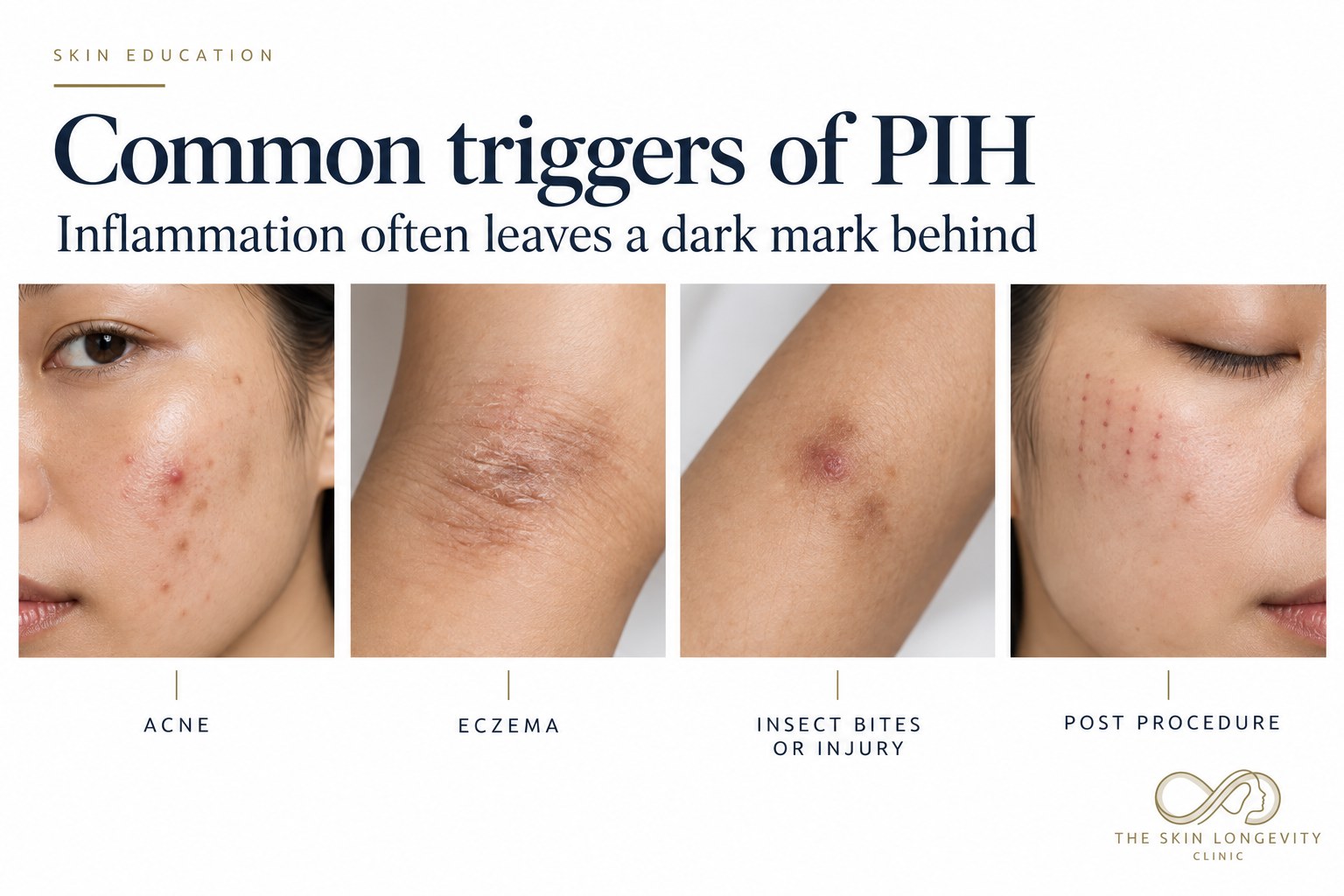
| Original trigger | Typical history | What the assessment should address |
|---|---|---|
| Acne | Brown marks remain where individual spots healed | Continuing breakouts and any accompanying scars1,4 |
| Eczema or contact dermatitis | Darkening follows an itchy, irritated or inflamed patch | Active dermatitis and products or exposures that may be aggravating it1,3 |
| Insect bites or minor injuries | Marks follow bites, scratching, burns or other trauma | Healing, scratching and repeated irritation1,2 |
| A peel, laser or other procedure | Pigmentation develops after treatment related inflammation | The timing, treatment history and current condition of the skin3 |
Treating the original cause helps reduce further pigment stimulation3. For example, controlling eczema may need to come before introducing a lightening cream to the same area3.
Is it pigmentation, redness or a scar?
Brown marks, residual redness and textural scars can require different treatments, even when they follow the same breakout1,4. PIH changes colour, while a depressed or raised scar also changes the skin’s contour1,4.
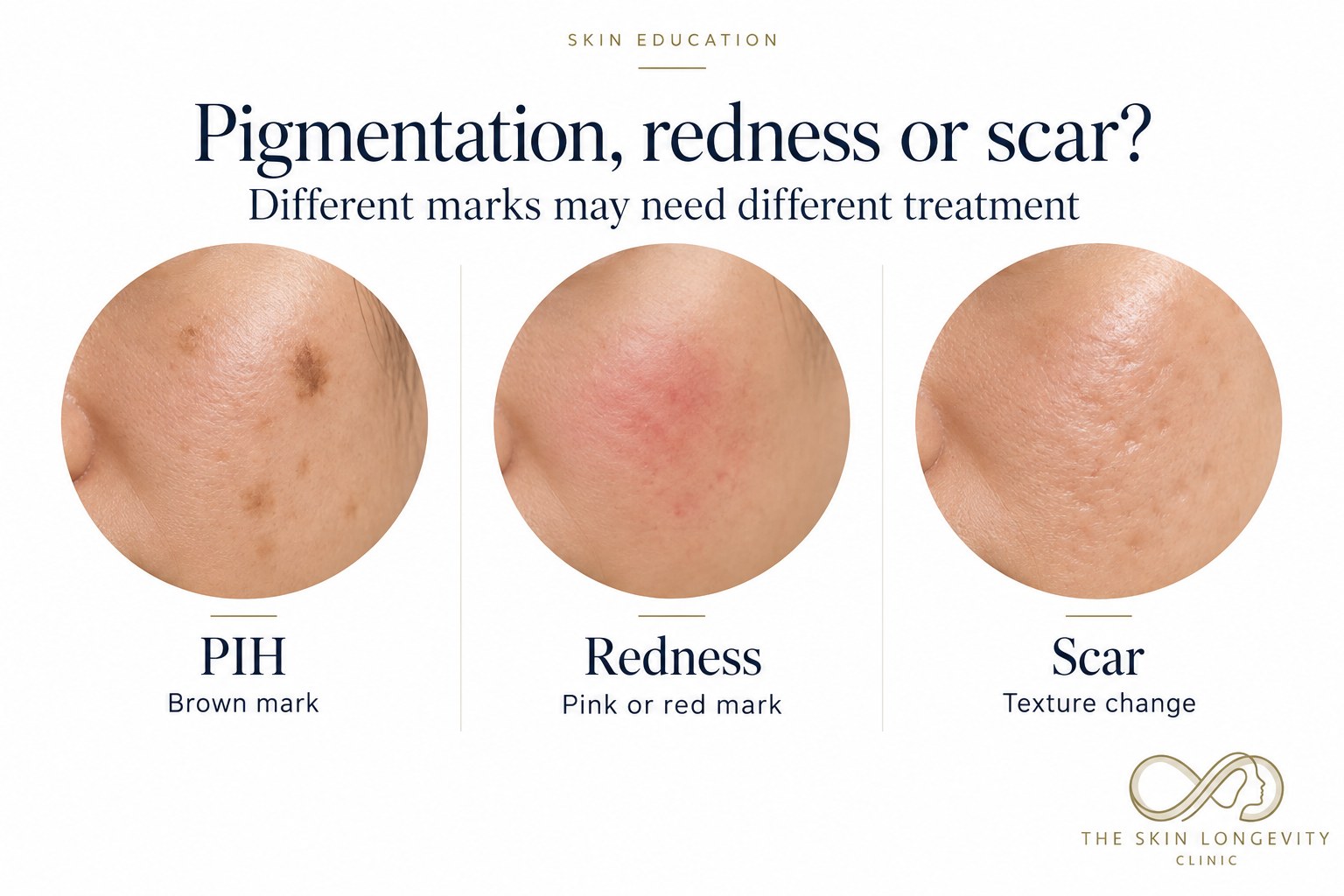
Pink or red marks may reflect a vascular component after inflammation, and redness and brown pigmentation can coexist1. Our guide to acne marks and acne scars explains that distinction in more detail.
Broader, relatively symmetrical facial patches may suggest melasma rather than marks from individual inflammatory lesions4. Dr Rachel Ho’s guide to assessing facial hyperpigmentation discusses the patterns that help guide diagnosis.
Why do some dark marks linger for months?
PIH can take months to fade, and deeper pigment may remain for years1,3. Continued inflammation, irritation and sun exposure can also slow improvement or produce further darkening3,5.
A persistent mark and a new mark have different explanations. Pigment retained in the dermis may be slow to clear, whereas fresh marks after another acne or eczema flare reflect renewed inflammation2,3.
This distinction helps make follow up more useful. We can assess whether existing marks are becoming lighter, whether new lesions are still appearing and whether the skincare routine is comfortable enough to continue.
What helps postinflammatory hyperpigmentation?
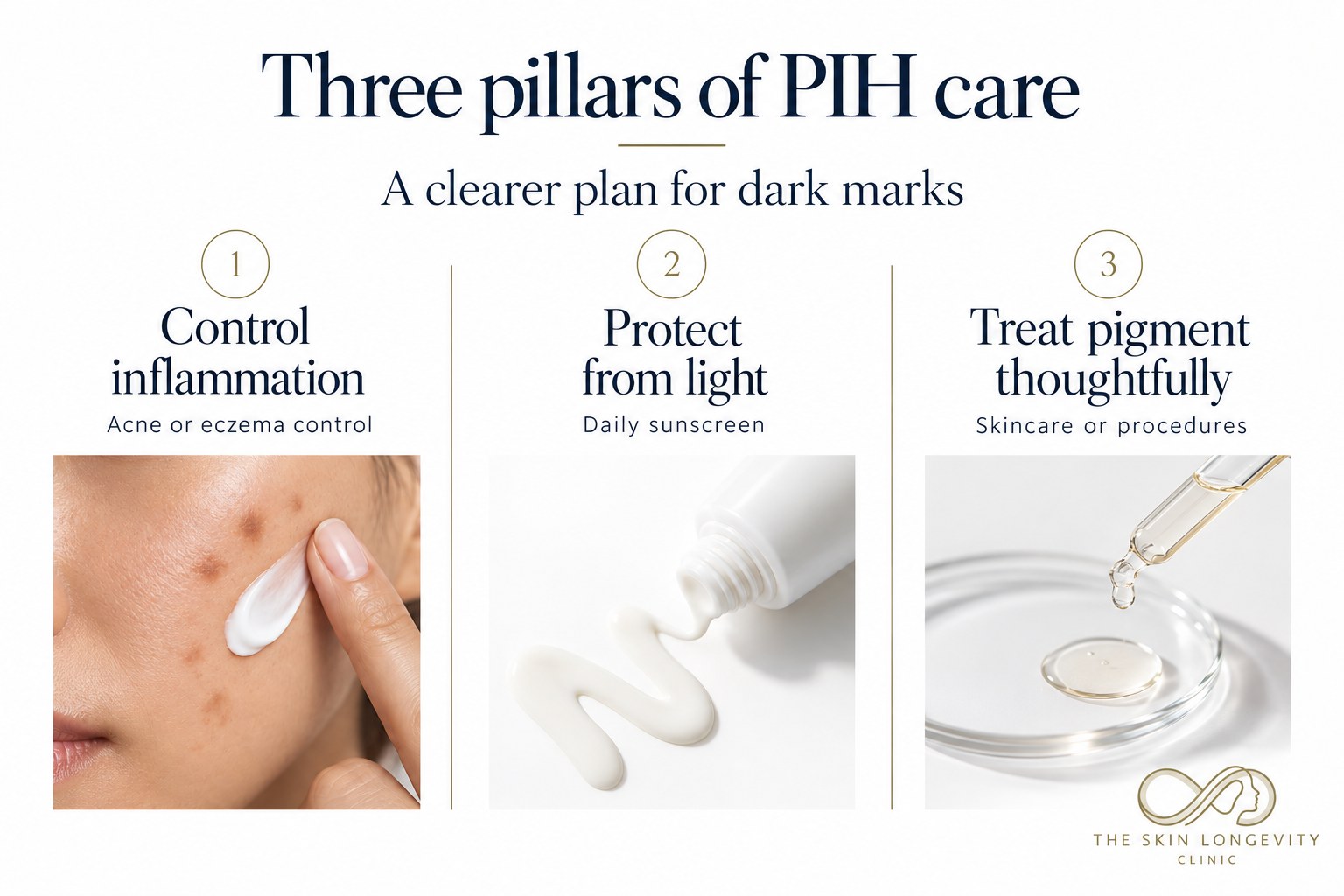
Control inflammation and protect the skin
Treatment of active acne, eczema or irritation reduces the continuing trigger for PIH3. Gentle cleansing and suitable moisturisation can support tolerance of the pigment treatment being used4.
Daily broad spectrum sunscreen helps limit light related darkening, with clothing and shade adding practical protection for exposed areas5. Our sunscreen guide for pigmentation explains ultraviolet and visible light protection, including when a tinted formulation may be useful.
Choose skincare for the diagnosis
Hydroquinone, retinoids and azelaic acid have roles in PIH treatment, with the choice influenced by skin sensitivity and any ongoing acne3,4. These ingredients work through different effects on pigment formation and epidermal renewal4.
Prescription treatment needs an appropriate application schedule and review, while irritation should be addressed rather than endured3. Dr Rachel Ho’s hyperpigmentation skincare guide compares the ingredients and the evidence behind them.
Which clinic treatments can help persistent PIH?
Procedures can complement skincare once the original inflammation has settled3. At The Skin Longevity Clinic, the discussion centres on the pigment being treated, the skin’s previous reactions and whether texture or scarring also needs attention.
Chemical peels for superficial pigmentation
Chemical peels provide controlled exfoliation that can help reduce superficial pigmentation3,4. A study in 30 Indian patients with facial PIH compared glycolic acid peels plus a topical regimen with the topical regimen alone, supporting the use of peels as an additional treatment in selected patients6.
The peeling agent and treatment depth are chosen for the skin rather than simply selecting the strongest peel3. Preparation and aftercare help manage irritation, an important consideration when treating skin prone to dark marks3.
Pico laser for selected persistent dark marks
Pico laser treatment can be considered for selected persistent PIH, with published reports documenting improvement after treatment7. A 2024 systematic review also identified laser treatment among the approaches used for PIH in skin of colour, while showing that outcomes vary8.
The wavelength, settings and treatment interval should reflect the diagnosis and skin response8. Pico specific PIH evidence includes small case reports, so the aim and review plan should be individualised rather than based on results from freckles or sun spots7,8.
PRX Plus when uneven tone and texture coexist
PRX Plus is a professional topical treatment with early research on tone and texture in photoaged skin9. A 2026 study reported improved colour uniformity in a pigmentation subgroup, although participants also used home skincare and there was no control group9.
That study examined overall photoaged skin rather than a dedicated PIH population9. Its role can therefore be discussed when broader tone or texture concerns accompany dark marks, alongside treatment directed at the cause of the PIH.
RF microneedling when scars or texture also need treatment
Radiofrequency microneedling delivers energy through fine needles and has evidence for improving acne scars and skin texture10. When scars and brown marks coexist, it may address the textural component while pigment treatment addresses the colour4,10.
The distinction helps each part of the plan have a clear purpose. Needle depth, energy settings and aftercare require individual assessment, with temporary redness, swelling and pigment changes included in the recovery discussion10.
What happens during a PIH consultation?
Bring photographs showing how the marks developed, the names of your skincare products and details of previous procedures. We will discuss whether the original skin problem is still active, what changes you hope to see and how much recovery time fits your routine.
Our broader guide to hyperpigmentation treatment in Singapore explains how different pigmentation conditions are assessed. The consultation can then focus on which treatments are relevant to your marks and how progress will be reviewed.
Frequently asked questions about PIH
Can PIH fade without a procedure?
PIH can fade as the skin recovers, especially when pigment is superficial and the original inflammation has stopped1,3. Treatment can support improvement, while deeper pigment usually needs a longer review period3.
Why do new marks keep appearing during treatment?
Further acne, eczema or irritation can create new PIH while older marks are fading1,3. Reviewing the underlying condition is therefore as important as assessing the lightening treatment3.
Can pigmentation after a laser be treated?
Pigmentation that develops after a procedure can be assessed and managed according to the condition of the skin and the cause of the darkening3. Our guide to pigmentation that returns or darkens after laser explains why reviewing the reaction helps guide the next step.
A clearer plan for persistent dark marks
You can book an assessment at The Skin Longevity Clinic to discuss the marks that are bothering you and the treatments you have already tried. We can work towards a plan with clear priorities, an agreed review point and practical care between appointments.
References
-
Kaufman BP, Aman T, Alexis AF. Postinflammatory Hyperpigmentation: Epidemiology, Clinical Presentation, Pathogenesis and Treatment. American Journal of Clinical Dermatology. 2018;19:489–503. DOI: 10.1007/s40257-017-0333-6. Springer
-
Silpa Archa N, Kohli I, Chaowattanapanit S, Lim HW, Hamzavi I. Postinflammatory hyperpigmentation: A comprehensive overview: Epidemiology, pathogenesis, clinical presentation, and noninvasive assessment technique. Journal of the American Academy of Dermatology. 2017;77(4):591–605. DOI: 10.1016/j.jaad.2017.01.035. PubMed
-
Chaowattanapanit S, Silpa Archa N, Kohli I, Lim HW, Hamzavi I. Postinflammatory hyperpigmentation: A comprehensive overview: Treatment options and prevention. Journal of the American Academy of Dermatology. 2017;77(4):607–621. DOI: 10.1016/j.jaad.2017.01.036. PubMed
-
Moolla S, Miller Monthrope Y. Dermatology: how to manage facial hyperpigmentation in skin of colour. Drugs in Context. 2022;11:2021-11-2. DOI: 10.7573/dic.2021-11-2. Drugs in Context
-
Fatima S, Braunberger T, Mohammad TF, Kohli I, Hamzavi IH. The Role of Sunscreen in Melasma and Postinflammatory Hyperpigmentation. Indian Journal of Dermatology. 2020;65(1):5–10. DOI: 10.4103/ijd.IJD_295_18. PubMed Central (PMC)
-
Sarkar R, Parmar NV, Kapoor S. Treatment of Postinflammatory Hyperpigmentation With a Combination of Glycolic Acid Peels and a Topical Regimen in Dark Skinned Patients: A Comparative Study. Dermatologic Surgery. 2017;43(4):566–573. DOI: 10.1097/DSS.0000000000001007. PubMed
-
Ren R, Bao S, Qian W, Zhao H. 755 nm Alexandrite Picosecond Laser with a Diffractive Lens Array or Zoom Handpiece for Postinflammatory Hyperpigmentation: Two Case Reports with a Three Year Follow Up. Clinical, Cosmetic and Investigational Dermatology. 2021;14:1459–1464. DOI: 10.2147/CCID.S323872. PubMed
-
Mar K, Khalid B, Maazi M, Ahmed R, Wang OJE, Khosravi Hafshejani T. Treatment of Postinflammatory Hyperpigmentation in Skin of Colour: A Systematic Review. Journal of Cutaneous Medicine and Surgery. 2024;28(5):473–480. DOI: 10.1177/12034754241265716. PubMed
-
Deda A, Duda P, Wcisło Dziadecka D, Maszczyk A, Wilczyński S. Instrumental Assessment of a Chemical Skin Biostimulator Combining Ammonium Trichloroacetate and Homocysteic Acid in Photoaged Mature Skin: A Single Arm Prospective Study. Molecules. 2026;31(17):3038. DOI: 10.3390/molecules31173038. PubMed Central (PMC)
-
Shauly O, Marxen T, Menon A, Gould DJ, Miller LB, Losken A. Radiofrequency Microneedling: Technology, Devices, and Indications in the Modern Plastic Surgery Practice. Aesthetic Surgery Journal Open Forum. 2023;5:ojad100. DOI: 10.1093/asjof/ojad100. Oxford Academic