Medically reviewed by Dr Rachel Ho, MBBS, MRCS, MMed (ENT), 19 October 2026.
Radiesse CaHA collagen biostimulator treatment in Singapore
Calcium hydroxylapatite (CaHA), supplied as Radiesse, is a collagen biostimulator made of calcium phosphate microspheres suspended in a gel. Injected undiluted, it restores volume and sharpens contours in the cheeks, chin and jawline. Diluted or hyperdiluted with saline, it is injected under the skin of the neck, décolletage, arms, abdomen, thighs, buttocks and hands, where the microspheres act as a scaffold for new collagen and elastin.1,2
At The Skin Longevity Clinic, Dr Rachel Ho uses CaHA for three indications, which are jawline and chin definition, crepey or loose skin on the neck and body, and thinning skin on the backs of the hands.
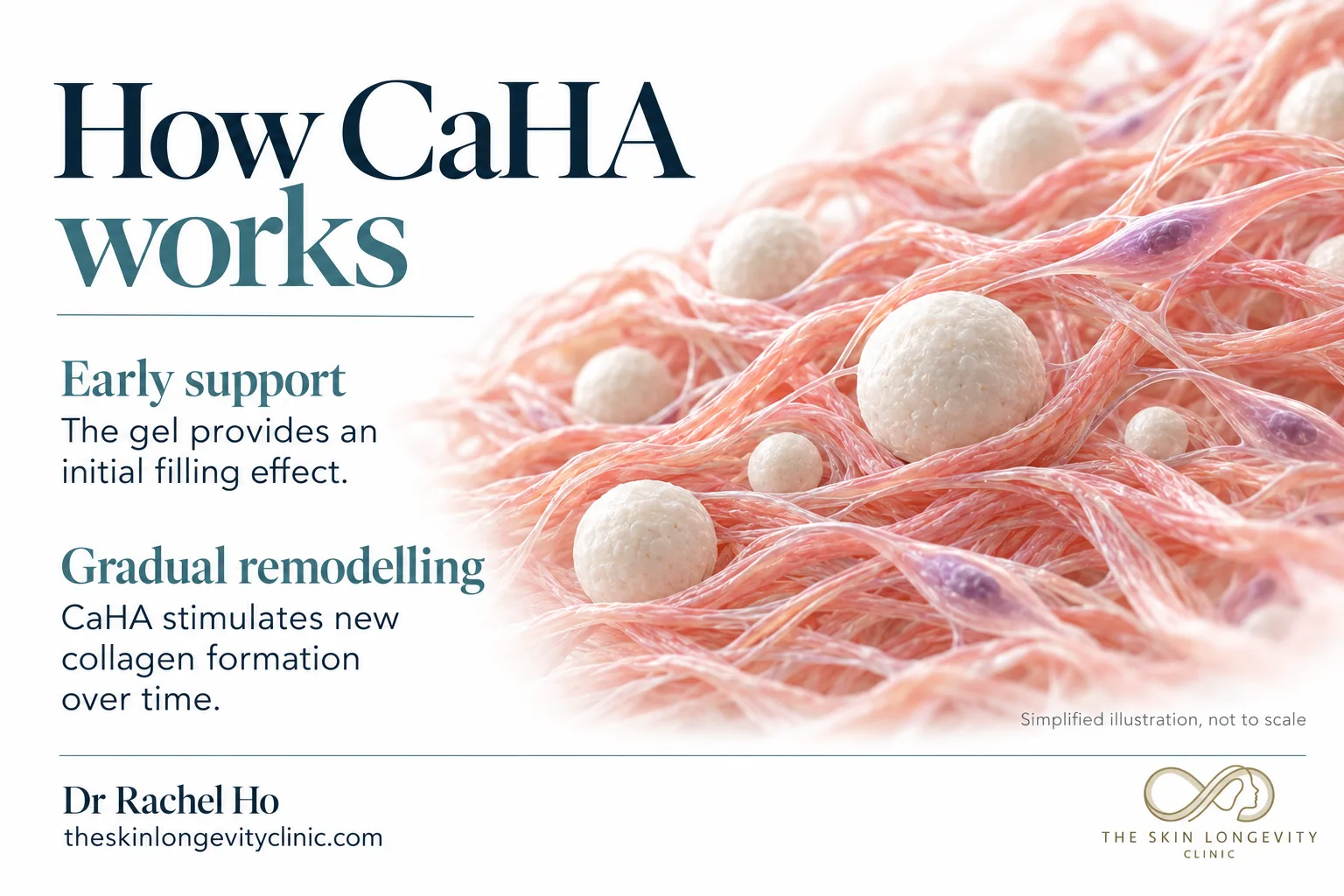
How CaHA works: early support from the gel, then gradual collagen remodelling.
CaHA consists of calcium hydroxylapatite microspheres suspended in a carboxymethylcellulose gel. The gel gives immediate volume, and the microspheres stimulate new collagen and elastin over the following months.
What is the main purpose?
Undiluted, it lifts and defines the jawline, chin and cheeks, whereas diluted, it firms lax skin on the neck, décolletage, hands and body without adding volume.
When do results appear?
Volume and contour changes are visible at once, and the collagen effect builds from 6 weeks and peaks at about 3 months.
How many sessions are needed?
Contouring takes one session, whereas skin firming takes one to three sessions, 4 to 8 weeks apart.
How long can results last?
Results last about 12 to 18 months, depending on the area, the dilution and the patient’s age.
Can CaHA be dissolved?
CaHA cannot be dissolved, because no enzyme breaks it down in the way hyaluronidase reverses a hyaluronic acid filler, so depth and dilution are planned conservatively.
What is the downtime?
Bruising, swelling and tenderness last a few days, and most patients return to work the next day.
What are the important risks?
The main risk is small nodules, which are usually not visible and resolve on their own, and rarely persistent swelling or redness. The risk rises when under-diluted product is placed superficially in thin or mobile skin.
What is a CaHA collagen biostimulator?
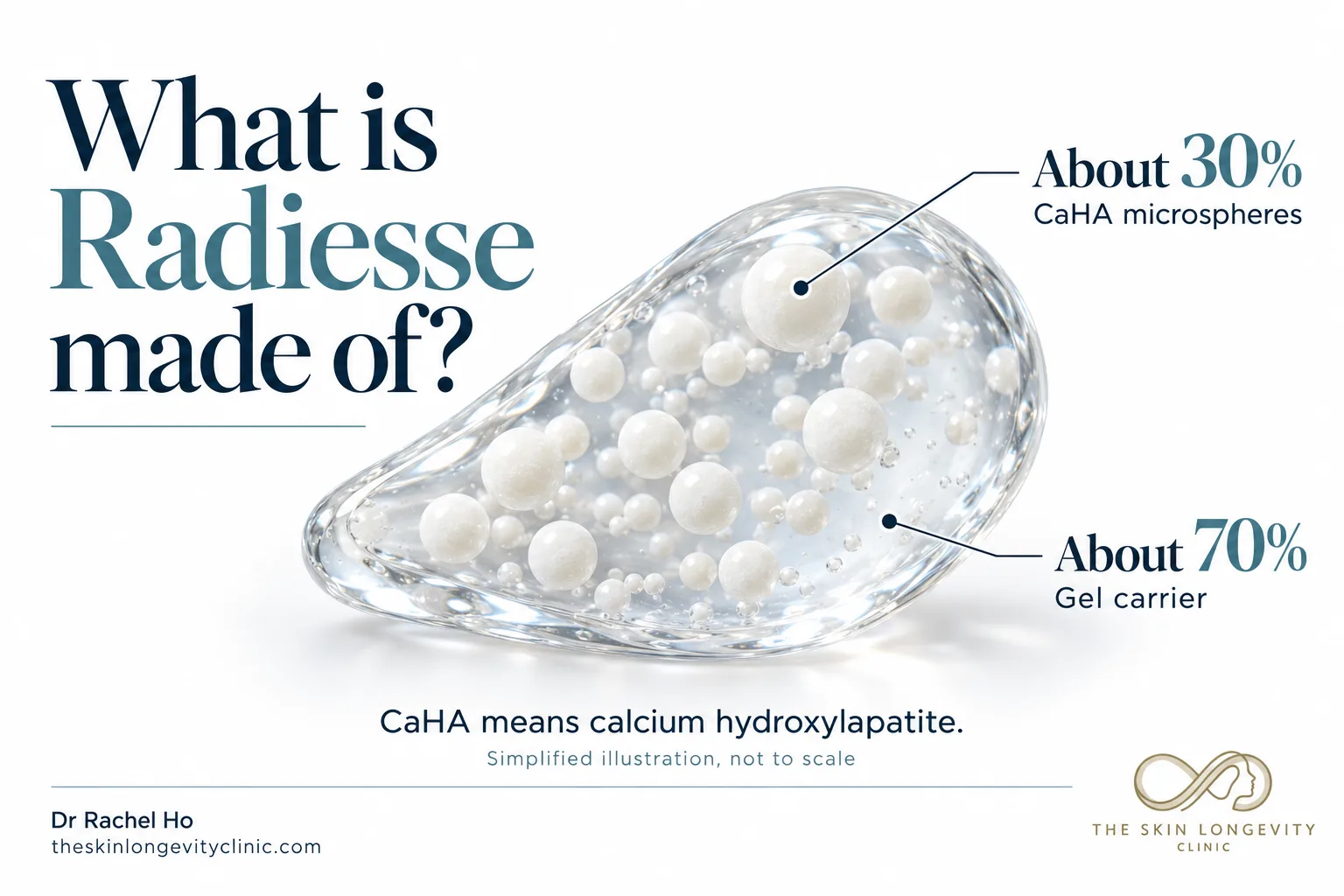
CaHA is calcium hydroxylapatite, the same mineral that gives bone and teeth their hardness, supplied as microspheres in a gel carrier. The gel gives immediate volume and is absorbed over several weeks. The microspheres remain for months and act as a scaffold on which fibroblasts, the cells that produce collagen, lay down new collagen and elastin, before the microspheres are broken down and cleared.1 CaHA has more than a decade of published clinical use for facial lines, folds and volume loss.4 How it compares with hyaluronic acid, poly-L-lactic acid (PLLA) and other biostimulators is covered in the CaHA doctor’s guide.
What Radiesse is made of: CaHA microspheres in a gel carrier (simplified, not to scale).
CaHA filler vs hyperdiluted CaHA, two ways to use one product
Undiluted, as a filler, CaHA is placed in structural areas that need lift and definition, namely the jawline, chin, cheeks and temples. One session gives an immediate result, and the collagen effect builds on top of it over the following months.
Diluted 1 to 1 or hyperdiluted 1 to 2 or more with saline, CaHA is injected in a thin layer under the skin to firm lax, crepey skin without adding volume. The thinner gel no longer holds volume, so only the collagen effect remains. A global consensus panel supports this use for the mid and lower face, neck, décolletage, upper arms, abdomen, upper legs and buttocks.2 A second consensus gives dilution ratios, injection points and session intervals for each area.5
Dr Rachel Ho chooses the dilution for each area at the consultation. Thin or darker skin is treated with a higher dilution placed deeper, because a thinner gel at depth is less likely to form visible nodules.2
What can a CaHA collagen biostimulator improve?
CaHA is chosen when the goal is definition, a visible change at the first visit, or firming of skin that has lost thickness. Treatment goals include the following.
A softening jawline or weak chin
Early jowls and lower face laxity
Crepey skin and horizontal lines on the neck and décolletage
Thinning skin and visible veins on the backs of the hands
Loose skin on the upper arms, abdomen, thighs, buttocks and knees
Broad, shallow acne scars
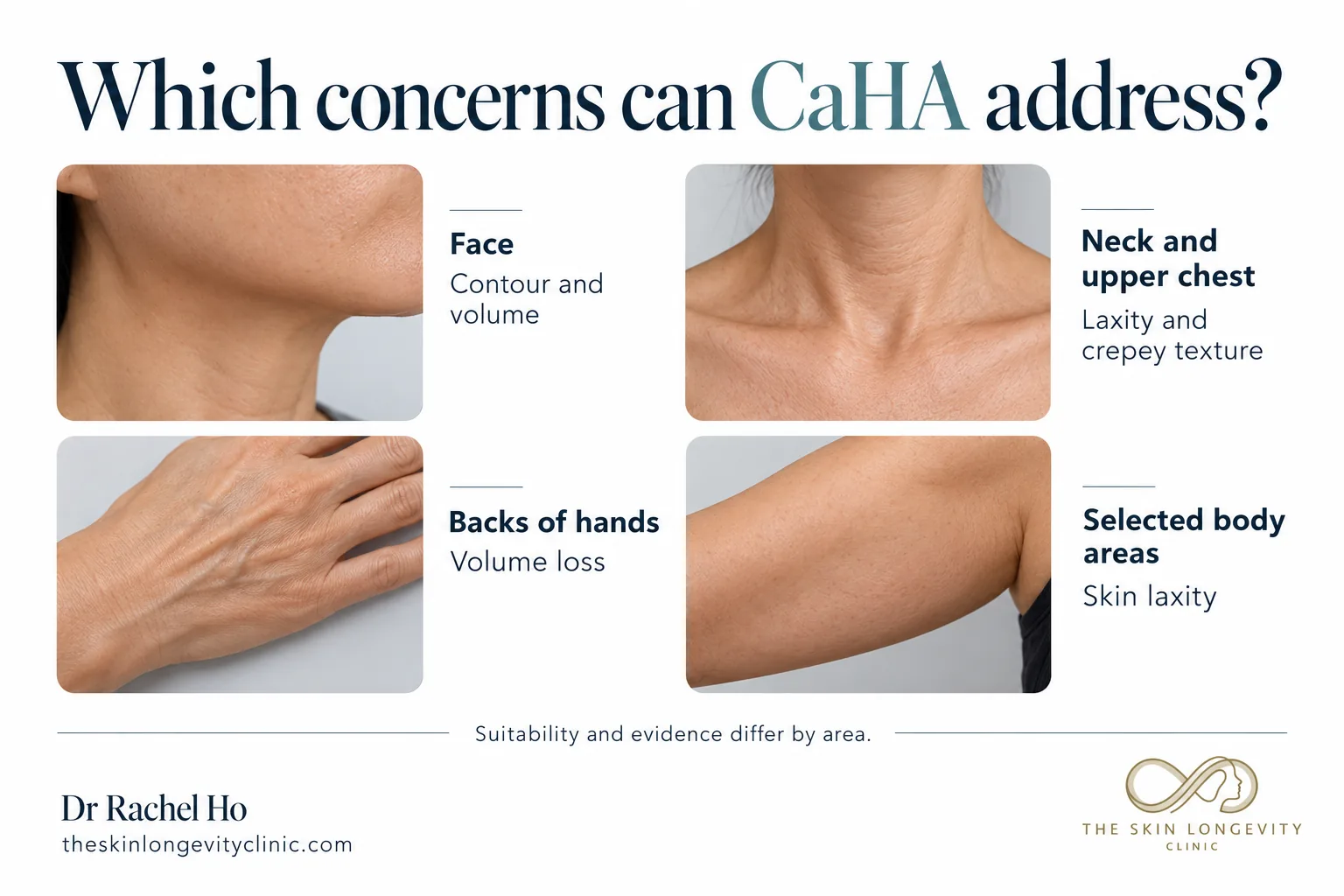
Which concerns CaHA can address: face, neck and upper chest, backs of hands and selected body areas.
Jawline and chin definition with CaHA
Undiluted CaHA placed along the mandible, the lower jawbone, and the chin gives a firmer jawline and a sharper chin outline in one session. It is often chosen over hyaluronic acid for the jawline because its firmer gel resists spreading along the bone, and the collagen it stimulates extends the result after the gel has been absorbed. See also jawline filler in Singapore.
Neck and décolletage skin tightening with CaHA
Hyperdiluted CaHA is injected under the skin of the neck and chest to firm crepey skin and soften horizontal neck lines. In a randomised split-face study of 20 patients, diluted CaHA combined with microfocused ultrasound improved marionette lines, jawline contour and neck scores at 15 months, and biopsies showed a marked increase in collagen and elastin.6
CaHA for lower face laxity
For a softening jawline and early jowls, hyperdiluted CaHA firms the skin over the lower face. A 2025 randomised pilot study found that microfocused ultrasound followed by hyperdiluted CaHA six weeks later produced a 143% increase in elastin coverage at 120 days, with better aesthetic scores than the reverse order.7 At the clinic, CaHA is combined with HIFU or XERF in the same sequence, with the device session first and CaHA six weeks later. HIFU is high intensity focused ultrasound, and XERF is a radiofrequency skin tightening device. See the sagging skin treatment page.
CaHA for hand volume loss
Volume loss on the backs of the hands makes veins and tendons stand out as the fat pad between the skin and the tendons thins with age. CaHA is approved for hand volume loss and is injected as a thin layer over the back of the hand, where it restores the cushion over the tendons at once and then thickens the skin through new collagen.2 In a 12-month randomised trial of 114 patients, 75% improved by at least one grade on a validated hand scale at 3 months, and 86% still reported improvement at 12 months, with no effect on hand function.8
CaHA for upper arms, abdomen, thighs and buttocks
Hyperdiluted CaHA firms loose skin on the body by thickening the dermis rather than by filling it. In a Singapore pilot study of 12 women, microfocused ultrasound followed by diluted or hyperdiluted CaHA improved objective skin firmness and elasticity of the upper arms at 24 weeks, and all subjects reported satisfaction.9 A 50-patient case series reported improvement in skin thickness, laxity and wrinkles in 81.6% of patients across the face, neck, décolletage and hands with hyperdiluted CaHA.10 For body skin, the same sequence applies, with the device session first and CaHA combined with XERF body treatment.
CaHA for depressed acne scars
Diluted CaHA lifts broad, saucer-shaped acne scars, the rolling and shallow boxcar types, by supporting the floor of the scar from beneath and stimulating collagen in the thinned dermis. In a pilot study of 10 patients with moderate to severe atrophic acne scars, microfocused ultrasound followed by diluted CaHA produced a significant improvement on the Goodman scar scale at day 90, greatest in severe scars, with no adverse events.11 Narrow ice-pick scars are treated instead with TCA CROSS, a concentrated acid applied into each pit. For tethered scars, the fibrous bands that pull the scar down are first released, and CaHA is placed after subcision. See the acne scar treatment guide.
When CaHA is chosen over PLLA or PDLLA
CaHA is chosen when the area needs definition or a visible change at the first visit, as for the jawline, chin, neck, hands, body laxity and broad acne scars.
PLLA is chosen when the problem is diffuse volume loss across the cheeks and temples, or cellulite, because it builds volume gradually over several months rather than at once.
PDLLA (poly-D,L-lactic acid) is chosen when the skin is very thin and the goal is fine texture and skin quality rather than contour, since its softer particles carry a lower nodule risk in thin skin.
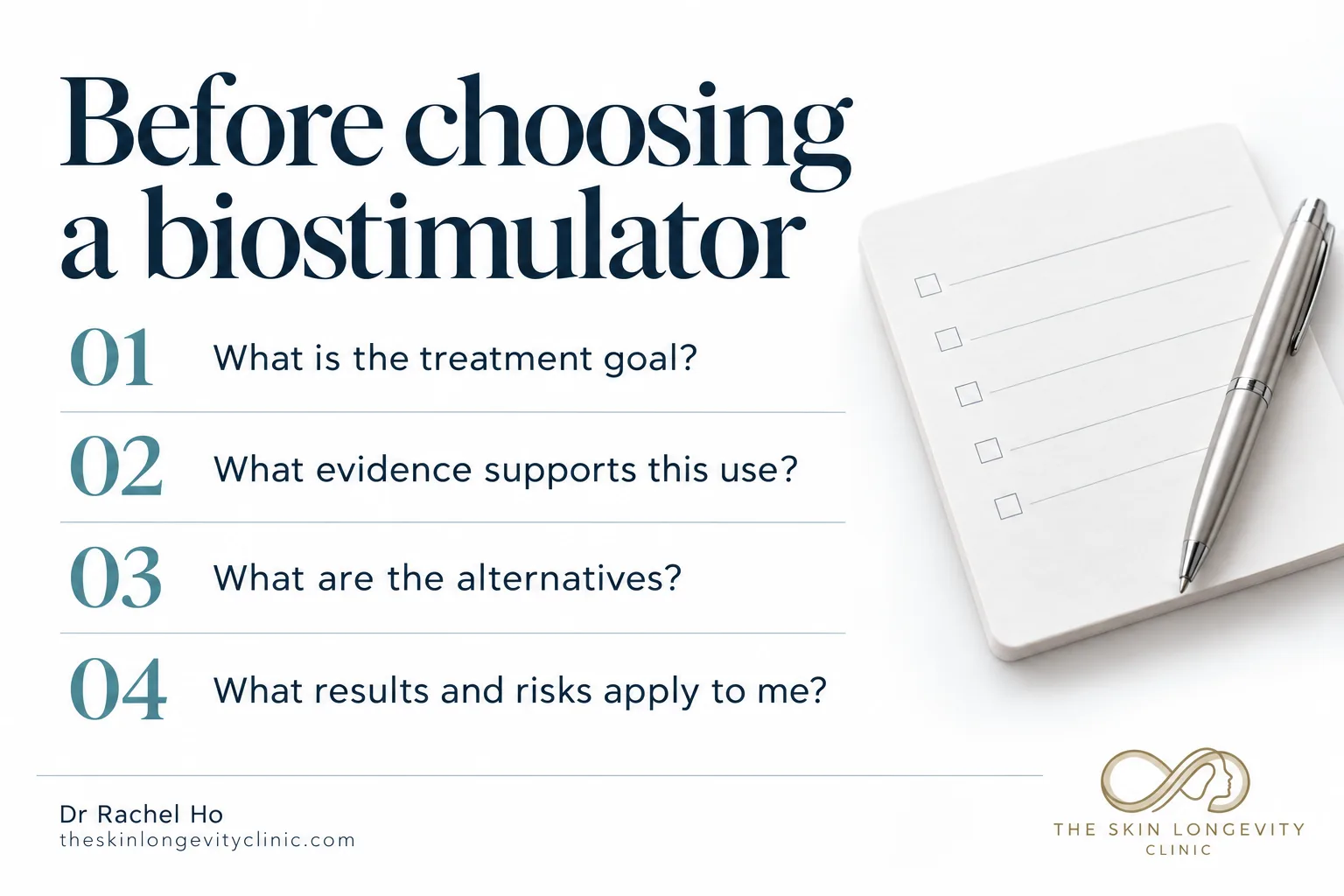
Four questions to ask before choosing a collagen biostimulator.
What happens during a CaHA consultation?
Dr Rachel Ho examines the area, grades the degree of laxity or volume loss and decides between undiluted and hyperdiluted CaHA. Thin, mobile or darker skin is noted, because each raises the risk of visible nodules and calls for a higher dilution placed deeper.
What happens during CaHA treatment?
Numbing cream is applied for 20 to 30 minutes. The product is mixed with lidocaine, a local anaesthetic, and, for skin firming, diluted with saline to the planned ratio. A blunt cannula or a needle places it in the deep dermis or just beneath it, and a cannula is preferred over larger areas because it causes less bruising. Contouring takes about 20 minutes, and a neck or body area takes 30 to 45 minutes. The area is then massaged to spread the product evenly, which lowers the chance of nodules.
When do CaHA results appear?
Volume and contour changes are visible at once. The collagen effect appears from 6 to 8 weeks and continues to build to about 3 months. In hyperdiluted areas, the skin looks unchanged for the first few weeks while the gel is absorbed, and firmness follows as collagen builds.
How many CaHA sessions are needed?
Jawline or chin contouring takes one session, reviewed at 4 weeks. Neck, hand or body skin firming takes one to three sessions, 4 to 8 weeks apart, reviewed at 8 weeks.
How long do CaHA results last?
Results last around 12 to 18 months, depending on the area, the dilution and the patient’s age. In a randomised trial of 205 patients, CaHA held its correction longer than three hyaluronic acid fillers.3 Maintenance is usually a single session every 12 to 18 months.
What are the side effects of CaHA?
Bruising, swelling and tenderness for a few days are expected. In a review of 5,081 CaHA treatments in 2,779 patients, 3% had an adverse event, and 96% of these were nodules, most of which were not visible and resolved on their own. Nodules are more likely in mobile areas such as the lips, which the clinic does not treat with CaHA, and in thin skin injected with under-diluted product, where the microspheres sit close to the surface and clump. CaHA cannot be dissolved with hyaluronidase, the enzyme that reverses hyaluronic acid fillers, so placement depth and dilution matter more than with hyaluronic acid fillers.12
Who should delay or avoid CaHA?
CaHA is not used during pregnancy or breastfeeding, over active infection, in the lips or tear trough, where the skin is thin and mobile and nodules are more likely, or in patients with a history of keloids in the treated area.
What affects the Radiesse price in Singapore?
The Radiesse price in Singapore depends on the number of syringes, the area treated, whether the product is used undiluted for contouring or hyperdiluted over a larger body area, and whether it is combined with HIFU or XERF. A quote is given after the consultation, once the number of syringes and sessions is known.
Dr Rachel Ho’s clinical perspective on CaHA collagen biostimulators
CaHA suits patients who want a visible change at the first visit and a collagen effect that follows. For the jawline and chin, it gives a firmer result than hyaluronic acid because the gel resists spreading along the bone. For the neck, hands and body, the hyperdiluted form firms skin without adding bulk.
Where skin is very thin, Dr Ho prefers PDLLA or a higher dilution of CaHA placed deeper, and she sequences energy devices before CaHA rather than after, the order that produced the greater elastin gain in the 2025 pilot study described above. Assessments take place at Scotts Medical Center, 9 Scotts Road. Book through the contact page or call +65 6514 2688.
CaHA results last about 12 to 18 months for both contouring and skin firming. Maintenance is usually one session every 12 to 18 months.
How many CaHA sessions are needed?
Jawline or chin contouring takes one session. Neck, hand or body skin firming takes one to three sessions, 4 to 8 weeks apart.
CaHA or PLLA for the jawline?
CaHA is the usual choice for the jawline, because it gives immediate definition and a firmer feel. PLLA suits diffuse volume loss across the cheeks and temples rather than a defined jawline.
Can CaHA be combined with HIFU or XERF?
CaHA can be combined with HIFU or XERF, and in a randomised pilot study, microfocused ultrasound first and hyperdiluted CaHA six weeks later gave the best elastin and aesthetic outcomes, so the clinic uses the same order.
Can CaHA be dissolved if I do not like the result?
CaHA cannot be dissolved, because unlike hyaluronic acid there is no enzyme that breaks it down, so Dr Rachel Ho plans depth and dilution conservatively and reviews contouring at 4 weeks.
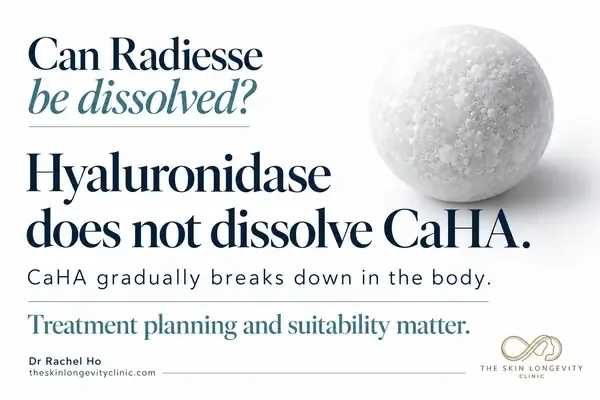
CaHA cannot be dissolved with hyaluronidase; it breaks down gradually.
Is there downtime after CaHA treatment?
Downtime is limited to bruising, swelling and tenderness for a few days. Most patients return to work the next day, and strenuous exercise and facials are avoided for 48 hours.
How much does CaHA treatment cost in Singapore?
The cost of CaHA treatment in Singapore depends on the number of syringes, the area, the dilution and any combination with HIFU or XERF. A quote is given after the consultation.
Which brand of CaHA does the clinic use?
The clinic uses Radiesse, the calcium hydroxylapatite injectable studied in the trials and consensus papers cited below.
Aguilera SB, McCarthy A, Khalifian S, Lorenc ZP, Goldie K, Chernoff WG. The Role of Calcium Hydroxylapatite (Radiesse) as a Regenerative Aesthetic Treatment: A Narrative Review. Aesthet Surg J. 2023;43(10):1063–1090. doi:10.1093/asj/sjad173. Product studied: Radiesse (calcium hydroxylapatite).
Goldie K, Peeters W, Alghoul M, et al. Global Consensus Guidelines for the Injection of Diluted and Hyperdiluted Calcium Hydroxylapatite for Skin Tightening. Dermatol Surg. 2018;44 Suppl 1:S32–S41. doi:10.1097/DSS.0000000000001685. Product studied: Radiesse (calcium hydroxylapatite).
Moers-Carpi M, Vogt S, Santos BM, et al. A multicenter, randomized trial comparing calcium hydroxylapatite to two hyaluronic acids for treatment of nasolabial folds. Dermatol Surg. 2007;33 Suppl 2:S144–151. doi:10.1111/j.1524-4725.2007.33354.x. Product studied: Radiesse (calcium hydroxylapatite).
van Loghem J, Yutskovskaya YA, Werschler WP. Calcium hydroxylapatite: over a decade of clinical experience. J Clin Aesthet Dermatol. 2015;8(1):38–49. PMID 25610523. Product studied: Radiesse (calcium hydroxylapatite).
de Almeida AT, Figueredo V, da Cunha ALG, et al. Consensus Recommendations for the Use of Hyperdiluted Calcium Hydroxyapatite (Radiesse) as a Face and Body Biostimulatory Agent. Plast Reconstr Surg Glob Open. 2019;7(3):e2160. doi:10.1097/GOX.0000000000002160. Product studied: Radiesse (calcium hydroxylapatite).
Yutskovskaya YA, Sergeeva AD, Kogan EA. Combination of Calcium Hydroxylapatite Diluted With Normal Saline and Microfocused Ultrasound With Visualization for Skin Tightening. J Drugs Dermatol. 2020;19(4):405–411. doi:10.36849/JDD.2020.4625. Product studied: Radiesse (calcium hydroxylapatite).
Doyle A, Looi I, Chu P. Microfocused Ultrasound With Visualization (MFU-V) and Hyperdilute Calcium Hydroxylapatite (CaHA-CMC) of the Lower Face and Submentum to Treat Skin Laxity: A Pilot Study. Aesthet Surg J. 2025;45(3):305–312. doi:10.1093/asj/sjae226. Product studied: Radiesse (calcium hydroxylapatite).
Goldman MP, Moradi A, Gold MH, et al. Calcium Hydroxylapatite Dermal Filler for Treatment of Dorsal Hand Volume Loss: Results From a 12-Month, Multicenter, Randomized, Blinded Trial. Dermatol Surg. 2018;44(1):75–83. doi:10.1097/DSS.0000000000001203. Product studied: Radiesse (calcium hydroxylapatite).
Ramirez S, Puah IBK. Effectiveness of combined microfocused ultrasound with visualization and subdermal calcium hydroxyapatite injections for the management of brachial skin laxity. J Cosmet Dermatol. 2021;20(12):3871–3879. doi:10.1111/jocd.14573. Product studied: Radiesse (calcium hydroxylapatite).
Massidda E. Starting Point for Protocols on the Use of Hyperdiluted Calcium Hydroxylapatite (Radiesse®) for Optimizing Age-Related Biostimulation and Rejuvenation of Face, Neck, Décolletage and Hands: A Case Series Report. Clin Cosmet Investig Dermatol. 2023;16:3427–3439. doi:10.2147/CCID.S420068. Product studied: Radiesse (calcium hydroxylapatite).
Casabona G. Combined use of microfocused ultrasound and a calcium hydroxylapatite dermal filler for treating atrophic acne scars: A pilot study. J Cosmet Laser Ther. 2018;20(5):301–306. doi:10.1080/14764172.2017.1406606. Product studied: Radiesse (calcium hydroxylapatite).
Kadouch JA. Calcium hydroxylapatite: A review on safety and complications. J Cosmet Dermatol. 2017;16(2):152–161. doi:10.1111/jocd.12326. Product studied: Radiesse (calcium hydroxylapatite).


 CaHA cannot be dissolved with hyaluronidase; it breaks down gradually.