

06 Oct RF Microneedling vs Pico Laser vs Fractional CO2 Laser, Which Treats Acne Scars Best?
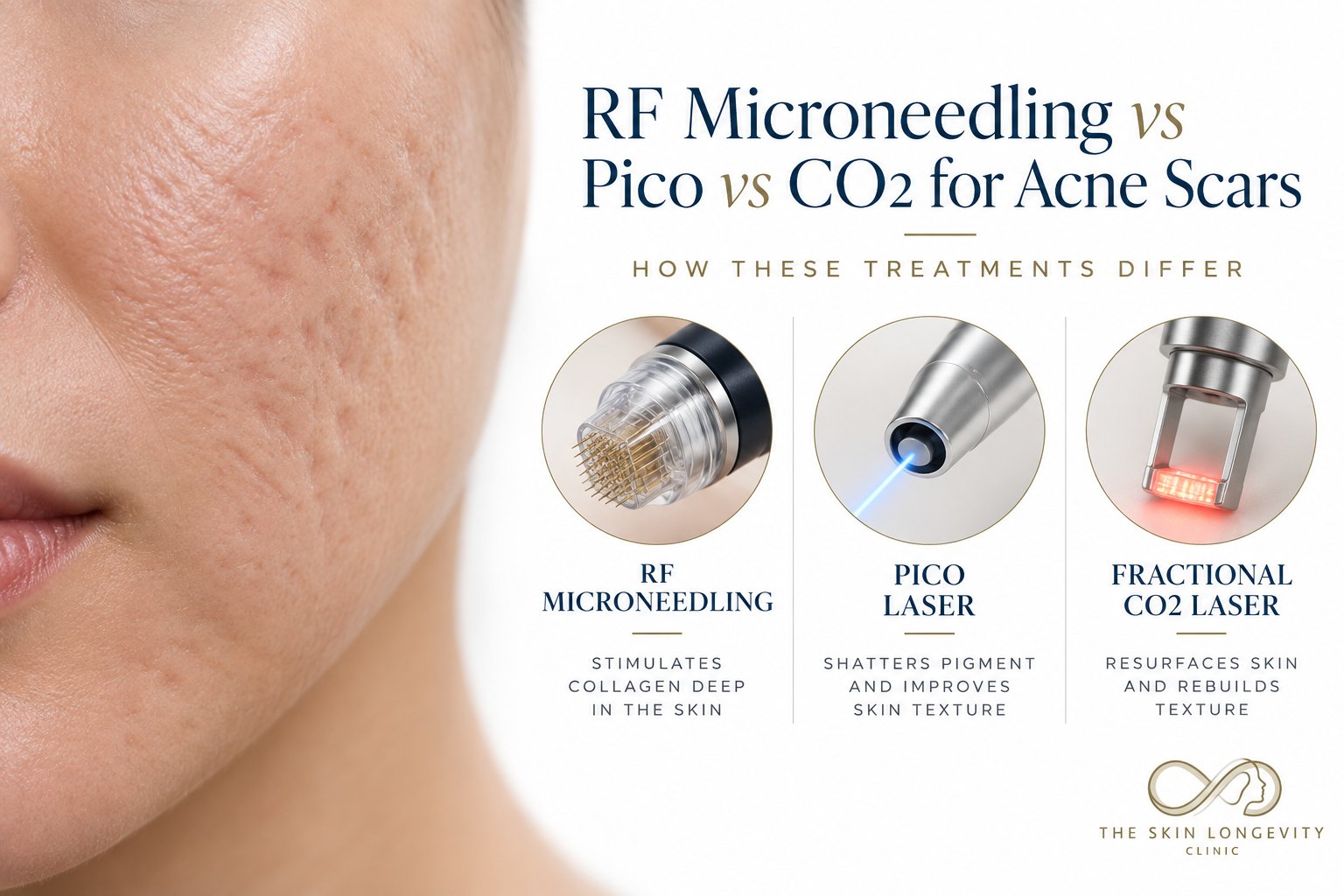
Three energy-based treatments dominate acne scar treatment in Singapore, namely fractional radiofrequency (RF) microneedling, fractional picosecond laser and fractional CO2 laser. They act through different mechanisms, suit different scar types and carry different pigmentation risks in Asian skin. The Skin Longevity Clinic offers all three and chooses by scar type rather than by device. This guide compares them using the randomised trials that have tested them head to head.
Medically reviewed by Dr Rachel Ho, MBBS, MMed (ENT). Last reviewed 6 October 2026.
How RF microneedling, pico laser and CO2 laser treat acne scars
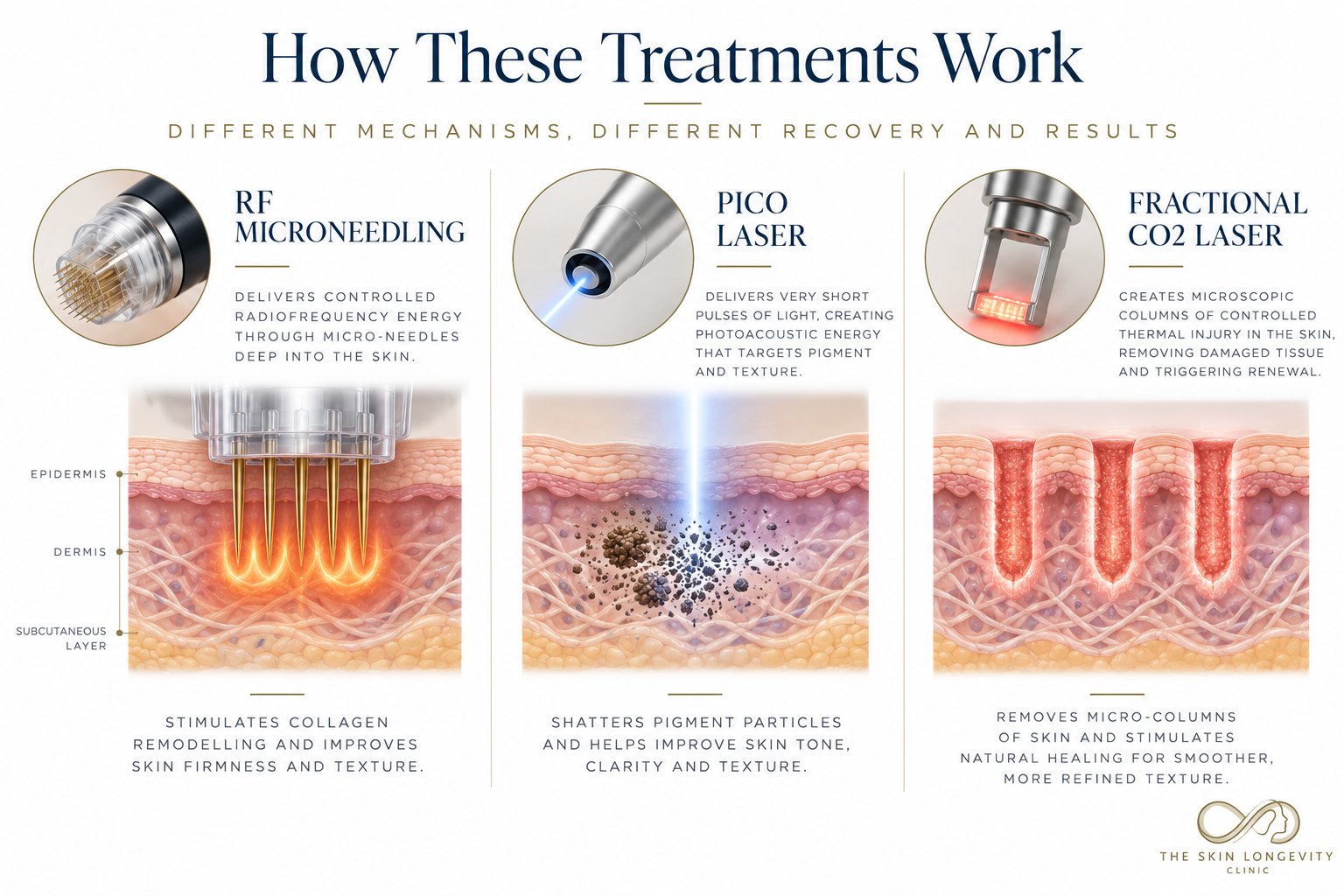
RF microneedling places insulated microneedles at a set depth and releases radiofrequency heat at the tip, so collagen is remodelled in the dermis while the epidermis is largely spared1. The procedure is described under RF microneedling in Singapore.
Fractional pico laser delivers picosecond pulses through a fractional lens that creates microscopic zones of laser-induced optical breakdown in the dermis, leaving the surface intact. Each zone is a tiny cavity that the skin repairs with new collagen2. The treatment is described under Pico laser in Singapore.
Fractional CO2 laser vaporises columns of skin from the surface down into the dermis, removing scar tissue directly and stimulating a strong wound-healing response, at the cost of an open surface wound3. The treatment is described under Fractional CO2 laser in Singapore.
RF microneedling vs fractional CO2 laser for acne scars
A 2026 meta-analysis of eight randomised controlled trials covering 249 patients found that fractional CO2 gave greater scar improvement and higher satisfaction, but with significantly more pain, 4.4 times the risk of post-inflammatory hyperpigmentation (PIH) and redness lasting about 1.7 days longer3. A randomised split-face trial in 2023 reached a similar conclusion, with CO2 producing the larger change in a single session and RF microneedling the gentler recovery4. For Fitzpatrick type III to V skin, the PIH difference often decides the choice, because the pigment produced after CO2 can take months to fade.
Pico laser vs fractional CO2 laser for acne scars
In a randomised split-face trial of 25 Asian patients, fractional 1064 nm picosecond laser matched fractional CO2 for texture and scar volume after a single session, with no PIH on the pico side against 24 percent mild PIH on the CO2 side2. Pico suits shallow rolling scars, pores and scars that come with pigmentation, since the same wavelength also breaks up melanin. It does less for deep boxcar scars, whose floor lies below the depth the fractional lens reaches.
RF microneedling vs pico laser for acne scars
Direct comparisons of RF microneedling with pico laser are few. In a 2025 split-face randomised trial, adding a fractional 755 nm picosecond laser to RF microneedling did not improve acne scar scores beyond RF microneedling alone over four sessions, although both sides improved significantly5. A 1550 nm non-ablative fractional laser and RF microneedling produced similar improvement after three sessions, with the laser slightly ahead and RF microneedling offering the shorter downtime6. In practice, RF microneedling is chosen for depth and pore remodelling, pico for shallow scars with pigmentation, and the two are sequenced over separate visits rather than stacked in one session.
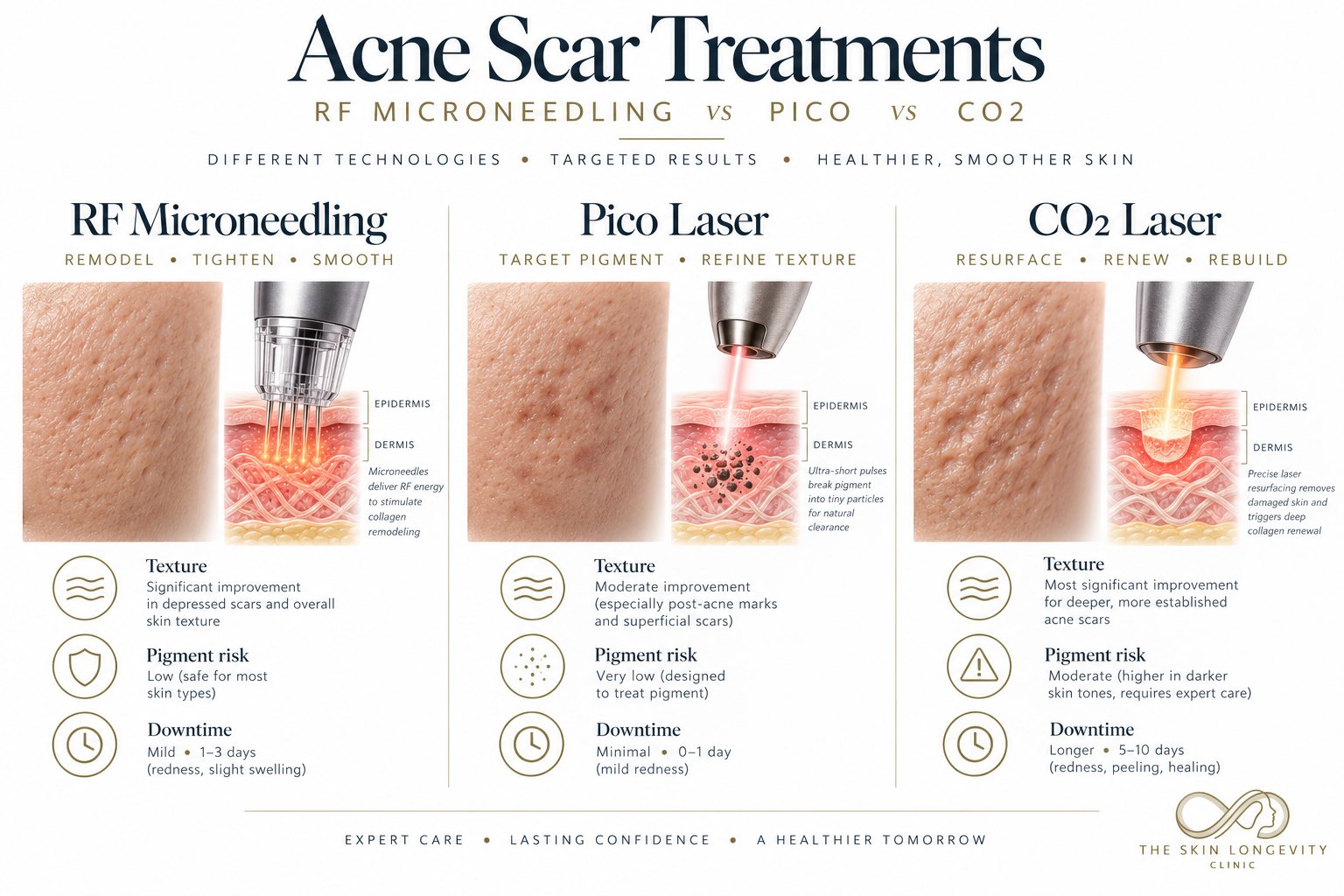
RF microneedling vs pico laser vs CO2 laser comparison table
| RF microneedling | Fractional pico laser | Fractional CO2 laser | |
|---|---|---|---|
| Scar types | Rolling, boxcar, pores, early laxity | Shallow rolling, pores, scars with PIH | Deep boxcar, broad atrophic areas |
| Surface damage | Minimal | Minimal | Ablative |
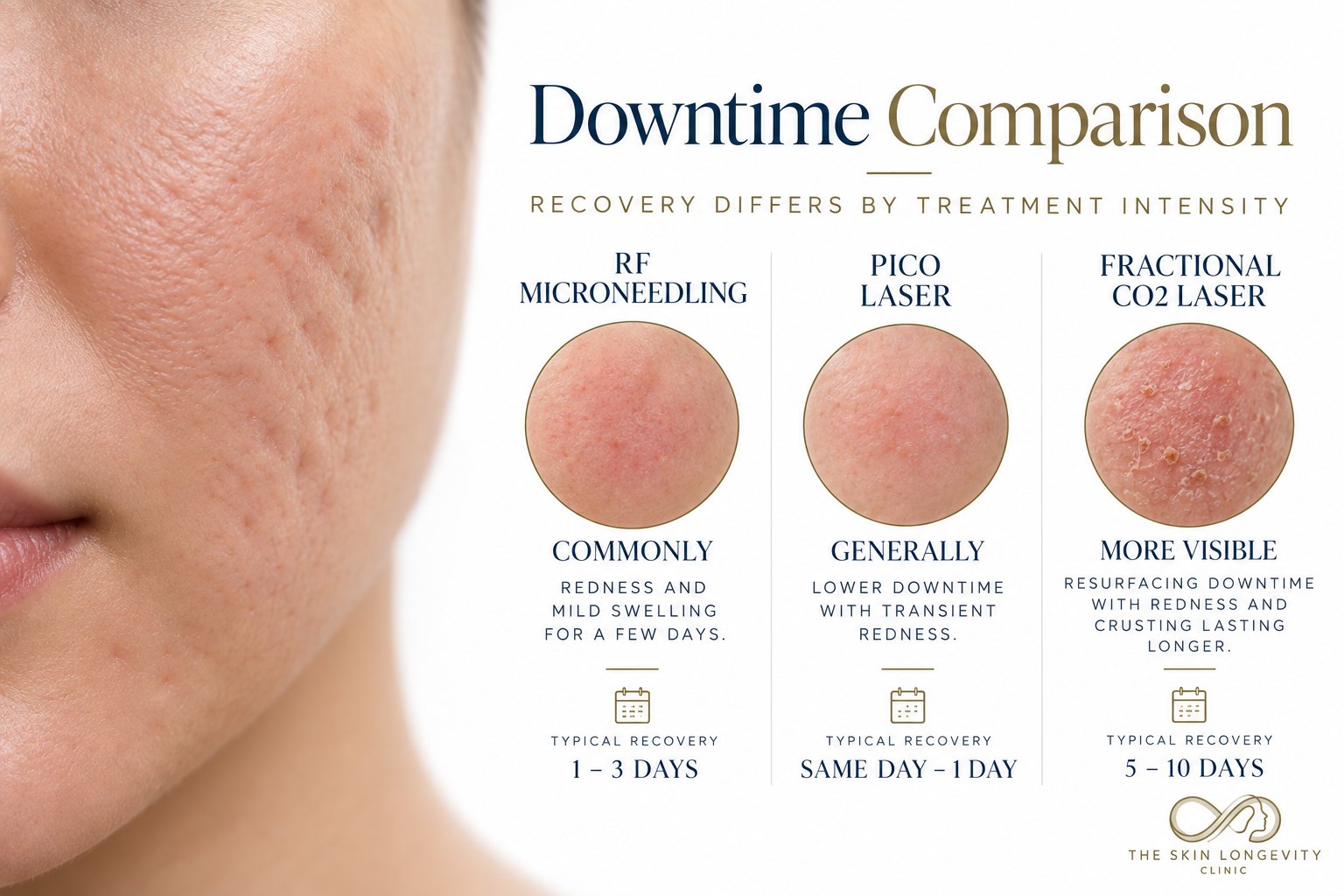
| Downtime | 2 to 4 days | 1 to 3 days | 5 to 7 days |
| PIH risk (Asian skin) | Low3 | Low2 | Higher2,3 |
| Pain | Moderate (numbing cream) | Mild to moderate | Higher3 |
| Sessions | 3 to 4 | 3 to 6 | 1 to 3 |
| Evidence | Multiple randomised trials, 2 meta-analyses | Randomised split-face trials | Largest effect size in randomised trials |
Which acne scar treatment is right for Asian skin?
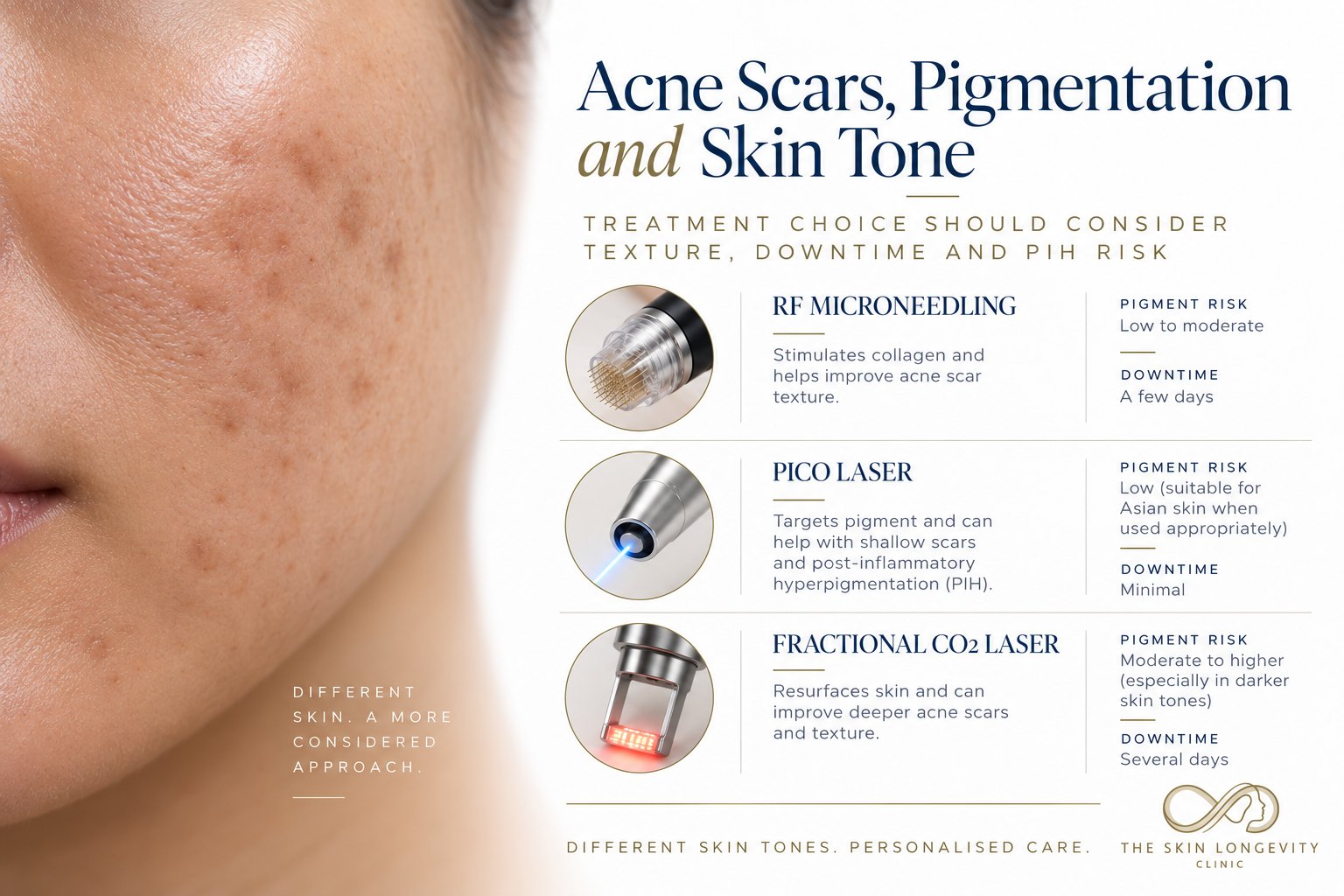
The choice follows three considerations in order. The first is scar type, with ice-pick scars treated by TCA CROSS (chemical reconstruction of skin scars with trichloroacetic acid) and tethered rolling scars by subcision before an energy device treats the remaining texture. The second is skin type, and for Fitzpatrick type IV to V skin or a history of PIH, RF microneedling or pico are preferred while CO2 is reserved for deep scars treated with conservative settings. The third is downtime, as patients who cannot take a week away from work choose RF microneedling or pico. The clinic’s full scar framework is set out under acne scar treatment in Singapore.
Dr Rachel Ho discusses microneedling and RF microneedling for acne scars, pores and skin texture in her doctor’s guide to RF microneedling.
Acne scar treatment comparison FAQs
Is RF microneedling better than CO2 laser for acne scars?
CO2 gives the larger change per session, whereas RF microneedling gives a comparable result over a course with less PIH and shorter downtime3,4.
Is pico laser or RF microneedling better for acne scars?
Pico suits shallow scars and pigmentation, and RF microneedling suits depth and pores. Combining them did not add benefit in one trial5.
Can RF microneedling and pico laser be done in the same session?
They can be sequenced within one treatment plan, but same-day stacking is not routine at the clinic.
Which acne scar treatment has the least downtime?
Fractional pico laser has the least downtime, followed by RF microneedling.
Which has the lowest pigmentation risk?
Pico and RF microneedling carry the lowest pigmentation risk, because both spare the epidermis2,3.
Selected references
- Tan MG, Jo CE, Chapas A, Khetarpal S, Dover JS. Radiofrequency Microneedling: A Comprehensive and Critical Review. Dermatol Surg. 2021;47(6):755-761. doi:10.1097/DSS.0000000000002972. PMID 33577211.
- Sirithanabadeekul P, Tantrapornpong P, Rattakul B, Sutthipisal N, Thanasarnaksorn W. Comparison of Fractional Picosecond 1064-nm Laser and Fractional Carbon Dioxide Laser for Treating Atrophic Acne Scars: A Randomized Split-Face Trial. Dermatol Surg. 2021;47(2):e58-e65. doi:10.1097/DSS.0000000000002572. PMID 32910030.
- Argobi Y, Tobeigei F, Alasiri FI. Fractional CO2 Laser Versus Micro Needling Radiofrequency for Post Acne Scarring: A Meta-Analysis of RCTs. J Cosmet Dermatol. 2026;25(3):e70765. doi:10.1111/jocd.70765. PMID 41821146.
- Hendel K, Karmisholt K, Hedelund L, Haedersdal M. Fractional CO2-laser versus microneedle radiofrequency for acne scars: a randomized, single treatment, split-face trial. Lasers Surg Med. 2023;55(4):335–343. doi:10.1002/lsm.23655.
- Darji K, Zarbafian M, Ishii L, Zubair R, Cho S, Zhou X, et al. Evaluating the Picosecond 755-nm Alexandrite Laser With Diffractive Lens Array and Radiofrequency Microneedling for the Treatment of Atrophic Acne Scarring. Dermatol Surg. 2025;51(9S):S69-S76. doi:10.1097/DSS.0000000000004817. PMID 41405932.
- Chae WS, Seong JY, Jung HN, Kong SH, Kim MH, Suh HS, et al. Comparative study on efficacy and safety of 1550 nm Er:Glass fractional laser and fractional radiofrequency microneedle device for facial atrophic acne scar. J Cosmet Dermatol. 2015;14(2):100-6. doi:10.1111/jocd.12139. PMID 25810322.