

Q-Switch Laser Treatment in Singapore (Nd:YAG 1064 nm)

Q-switched (QS) Nd:YAG 1064 nm laser is one of the most established pigment-targeting lasers in dermatology. It is used lightening hyperpigmentation and tattoo ink, and treating acne, especially for Asians and patients with darker skin. Treatment plans at The Skin Longevity Clinic are tailored to your skin type, pigment depth, and tendency for post-inflammatory hyperpigmentation, which is especially relevant in Asian skin.

Medically reviewed by Dr Rachel Ho, MBBS, MRCS, MMed (ENT), 6 October 2026.

What is a Q-switched laser treatment?

A Q-switched laser is a laser system engineered to deliver very short, high-energy pulses (in the nanosecond range). These ultra-short pulses create a photoacoustic effect that fragments pigment particles (melanin clusters or tattoo ink) into smaller pieces that the body can gradually clear. 


For the Nd:YAG 1064 nm wavelength, the light penetrates relatively deeper than shorter wavelengths and is generally safer in darker skin tones compared with some other pigment lasers, when used appropriately.

What can q-switch laser treat?

When appropriately selected and performed, QS Nd:YAG 1064 nm may help with:


  • Tattoo removal 
  • Hyperpigmentation
  • Acne
  • Skin clarity

Q-switch laser for pigmentation and melasma

Freckles and sun spots: Q-switched lasers are an established option. In a randomised split-face trial in Asian patients, Q-switched alexandrite laser cleared freckles better than intense pulsed light1. PIH is more common after Q-switched than after long-pulsed treatment in darker skin (22% vs 6% of patients), so energy is set for each spot2.

Melasma: low-fluence Q-switched Nd:YAG 1064 nm (“laser toning”) gave results similar to medical treatment in a meta-analysis of 12 studies. Laser combined with medication gave more improvement3. Repeated toning can leave mottled white spots4, so courses are limited and combined with sunscreen and topical treatment. Adding fractional microneedle radiofrequency lowered the rate of rebound pigmentation compared with toning alone5.

For some pigment, a picosecond laser is chosen instead. See pico laser in Singapore and the pigmentation treatment guide.

How does the Q-switched laser treatment laser work?

Melanin or pigment particles in the skin reside in:


  • the epidermis and/or 
  • the dermis 


Q-switched laser pulses create a photoacoustic impact that breaks pigment into smaller fragments. These fragments are then cleared over time by the skin’s immune cells and lymphatic drainage channels.

Q-switch laser vs pico laser for pigmentation

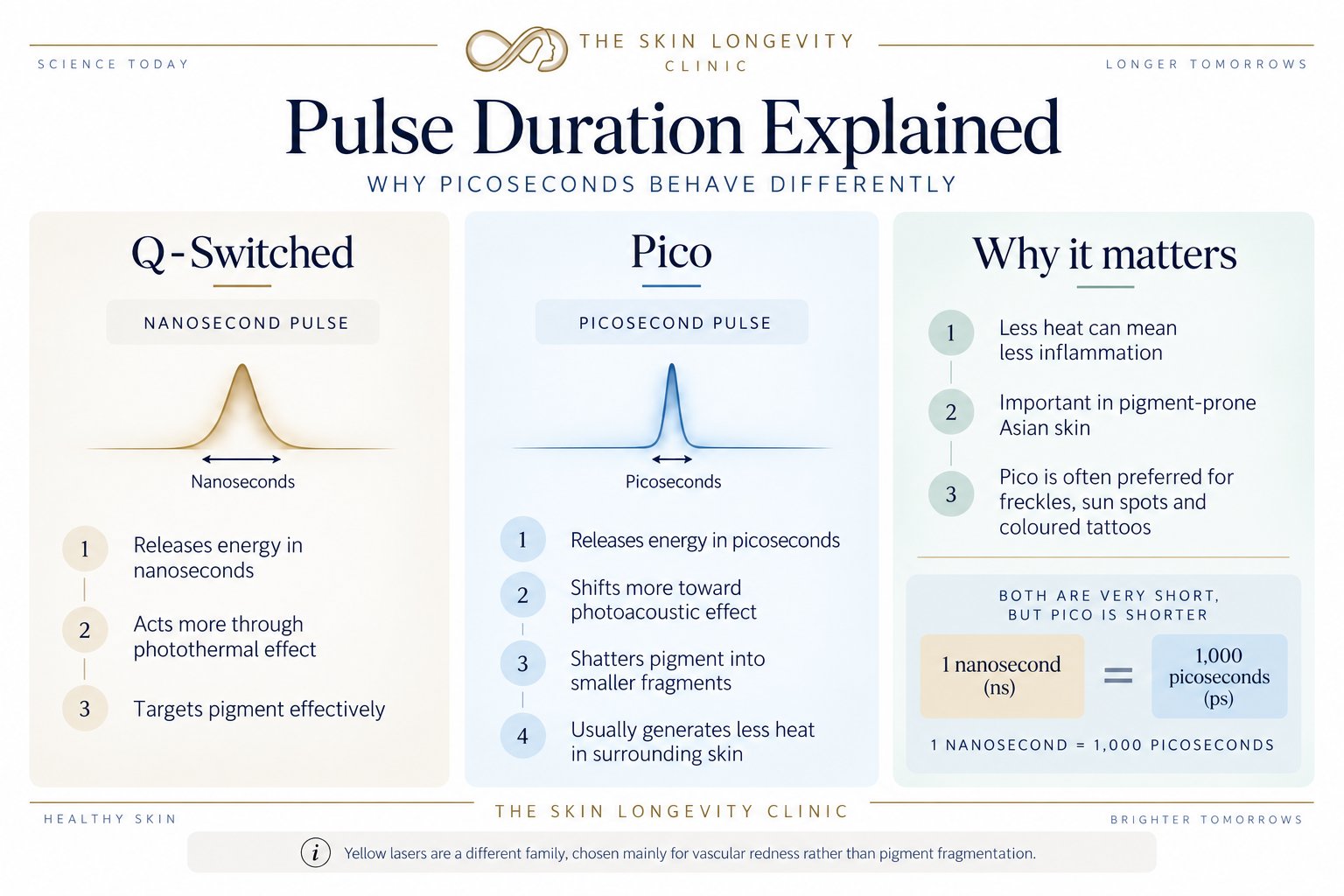
Q-switch laser and pico laser both break up pigment, but a picosecond pulse is about a thousand times shorter than a nanosecond pulse, so more of the energy works by photoacoustic fragmentation and less spreads as heat.

Q-switch laser nanosecond pulse vs pico laser picosecond pulse: 1 nanosecond equals 1,000 picoseconds, and shorter pulses generate less heat
Pulse duration: Q-switched nanoseconds vs pico picoseconds.

In two randomised split-face trials in Asian patients, picosecond laser cleared sun spots and mixed pigmented lesions more than Q-switched laser6,7. In the sun spot trial, post-inflammatory hyperpigmentation followed 5% of picosecond-treated sides and 30% of Q-switched sides7. Q-switched Nd:YAG remains an established option, particularly low-fluence toning for melasma alongside topical treatment3, and the choice follows the diagnosis rather than the device.

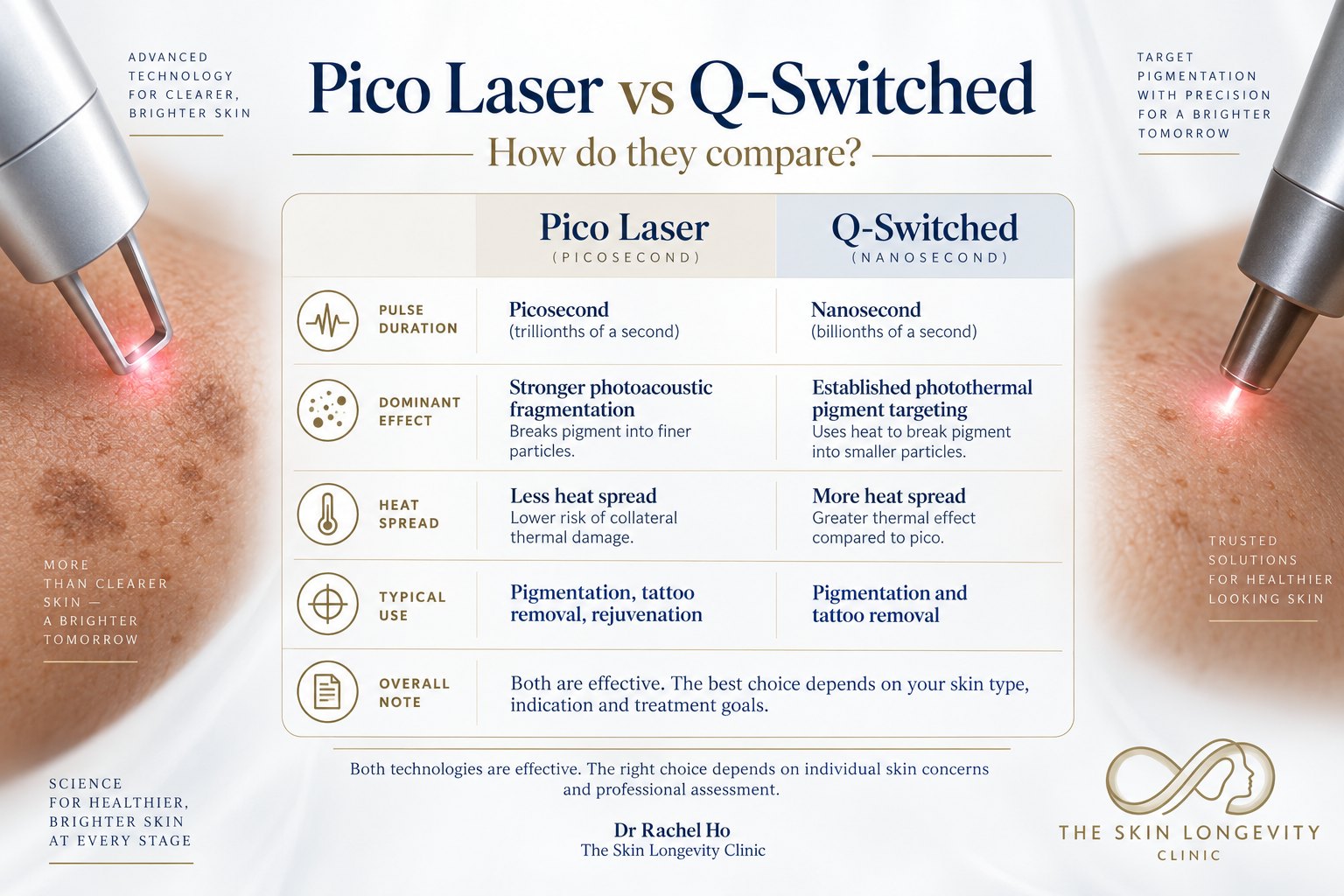
Q-switch laserPico laser
Pulse durationNanoseconds (billionths of a second)Picoseconds (trillionths of a second)
Main effectPhotothermal and photoacousticMainly photoacoustic, with less heat in surrounding skin
Sun spots and lentiginesEffective; post-inflammatory hyperpigmentation in 30% of sides in one trial7More clearance and PIH in 5% of sides in the same trial7
Mixed epidermal and dermal pigment (including Hori’s naevus)Over 50% improvement in 57% of sites at six months6Over 50% improvement in 86% of sites, with less discomfort6
Melasma toningEstablished low-fluence toning; best combined with topical treatment3Low-fluence toning also used; choice depends on response and history
DiscomfortSnapping sensationRated less uncomfortable in a split-face trial6
Q-switch laser vs pico laser in Singapore: nanosecond vs picosecond pulse, photothermal vs photoacoustic effect, heat spread and typical uses
Q-switch laser vs pico laser: how the two pigment lasers compare.

See our pico laser in Singapore page and the guide to pico laser vs Q-switched vs yellow laser.

Q-switch laser vs pico laser and other lasers

QS Nd:YAG 1064 vs long-pulse lasers?

  • QS is designed for pigment fragmentation (photoacoustic).
  • Long-pulse lasers are more photothermal (heat-based) and are often used for vessels, hair, or collagen remodeling.


QS Nd:YAG vs Pico lasers

  • Picosecond lasers deliver even shorter pulses and can be more efficient for some pigments and tattoos, but treatment choice depends on lesion type, skin tone, budget, and risk profile.


QS Nd:YAG vs Fractional lasers

Fractional lasers are better for improving skin texture, pores, scars, and remodeling. They can also lighten hyperpigmentation but may carry higher PIH risk in some skin types if not selected carefully.

Q-switch laser FAQs

What is the Q-switched laser treatment like?

A typical session at The Skin Longevity Clinic involves:

  1. Skin assessment and diagnosis  
  2. Photos and evaluation
  3. Cleansing and eye protection
  4. Laser delivery in controlled passes 
  5. Recovery treatment

Session time is usually 15–20 minutes .

Is there downtime for Q-switched laser treatment?

Most patients have minimal downtime:

  • mild redness/warmth for a few hours
  • occasionally subtle swelling
  • for targeted spots (e.g., lentigines), temporary darkening and light flaking can occur

If you are treating melasma/PIH, we typically aim for lower inflammation, because irritation itself can worsen pigment.

How soon can I see results?

  • Tattoo ink: gradual fading over multiple sessions; clearance continues between sessions as the body processes fragmented ink.
  • Hyperpigmentation and acne: often noticeable change within 1–3 sessions, over 4 weeks.

Can Q-switched laser treatment be combined with other aesthetic treatments?

Yes—combination plans are common in evidence-informed pigment management, but must be sequenced carefully to avoid irritation. Q-switched laser treatment can be combined with chemical peels and other hyperpigmentation medical treatments. 


Key principle: more aggressive is not better for pigment-prone skin. Over-treating increases PIH risk.

How safe are Q-switched Nd:YAG treatments?

In the hands of experienced doctors and the right diagnosis and settings, QS Nd:YAG 1064 is widely used and can be safe across many skin types. 

That said, reputable medical literature highlights specific risks, especially with repeated “laser toning” for melasma:

  • Rebound hyperpigmentation
  • Mottled hypopigmentation (rare but significant; risk increases with overly frequent or overly aggressive protocols, and in darker skin tones) 

This is why your consultation and evaluation matters: the safest laser is the one used for the right diagnosis, with skin-type appropriate parameters, and with a plan that protects the skin barrier and reduces inflammation.

Is Q-switch laser better than pico laser?

Not for most pigment. In randomised split-face trials in Asian patients, pico laser cleared sun spots and mixed pigmented lesions more than Q-switched laser, with less post-inflammatory hyperpigmentation after sun spot treatment6,7. Q-switched Nd:YAG 1064 nm remains an effective option, especially low-fluence toning for melasma combined with topical treatment3.

How many Q-switch laser sessions are needed?

Discrete freckles and sun spots often need one to three sessions. Melasma toning is given as a limited course with topical treatment and sun protection, because repeated toning can leave mottled white spots3,4. Tattoos need multiple sessions several weeks apart.

Can Q-switch laser remove melasma permanently?

No. Low-fluence Q-switched toning can lighten melasma, and results are better when it is combined with medication3, but melasma tends to recur with sun, heat and hormones. Adding fractional microneedle radiofrequency lowered rebound pigmentation in one study5. Ongoing sunscreen and topical care are needed. See our melasma treatment guide.

Is Q-switch laser painful?

Most people feel a snapping or flicking sensation. Toning passes are usually tolerated without numbing, while spot treatment feels stronger, so a topical anaesthetic cream can be applied first.

Dr Rachel Ho on q-switch laser

Q-switched Nd:YAG 1064 nm is an established laser treatment in dermatology for pigment, tattoo ink and acne. The best outcomes come from matching the laser physics to your pigment biology: where the pigment sits, why it formed, and how your skin responds to inflammation. Evidence reviews and clinical studies consistently show that results are achievable, but complications can occur when protocols are overly aggressive, so treatment should be medically guided and combined with long-term pigment control strategies.

References

  1. Wang CC, et al. A comparison of Q-switched alexandrite laser and intense pulsed light for the treatment of freckles and lentigines in Asian persons: a randomized, physician-blinded, split-face comparative trial. J Am Acad Dermatol. 2006;54(5):804–10. doi:10.1016/j.jaad.2006.01.012.
  2. Ho SG, et al. A comparison of Q-switched and long-pulsed alexandrite laser for the treatment of freckles and lentigines in oriental patients. Lasers Surg Med. 2011;43(2):108–13. doi:10.1002/lsm.21045.
  3. Chen J, et al. Efficacy of low-fluence 1064 nm Q-switched Nd: YAG laser for the treatment of melasma: A meta-analysis and systematic review. J Cosmet Dermatol. 2022;21(7). doi:10.1111/jocd.15126.
  4. Chan NP, et al. A case series of facial depigmentation associated with low fluence Q-switched 1,064 nm Nd:YAG laser for skin rejuvenation and melasma. Lasers Surg Med. 2010;42(8):712–9. doi:10.1002/lsm.20956.
  5. Kwon HH, et al. Combined treatment of melasma involving low-fluence Q-switched Nd:YAG laser and fractional microneedling radiofrequency. J Dermatolog Treat. 2019;30(4):352–356. doi:10.1080/09546634.2018.1516858.
  6. Ungaksornpairote C, Manuskiatti W, Junsuwan N, Wanitphakdeedecha R. A prospective, split-face, randomized study comparing picosecond to Q-switched Nd:YAG laser for treatment of epidermal and dermal pigmented lesions in Asians. Dermatol Surg. 2020;46(12):1671–5. doi:10.1097/DSS.0000000000002486. PMID 32604235.
  7. Kim JY, Yang J, Huh G, Choi YJ, Kim WS. A split-face, single-blinded, randomized controlled comparison of 532 nm picosecond Nd:YAG laser versus 532 nm Q-switched Nd:YAG laser in the treatment of solar lentigines. Ann Dermatol. 2020;32(1):8–13. doi:10.5021/ad.2020.32.1.8. PMID 33911703.