

19 Oct CaHA Collagen Biostimulator (Radiesse), a Doctor’s Guide to Face, Neck, Hands and Body
By Dr Rachel Ho | Aesthetic Doctor, Founder, The Skin Longevity Clinic, Singapore
Medically reviewed by Dr Rachel Ho, MBBS, MRCS, MMed (ENT), 19 October 2026.
Dr Rachel Ho is an aesthetic doctor and the founder of The Skin Longevity Clinic. She holds an MBBS from the National University of Singapore, the MRCS (Edinburgh) and a Master of Medicine, with more than 16 years of clinical experience spanning facial reconstructive surgery and aesthetic medicine. Her work has been featured in Vogue Singapore, Harper’s Bazaar, CNA Lifestyle and The Straits Times. She also writes about skincare science at drrachelho.com.
Calcium hydroxylapatite (CaHA), sold as Radiesse, is the collagen biostimulator most often chosen when a patient wants a visible change on the day of treatment and firmer skin in the months after. This guide explains what CaHA is made of, how it differs from hyaluronic acid fillers and from poly-L-lactic acid (PLLA, sold as Sculptra) and other biostimulators, which areas it treats, how long results last and what the risks are.
Key takeaways on CaHA collagen biostimulators
- CaHA is calcium hydroxylapatite, the mineral found in bone, supplied as microspheres in a gel carrier. The gel gives immediate volume, and the microspheres build collagen and elastin over 2 to 3 months.1
- Undiluted, CaHA is a contouring filler for the jawline, chin and cheeks. Hyperdiluted with saline, it firms lax skin on the neck, hands and body without adding volume.2
- In a randomised trial of 205 patients, CaHA lasted longer and needed less product than three hyaluronic acid fillers.3
- Results last about 12 to 18 months. In over 5,000 treatments, 3% had an adverse event, nearly all small nodules that resolved on their own.4
What is a CaHA collagen biostimulator made of?
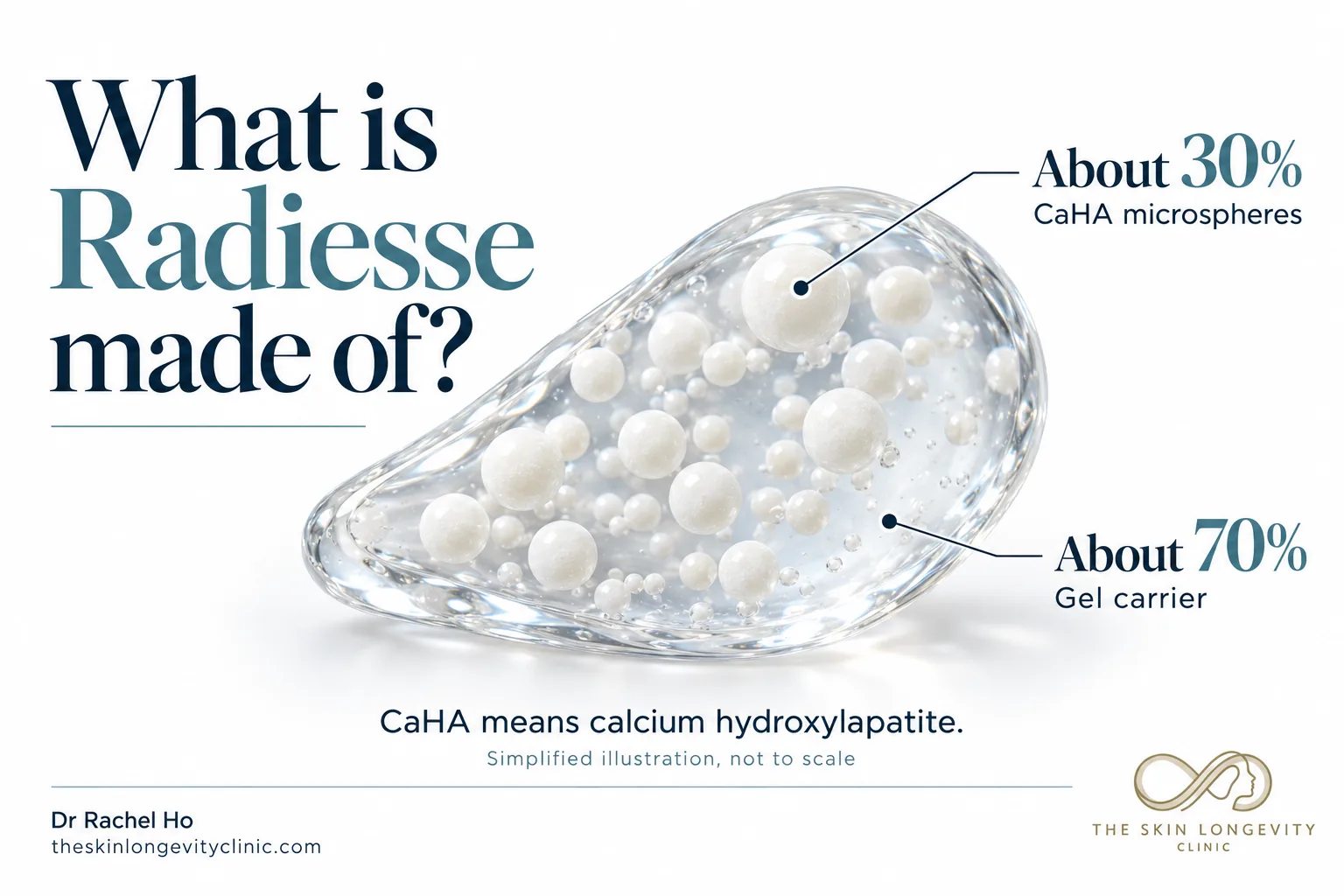
CaHA injectables contain 30% calcium hydroxylapatite microspheres, 25 to 45 micrometres across, roughly half the width of a human hair, suspended in 70% carboxymethylcellulose gel.1 Calcium hydroxylapatite is the mineral that gives bone and teeth their hardness, so the body recognises it and breaks it down over time without a foreign-body reaction.
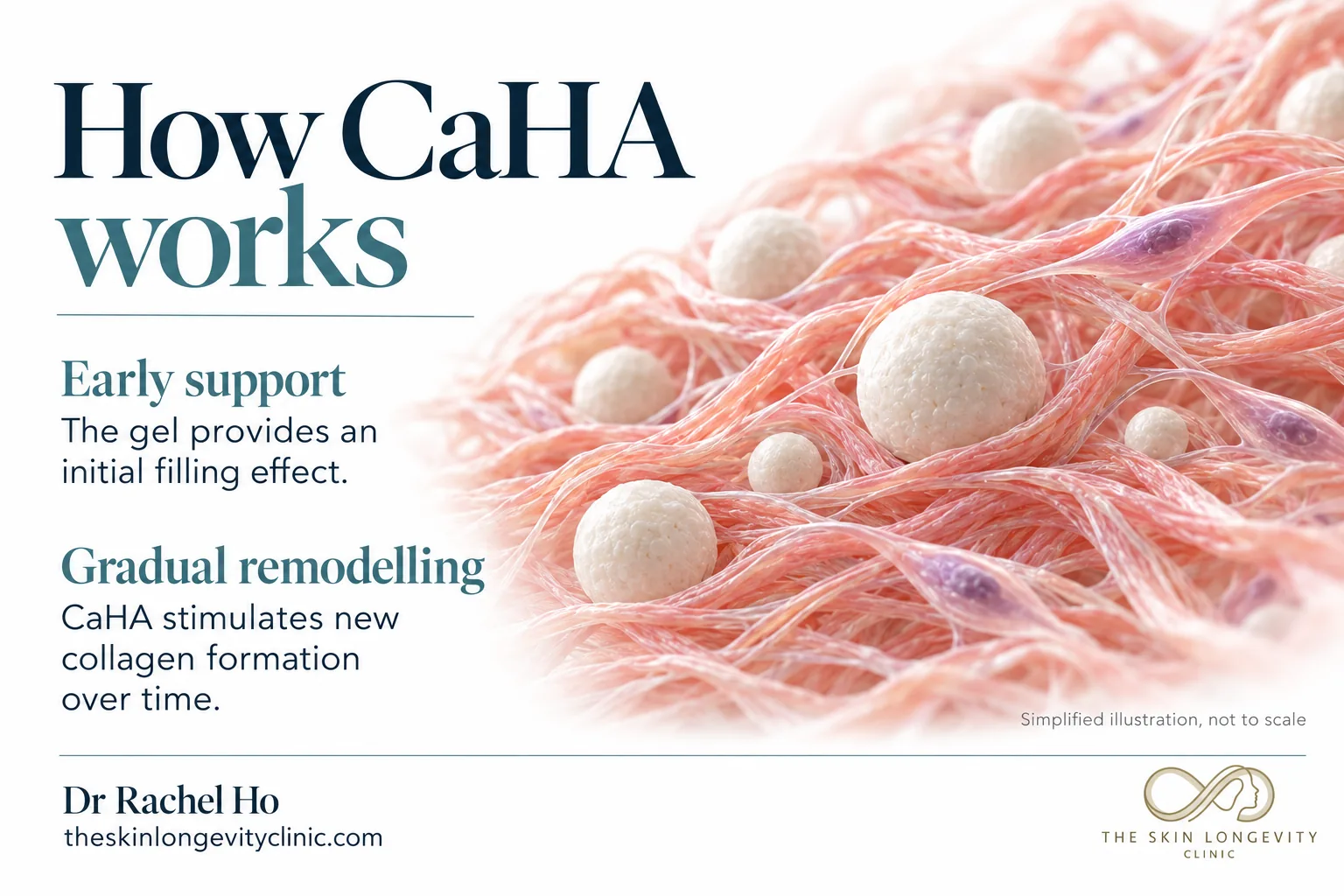
After injection, the gel is absorbed over several weeks. The microspheres stay in place and act as a scaffold, around which fibroblasts, the cells that produce collagen, gather and lay down new collagen, elastin and small blood vessels. Over 12 to 18 months, the microspheres are broken down into calcium and phosphate ions and cleared.1
How does CaHA differ from a hyaluronic acid filler?
Hyaluronic acid fillers hold water and add volume for as long as the gel remains. CaHA adds volume through its gel for a few weeks and then through new collagen, so the result outlasts the product itself. In a randomised multicentre trial of 205 patients, CaHA corrected nasolabial folds with 2.2 mL of product, compared with 2.9 to 4.8 mL for three hyaluronic acid fillers, was rated improved in more patients at 8 months and scored highest for satisfaction.3 The trade-off is that CaHA cannot be dissolved with hyaluronidase, so it is placed with more caution in thin or mobile areas.
CaHA vs PLLA (Radiesse vs Sculptra), which collagen biostimulator?
This is the comparison patients ask about most often, because both products build collagen but differ in what is visible on the day and in where each performs best.
| CaHA | PLLA | |
|---|---|---|
| What you see on the day | Immediate lift or volume | Nothing, as the water carrier is absorbed in days |
| Collagen effect | 6 weeks to 3 months | 3 to 6 months |
| Sessions | 1 to 3 | 2 to 3, 4 to 6 weeks apart |
| Best areas | Jawline, chin, neck, hands, body laxity, acne scars | Cheeks, temples, diffuse facial volume loss, cellulite, body skin quality |
| Lasts | 12 to 18 months | 18 to 24 months |
| Can be dissolved | No | No |
CaHA is chosen when the goal is definition, a visible result at the first visit, or firming of the neck, hands or body. PLLA is chosen for diffuse volume loss across the face, for cellulite, or when a slower, more gradual change is preferred. The two are often used together, with CaHA for the jawline and PLLA for the cheeks. The PLLA collagen biostimulator page covers Sculptra in detail, and the full collagen biostimulators guide covers poly-D,L-lactic acid (PDLLA), polycaprolactone (PCL) and polydeoxyribonucleotide (PDRN).
What is comparable to CaHA?
PCL is the closest match, since it also combines a gel carrier for immediate volume with microspheres that stimulate collagen, and its result lasts longer. PLLA and PDLLA stimulate collagen without an immediate filling effect. No other biostimulator is approved for hand volume loss. See collagen biostimulator treatments in Singapore.
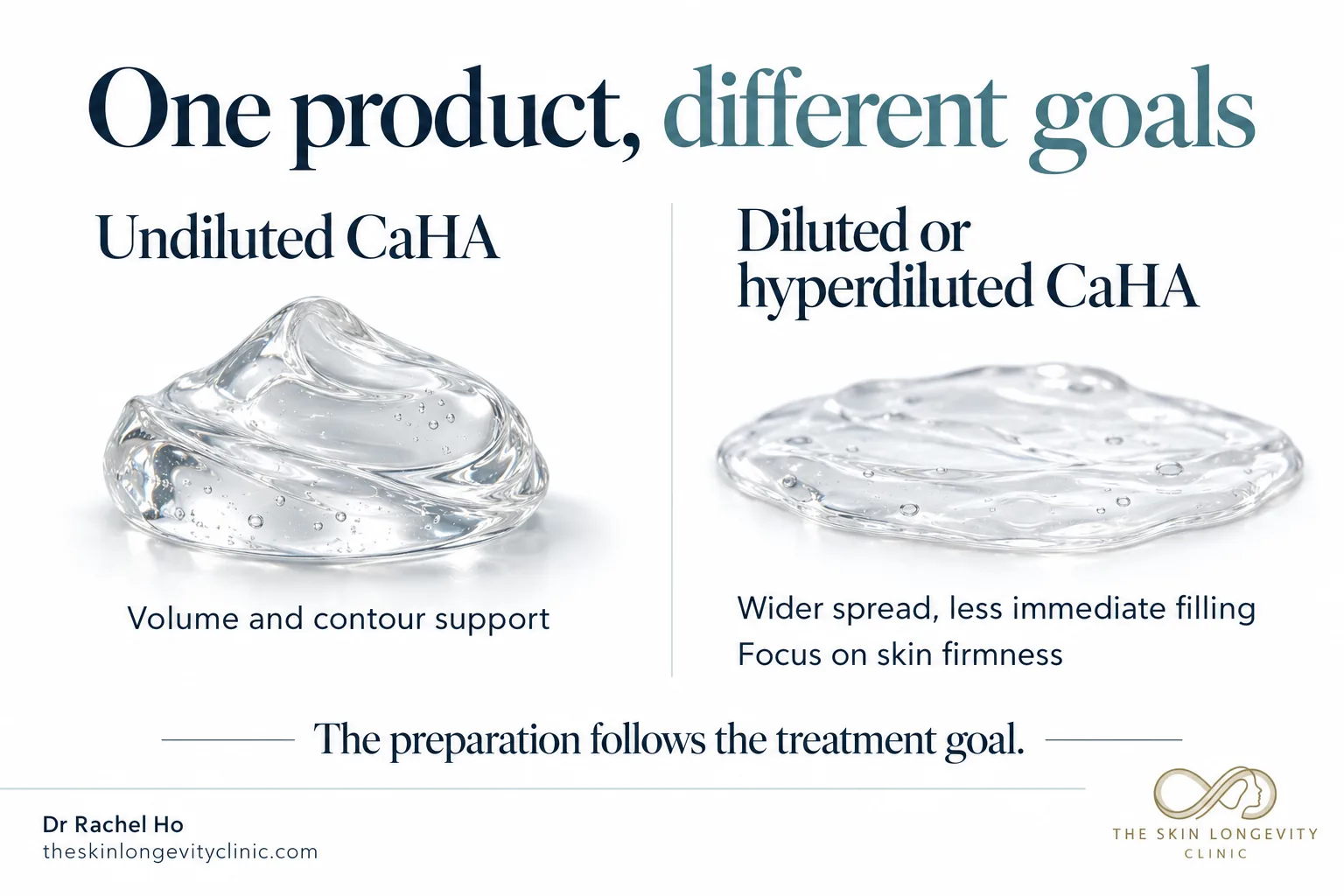
Undiluted vs hyperdiluted CaHA
The same product is used in two ways, and the dilution decides whether it fills or firms.
- Undiluted CaHA is a firm gel placed deep, on bone or in the deep fat, to lift and define, and one session is usually enough.
- Diluted (1 to 1) and hyperdiluted (1 to 2 up to 1 to 6) CaHA is mixed with saline and lidocaine and spread in a thin layer under the skin. The volume effect disappears, whereas the collagen effect remains. A global consensus of 14 physicians recommends this for the mid and lower face, neck, décolletage, upper arms, abdomen, thighs and buttocks, with higher dilution in thinner and darker skin.2 A second consensus sets out dilution, dose and session intervals area by area.5
Which areas can CaHA treat?
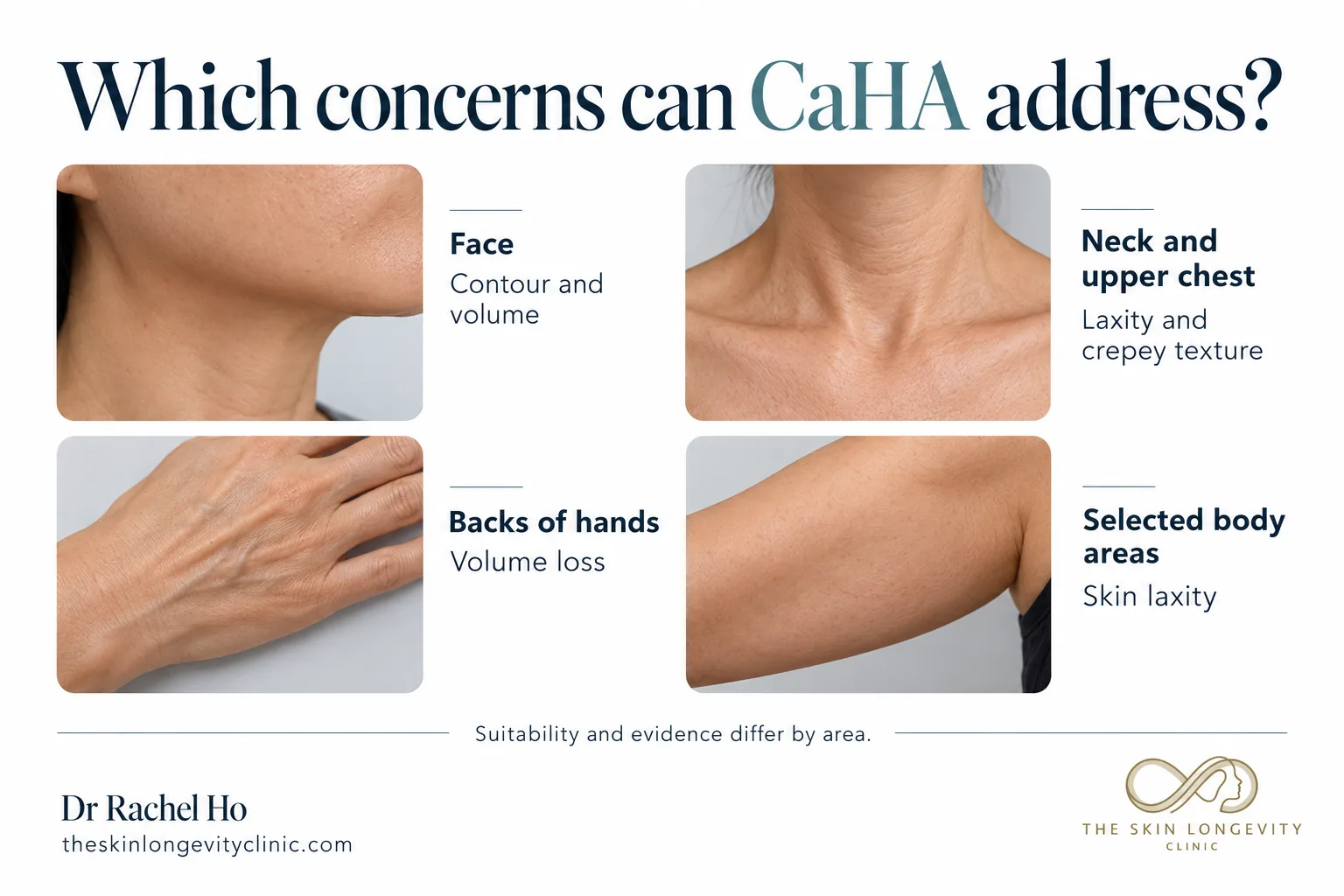
The same product, at different dilutions, treats the face, neck, hands and body. The area-by-area evidence, sessions and recovery are on the CaHA collagen biostimulator in Singapore page.
- Jawline and chin are treated with undiluted CaHA in one session, for a sharper, firmer outline. Its firmness suits bone-like contours better than softer hyaluronic acid gels.
- Neck and décolletage are treated with hyperdiluted CaHA to firm crepey skin and soften horizontal lines.
- Lower face and early jowls are treated with hyperdiluted CaHA sequenced after energy-based tightening, six weeks after the device session.
- Hands receive CaHA as a thin layer over the back of the hand, and it is the one biostimulator approved for hand volume loss.2
- Upper arms, abdomen, thighs, buttocks and knees are treated with hyperdiluted CaHA for loose body skin, with consensus dilution and dose for each area.5
- Broad, shallow acne scars are lifted with diluted CaHA, whereas ice-pick scars need a different treatment.
Sequencing CaHA with energy-based skin tightening
CaHA is often combined with microfocused ultrasound or radiofrequency, since the device tightens existing collagen while CaHA builds new collagen. In a 2025 randomised pilot study of 12 women, microfocused ultrasound first and hyperdiluted CaHA six weeks later produced a 143% increase in elastin coverage at 120 days, against 63% when CaHA came first, with better aesthetic scores.6 The device session first and CaHA six weeks later is the sequence used at the clinic with HIFU and XERF. HIFU is high intensity focused ultrasound, and XERF is a radiofrequency skin tightening device.
CaHA results timeline, what to expect and when
| Time | What you see |
|---|---|
| Day 0 | Volume or contour change (undiluted). Mild swelling. |
| Days 1 to 7 | Bruising and swelling settle. |
| Weeks 2 to 6 | Gel absorbs. Hyperdiluted areas look the same as before. |
| Weeks 6 to 12 | New collagen builds and skin feels firmer and thicker. |
| Months 3 to 12 | Peak result holds. |
| Months 12 to 18 | Gradual fade. Maintenance session planned. |
Results last about 12 to 18 months.1,3 Published before-and-after photographs are in the consensus papers and case series cited below, and the clinic does not publish patient photographs.
CaHA side effects, lumps and safety
Bruising, swelling, tenderness and firmness for a few days are expected.
In a review of 21 studies covering 5,081 CaHA treatments in 2,779 patients, 173 adverse events (3%) were reported. Nodules made up 96% of them, and most were not visible and resolved without treatment. Half the nodules occurred in mobile areas such as the lips, where muscle movement pushes the product into clumps.4 Superficial injection of under-diluted product in thin or darker skin raises the risk, so dilution and depth are matched to the skin.2
CaHA cannot be dissolved, so nodules are treated with massage, saline or steroid injection, and most settle with these measures. CaHA is not used in the lips, during pregnancy or breastfeeding, or over active infection.
Who should consider CaHA?
- Patients in their 30s to 60s with a softening jawline, early jowls or a weak chin.
- Crepey or loose skin on the neck, décolletage, arms, abdomen, thighs or buttocks.
- Thinning skin on the backs of the hands.
- Broad, shallow acne scars.
- Patients who want a visible result at the first visit, not only a gradual one.
CaHA is less suitable for the lips, the tear trough and very thin skin, because movement and thin cover make nodules more likely and the product cannot be dissolved, so PDLLA or a hyaluronic acid skin booster is chosen instead.
CaHA FAQs
Is CaHA a filler or a collagen biostimulator?
CaHA is both, since the gel fills for a few weeks and the microspheres stimulate collagen for months.
What is CaHA made of?
CaHA is made of calcium hydroxylapatite microspheres, the same mineral as bone, suspended in a carboxymethylcellulose gel.
Is CaHA safe?
CaHA has a long safety record, and in a review of over 5,000 treatments, 3% had an adverse event, nearly all small nodules that resolved on their own.
What causes CaHA lumps?
Nodules form when product is placed too superficially, under-diluted in thin skin, or in mobile areas such as the lips. Most are not visible and settle without treatment.
Does hyperdiluted CaHA give volume?
Hyperdiluted CaHA does not add volume, because at 1 to 2 dilution or more the gel is too thin to fill, and it firms skin through new collagen instead.
Is CaHA better than hyaluronic acid filler?
For lift and longevity, CaHA outperformed three hyaluronic acid fillers in a 205-patient randomised trial. Hyaluronic acid remains the choice for lips, tear troughs and anywhere a reversible result matters.
What is comparable to CaHA?
Polycaprolactone is the closest match, as it also pairs an immediate gel volume with microspheres that stimulate collagen. PLLA and PDLLA stimulate collagen without the immediate filling effect.
Book a CaHA consultation
Dr Rachel Ho assesses whether undiluted or hyperdiluted CaHA suits the area and plans any combination with HIFU or XERF. See the CaHA collagen biostimulator in Singapore page, call +65 6514 2688, or book through the contact page.
Selected References
- Aguilera SB, McCarthy A, Khalifian S, Lorenc ZP, Goldie K, Chernoff WG. The Role of Calcium Hydroxylapatite (Radiesse) as a Regenerative Aesthetic Treatment: A Narrative Review. Aesthet Surg J. 2023;43(10):1063–1090. doi:10.1093/asj/sjad173. Product studied: Radiesse (calcium hydroxylapatite).
- Goldie K, Peeters W, Alghoul M, et al. Global Consensus Guidelines for the Injection of Diluted and Hyperdiluted Calcium Hydroxylapatite for Skin Tightening. Dermatol Surg. 2018;44 Suppl 1:S32–S41. doi:10.1097/DSS.0000000000001685. Product studied: Radiesse (calcium hydroxylapatite).
- Moers-Carpi M, Vogt S, Santos BM, et al. A multicenter, randomized trial comparing calcium hydroxylapatite to two hyaluronic acids for treatment of nasolabial folds. Dermatol Surg. 2007;33 Suppl 2:S144–151. doi:10.1111/j.1524-4725.2007.33354.x. Product studied: Radiesse (calcium hydroxylapatite).
- Kadouch JA. Calcium hydroxylapatite: A review on safety and complications. J Cosmet Dermatol. 2017;16(2):152–161. doi:10.1111/jocd.12326. Product studied: Radiesse (calcium hydroxylapatite).
- de Almeida AT, Figueredo V, da Cunha ALG, et al. Consensus Recommendations for the Use of Hyperdiluted Calcium Hydroxyapatite (Radiesse) as a Face and Body Biostimulatory Agent. Plast Reconstr Surg Glob Open. 2019;7(3):e2160. doi:10.1097/GOX.0000000000002160. Product studied: Radiesse (calcium hydroxylapatite).
- Doyle A, Looi I, Chu P. Microfocused Ultrasound With Visualization (MFU-V) and Hyperdilute Calcium Hydroxylapatite (CaHA-CMC) of the Lower Face and Submentum to Treat Skin Laxity: A Pilot Study. Aesthet Surg J. 2025;45(3):305–312. doi:10.1093/asj/sjae226. Product studied: Radiesse (calcium hydroxylapatite).