


15 Aug GLP-1 Skin Changes and Skin Longevity in Singapore
By Dr Rachel Ho | Aesthetic Doctor, Founder, The Skin Longevity Clinic, Singapore
By Dr Rachel Ho | Aesthetic Doctor, Founder, The Skin Longevity Clinic, Singapore
Medically reviewed by Dr Rachel Ho, MBBS, MRCS, MMed (ENT), August 2026.
GLP-1 based medicines can change the appearance of the face and skin during substantial weight loss. The most consistent explanations are facial fat loss, reduced tissue support, some loss of lean mass, lower food and fluid intake, and limited skin recoil rather than a proven direct ageing effect of the medicine itself1,2.
GLP-1 skin longevity focuses on preserving facial structure, skin resilience, muscle, hair and recovery capacity throughout the weight loss journey. The approach combines medical supervision, adequate nutrition, resistance exercise, barrier care and carefully timed aesthetic treatment.
Skincare can improve dryness, comfort and surface texture during GLP-1 treatment. It cannot preserve every facial fat compartment, replace lost muscle or remove significant excess skin.
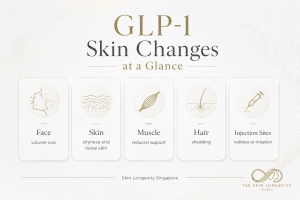
How can GLP-1 treatment affect the face, skin and hair? Reported concerns include facial volume loss, dryness, loose skin, reduced tissue support, hair shedding and temporary irritation around injection sites. Each concern has a different cause and should be assessed separately.
GLP-1 skin changes at a glance
GLP-1 skin changes at a glance
| Area | Changes that can occur | Likely contributors | First step |
|---|---|---|---|
| Face | Flatter cheeks, temple hollowing, deeper folds and jawline laxity | Facial fat loss, reduced support and limited skin recoil | Separate volume loss from laxity before choosing treatment |
| Skin | Dryness, crepey texture and loose folds | Reduced intake, dehydration, weight loss and age-related elasticity | Gentle cleansing, moisturiser, sunscreen and medical review where needed |
| Muscle | Reduced strength or lean mass in susceptible patients | Energy deficit, reduced intake and weight reduction | Resistance exercise, nutrition and body composition review |
| Hair | Diffuse shedding or more visible pattern hair loss | Telogen effluvium, nutritional insufficiency and possible medication association | Diagnose the type of hair loss before treatment |
| Injection site | Redness, itching, bruising or swelling | Local reaction to an injectable medicine | Rotate sites and seek review if the reaction is persistent or severe |
Skin quality and facial volume changes during GLP-1 treatment can be reviewed in a skin longevity assessment in Singapore.
What are GLP-1 agonists?
Glucagon-like peptide 1 receptor agonists influence appetite, satiety, insulin release and glucose regulation. Examples include semaglutide and liraglutide, while tirzepatide acts on both GIP and GLP-1 receptors and is commonly discussed within the same weight management category.
These are prescription medicines in Singapore, and the approved indication depends on the individual product.
Facial or skin concerns should be discussed without losing sight of the metabolic reason for treatment. Medication should not be reduced or stopped because of an aesthetic concern without speaking to the prescribing doctor.
Overviews of semaglutide for chronic weight management and of tirzepatide are listed in the references9,10.
Does GLP-1 treatment directly age the skin?
Current evidence has not established that GLP-1 medicines directly accelerate biological skin ageing in every patient. Most visible facial changes occur alongside substantial weight loss and resemble changes seen after bariatric surgery, restrictive dieting or weight loss achieved through other methods1,2.
Direct skin effects remain under investigation. Reviews have described injection site reactions, dryness, altered sensation, hair shedding and rare immune-mediated reactions, but much of the evidence comes from case reports, pharmacovigilance databases and observational studies rather than prospective trials designed specifically to study the skin1.
The popular term GLP-1 face is therefore best understood as a description of visible facial change rather than a formal diagnosis.
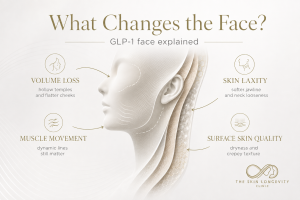
What is GLP-1 face? It is an informal term for visible facial changes during substantial weight loss. Facial volume loss, skin laxity, muscle-driven lines and surface skin quality are separate components, so they do not respond to the same treatment.
How does GLP-1 weight loss change facial volume?
Facial fat is arranged in separate superficial and deep compartments. Weight loss does not affect every compartment equally, so the temples, cheeks and under-eye area can lose support at different rates.
A 2025 radiographic study reviewed scans from 20 patients before and after GLP-1 treatment. The median reduction in total midfacial volume was 9 percent, and the researchers estimated an average loss of 7 percent of midfacial volume for every 10 kg of body weight lost, predominantly within superficial fat pads2.
This result should not be treated as a prediction for every patient. The study was retrospective, involved a small group and did not prove that the medication had a direct effect independent of the weight loss.
Fast fat loss deflates the cheeks and temples and loosens skin that has lost its support, which reads as older even though the skin itself has not aged.
Four facial changes need to be assessed separately
GLP-1 Facial Changes
| Facial change | What the patient notices | More relevant treatment category |
|---|---|---|
| Volume loss | Hollow temples, flatter cheeks and deeper tear troughs | Precise volume assessment |
| Skin laxity | Softer jawline, neck looseness and skin folding | Radiofrequency, focused ultrasound or surgical assessment |
| Muscle movement | Forehead lines, frown lines and crow’s feet | Muscle-directed wrinkle assessment |
| Surface skin quality | Dryness, crepey texture, fine lines and dullness | Barrier care, resurfacing or collagen support |
One treatment rarely addresses all four components. The existing clinic guide to GLP-1 Face Treatment Singapore explains how they are assessed separately before a plan is recommended.
Dryness, crepey skin and loose skin
Dryness during GLP-1 treatment can be influenced by reduced fluid intake, nausea, vomiting, dietary restriction and changes in the skin’s underlying support. The American Academy of Dermatology includes dry skin, loose skin, thinning hair, brittle nails and irritation at injection sites among the concerns reported during GLP-1 treatment4.
Loose skin is different from dehydration. A moisturiser can improve tightness, scaling and surface crepiness, but it cannot remove true excess skin or restore the volume beneath it.
The amount of skin recoil varies with age, genetics, previous weight changes, pregnancies, ultraviolet exposure, smoking history and the scale of weight loss. Mild laxity can improve gradually after weight stabilises, while established folds or significant overhang usually need a separate body or surgical assessment.
Why muscle and body composition are relevant
Weight reduction with GLP-1 treatment consists mainly of fat loss, although some lean mass is also lost. Lean mass includes muscle, organs, bone and body water, so it should not be treated as an exact synonym for skeletal muscle.
A 2026 meta-analysis of seven randomised trials involving 821 patients found that absolute lean mass fell by an average of 1.74 kg. Lean mass nevertheless increased as a proportion of total body weight because fat loss was greater, and there was considerable variation between studies5.
This distinction is important. GLP-1 treatment can improve overall body composition while still creating a need to protect muscle strength and function.
Resistance exercise, adequate energy and protein intake, and clinical monitoring are sensible parts of treatment. Protein requirements should be individualised for body size, age, kidney health, activity and medical history rather than prescribed as one universal target.
Does GLP-1 treatment cause hair loss?
An emerging association exists between some GLP-1 therapies and hair loss, particularly semaglutide and tirzepatide. A 2026 systematic review included 24 studies, but most evidence came from pharmacovigilance analyses, retrospective cohorts and clinical trials that did not examine hair loss as a primary outcome6.
When the type of hair loss was reported, diffuse telogen effluvium and more visible androgenetic hair loss were the most frequent patterns. Causality remains uncertain because rapid weight loss, reduced protein or iron intake, illness, hormonal change and pre-existing hair loss can produce the same presentation.
Heavy, prolonged, patchy or scarring hair loss deserves assessment. Supplements should follow a diagnosis or documented deficiency rather than being started automatically.
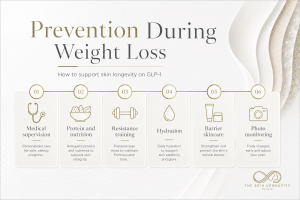
Can GLP-1 face and loose skin be prevented? Complete prevention cannot be guaranteed. Medical supervision, adequate nutrition, resistance training, hydration, barrier-supportive skincare and standardised photographs can reduce avoidable contributors and help guide treatment timing.
Can GLP-1 skin changes be prevented?
Complete prevention cannot be guaranteed. Baseline facial anatomy, age, total weight loss and individual fat distribution all influence how the face and body respond.
The following measures can reduce avoidable contributors:
- Keep treatment medically supervised. Dose escalation, gastrointestinal symptoms and the rate of weight reduction should be reviewed by the prescribing doctor.
- Protect nutritional intake. Adequate protein, iron, zinc, vitamins and essential fatty acids support muscle, hair and normal skin function.
- Include resistance exercise. Strength training supports muscle retention and physical function during weight reduction.
- Address dehydration early. Persistent vomiting, diarrhoea or difficulty maintaining fluids requires medical review.
- Use simple barrier-supportive skincare. Gentle cleansing, moisturiser and daily sunscreen provide more value than a complicated GLP-1 skincare routine.
- Monitor facial and hair changes. Standardised photographs taken during treatment can help distinguish gradual change from temporary fluctuations.
The clinic’s GLP-1 Weight Loss Singapore page explains why body composition, nutrition and medical monitoring should be considered alongside the number on the scale.
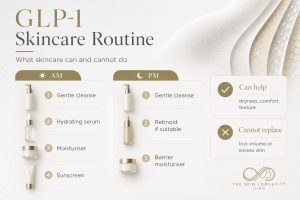
What skincare helps during GLP-1 weight loss? Gentle cleansing, hydration, moisturiser and daily sunscreen can support dryness, comfort, texture and barrier health. Skincare cannot restore lost facial fat, rebuild muscle support or remove significant excess skin.
Skincare during GLP-1 weight loss
A GLP-1 label does not create a new category of essential skincare ingredients. Products marketed for Ozempic face usually contain familiar ingredients such as ceramides, glycerin, hyaluronic acid, retinoids, peptides and antioxidants.
A practical routine can remain simple:
Morning
- Gentle cleanser or water rinse
- Hydrating serum where needed
- Ceramide or glycerin moisturiser
- Broad spectrum sunscreen
Evening
- Gentle cleanser
- Retinoid where appropriate and well tolerated
- Barrier-supportive moisturiser
Retinoids can support photoageing and surface texture, but they do not preserve facial fat. Peptides and collagen creams can improve hydration or skin feel, but they cannot replace lost volume or remove loose skin.
Skin folds that rub, remain damp or become sore can develop intertrigo or infection. These areas should be kept dry and assessed when redness, pain, odour or discharge develops.
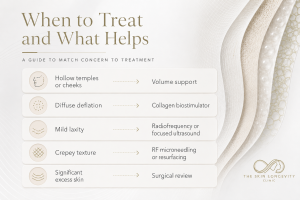
Which treatment can help GLP-1 facial changes? Localised hollowing, diffuse facial deflation, mild laxity, crepey texture and true excess skin require different approaches. Options can include precise volume support, collagen biostimulation, radiofrequency or focused ultrasound, resurfacing and, for significant skin excess, surgical review.
When should GLP-1 face treatment begin?
Assessment can take place while weight loss is continuing. Definitive structural correction often becomes more predictable when the weight trajectory is relatively stable, because further weight reduction can alter facial proportions again.
A fixed waiting period does not suit every patient. The direction and stability of weight, the severity of the concern, medical health and emotional impact are more useful than applying one number of months to everyone.
Treatment of GLP-1 facial and skin changes
| Main concern | Options that can be discussed | Main limitation |
|---|---|---|
| Localised temple or cheek hollowing | Hyaluronic acid volume support | Further weight loss can change the required amount |
| Diffuse facial deflation and reduced skin quality | Collagen biostimulator | Improvement is gradual and does not replace every fat compartment |
| Mild to moderate facial or neck laxity | Radiofrequency or focused ultrasound | Results are subtler than surgery |
| Crepey texture and fine lines | RF microneedling or fractional resurfacing | These improve skin quality rather than replacing volume |
| Significant excess skin | Surgical opinion | Non-surgical treatments cannot remove a large skin overhang |
An open-label 2026 study involving 41 patients reported improvements in facial contour and skin quality after a combined programme of a collagen biostimulator and hyaluronic acid fillers. The study was uncontrolled, used a specific commercial protocol and included industry-employed authors, so it supports further research rather than one universal treatment formula7.
Can GLP-1 medicines improve some inflammatory skin conditions?
Early studies suggest that GLP-1 receptor agonists can improve psoriasis and hidradenitis suppurativa in selected patients. Weight loss, better metabolic health and possible anti-inflammatory signalling can all contribute to the observed change8.
The evidence remains preliminary and includes small prospective studies, retrospective analyses and case reports. These findings do not establish GLP-1 treatment as routine skin therapy, but they show why its dermatological effects are more complex than facial ageing alone.
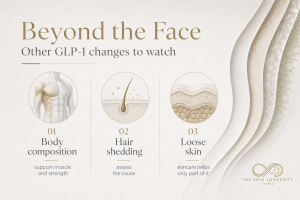
Which GLP-1 changes can occur beyond the face? Body-composition change, diffuse hair shedding and loose skin deserve separate assessment. Skincare alone cannot address loss of muscle support, nutritional triggers for hair shedding or significant excess skin after substantial weight loss.
When should you seek medical review?
Speak to the prescribing doctor when there is persistent vomiting, diarrhoea, dehydration, difficulty maintaining nutrition or an adverse reaction at the injection site. A severe rash, facial swelling or breathing difficulty requires urgent medical attention.
A skin or hair assessment is also appropriate when:
- Hair shedding is heavy, prolonged or patchy
- The scalp is painful, inflamed or scarred
- Loose skin folds become sore or infected
- Dryness progresses to cracking, bleeding or dermatitis
- Facial changes are distressing or difficult to interpret
- The weight trajectory has stabilised and treatment is being considered
Dr Rachel Ho’s clinical perspective on GLP-1 agonist medications and skin longevity
GLP-1 face is usually a combination of problems rather than one diagnosis. I separate facial volume loss, skin laxity, muscle movement and surface skin quality before deciding whether a patient needs skincare, tightening, volume support, collagen stimulation or time.
The purpose of skin longevity during GLP-1 treatment is to support the patient’s health goals while preserving strength, skin resilience and a recognisable facial identity. Aesthetic care should complement medically appropriate weight management rather than compete with it.
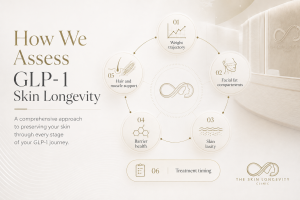
How does The Skin Longevity Clinic assess GLP-1 skin changes? Dr Rachel Ho reviews the patient’s weight trajectory, facial fat compartments, skin laxity, barrier health, hair and muscle support, and treatment timing before recommending care. The assessment is available at The Skin Longevity Clinic near Orchard Road in Singapore.
GLP-1 skin longevity assessment in Singapore
At The Skin Longevity Clinic, a GLP-1 skin longevity assessment reviews the weight trajectory, facial fat compartments, skin laxity, barrier health, pigmentation risk, muscle support, hair changes and treatment readiness. The wider clinic framework considers barrier strength, inflammation, pigment stability, collagen integrity and facial structure before procedures are recommended.
The Skin Longevity Clinic is located at 9 Scotts Road, #06-05 Scotts Medical Center at Pacific Plaza, Singapore 228210, near Orchard Road. Patients can begin with a Skin Longevity Assessment, especially when it is unclear whether the concern is volume loss, laxity, dryness or another effect of weight reduction.
Frequently asked questions
What is GLP-1 face?
GLP-1 face is an informal term for facial hollowing, deeper folds and skin laxity that become visible during substantial weight loss. The same changes can occur after bariatric surgery, restrictive dieting or weight reduction achieved without medication.
Can GLP-1 face be prevented?
Complete prevention cannot be promised because facial fat loss depends on individual anatomy and the amount of weight lost. Medical supervision, adequate nutrition, resistance exercise and early monitoring can reduce avoidable contributors.
Does GLP-1 face go away?
Dryness and temporary surface changes can improve after hydration, nutrition and weight stabilisation. Established facial fat loss or significant excess skin can persist and may require a structural treatment plan.
Can skincare prevent Ozempic face?
Skincare can support hydration, barrier health and fine surface texture. It cannot preserve facial fat, rebuild muscle or remove true skin excess.
When is the best time to treat facial changes?
Assessment can begin during active weight loss, while definitive volume or lifting treatment is often easier to plan once the weight trajectory is clearer. Individual anatomy and treatment goals are more relevant than a fixed waiting period.
Should I stop GLP-1 medication because of facial changes?
Medication decisions should remain with the prescribing doctor. Facial or skin changes can be assessed separately so that health treatment is not altered without a medical reason.
References
- Burke OM, et al. Dermatologic Implications of Glucagon-Like Peptide-1 Receptor Agonist Medications. Skin Appendage Disorders. 2025;11(5):416–423.
- Sharma RK, Vittetoe KL, Barna AJ, et al. Radiographic Midfacial Volume Changes in Patients on GLP-1 Agonists. Otolaryngology Head and Neck Surgery. 2025;173(2):360–366. PMID 40407186.
- HealthHub Singapore. Semaglutide Injection for Weight Management. Updated 2026. Health Sciences Authority Singapore. Tirzepatide Registration and Approved Indications. Updated 2025.
- American Academy of Dermatology. How GLP-1 Drugs Can Affect the Skin, Hair and Nails. Updated February 2026.
- Laverde LP, et al. Effect of GLP-1 Receptor Agonists at Doses for Obesity Management on Muscle Health: A Systematic Review and Meta-Analysis of Randomised Controlled Trials. International Journal of Obesity. 2026.
- Gupta AK, Teasell EM, Economopoulos V. GLP-1 Therapies and Hair Loss: A Systematic Review of Clinical Evidence. Science Progress. 2026. PMID 41998799.
- Lorenc ZP, et al. Multicenter Open-Label Study of Combined Poly-L-Lactic Acid and Hyaluronic Acid Treatment Following GLP-1 Receptor Agonist Driven Weight Loss. Aesthetic Surgery Journal. 2026;46(5):509–519.
- Morales JK, et al. The Therapeutic Potential of GLP-1 Receptor Agonists in Psoriasis and Hidradenitis Suppurativa. Journal of Clinical and Aesthetic Dermatology. 2026. PMID 41890772.
- Singh G, Krauthamer M, Bjalme-Evans M. Wegovy (semaglutide): a new weight loss drug for chronic weight management. Journal of Investigative Medicine. 2022;70(1):5–13. PMID 34706925.
- Davies C. Use of tirzepatide (Mounjaro) in type 2 diabetes management: an overview. Nursing Standard. 2025. PMID 40383978.