

13 Oct How to Get Rid of Cellulite: A Doctor’s Guide
By Dr Rachel Ho | Aesthetic Doctor, Founder, The Skin Longevity Clinic, Singapore
Medically reviewed by Dr Rachel Ho, MBBS, MRCS, MMed (ENT), 13 October 2026.
Dr Rachel Ho is an aesthetic doctor and the founder of The Skin Longevity Clinic. She holds an MBBS from the National University of Singapore, the MRCS (Edinburgh) and a Master of Medicine, with more than 16 years of clinical experience spanning facial reconstructive surgery and aesthetic medicine. Her work has been featured in Vogue Singapore, Harper’s Bazaar, CNA Lifestyle and The Straits Times. She also writes about skincare science at drrachelho.com.
This doctor’s guide explains what cellulite is, what causes cellulite on the thighs and buttocks, whether weight loss, exercise or drinking water help, and how to get rid of cellulite with treatments that have clinical trial evidence.
Key takeaways: how to get rid of cellulite
- Cellulite affects 85 to 98% of women after puberty, which makes it a structural feature of female skin rather than a sign of poor health.1
- Weight loss improves cellulite in most women, but the dimpling can become more visible in some, particularly in those who start at a lower weight.2
- No cream, drink or diet removes cellulite. In clinical trials, the largest improvements come from treatments that release the tethering bands, thicken the skin or tighten it.3
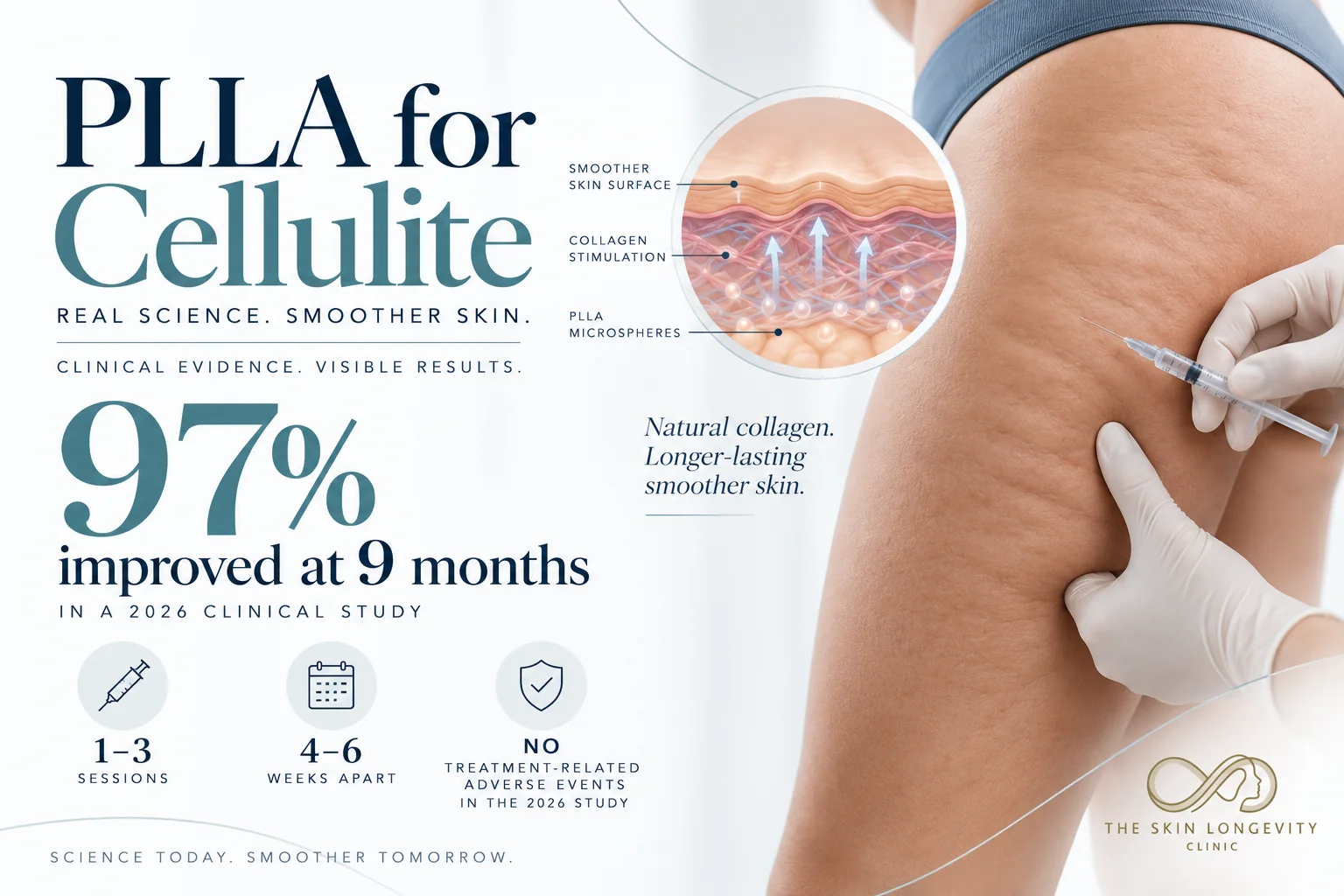
- Poly-L-lactic acid (PLLA), a collagen biostimulator, improved cellulite in 97% of patients at 9 months in a 2026 study.4
What is cellulite?
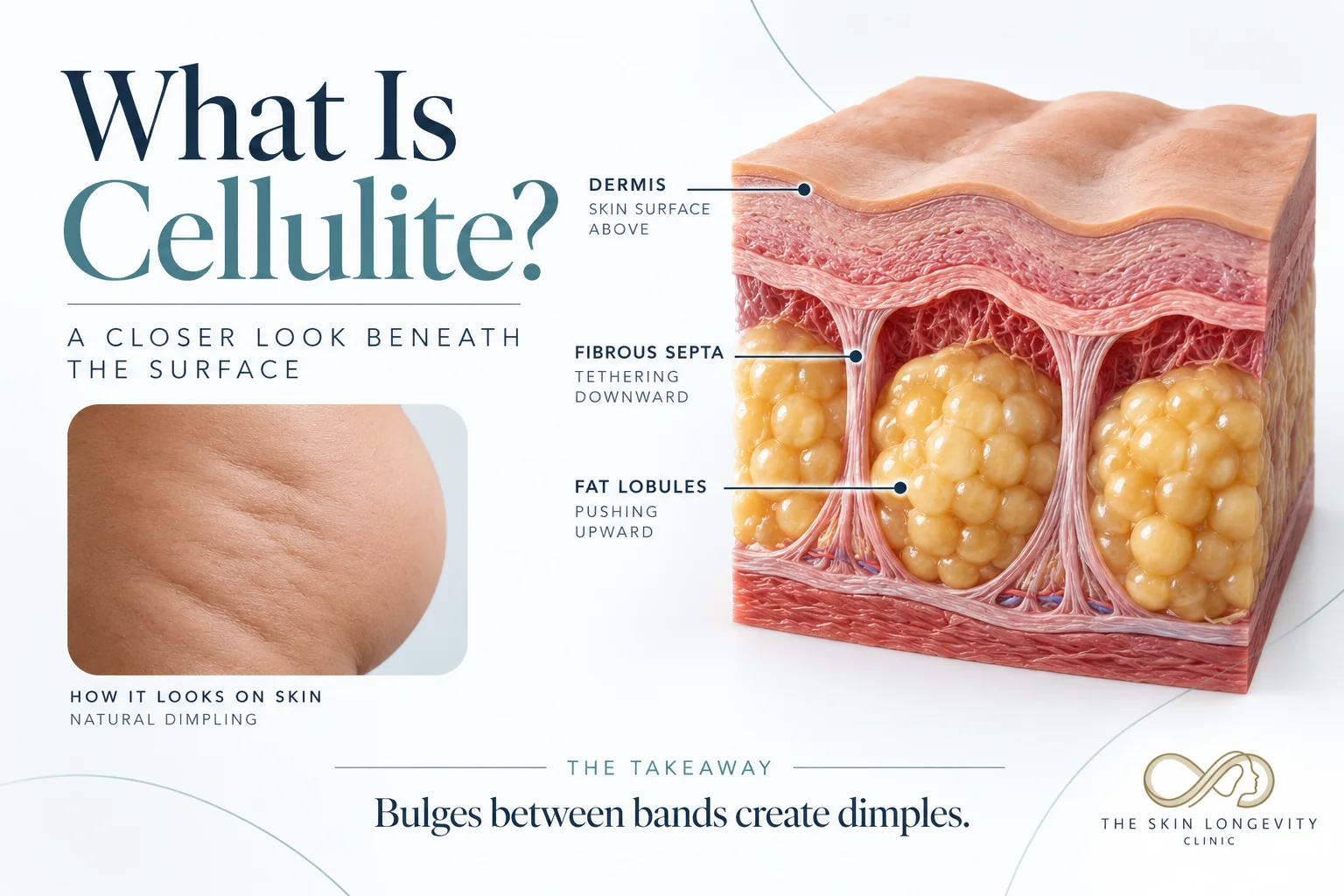
Cellulite is dimpled, orange-peel or “cottage cheese” skin, usually on the thighs, buttocks and hips. It forms where fat pushes upward against the underside of the skin while fibrous bands pull the skin down at fixed points. The result is a pattern of bulges between the bands and dips where they attach.
Its medical names are gynoid lipodystrophy and oedematous fibrosclerotic panniculopathy. Cellulite is not a disease. It is so common in women that one review describes it as nearly universal after puberty.5
What causes cellulite?
Cellulite arises from three features of the skin and the fat beneath it.
- Fibrous septa are bands of connective tissue that run from the skin down to the muscle. Where they are short or stiff, they tether the skin and form a dimple.
- Fat lobules are compartments of fat held between the septa. Large lobules bulge upward against the skin between the tethering points.
- The dermis, the thick layer of skin above the fat, thins with age, so the pattern beneath it shows through more clearly.6
Hormones, genetics, age, weight change and reduced circulation can all alter how visible the pattern becomes. Oestrogen, for example, promotes fat storage in the thighs and buttocks, which is one reason cellulite appears after puberty.5
Why do women get cellulite on the thighs?
Cellulite on the thighs and buttocks is far more common in women because the connective tissue under female skin is arranged differently. A 2019 study of gluteal tissue found that women have fewer septal connections, taller fat lobules near the surface and weaker septa than men.6 In men, the septa form a criss-cross mesh that holds the fat flat. In women, the septa run vertically, so the fat lobules can push upward between them.

Because the cause is structural, cellulite also appears in slim and athletic women, not only in those carrying extra weight.
What are the cellulite grades, and what does stage 4 cellulite look like?
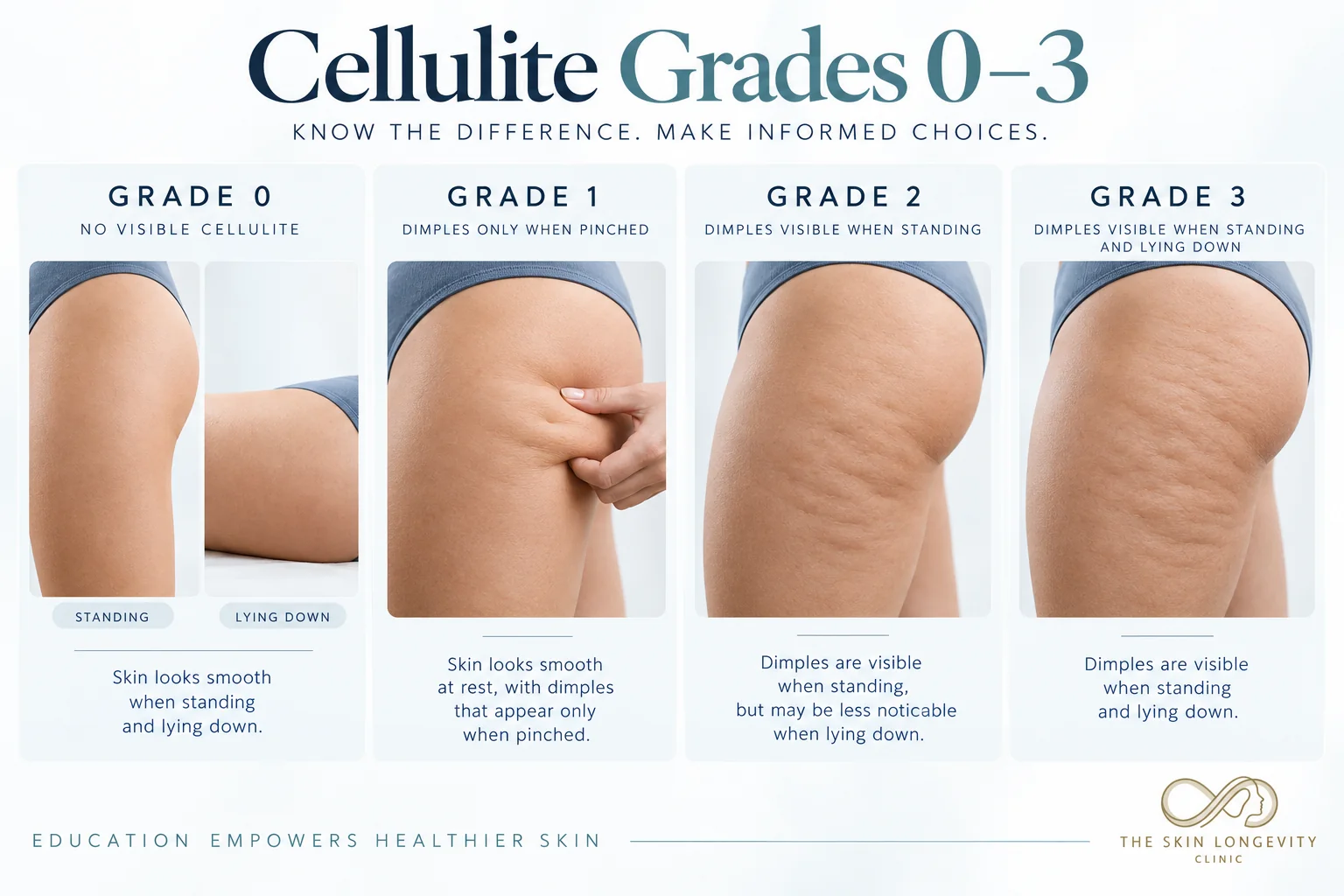
Cellulite is graded by how visible the dimpling is when standing, when lying down and when the skin is pinched.
| Grade | Appearance |
|---|---|
| 0 | Smooth skin when standing and lying down |
| 1 | Smooth when standing, with dimples appearing only when the skin is pinched |
| 2 | Dimples visible when standing, smooth when lying down |
| 3 | Dimples visible when standing and when lying down |
Some clinics describe four stages instead of grades 0 to 3. Stage 4 cellulite, the most severe stage on that scheme, shows deep dimples in every position, raised and depressed areas, and often loose skin. Because this stage combines tethering, bulging fat and laxity, it usually needs a combination of treatments, one for each cause.
Can you get rid of cellulite?
Treatment can reduce cellulite, often by a full grade, but no treatment removes it permanently. The septa and fat lobules remain after treatment and continue to change with age and weight, so maintenance sessions are needed to hold the result. A 2025 review of 24 randomised trials involving 2,084 patients found the strongest results for shockwave therapy, radiofrequency and injectable treatments.3
Will cellulite go away if I lose weight?
Weight loss does not reliably clear cellulite. In a study of women who lost weight, cellulite improved in most but became worse in some. Worsening was more common in women with a lower starting weight and a smaller weight loss, likely because the skin loosened over the remaining fat.2
Weight loss helps most when there is excess fat to lose, because smaller fat lobules bulge less against the skin. For women already at a healthy weight, treatments that firm the skin or release the bands achieve more than further dieting.
Does exercise or strength training help cellulite?
Strength training for cellulite is widely recommended. Building gluteal and thigh muscle firms the base beneath the fat, and lowering body fat reduces the bulge of the lobules, so dimpling can become less visible in some women. No trial has shown that exercise alone removes cellulite, because it does not change the septa that pull the skin down. Exercise supports treatment but does not replace it.
Does drinking water reduce cellulite?
No study has shown that drinking more water reduces cellulite. Adequate hydration benefits general health but does not alter the septa or the fat lobules that produce the dimpling.
Do cellulite creams work?
Creams containing caffeine or retinol may slightly improve skin texture, but the effect is small and lasts only while the cream is used. No topical product reaches the fibrous bands, and none thickens the dermis enough to change grade 2 or 3 cellulite.

How to get rid of cellulite with treatments backed by clinical trials
The choice of treatment depends on which feature is causing the dimples. Thin, crepey skin responds to collagen stimulation, which thickens the dermis over the fat. Deep, tethered dimples improve only when the bands that hold them down are released. Loose skin over the cellulite requires tightening with heat.

PLLA collagen biostimulator for cellulite
PLLA is injected into the deep dermis, where its microparticles prompt fibroblasts, the cells that produce collagen, to lay down new collagen. The dermis thickens over 2 to 3 months and masks more of the pattern beneath. In a randomised trial, three PLLA sessions improved cellulite, with follow-up to 11 months.7 In a 2026 study, women received one to three sessions 4 to 6 weeks apart on the back of the thighs, and investigators rated 28 of 29 (97%) as improved at month 9, with no treatment-related adverse events.4 Treatment details appear on the PLLA collagen biostimulator page.
PDLLA collagen biostimulator for thin skin over cellulite
Poly-D,L-lactic acid (PDLLA) stimulates collagen through the same mechanism as PLLA. No published trial has tested PDLLA on cellulite, so its use to firm thin skin over mild to moderate dimpling is an extension of the PLLA evidence. Treatment details appear on the PDLLA collagen biostimulator page.
ECM skin boosters for skin quality over cellulite
Extracellular matrix (ECM) skin boosters deliver components of the extracellular matrix, the protein and sugar scaffold that surrounds skin cells, to improve skin quality and hydration. Published studies have so far examined facial skin only. On the body, they are used to improve the texture of the skin over the dimples, not the dimples themselves. Treatment details appear on the ECM skin booster page.
Bellasonic LDM ultrasound for cellulite
Bellasonic LDM is a non-invasive ultrasound treatment that delivers three frequencies to the skin and the fat layer beneath it. In a 2024 study of 20 women, the average cellulite severity score fell from 2.22 to 1.18 by the last session and to 0.84 at follow-up, with no side effects and a mean satisfaction score of 8.95 out of 10.8 The study was small and had no control group, so the size of the effect is not yet confirmed. Treatment details appear on the Bellasonic LDM page.
Subcision for deep cellulite dimples
Subcision uses a fine needle or blade, passed under the skin through a small entry point, to cut the fibrous bands that pull the skin down. Once a band is cut, the dimple above it is free to rise. The procedure treats individual deep dimples and is often combined with a biostimulator, which thickens the skin over the released area.9 The same technique is used for subcision of acne scars.
Radiofrequency for loose skin with cellulite
Radiofrequency energy heats the deeper skin, which contracts existing collagen and stimulates new collagen over the following months, so loose skin tightens. In a trial of 50 people with grade II or III thigh cellulite, a single treatment with a microneedle radiofrequency device, which delivers the heat beneath the skin through fine needles, was rated a success in 93% by blinded physicians at 6 months.10 The clinic uses RF microneedling for skin texture and XERF body treatment for loose skin on the thighs.
All options are compared on the cellulite treatment in Singapore page.
What is the best cellulite treatment?
There is no single best cellulite treatment. Results are best when each treatment is matched to the feature causing the dimples.
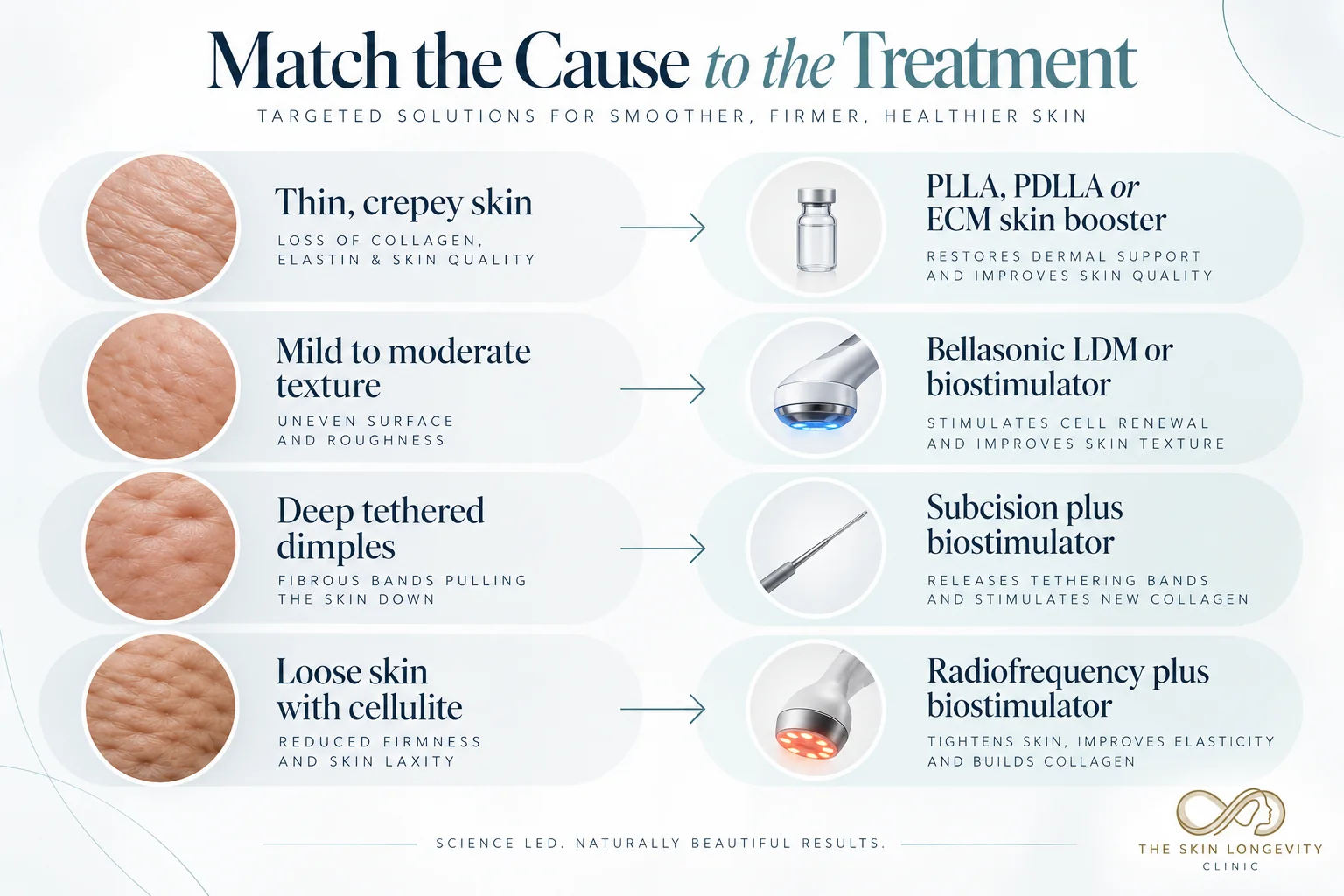
| Main cause | Matched cellulite treatment |
|---|---|
| Thin, crepey skin | PLLA or PDLLA biostimulator, ECM skin booster |
| Mild to moderate texture | Bellasonic LDM, biostimulator |
| Deep tethered dimples | Subcision plus a biostimulator |
| Loose skin with cellulite | Radiofrequency plus a biostimulator |
How much does it cost to get rid of cellulite?
Cost depends on the area treated, the grade, the number of vials or sessions and whether treatments are combined. At The Skin Longevity Clinic, cost is quoted after the consultation, once the cellulite has been graded and the treatment plan set.
Cellulite FAQs
Is cellulite normal?
Cellulite is normal and affects 85 to 98% of women after puberty.1
Can thin people have cellulite?
Thin people can have cellulite, because it is caused by the structure of the septa and skin, not only by body fat.6
How long do cellulite treatment results last?
In the 2026 PLLA study, at least 93% of women remained improved at every assessment from month 9 to month 12.4 Maintenance sessions extend results, because the septa and fat lobules that cause cellulite remain.
Does dry brushing or massage get rid of cellulite?
Massage can reduce swelling and make the skin look smoother temporarily. Neither massage nor dry brushing changes the septa, so the dimpling returns.
When will I see cellulite treatment results?
Bellasonic LDM produces gradual change over a course of sessions rather than after a single visit. Biostimulator results build over 2 to 3 months as new collagen forms.
Book a cellulite assessment in Singapore
At The Skin Longevity Clinic, Scotts Medical Center, 9 Scotts Road, Singapore, Dr Rachel Ho grades the cellulite, identifies whether the dimples come from tethering, thin skin or laxity, and plans treatment around that finding. Call +65 6514 2688, book through the contact page or see cellulite treatment in Singapore.
Selected references
- Avram MM. Cellulite: a review of its physiology and treatment. J Cosmet Laser Ther. 2004;6(4):181–185. PMID 16020201
- Smalls LK, Hicks M, Passeretti D, et al. Effect of weight loss on cellulite: gynoid lipodystrophy. Plast Reconstr Surg. 2006;118(2):510–516. PMID 16874227
- Lim SK, Gultekin G, Suresan S, et al. Comparative analysis of cellulite treatment modalities: a systematic review. Aesthetic Plast Surg. 2025;49(7):2051–2075. doi:10.1007/s00266-024-04365-8
- Beleznay K, Humphrey S, Wolgast C, et al. Safety and effectiveness of poly-L-lactic acid (PLLA-SCA) for improvement in the appearance of cellulite. J Drugs Dermatol. 2026;25(7):649–654. doi:10.36849/JDD.9997
- Khan MH, Victor F, Rao B, Sadick NS. Treatment of cellulite: part I. Pathophysiology. J Am Acad Dermatol. 2010;62(3):361–370. doi:10.1016/j.jaad.2009.10.042
- Rudolph C, Hladik C, Hamade H, et al. Structural gender dimorphism and the biomechanics of the gluteal subcutaneous tissue: implications for the pathophysiology of cellulite. Plast Reconstr Surg. 2019;143(4):1077–1086. doi:10.1097/PRS.0000000000005407
- Almukhtar RM, Wood ES, Loyal J, et al. A randomized, single-center, double-blinded, split-body clinical trial of poly-L-lactic acid for the treatment of cellulite of the buttocks and thighs. Dermatol Surg. 2023;49(4):378–382. doi:10.1097/DSS.0000000000003718
- Chervinskaya I, Kuprina NI, Kruglikov I. A retrospective pragmatic longitudinal case-series clinical study to evaluate the clinical outcome of triple-frequency ultrasound in treatment of cellulite. Clin Cosmet Investig Dermatol. 2024;17:2779–2794. doi:10.2147/CCID.S488977
- Mazzuco R. Subcision plus poly-L-lactic acid for the treatment of cellulite associated to flaccidity in the buttocks and thighs. J Cosmet Dermatol. 2020;19(5):1165–1171. doi:10.1111/jocd.13364
- Alexiades M, Munavalli G, Goldberg D, Berube D. Prospective multicenter clinical trial of a temperature-controlled subcutaneous microneedle fractional bipolar radiofrequency system for the treatment of cellulite. Dermatol Surg. 2018;44(10):1262–1271. doi:10.1097/DSS.0000000000001593