

24 Aug XERF vs Ultherapy: Radiofrequency or Ultrasound for Skin Tightening?
XERF vs Ultherapy: Radiofrequency or Ultrasound for Skin Tightening?
By Dr Rachel Ho | Aesthetic Doctor, Founder, The Skin Longevity Clinic, Singapore
Updated August 2026
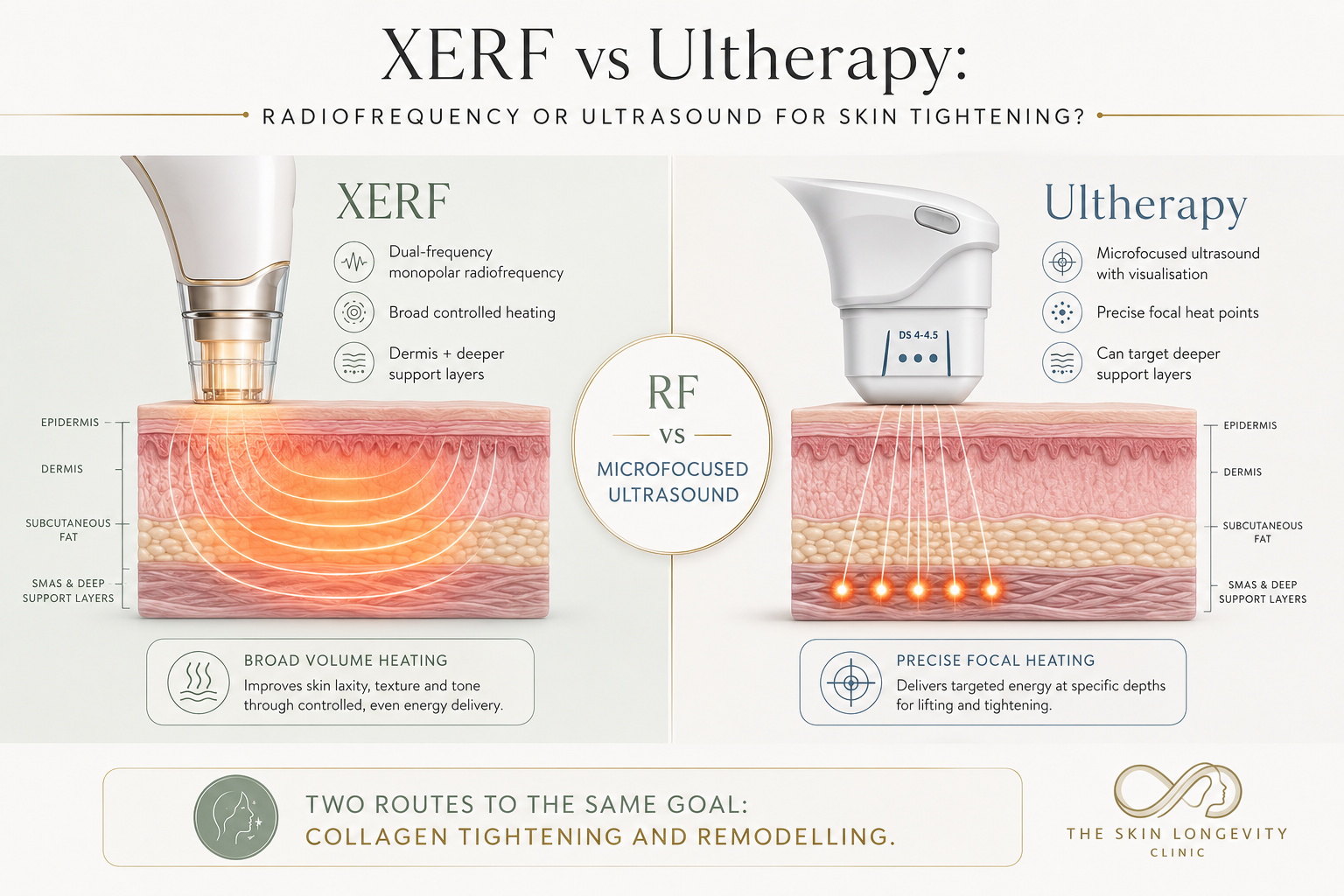
XERF and Ultherapy are often compared, and it is an interesting comparison because, unlike XERF and Thermage, these two treatments are not in the same family. They use different forms of energy to achieve a similar goal. XERF uses radiofrequency. Ultherapy uses focused ultrasound. This guide explains how the two differ, what each does well and how to think about choosing between them.
For the wider context, our guide to skin tightening in Singapore sets out the full range of options.
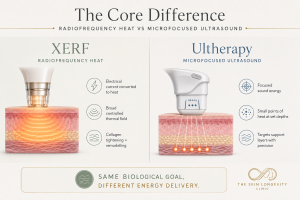
The core difference is energy delivery. XERF converts electrical current into a broad, controlled thermal field, while Ultherapy focuses ultrasound energy into small thermal points at selected tissue depths.
XERF vs Ultherapy: The Core Difference is Energy Type
The single most important difference between XERF and Ultherapy is the type of energy each uses.
XERF is a radiofrequency treatment. It passes a high-frequency electrical current through the skin, and the skin’s resistance converts that current into heat. The heat tightens existing collagen and stimulates new collagen over time.
Ultherapy is a focused ultrasound treatment. It uses focused sound waves to create small, precise points of heat at set depths in the tissue. These heated points also trigger collagen contraction and new collagen formation. Both treatments end up stimulating collagen, but they get there by different routes.
XERF: Radiofrequency Energy
XERF is a dual-frequency monopolar radiofrequency treatment, delivering energy at 6.78 MHz and 2 MHz. It heats the dermis and the deeper support layers across more than one depth, and it does so as a broad, controlled warming of the tissue. Our guide to the XERF treatment procedure describes the experience in detail.
Radiofrequency has a useful property for Singapore patients. It does not target melanin, so the risk of pigment-related side effects is comparatively low, which is relevant for darker and more pigment-prone skin.
Ultherapy: Microfocused Ultrasound
Ultherapy is a specific, branded form of microfocused ultrasound. It received its first clearance from the United States Food and Drug Administration in 2009, initially for a non-invasive brow lift, and later for the neck, under the chin and the lines on the décolletage.
Two features distinguish it. The first is depth. Focused ultrasound can deliver energy to deeper layers, including the level of the deep support tissue that surgeons address in a facelift. The second is imaging. Ultherapy includes an ultrasound visualisation feature that allows the provider to see the layers being treated. It is also worth noting that Ultherapy is a specific device. The general term HIFU covers many focused ultrasound devices, and they are not all equivalent in their clinical data.
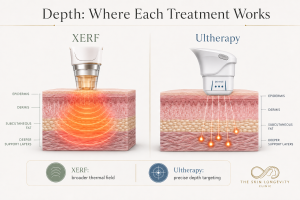
Where does each treatment work? XERF distributes controlled heat broadly through the dermis and support layers. Ultherapy places focal heat at selected depths, so suitability depends on where the laxity is actually located.
Depth: Where Each Treatment Works
The practical consequence of the energy difference is depth. Radiofrequency such as XERF heats tissue broadly across the dermis and deeper support layers. Focused ultrasound such as Ultherapy places energy at specific, often deeper, points.
This is why the two can suit different patterns of laxity. Where laxity sits in the skin and the more superficial support layers, radiofrequency is well placed. Where the goal involves the deeper support layer, focused ultrasound has a depth advantage. Neither is universally superior, because the right tool depends on where the problem actually is.
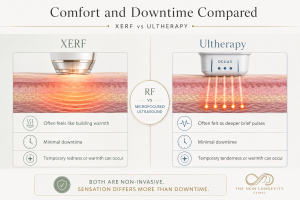
Which treatment is more comfortable? XERF is commonly experienced as building warmth, while Ultherapy is often felt as brief, deeper pulses. Both are non-invasive and generally involve little social downtime, although individual sensation and recovery vary.
Comfort and Downtime Compared
Both treatments are non-invasive and both have minimal downtime, with temporary redness and warmth the usual after-effects. They differ somewhat in sensation. Radiofrequency is generally described as a building warmth. Focused ultrasound is often described as brief, deeper pulses that some patients find more intense. Comfort varies between individuals, and both can be managed with sensible technique and settings.
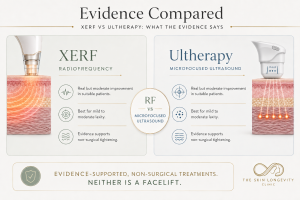
What does the evidence show? Radiofrequency and microfocused ultrasound can produce real but moderate improvement in appropriately selected mild to moderate laxity. Neither should be presented as equivalent to a surgical facelift.
XERF vs Ultherapy: Evidence Compared
Both modalities have a reasonable evidence base. For radiofrequency, the 2011 review by El Domyati and colleagues in the Journal of the American Academy of Dermatology and the 2024 systematic review by Shin and colleagues in the journal Cosmetics support a modest, genuine effect for mild to moderate laxity. For focused ultrasound, systematic reviews of microfocused ultrasound have reported measurable tightening, including brow lift and improvement under the chin, and a 2025 systematic review and meta-analysis in the Aesthetic Surgery Journal examined the effectiveness and safety of microfocused ultrasound with visualisation.
The fair summary is that both XERF and Ultherapy are evidence-supported, non-surgical treatments that produce a real but moderate improvement in suitable patients. Neither is a facelift.
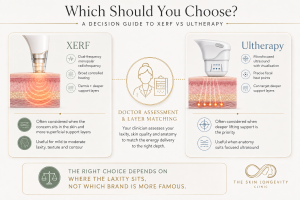
Should you choose XERF or Ultherapy? XERF can be considered when broader heating across the dermis and support layers suits the concern. Ultherapy can be considered when focal energy delivery at selected depths is the priority. Facial anatomy and the location of laxity should guide the decision.
Which Should You Choose- Ultherapy or XERF?
Dr Rachel Ho, MBBS, MMed(ENT), Founder and Medical Director of The Skin Longevity Clinic, would choose XERF when the goal is to treat sagging such as nasolabial folds and jowls, because XERF builds collagen and remodels tissue to lift, tighten and contour. Ultherapy comes into consideration when deeper lifting support is the priority and the anatomy suits focused ultrasound. In selected patients the two can be combined, but only when different tissue layers genuinely need support.
The choice is not about which treatment is fashionable. It is about where your laxity sits and what your skin needs. A proper assessment, rather than a brand preference, is what should decide it. Our evidence-based XERF review explains how to judge a treatment on its merits.
XERF vs Ultherapy: What are the differences?
| Lifting treatment | XERF | Ultherapy |
|---|---|---|
| Energy type | Radiofrequency | Microfocused ultrasound |
| How energy is delivered | Broad controlled heating, with cooling system and temperature effector | Focused points of heat |
| Depth | Dermis and deeper support layers | Can reach deeper support layers |
| Imaging | No tissue visualisation | Includes ultrasound visualisation |
| Pigment risk | Low, does not target melanin | Low |
| Best suited to | Mild to moderate laxity | Mild to moderate laxity |
Two Routes to the Same Biological Goal
It helps to step back and see what XERF and Ultherapy have in common, because it is more than it first appears. Both treatments aim at the same biological goal, which is to prompt the skin to contract existing collagen and produce new collagen. Both create that effect with controlled heat. The difference is only in how the heat is generated and placed.
XERF generates heat through electrical resistance, warming the tissue broadly. Ultherapy generates heat by focusing sound energy to precise points. One is not a more advanced version of the other. They are two engineering solutions to the same problem, each with its own pattern of strengths. This is why the comparison should not be framed as old against new, or weaker against stronger. It is better framed as broad heating against focused heating, and which of those suits you depends entirely on where your laxity sits.
Cost and Number of Sessions Compared for XERF and Ultherapy
At The Skin Longevity Clinic, the choice between radiofrequency and microfocused ultrasound is made by assessing which layer of tissue is actually driving the patient’s concern. The skin longevity assessment evaluates skin quality, dermal collagen, deeper support and facial structure together, so XERF, Ultherapy or a combination is recommended only when the underlying layer each acts on matches the cause of laxity. For the clinic’s dedicated treatment page, see XERF in Singapore, and for ultrasound-based tightening see the clinic’s HIFU treatment page.
Practical factors also differ between the two treatments. Ultherapy is often delivered as a single session, with the result developing over the following months. XERF may be delivered as a single session or as a planned course, depending on the patient and the degree of laxity. This affects both the schedule and the way each treatment is priced.
Cost is best compared with care. Focused ultrasound treatments are commonly priced by the number of lines or shots delivered, while radiofrequency is usually priced per session or per course. A low price in either case can mean a lighter treatment, so the number behind the headline number matters. As with every treatment in this library, the most reliable figure follows an assessment, because only then is the price attached to a real plan rather than a generic package.
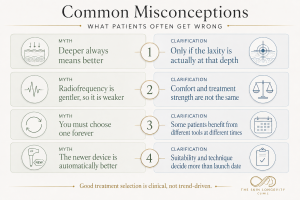
Four common skin-tightening misconceptions: deeper is not automatically better, a more comfortable treatment is not necessarily weaker, patients do not always have to choose one technology forever, and a newer device is not automatically more suitable.
Common Misconceptions about XERF and Ultherapy
If you are unsure where to begin, a skin longevity assessment is a sensible first step.
A few misconceptions are worth correcting directly. The first is that ultrasound is automatically deeper and therefore better. Focused ultrasound can reach deeper layers, but deeper is only an advantage when your laxity is actually at that depth. The second is that radiofrequency is the gentler and therefore weaker option. Comfort and strength are not the same thing, and an adequately delivered radiofrequency treatment is a serious treatment. The third is that you must choose one and never the other. In some plans a doctor may use both, at different times, because they reach tissue differently. A fourth misconception is that the newer treatment must be the better one. Newer technology can offer genuine refinements, but in skin tightening the decisive factors remain the suitability of the patient and the skill of the provider, not the launch date of the device. Judged on those terms, both XERF and Ultherapy can serve a patient well when they are matched correctly to the concern. The sensible conclusion is that the two are credible, evidence-supported treatments, and the choice between them is a clinical one rather than a contest.
Frequently Asked Questions
Is XERF or Ultherapy better?
Neither is better in absolute terms. They use different energy and suit different patterns of laxity. XERF, a radiofrequency treatment, heats tissue broadly. Ultherapy, a focused ultrasound treatment, places energy at specific depths. The better choice depends on your assessment.
Is Ultherapy the same as HIFU?
Ultherapy is a specific, branded microfocused ultrasound device with its own clinical data and an imaging feature. HIFU is a general term for focused ultrasound and covers many different devices. They are related but not identical, and the clinical evidence varies between devices.
Which is more comfortable, XERF or Ultherapy?
Many patients describe radiofrequency as a building warmth and focused ultrasound as briefer, deeper pulses that can feel more intense. Comfort is individual, and both can be managed with appropriate technique and settings.
Can XERF and Ultherapy be combined?
In some cases a doctor may use radiofrequency and focused ultrasound as part of a wider plan, since they reach tissue differently. Whether this is appropriate depends entirely on the individual assessment, and it should be planned rather than stacked without reason.
Related XERF and Skin Tightening Guides
These articles form a connected library on XERF and skin tightening at The Skin Longevity Clinic. You may also find the following guides helpful:
- XERF in Singapore: a complete guide
- XERF price in Singapore
- XERF treatment: the procedure explained
- XERF review: an evidence-based look
- XERF before and after results
- RF skin tightening in Singapore
- Skin tightening in Singapore: your options
XERF and Ultherapy at The Skin Longevity Clinic
The Skin Longevity Clinic is a doctor-led practice in the Orchard area of Singapore. The clinic assesses where your laxity actually sits before recommending radiofrequency, focused ultrasound or another approach. You can read about the clinic’s HIFU treatment or contact the clinic to arrange a consultation.