


22 Jul XERF Before and After: What Results Are Realistic and When to Expect Them
By Dr Rachel Ho | Aesthetic Doctor, Founder, The Skin Longevity Clinic, Singapore
When people search for XERF before and after, they usually want to see what the treatment can do. Photographs can be helpful, but they can also mislead, and they rarely explain the most important thing, which is timing. XERF results are gradual, so a before-and-after taken too soon tells you very little. This guide explains what XERF results realistically look like, when to expect them and how to read before-and-after photos with a sensible eye.
For the wider context of how the treatment works, see our complete guide to XERF in Singapore.
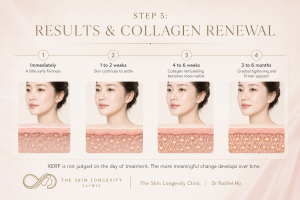
XERF results develop gradually. Some early firmness may be noticed, while collagen remodelling and firmer support usually build over weeks to months.
The XERF Results Timeline
XERF results follow the biology of radiofrequency tightening, and that biology has two distinct stages.
The first stage is immediate. The heat from the treatment causes existing collagen fibres to contract, which produces a small, early tightening. In the radiofrequency literature this immediate effect is usually modest, in the order of a small percentage improvement, and it is not the main event.
The second stage is gradual. Over the following weeks and months, the controlled heat stimulates fibroblasts to lay down new collagen. This process, neocollagenesis, builds steadily. The radiofrequency literature generally describes peak improvement developing over roughly three to six months as new collagen remodels the dermis. This is why XERF should never be judged on the day of treatment, or even in the first week.
A simple way to hold the timeline in mind is this: a little early, and most of it later.
What Before and After Actually Means for XERF
A realistic XERF before-and-after shows a subtle change, not a transformation. The kind of difference to expect is firmer-looking skin, a slightly cleaner jawline and a modest improvement in lower face definition. It is the sort of difference a friend might notice without being able to say exactly what changed.
It is not the difference a surgical facelift produces. If a before-and-after image appears to show a dramatic lift from a single non-invasive session, it is reasonable to be sceptical, or to suspect that more than one treatment was involved. Honest XERF results are real and worth having, but they are measured rather than spectacular.
How to Read XERF Before-and-After Photos
Before-and-after photographs are only as good as the conditions they were taken in. A few things make a real difference to how a result looks on camera. Lighting can add or remove the appearance of firmness. Head angle and the tilt of the chin change the jawline dramatically. Facial expression matters. The camera and even the time of day can shift the impression. A photo pair that varies in any of these ways is not a fair comparison.
Two further points are worth keeping in mind. Clinics naturally display their better results, so photos show what is possible rather than what is typical. And many before-and-after images reflect a combination of treatments rather than XERF alone. None of this means photos are useless. It means they should be read as examples, with attention to whether the conditions are consistent.

Clinical evidence on monopolar radiofrequency supports real but modest improvement in mild to moderate skin laxity when patients are appropriately selected
What the Evidence Says About Measurable Change
Beyond photographs, researchers measure radiofrequency results with objective tools. A 2025 study by Suh and colleagues in the Journal of Cosmetic Dermatology assessed improvement in skin laxity after monopolar radiofrequency using several different measurement tools rather than relying on impression alone. A 2025 prospective randomised controlled study by Wang and colleagues in Lasers in Surgery and Medicine examined the longer-term efficacy and safety of a monopolar radiofrequency device for skin tightening. And a 2024 histological study of dual-frequency monopolar radiofrequency reported increased collagen and elastic fibre density in treated skin.
The value of this kind of evidence is that it does not depend on lighting or angle. It supports the same realistic conclusion as the photographs when they are honest, which is a genuine but moderate improvement that develops over time.
Factors That Affect Your Results
Two people can have the same treatment and see different before-and-after results, because several factors influence the outcome. Age and the severity of laxity at the start both matter, since XERF suits mild to moderate laxity rather than advanced sagging. Skin quality and individual collagen response vary from person to person. Lifestyle plays a part, with sun exposure and smoking working against collagen, and significant weight change altering the face. And completing the recommended plan, including any maintenance, affects how well a result holds.
This is also why a result should be judged against your own starting point, not against someone else’s photograph.
How to Document Your Own Before and After
The most useful before-and-after is your own, taken properly. If you want to track your result, photograph yourself before treatment in consistent conditions, with the same lighting, the same angles, a neutral expression and ideally the same place and time of day. Repeat the photographs at intervals, for example at one month and three months, rather than every few days.
This gives you a fair comparison and protects you from two common mistakes, which are judging the result too early and being swayed by a photo taken in flattering or unflattering light. A review appointment with your provider serves the same purpose.
When Before and After Will Disappoint
It is worth being direct about when XERF before-and-after results tend to disappoint. They disappoint when XERF is used for advanced sagging that really needed a surgical opinion. They disappoint when the real concern was volume loss, because tightening does not refill a deflated face. And they disappoint when the expectation was a dramatic lift rather than a subtle improvement.
In each case the issue is not the treatment failing, but the treatment being asked to do something it was never designed to do. Our evidence-based XERF review discusses realistic expectations in more detail.
How Maintenance Shapes Your Long-Term Before and After
A before-and-after taken three months after treatment captures one moment. Your long-term result depends on what happens after that. Because collagen continues to decline with age, the improvement from XERF is maintained rather than permanent. How well it holds depends partly on biology and partly on choices.
Sun protection matters a great deal in Singapore, where year-round ultraviolet exposure works steadily against collagen. Not smoking, a stable weight and a sensible skincare routine all support the result. Periodic maintenance treatment, timed to your skin rather than to a calendar, helps keep the improvement visible. A realistic before-and-after, in other words, is not a single pair of photos. It is a trend over time that you and your provider manage together.
When Results Reflect More Than One Treatment
Many impressive before-and-after results reflect a combination of treatments rather than XERF alone. This is not dishonest in itself, because combining treatments is often the right clinical decision, but it matters when you are setting expectations. If a striking photograph reflects XERF together with volume support or other treatments, then XERF alone may give a more modest result. When you look at before-and-after images, or discuss them at consultation, it is reasonable to ask exactly what was done. A clear answer helps you understand what XERF on its own is likely to achieve for you. It also lets you compare your own expectations against a fair example rather than an unusually flattering one. The clearer your understanding of what produced a given result, the more realistic your own before-and-after is likely to be.
Frequently Asked Questions
When will I see XERF results?
Some patients notice a little early firmness within days, from the immediate contraction of collagen. The more meaningful change develops gradually, with the radiofrequency literature generally describing peak improvement over about three to six months as new collagen forms. It is best not to judge your result too early.
How long do XERF results last?
Results are not permanent, because collagen continues to decline with age. How long they last depends on your age, skin quality, lifestyle and whether you have maintenance treatments. Many patients maintain their result with periodic sessions rather than expecting a single treatment to last indefinitely.
Why do some people see better results than others?
Results depend on the starting point and the cause of the laxity. XERF works best for mild to moderate laxity with good underlying facial volume. Patients with advanced sagging, significant volume loss or heavy lifestyle factors working against collagen tend to see less. Suitability, established at assessment, is the strongest predictor of a good before-and-after.
Can I see before-and-after photos before deciding?
Many clinics can show example photographs at consultation. They are most useful when the lighting and angles are consistent and when the patient shown had a concern similar to yours. They are best treated as an indication of what is possible rather than a guarantee of your own outcome.
Related XERF and Skin Tightening Guides
These articles form a connected library on XERF and skin tightening at The Skin Longevity Clinic. You may also find the following guides helpful:
- XERF in Singapore: a complete guide
- XERF price in Singapore
- XERF treatment: the procedure explained
- XERF review: an evidence-based look
- XERF vs Ultherapy compared
XERF at The Skin Longevity Clinic
The Skin Longevity Clinic is a doctor-led practice in the Orchard area of Singapore. The clinic sets realistic expectations before treatment and uses a review appointment to assess your before-and-after honestly. If you would like to understand what results are realistic for your skin, you can contact the clinic to arrange a consultation.