

Jawline Fillers in Singapore: Contour, Suitability and Recovery
Jawline filler adds volume to selected areas of the lower face to change the outline of the jaw1. This page focuses on temporary hyaluronic acid, or HA, fillers used for jawline contouring1. For a firmer gel with a collagen effect, see CaHA collagen biostimulator for the jawline.
For someone considering jawline filler in Singapore, it helps to describe the change you want before discussing an amount. A more prominent jaw angle, a smoother jaw border and a narrower face are different preferences, so explain what you would like to preserve as well as what you hope to adjust.

What can jawline filler change?

Treatment can emphasise the jaw angle, improve definition along the lower border of the jaw and fill selected indentations beside the chin2. The placement of the material determines which part of the contour changes2.
Assessment should consider the chin and jawline together, including their relationship to the rest of the face2. Ask the doctor to explain the proposed result from the front and side, particularly when you want more definition without a substantially different face shape.
Our overview of dermal fillers in Singapore explains the wider range of injectable materials. The evidence discussed below concerns HA filler and should be distinguished from research on other preparations.
Will jawline filler make my face wider?
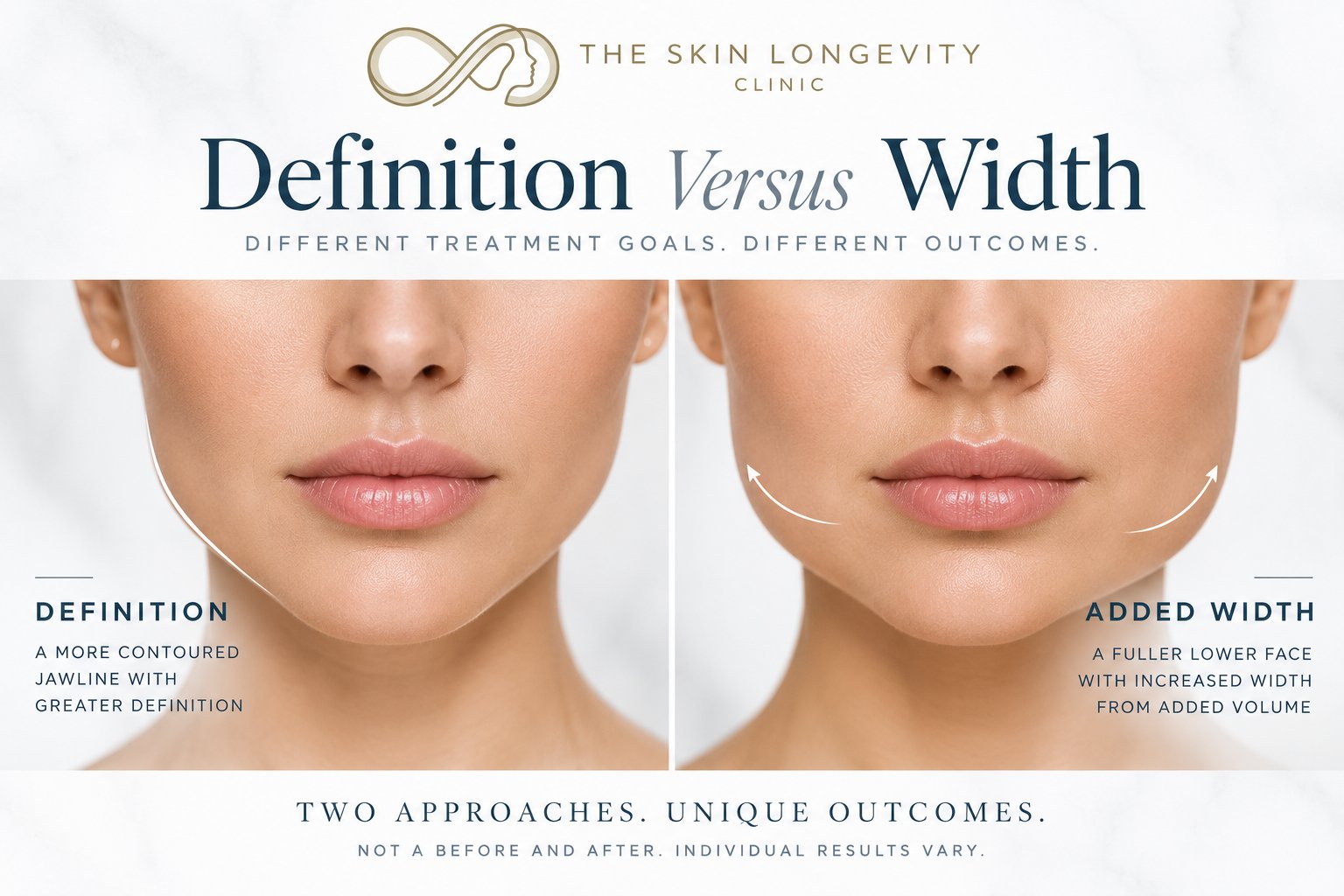
Filler placed around the jaw angles can increase lower face width1. Improved definition does not necessarily mean a slimmer face, which makes the intended direction of change important to discuss1.
A concern about muscular width requires a separate assessment from an indentation along the jaw border. Our guide to masseter hypertrophy and jaw slimming explains how the chewing muscles can contribute to lower face shape.
Can jawline filler improve jowls or a double chin?
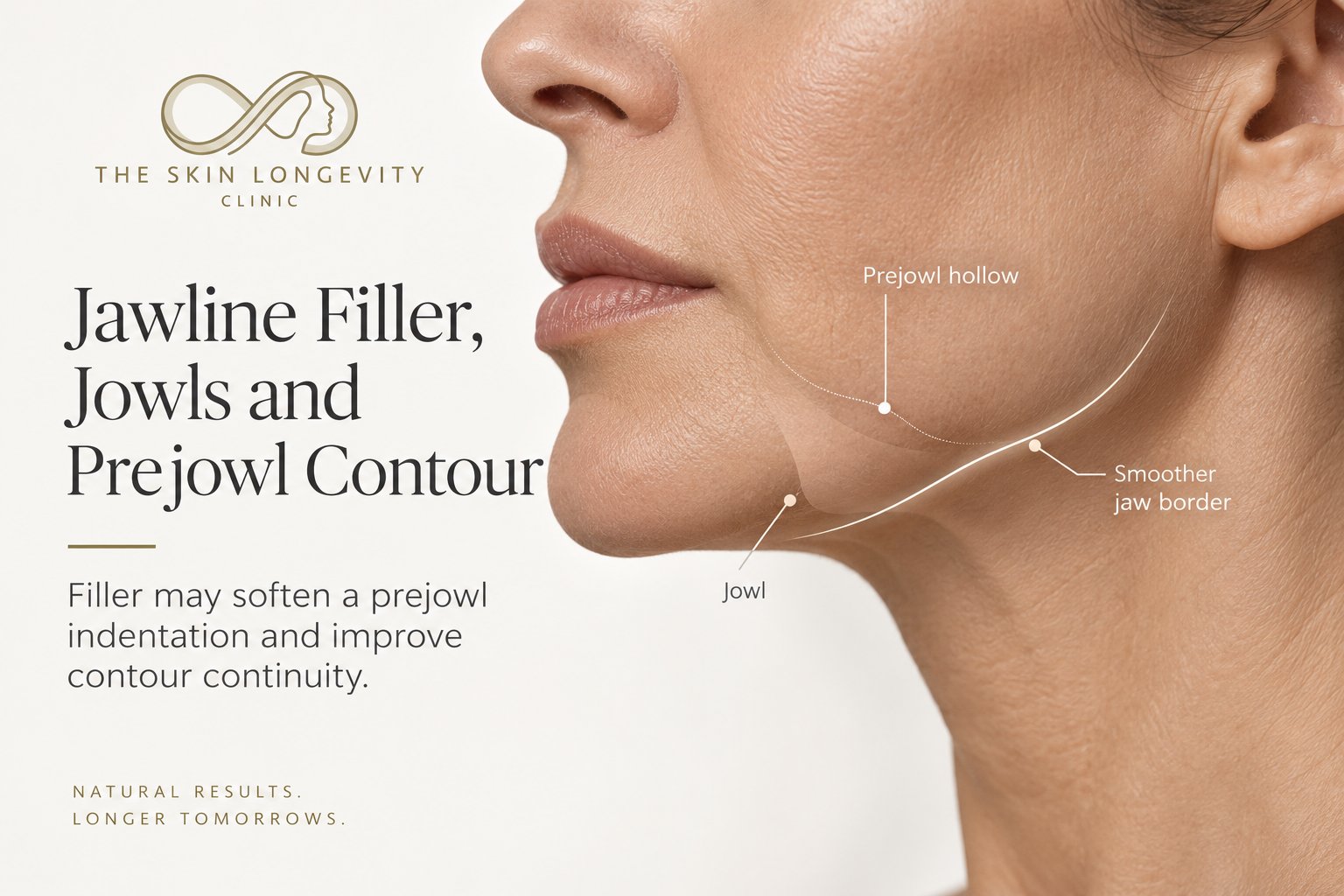
Filling the indentation in front of a jowl, called the prejowl area, can make the jaw border appear more continuous in selected patients1. This changes the surrounding contour rather than removing the jowl, and substantial skin laxity may require a different approach1.
Jawline filler adds volume rather than removes fat, so it should not be presented as a treatment that eliminates a double chin1. Our guide to sagging skin and facial laxity discusses the broader assessment when loose skin or tissue descent is the main concern.
How does jawline filler differ from chin filler?
Chin filler concentrates on the projection, height or width of the chin, while jawline treatment can extend along the jaw border and towards the angles below the ears2. These areas influence one another visually, but they remain distinct treatment objectives2.
Read our chin filler information page and Dr Rachel Ho’s review of nonsurgical chin augmentation for that discussion. A recommendation to treat both areas should explain the separate purpose of each part of the plan.
Who might be suitable for jawline filler?
Filler may be considered when adding volume can address a contour deficit identified during examination1. Existing fullness and significant laxity can limit the value of further augmentation1.
Before treatment, share your medical history, medicines, allergies and details of previous filler or facial surgery3. Active infection or inflammation can affect treatment timing, and pregnancy or breastfeeding should also be disclosed when discussing an elective procedure3.
You can use the consultation to understand the options without committing to an injection. The proposed change should feel worthwhile to you, including when the alternative is to leave the jawline unchanged.
How are jawline filler injections performed?
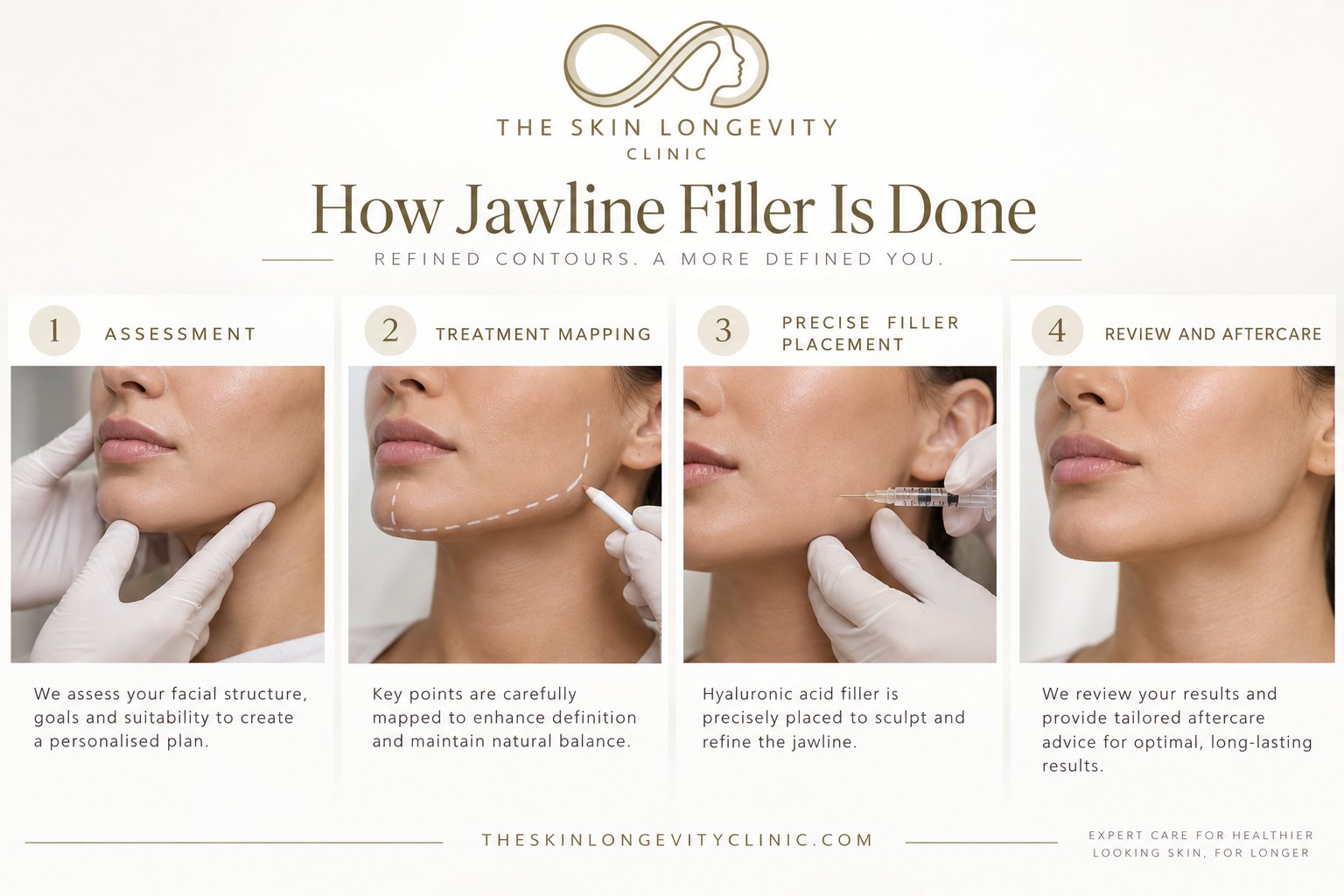
The procedure begins with assessment, discussion of benefits, alternatives and risks, and informed consent3. The skin is cleansed, treatment areas are planned, and local anaesthesia may be used to improve comfort3.
A needle, cannula or combination is selected according to the area and treatment plan2. The filler is placed in the tissues around the jawline, with its distribution tailored to the intended contour2.
Pressure, tenderness or discomfort can still occur despite measures to improve comfort4. Before leaving, obtain written aftercare instructions and confirm how to contact the treating clinician if something feels unexpected3.
How much jawline filler is needed?
The amount depends on the starting anatomy, the areas being treated and the intended change2. A proposal for 1 ml, 2 ml or 4 ml should therefore be explained as part of a treatment plan rather than a standard result.
Clarify whether the quoted amount covers both sides, the jaw angles alone or a broader plan that includes the chin. It is also reasonable to ask how the initial response will be assessed before any further treatment is considered.
What does the evidence show about jawline filler results?
A 2024 randomised study involving 206 adults compared one HA preparation with an initially untreated control group4. At six months, 69% of treated participants achieved at least one grade of improvement in jawline definition on both sides, compared with 38% of controls, according to the study’s evaluator assessment4.
The manufacturer funded the study4. Its findings support the particular preparation and protocol studied, rather than an identical outcome with every filler or for every patient4.
How long does jawline filler last?
The same trial recorded sustained improvement in jawline definition through twelve months4. That follow up period should be distinguished from a fixed expiry date or a universal maintenance schedule.
Ask about the evidence for the preparation being proposed. Decisions about further treatment should follow reassessment of the remaining contour rather than an assumption that another injection is needed at a particular calendar interval.
What should you expect during recovery?
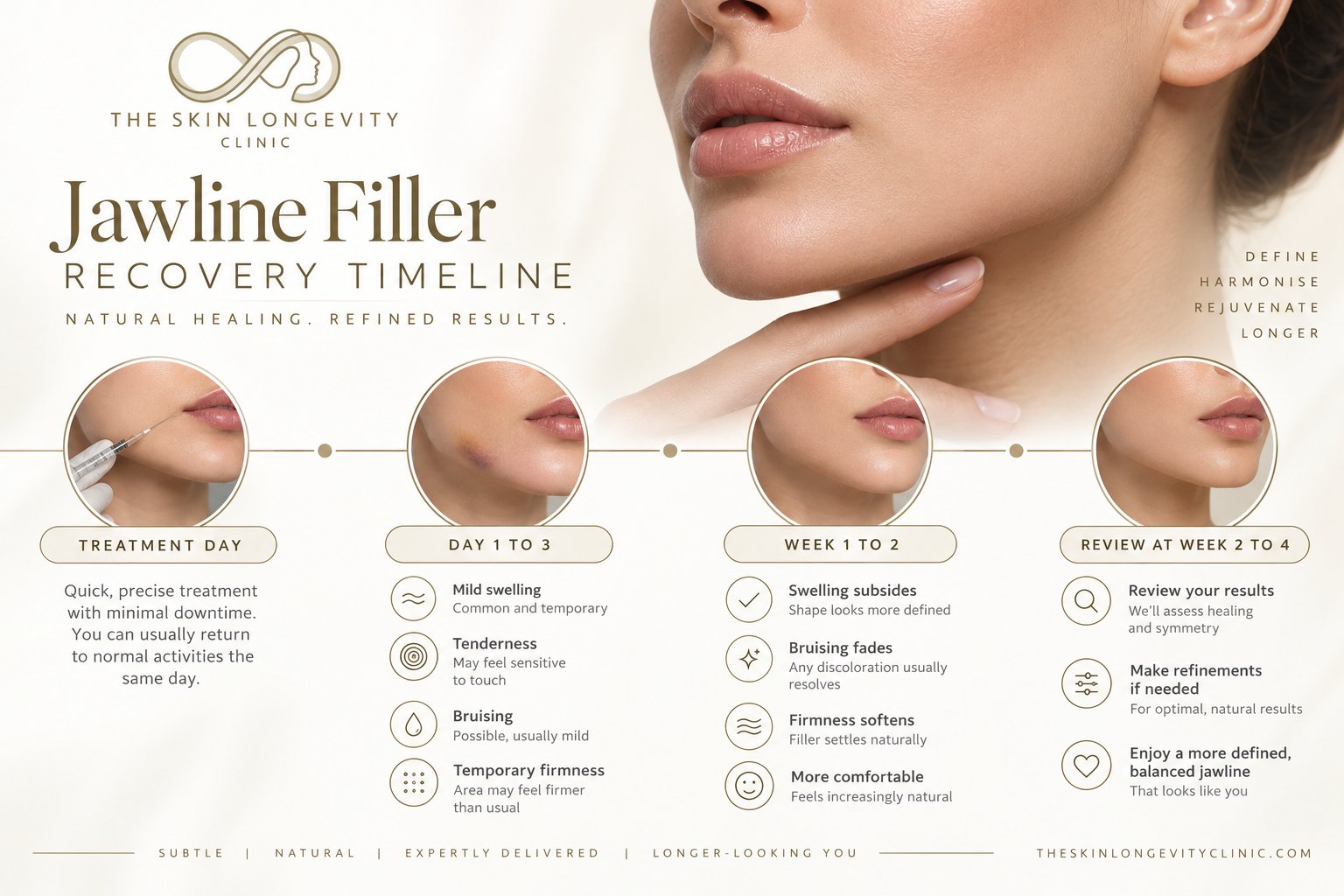
Swelling, tenderness, bruising and temporary lumps can occur after jawline filler treatment4. Most recorded injection reactions in the jawline trial were mild or moderate and resolved within two weeks4.
A persistent lump can have different causes, including product placement, inflammation or infection5. Contact the treating doctor promptly when a lump becomes painful, red, warm or increasingly swollen rather than assuming it will settle without assessment5.
Expert consensus recommends avoiding strenuous exercise for the first twenty four hours and leaving massage of irregularities to the treating clinician3. These are consensus recommendations, so follow the written instructions for your particular procedure3.
Published guidance suggests review at approximately two to four weeks for patients receiving filler in a new area3. Your clinician should confirm the actual review arrangements, with earlier assessment for concerning symptoms.
Our guide to jawline filler recovery covers swelling, firmness, unevenness and the symptoms that need review.
What are the risks of jawline filler?
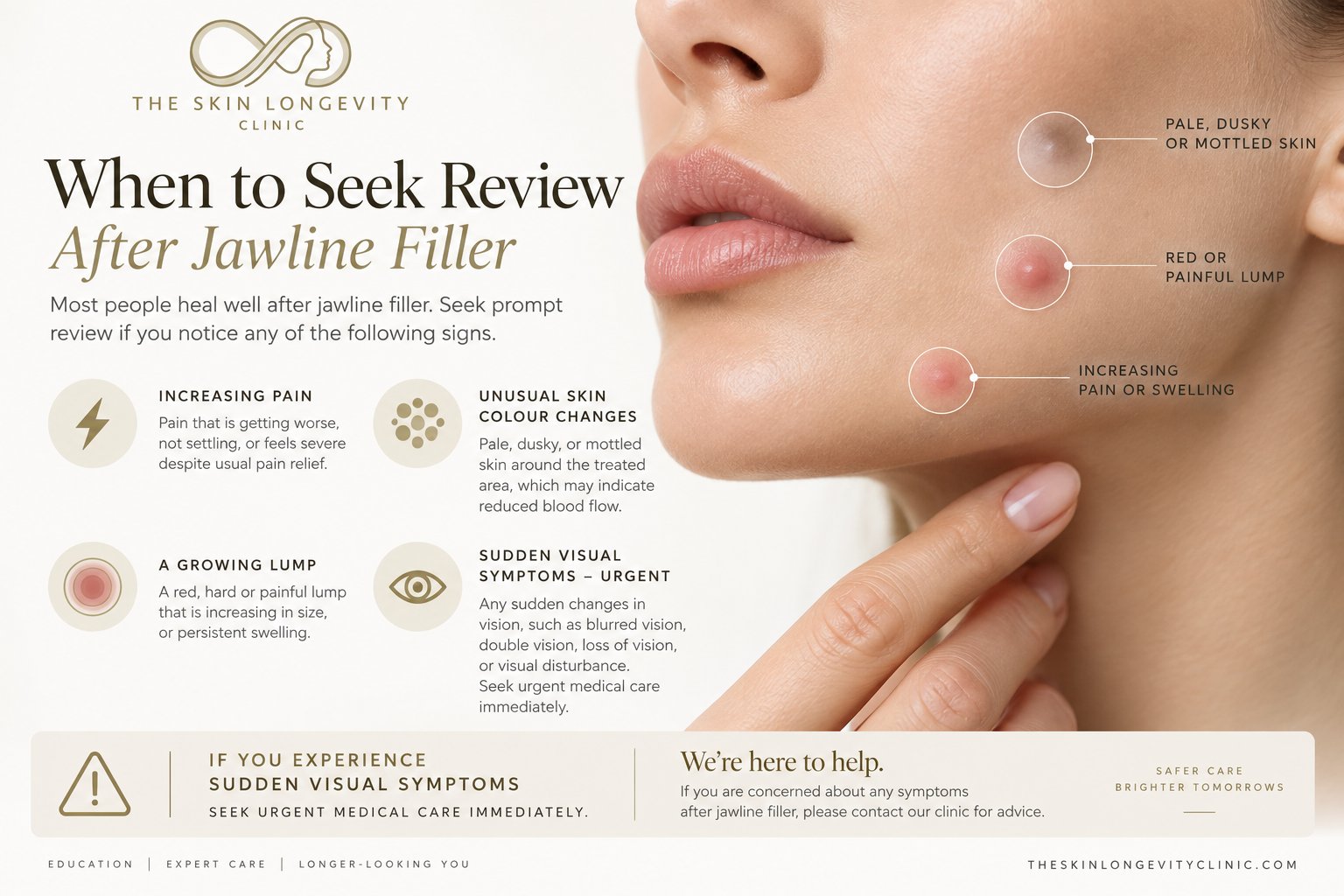
Possible complications include unwanted fullness, asymmetry, infection and delayed inflammatory nodules5. A more serious complication occurs when filler obstructs blood supply, potentially causing skin injury or tissue loss6.
Vascular occlusion has been reported with both needles and cannulas, although fewer events were reported with cannulas in a large observational study7. The choice of instrument does not eliminate vascular risk7.
Increasing pain or skin that becomes unusually pale, dusky or mottled requires immediate medical assessment6. Significant pain may be absent early in a vascular complication, so concerning colour changes deserve attention even when the area feels relatively comfortable6.
Sudden blurred vision, loss of vision or new neurological symptoms after a facial filler injection require emergency care8. Call 995 in Singapore for emergency assistance rather than waiting for a routine clinic appointment8,9.
Can jawline filler be dissolved?
Hyaluronic acid filler can be broken down using hyaluronidase, an enzyme administered by a clinician for selected unwanted results or complications5. The response varies, and more than one treatment may be required5.
Hyaluronidase can itself cause adverse reactions, including allergy5. The ability to dissolve HA does not guarantee reversal of tissue injury or visual loss caused by a vascular complication5.
Read Dr Rachel Ho’s guide to dissolving fillers with hyaluronidase for further detail. Assessment should establish the material involved and the cause of the concern before a correction is proposed.
How much does jawline filler cost in Singapore?
Request a quotation after assessment that identifies the proposed material, amount and treatment areas. Clarify whether it includes consultation fees, GST, aftercare and planned reviews, and how additional assessment would be charged.
Our article on what to expect at your first aesthetic consultation includes questions about treatment planning and ongoing care. Compare the complete proposal rather than a syringe price without knowing what that quantity is intended to achieve.
Jawline assessment at The Skin Longevity Clinic
The Skin Longevity Clinic’s published dermal filler approach considers facial proportions and contour changes in selected candidates. The consultation should connect those considerations with your preferences, including any concern about added width or fullness.
Dr Rachel Ho is an aesthetic doctor and the clinic’s founder. Her professional profile outlines her qualifications and clinical background.
The clinic is located at Scotts Medical Center, 9 Scotts Road, Singapore 228210. Use the contact page to arrange an assessment and confirm current appointment arrangements.
References
-
Go BC, Frost AS, Friedman O. Using injectable fillers for chin and jawline rejuvenation. World Journal of Otorhinolaryngology Head and Neck Surgery. 2023;9(2):131 to 137.
-
Braz A, Eduardo CCP. Reshaping the Lower Face Using Injectable Fillers. Indian Journal of Plastic Surgery. 2020;53(2):207 to 218.
-
Goodman GJ, Liew S, Callan P, Hart S. Facial aesthetic injections in clinical practice: Pretreatment and posttreatment consensus recommendations to minimise adverse outcomes. Australasian Journal of Dermatology. 2020;61(3):217 to 225.
-
Rivkin A, Green JB, Bruce S, et al. Randomised controlled study of HA filler for restoring jawline definition. Aesthetic Surgery Journal. 2024;44(12):1341 to 1349. doi:10.1093/asj/sjae147.
-
Kroumpouzos G, Treacy P. Hyaluronidase for Dermal Filler Complications: Review of Applications and Dosage Recommendations. JMIR Dermatology. 2024;7:e50403.
-
Murray G, Convery C, Walker L, Davies E. Guideline for the Management of Hyaluronic Acid Filler Induced Vascular Occlusion. Journal of Clinical and Aesthetic Dermatology. 2021;14(5):E61 to E69.
-
Alam M, Kakar R, Dover JS, et al. Rates of Vascular Occlusion Associated With Using Needles vs Cannulas for Filler Injection. JAMA Dermatology. 2021;157(2):174 to 180.
-
Sansome S, Clague M, Convery C, et al. Consensus guidelines for managing tissue filler related vision loss. Aesthetic Surgery Journal. 2026;46(5):563 to 568.
-
Singapore Civil Defence Force. Emergency Medical Services.