

06 Sep Types of Acne Scars: How to Recognise Different Patterns
Written by Dr Rachel Ho , MBBS, MMed(ENT)
Dr Rachel Ho is an aesthetic doctor and the founder of The Skin Longevity Clinic. She holds an MBBS from the National University of Singapore, the MRCS (Edinburgh) and a Master of Medicine, with more than 16 years of clinical experience spanning facial reconstructive surgery and aesthetic medicine. Her work has been featured in Vogue Singapore, Harper’s Bazaar, CNA Lifestyle and The Straits Times. She also writes about skincare science at drrachelho.com.
Uneven texture after acne can look different under a bathroom light, beside a window or in a photograph. Understanding the shape of the changes gives you a clearer starting point for a consultation, even when more than one pattern is present.
Acne scars fall into a few recognisable patterns, and identifying yours is the first step before choosing acne scar treatment.
This guide focuses on recognising acne scars and the findings a doctor assesses. For procedures, recovery and quotation considerations, read our acne scar treatment guide.
Medically reviewed by Dr Rachel Ho, MBBS, MRCS, MMed (ENT), 10 October 2026.
What are the main types of acne scars?
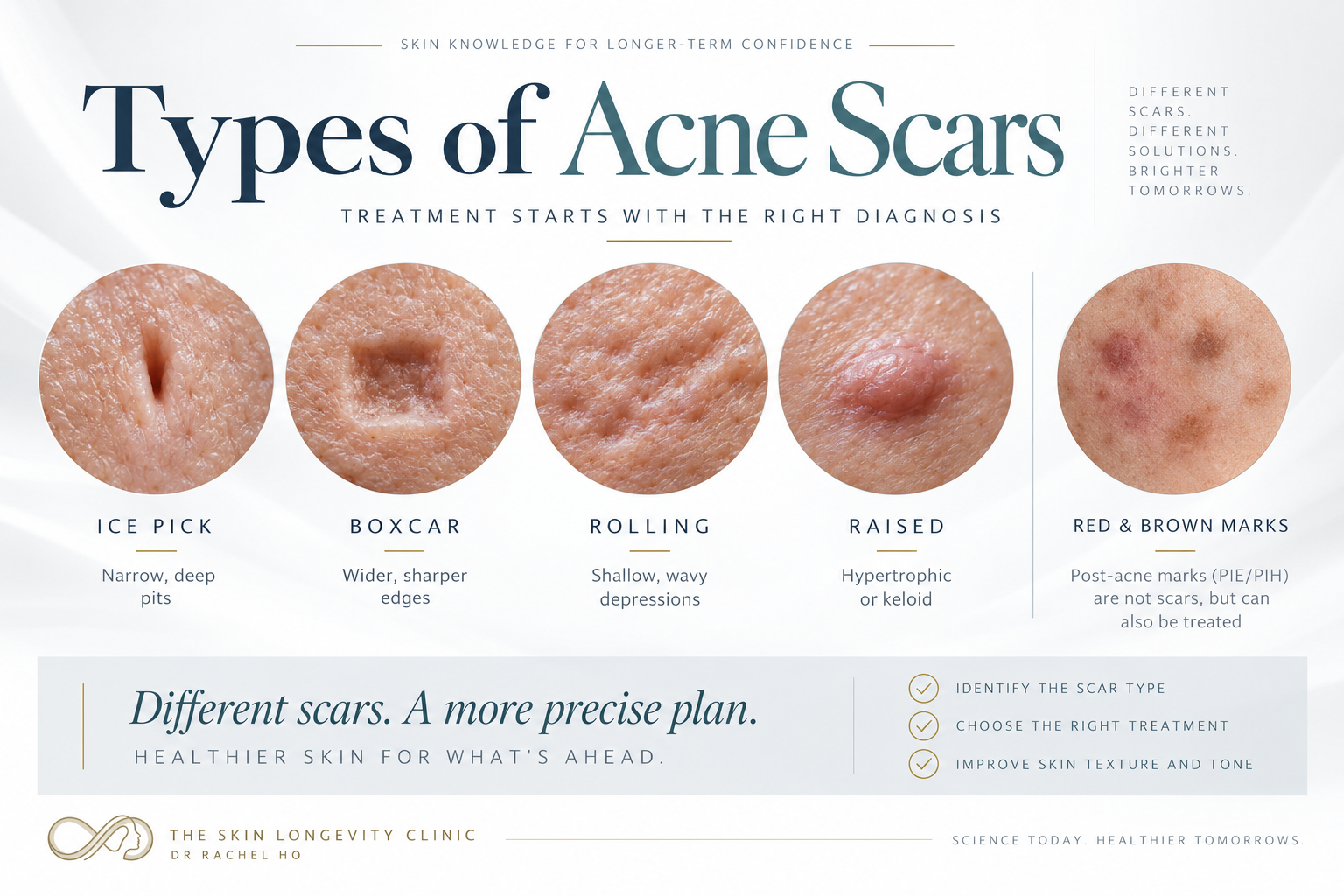
Depressed acne scars are commonly grouped into ice pick, boxcar and rolling patterns1. Raised scars include hypertrophic scars and keloids, which differ from depressions in the skin surface2.
| Pattern | Main visible feature |
|---|---|
| Ice pick | A narrow opening with a deep tract1. |
| Boxcar | A wider depression with defined edges1. |
| Rolling | Broader dips with sloping contours and an undulating appearance1. |
| Hypertrophic | Raised scar tissue within the original injury boundary2. |
| Keloid | Raised scar tissue extending beyond the original injury boundary2. |
What causes acne scars?
Acne scars form when deep, inflamed lesions damage the dermis and the skin heals with an imbalance of collagen2. Too little new collagen leaves a depressed (atrophic) scar, the most common type after acne; too much produces a raised hypertrophic scar or keloid2. The longer inflammatory acne goes untreated, the greater the chance of scarring2.
What do ice pick scars look like?
Ice pick scars appear as narrow pits whose depth can be substantial compared with their small opening1. They taper more sharply than the broader base of a boxcar scar1.
What do boxcar scars look like?
Boxcar scars have more clearly defined walls and a broader base than ice pick scars1. Their depth varies, so two depressions with a similar outline can still differ on examination1.
What do rolling scars look like?
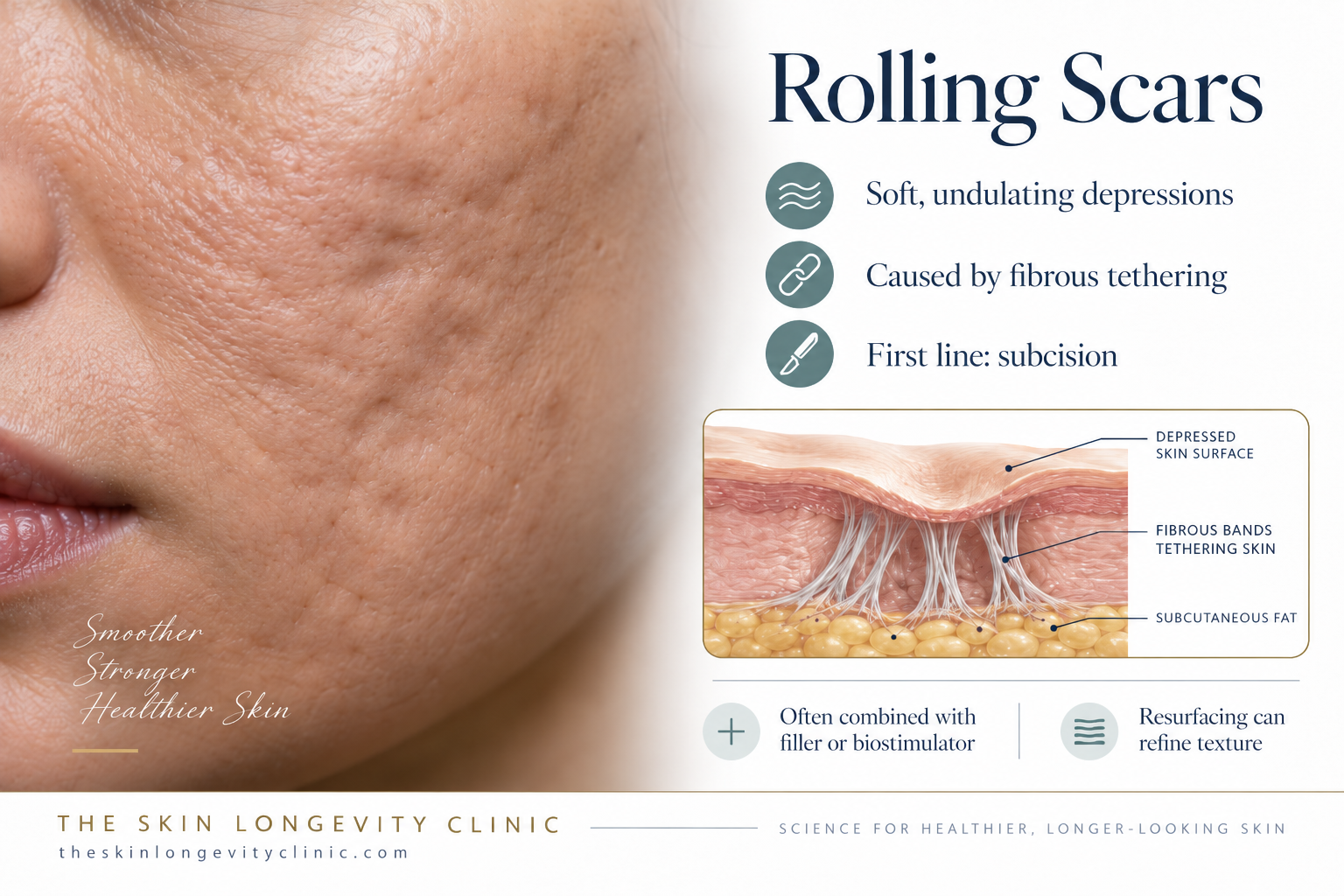
Rolling scars form broader depressions with gentler transitions into the surrounding skin1. Fibrous attachments beneath the skin contribute to the undulating contour2.
How do hypertrophic scars and keloids differ?
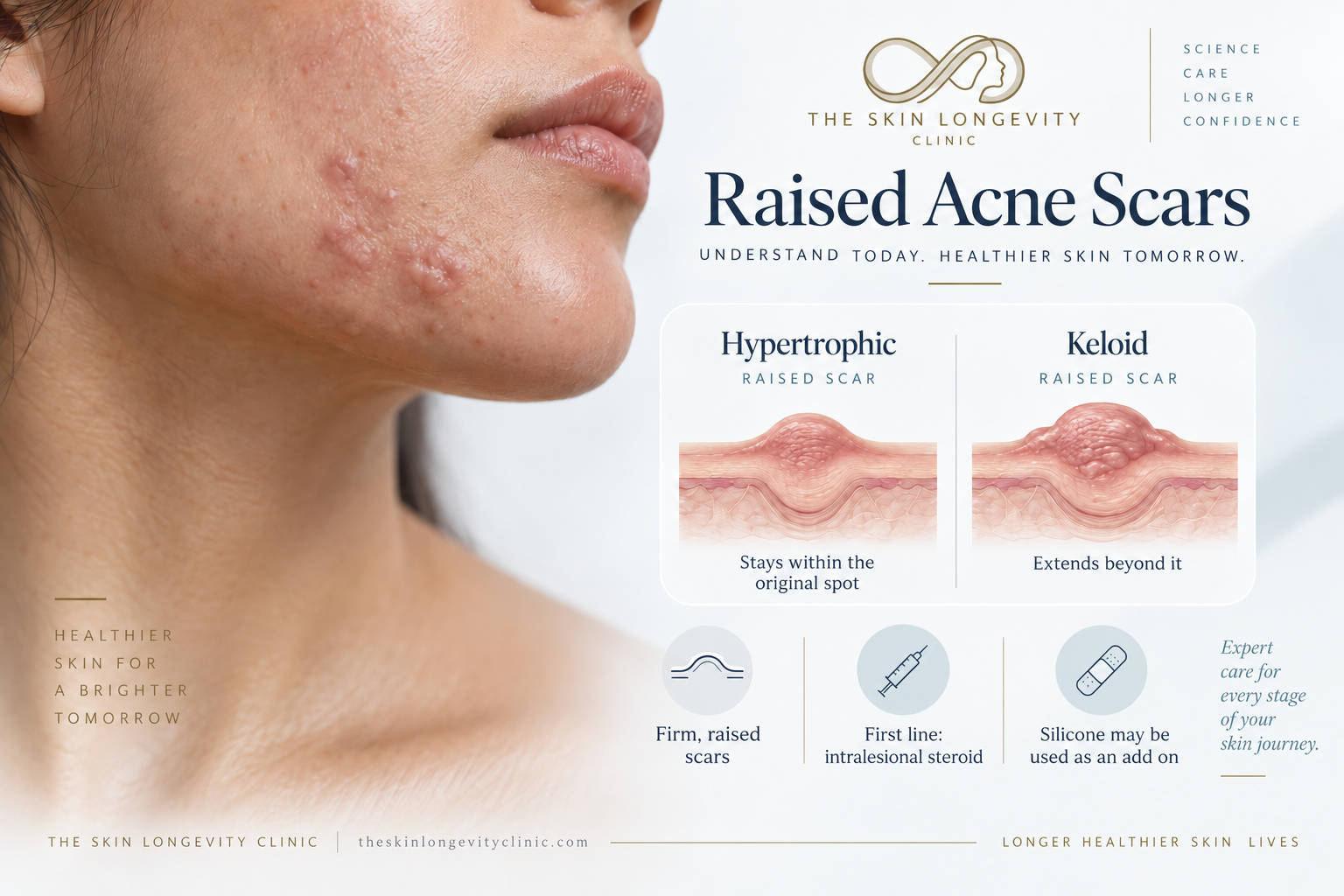
Both are raised scars, but their boundaries provide an important distinction2. Hypertrophic scars remain within the original area of injury, while keloids extend beyond it2.
Are flat red or brown patches scars?
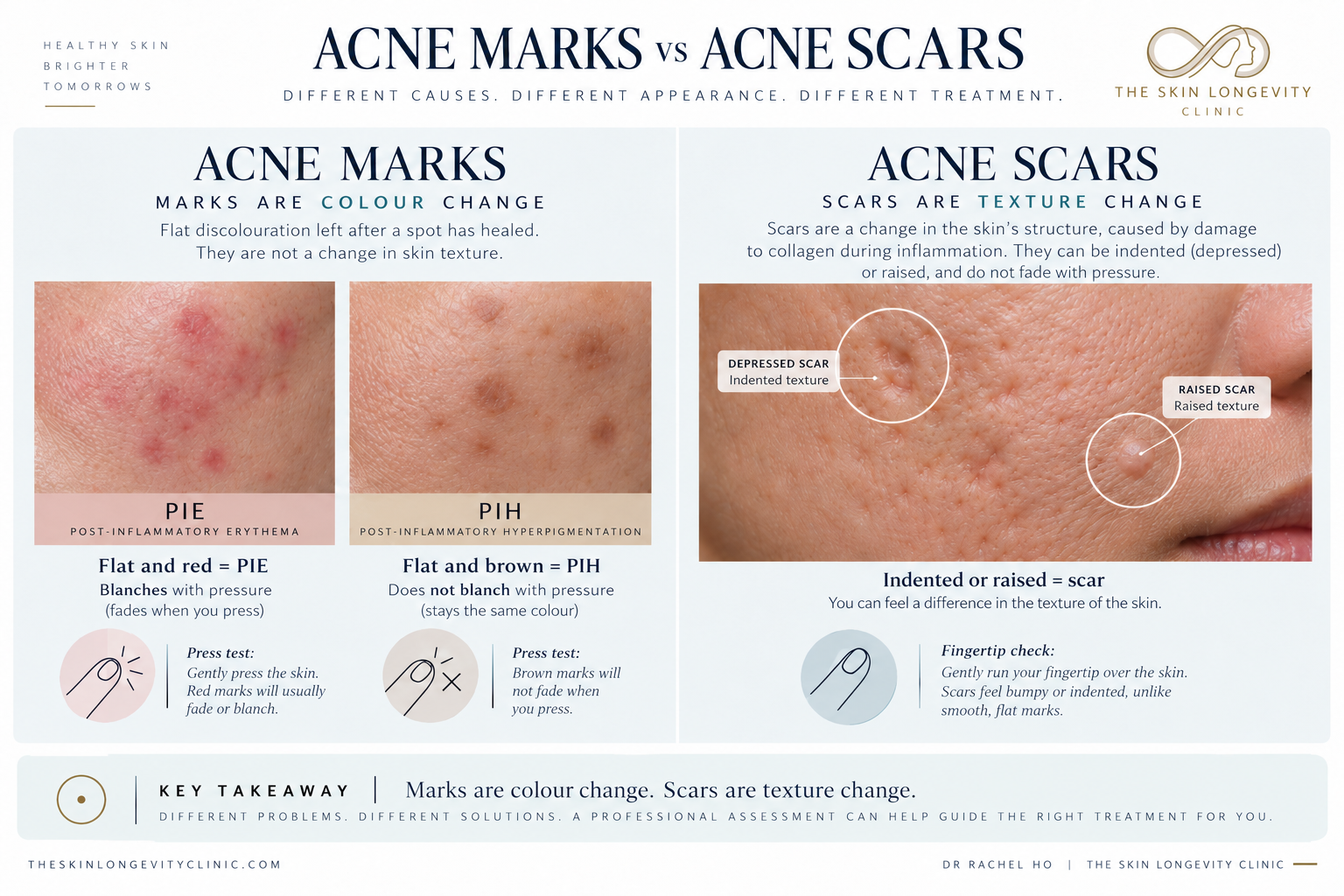
Flat colour changes and altered skin contour should be described separately when assessing acne aftereffects2. Colour changes can also occur over an area with a depression or raised scar, so both findings may need to be recorded2.
Our acne marks and acne scars article explains the distinction in more detail. A photograph or a home pressure test should not replace an assessment when the cause is unclear.
How does a doctor assess scar severity?
Assessment can consider scar type, visibility and the response to gentle skin stretching, rather than relying on a single count3. Published grading systems organise these observations to describe the extent of scarring3.
Bring photographs you find representative and explain which areas bother you most. Mention previous acne, procedures and any remaining breakouts so the discussion includes the history as well as the appearance on the day.
Can you have more than one scar type?
Different depressed scar patterns can occur together2. The assessment should describe the individual findings rather than force the whole face into one category.
Do acne scars go away on their own?
Depressed and raised acne scars are permanent changes in skin structure2. Flat red or brown marks are not scars and usually fade with time and sun protection2. Treatment for true scars aims at visible improvement, with the approach chosen by scar type.
Preparing for your consultation
Make a note of when the texture developed and what you have already tried. The aim of identifying the pattern is to support a clearer clinical discussion, rather than to make a diagnosis from one online image. If you still have active breakouts, read about sebaceous gland ablation for acne before the consultation, since active acne is treated first.
For scars from surgery or injury, or raised scars that itch, see our scar treatment in Singapore page.
In this series: acne scars
References
-
Jacob CI, Dover JS, Kaminer MS. Acne scarring: a classification system and review of treatment options. Journal of the American Academy of Dermatology. 2001;45(1):109 to 117. https://pubmed.ncbi.nlm.nih.gov/11423843/
-
Fabbrocini G, Annunziata MC, D’Arco V, et al. Acne Scars: Pathogenesis, Classification and Treatment. Dermatology Research and Practice. 2010;2010:893080. https://doi.org/10.1155/2010/893080
-
Goodman GJ, Baron JA. Postacne Scarring: A Qualitative Global Scarring Grading System. Dermatologic Surgery. 2006;32(12):1458 to 1466. https://doi.org/10.1111/j.1524-4725.2006.32354.x
This article is for general information and does not replace a medical consultation. To discuss your own scar pattern, book a consultation at The Skin Longevity Clinic, 9 Scotts Road, #06-05 Scotts Medical Center, Pacific Plaza, Singapore 228210, tel +65 6514 2688, or via the contact page.